
Features
Unravelling Sri Lanka’s great mysteries


Asiff Hussein, author of The Zeylonese Treasure Book on Myth, Mystery and Mystique, traces the origins of some well-known but elusive local beliefs and legends
Interviewed by Ifham Nizam
Q: The Zeylonese Treasure Book of Myth, Mystery and Mystique you wrote was a pioneering attempt at solving some yet unsolved mysteries which have eluded many. Could you elucidate some of them for the benefit of our readers?
A: The book deals with a hundred such topics, from the whereabouts of Ravana’s kingdom, the strange sanctity of Adam’s Peak, the legendary Nagas, a missing race of dwarfs, cannibalistic women, lost gold mines, buried treasure, strange phenomena and other oddities such as the mysterious female spectre known as Mohini, to name just a few.
What I have done is adopt a multi-disciplinary approach to the problem at hand, incorporating historical notices, archaeological evidence, a study of etymology or word origins, etc., to come to a tenable solution to these problems. Also, very important is to interpret historical data through a modern lens.
For example, we read in the Mahavamsa that during the reign of King Sirisanghabodhi, a Yakkha (Demon) named Rattakkhi (Red Eye) came here and made the eyes of people red, causing their deaths. This ancient account may well be a reference to a fatal epidemic that swept through Sri Lanka in the 3rd century. One of the telltale symptoms of Rattakkhi, according to the chronicle, was Red Eyes, a condition where the white of the eye becomes reddened. Although we cannot say for certain what it was, given the reference to red eyes followed by the death of the victims, we can only guess that it might have been an outbreak of a deadly mutant strain of cholera.
Another example is the origins of the ancient temple of Tirukonesvaram in Trincomalee, the origins of which are recounted in hoary old Tamil tradition, faithfully recorded by Sir Emerson Tennent in his book Ceylon, published in 1860, where it is stated: “A Hindu prince, having ascertained from the Puranas that the rock of Trincomalie was a holy fragment of the golden mountain of Meru, hurled into its present site during a conflict of the gods, repaired to Ceylon and erected upon it a temple to Siva”.
This is a very interesting account as it may suggest how the temple came to be founded. The reference to a fragment of the sacred mountain Meru flung here in a conflict between the gods may well be a recollection of some ancient meteorite that fell here and later came to be worshipped as a lingam or relic, setting in motion the building of this temple of a thousand columns that was later razed to the ground by the intolerant Portuguese conquistadors. The Hindu temple that presently stands in its place is only a shell of its former self.
Q: You have made a painstaking effort to trace the origins of some of our local legends such as the origin of Mohini. Would you care to elaborate a bit on this, how she came to be?
A: Mohini, as we know, is a sort of female spirit who is said to appear to travellers in the middle hours of the night, dressed in white, half-clad to expose her body and cradling a babe in her arms. She would beseech unsuspecting travellers to hold the child while she tightens her garment. No sooner they do so, she would vanish into thin air with her child. Her victims would take on an unusual pallor, develop a high fever and go berserk before dying an untimely death.
This belief is at least a 100 years old, probably more. Perhaps the earliest reference to it is the so-called Teldeniya Ghost mentioned by a writer simply known as L.A.D in his Some Ceylon Ghost Stories published in the Times of Ceylon, Christmas Number 1925. L.A.D says of this phantom: “It appears that her particular friends are cartmen, who rest themselves and their weary cattle by the roadside, and begin to cook a mid-night meal.
With a crying child in her arms, and tears flowing down her cheeks, she creeps from the shadows, and begs them to escort her to a neighbouring village, explaining that she has lost her way and is benighted. Beauty in distress appeals to them as it does to every gallant heart, and they immediately offer assistance. One fatherly man lifts the crying babe from her arms, and attempts to pacify it, but as he does so the girl vanishes. They search for her in bewilderment, and the baby disappears mysteriously, too.
This is more than even a cartman can stand, and they hastily yoke the bullocks to the carts, and hurry away. The following day the unfortunate man who held the baby dies suddenly, and ghostly mocking laughter is heard in the night. His relatives feel quite peeved over it all, but are helpless, and what is worse, the poor bereaved wives cannot have the satisfaction of pulling the hussy’s hair, or of biting her”.
It seems from the above account that belief in the Mohini was once not as widespread as today and it is possible that even a 100 years ago it was localised to Teldeniya and neighbouring areas. This is supported by the folk tale of Galmal Oya Pokuti recorded by Sandaruvan Lokuhewa in his Dumbara Janakata (2011) which tells of a woman named Kumarihami, who upon seeing her little son floating lifeless in a body of water, committed suicide by jumping into it.
She is said to have been reborn as Pokuti, a sort of she-demon taking her name from her pokutuor curly hair, and haunting the area known as Katubokkuva on the Teldeniya-Hunnasgiriya road in the dead of night, taking form as a beautiful woman with babe in arms and telling travellers “Aney, me daruva tikak atata ganta ko, mage redipota aenda gannakal” (Please take this child in your arms while I correct my attire). If the man as much as holds the child, he would certainly die, this legend tells us.
Q: You have also made a detailed attempt to trace the origins of our lost tribes, such as the Nagas. What is your take on the Nagas, did they really exist in ancient Lanka or are they the stuff of myth?
A: Although I was earlier very sceptical that such a race known as Nagas existed in our country, I have lately revised this view to admit the possibility that they might have well lived here in ancient times.
These Nagas,if at all they existed, were probably Austronesian or Malayo-Polynesian pirates and seafarers. These were the folk, known as Orang Lautor ‘Sea Peoples,’ who had made the sea their principal domain and who in later times possibly settled in the southern parts of our island. A good many old accounts connect them with piracy, seafaring and settlements on the coast or river mouths.
The ancient Sinhalese chronicle, Dipavamsa speaks of the pious Naga named Maniakkhika who lived in Lanka in the time of the Buddha, around the 6th or 5th century BC, when it states: “At the mouth of the Kalyani river, there lived a Naga together with his children and a great retinue of Nagas”. We also read in the Mahavamsa that the Naga King Mahodara had his Naga Kingdom”in the Ocean that covered half a thousand yojanas”. This work also tells us that when the Theri Sanghamitta was conveying the great Bodhi tree from the dominion of Emperor Asoka to Sri Lanka and had fared forth into the sea, the Nagas practiced their magic to win it.
Hoary old local tradition also records that there once lived in a village, to the West of Anuradhapura, a beautiful woman named Hema who got romantically involved with a merchant who resorted to Mantota. When he left for his country, the infatuated maiden, unable to bear the delay in his return, took to the sea one night in desperate hope of finding him. She was captured by a Naga-Raja or Naga King to whom she preached Buddhism and who, being pleased with her, rewarded her with a valuable gemstone.
Such stories, though of a seemingly mythical character, suggest that the Nagas were thought to be a seafaring nation, thus connecting them to the Malayo-Polynesians. Although the Nagas of these stories seem to have been thought of as water-spirits, living beneath the waters, it is possible that the idea evolved from the sea-pirating activities of maritime Oceanic or Malayo-Polynesian peoples which is known to have taken place in ancient times. This idea finds support in Kshmendra’s Bodhisattvavadana Kalpalata of the 10th century which records serious depredations against maritime trade in the Gulf of Bengal by Naga sea pirates from the days of King Asoka.
This suggests a connection of the Nagas with the freebooting sea people in the seas in and around West Malayo-Indonesia who are very ancient and already mentioned in early Chinese accounts of the region.
It is quite possible that it was the Naga race that introduced to our island the Oruva or Outrigger canoe, the coconut and the culture of betel chewing, not to mention a faint mongoloid strain found among some Sinhalese. It is pertinent that Sinhalese folk tradition holds that the betel vine was introduced from the Naga world and this was known among the ancient Austronesians as bulu which could well account for the Sinhala word for betel bulat, from bulu-pat ‘betel leaf’.
Q: In your book, you have propounded some interesting new theories, including the rather outlandish view that the Skanda god of Kataragama had his origins in Alexander the Great. How would you justify such a view?
A: Whether we like it or not, there are many similarities between Alexander and Skanda. Both the names Alexander and Skanda are very similar sounding especially when we consider that the eastern form of Alexander was Iskandar or Sikkandar.
Strangely, the Sinhalese tradition also knew the Kataragama deity as Iskanda, which it attributed to the Brahmins, who, wanting to give him a name and knowing well that he would do heroic deeds and end up possessing a heap of heads, called him Iskanda (Mountain of heads). Iskanda is said to have, as a young man, committed all sorts of heroic acts and a lot of terrible things and was thus exiled by way of a ship that eventually landed in Devundara whence he proceeded eastwards on foot a long way (katara) when he came to a village which was henceforth called Kataragama.
This derivation is no doubt due to folk etymology. This means that when the original meaning of a particular word has been lost over time, later folk tend to give other explanations as to its meaning. So here we find the older name of Iskanda being preserved bringing it closer to the name by which Alexander was known in the East, Iskandar.
Alexander was a prince of Macedon and Skanda, too, we know, was given the princely epithet of Skanda Kumara ‘Prince Skanda’. It might also reflect Alexander’s supposed claim to be the son of Zeus, in this case the epithet kumara being simply a reference to his sonship in relation to Zeus of Ammon whom later Hinduism must have confounded with Siva, thus making him to be a son of Siva.
Alexander was also regarded as the Warrior par excellence and Skanda was known as Mahasena ‘Great Army’ meaning a commander of the Army. That he was once considered the God of War and may have been originally worshipped by soldiers may be the reason why he was called Kanda Surindu Mahasen (The Soldier God Skanda). We also know that the Kataragama deity was much feared, being regarded as the god of war, and in the olden days struck terror to those who even as much as heard his name. Alexander, too, we know, was both loved and feared in his lifetime, often more feared than loved due to his warmongering and reputation as a stern administrator. In contrast, Murugan, with whom he is today often confounded, especially by Hindus, is never feared as such by his devotees.
Another proof of Skanda’s connection to Alexander is seen in the velor lance as the symbol of the deity which can be seen planted in the ground at Kataragama. Pilgrims would bring iron lances which they leave as votive offerings and silver needles with which they pierce their cheeks and tongues. These are actually regarded as little lances and taken to be symbols of the deity himself.
The fact that the lance was regarded as the symbol of the deity suggests his military character was deemed to be very important by his worshippers of an earlier age who came up with these rituals. Likewise, we find Alexander being depicted holding a lance or spear as his weapon of choice in the Issus Mosaic which is believed to be a Roman copy of an original painting by Philoxenus and which was produced during Alexander’s lifetime or shortly afterwards.
The similarities go on. Alexander conquered Persia whose Shahs of later times were seated on the Peacock Throne and to this day the vehicle of Skanda or Kataragama Deviyo as he is called locally is the peacock. Alexander encouraged mixed marriages between the Macedonians of the West and Persians of the East and himself married a Sogdian princess named Roxana, while in local tradition we have Skanda the foreigner marrying the Vedda girl Valli. Such resemblances are too close to be dismissed.
Another possible vestige of Macedonian influence that survived was to be seen a little more than a 100 years ago during the festival of the shrine that took place in the Esala period (July-August). C.A.Murray, a British Government Agent who supervised the Kataragama festival in 1897, had this to say about it: “Six women take part in the procession, walking in front of the elephant. They have their hair done up in a peculiar Grecian style, the secret of which it is said no one can master”.
The supposed date of Skanda’s arrival here is also pertinent, since it places it fairly close to Alexander’s period. The Okanda Devala near the beach in Yala is said to have been erected on the site where Skanda landed in the island on his way to Katararagama about 2,000 years ago.
What we must understand here is that when a deity is said to visit a particular country, it does not necessarily mean that he in his human form prior to deification physically visited the locality but more probably meant that his cult had spread to these parts. Thus, it is possible that Greek or Macedonian worshippers of Alexander, possibly those given to military pursuits, perhaps even mercenaries, had arrived here long ago before establishing his worship in the country. This is supported by the finding of a Greek or Macedonian coin in Tissamaharama in the Southern part of the country. It is therefore quite possible that soldiers or mercenaries from the Balkan or Mediterranean region, or who knows, even Hellenized Egypt, where Alexander was worshipped following his death had settled here in times long past.
There is a lot we can discern from old stories and legends but it depends how far we are willing to think out of the box and interpret them through a modern lens.







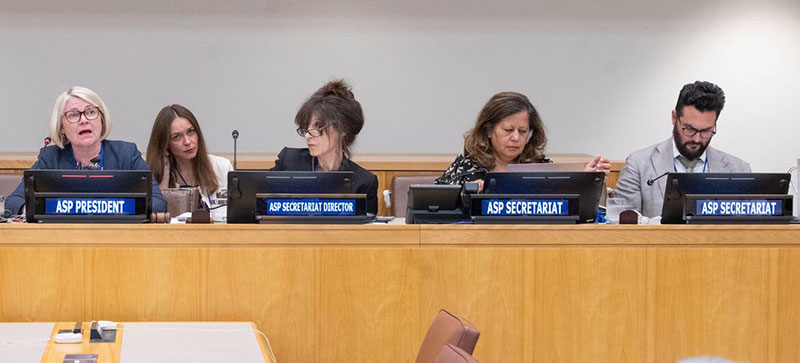
 US Secretary of State Marco Rubio’s warning to the International Criminal Court (ICC) was stark: ‘Either the ICC will end its threats, or we will end the ICC.’ It followed US central administration accusations that the court was unfairly targeting Americans on the basis of trumped-up war crimes charges.
However, a new plethora of sanctions has been clamped on the ICC by the US, which in turn has spurred accusations by sections of the world that the latter has unleashed an ‘assault’ on the international legal order.
What some of the sanctions would mean for the ICC was outlined by Rubio: ‘We will ban transactions with this rogue court, cutting off their resources and crippling their ability to operate against us.’
The ICC has shown consistency of purpose over the years. Despite some operational constraints it has indicted a large number of political strongmen from around the world, accused of war crimes and other governance excesses that come under its purview. Two such recent figures are: Russian President Vladimir Putin and Israeli Prime Minister Benjamin Netanyahu.
Rather than enjoy a mere nominal presence in the world community, the ICC has proved its effectiveness by detaining and bringing to justice scores of VIP politicians and others of their ilk who have been found guilty of human rights abuses and kindred excesses that come within the terms of reference of the ICC.
Accordingly, the international justice system would be stymied considerably as a result of the ICC being dis-empowered, particularly financially. Needless to say, potential and real perpetrators of the species of crime coming under the jurisdiction of the ICC would stand to gain most from such anarchic tendencies. That is, political repression globally would be enabled to enjoy a new lease of life.
A detailing of the types of crime coming under the purview of the ICC provides an idea of what it would cost the international community if the ICC’s operations are gravely hampered. They are mainly: genocide, war crimes, crimes against humanity and the crime of aggression.
That is, the part of the world to be worst affected would be the global South, since the latter is awash with the mentioned crimes. Needless to say, a chronically-disaffected South will sooner rather than later undermine the well being of the world dangerously. The world is already being put through these paces.
At the time of writing, ‘illegal migrants’ from the South, for example, are aggravating many a Western economy’s woes, besides creating for them acute law and order issues. The fact that these migrants’ presence goes on to become a virtual test of the migrant receiving states’ ability to forge domestic social inclusion in the face of jingoistic protests by mainly white supremacist groups is evidence of the latter. As is known, the US, to take just one example, has been up against this crisis for quite a while.
Accordingly, it will be in the best interests of the West if ‘illegal’ migrant arrivals on their shores are stemmed. If the socio-political and economic problems assailing the South are effectively managed through North-South collaborative, ‘trouble-shooting’ efforts the causes leading to ‘illegal’ migration and connected issues could be resolved at source as it were. For, it is the aggravation of the South’s material questions that lays the basis for the emergence of repressive and anti-democratic regimes in the hemisphere.
Until such time that the aforementioned issues in North-South relations are visited afresh and addressed urgently, a vibrantly functioning ICC would be needed. For, the latter would prove a deterrent to Southern political and military strongmen, highly prone to power abuse and like excesses, from coming into being in the wake of the South’s chronic material woes and the wars and conflicts that result from them.
It stands to reason then that the US would be acting in its own interests by enabling the ICC to perpetuate its mandate without hindrance. For a crop of issues that impinges negatively on internal law and order would be defused.
Meanwhile, there needs to be a meeting of minds among the rest of the West to put back in place a North-South dialogue process aimed at reducing some of the economic pressures that are weighing on the South.
Since economics usually drives politics it will be in the interests of the world community to scrutinizingly re-visit North-South issues of the past and put in place economic relief packages for Southern publics that would enable them to tide over their material hardships rather than permit the latter to aggravate into social disaffection and eventually armed militancy. It is the latter juncture that paves the way for the emergence of authoritarian rulers in the South who then go on to be a blight on their publics.
Accordingly, the Southern-based global development thinking of the past that envisaged a more equitable world economic order needs to be seen as an urgent need. That is, NAM’s international development paradigms need to be resuscitated to the extent possible.
It is unlikely that rightist governments of the West, such as the current Republican administration in the US, would find these projects feasible, but democratic states of Europe, led by perhaps the UK, are likely to think otherwise. For it would not be beneficial for the democratic world to be having on their hands repressive governments in the South who would be gravitating towards the major military and economic actors of the South, such as Iran and North Korea, who tend to be in constant power struggles with the West.
However, until such time that the mentioned, pro-people initiatives are given serious thought the ICC would need to be enabled by the international community to be in place comfortably and carry on with its mandate of bringing repressive rulers to book. Besides the ICC should pave the way for the peoples of the developing world to enjoy some substantial respite from the political repression and even terror which tend to be their lot.
Meanwhile, the wars of West Asia are relentlessly aggravating the economic hardships of people everywhere, driving the point home to enlightened sections that there is no alternative to peacemaking. A challenge is to convert the US under President Trump to this line of thinking.

 This week, I give you five simple, time-tested homemade remedies that help reduce the appearance of blemishes, control excess shine and leave your skin feeling softer and smoother.
The Honey and Lemon Brightening Dab:
For stubborn blemish marks, this is a classic. Mix one teaspoon of pure bee honey with three to four drops of fresh lemon juice. Apply gently, only on the affected spots, and leave for 10 minutes before rinsing with lukewarm water. While honey soothes and softens, lemon helps to brighten naturally. Use twice a week in the evening.
Besan and Rose Water Oil-Control Pack:
An ideal remedy to combat shine, especially on the T-zone. Take two teaspoons of besan (gram flour) and mix with sufficient rose water to form a smooth paste. Add a pinch of turmeric for its antiseptic goodness. Apply evenly, keep for 15 minutes and wash off. It absorbs excess oil without over-drying, leaving a beautiful matte finish.
Aloe Vera and Cucumber Ice Soother:
Blend fresh aloe vera gel with the juice of a grated cucumber and freeze the mixture in an ice tray. Each morning, wrap one cube in a soft muslin cloth and gently rub over a cleansed face for 30 seconds. It calms, tightens pores and imparts a baby-soft smoothness.
Oatmeal and Curd Gentle Polish:
Roughness and old blemish marks need gentle exfoliation. Combine one tablespoon of finely powdered oatmeal with one tablespoon of fresh curd (yoghurt). Massage very gently, in circular motions, for one minute, leave for five minutes and rinse. It removes dead cells and unveils softer, clearer skin.
Multani Mitti and Green Tea Magic Mask:
Brew some green tea and allow it to cool completely. Mix one and a half teaspoons of Multani Mitti (Fuller’s Earth) with the tea water to make a fine paste. Apply for 10 to 12 minutes – do not let it dry and crack completely – and wash off. It draws out impurities, fades blemishes and bestows a fresh, shine-free glow.
A Gentle Reminder:
As with any natural remedy, always do a patch test on your inner arm first. For those with oily or combination skin, avoid heavy coconut oil application and harsh scrubbing, as they tend to aggravate shine and blemishes.

 Dream of performing on a world stage? Well, here is your unique, golden opportunity!
The World Championships of Performing Arts (WCOPA) — the one and only official “Talent Olympics” — is the world’s premier global platform for aspiring singers, dancers, actors, models, instrumentalists, etc., to compete, shine and be discovered!
And, yes, this world stage is open to YOU, Sri Lankans living in Sri Lanka and overseas!
Held annually in glittering Las Vegas, WCOPA brings together over 70 countries, all competing for Gold, Silver and Bronze Medals, just like the traditional Olympics.

Lakisha Bernard: Will represent Team Sri Lanka at WCOPA 2027
Outstanding performers vie for the coveted titles of Junior and Senior Grand Champion Performer of the World, with winners and standout participants awarded over $500,000 in scholarships, cash awards and prizes to catapult their education and careers!
Sri Lanka is already making waves! At WCOPA 2026, Natharie Wickramasinghe, representing Team Sri Lanka, made the nation proud by winning a Bronze Medal in the Ethnic/Folklore Dance category!

Lakisha: Accomplished freelance Model and Fashion Design graduate
Recruitment for this prestigious competition is handled through a system of scouts and licensed National Directors — and this is where our very own Chris Rajendra, now based in Las Vegas, and National Director for Team Sri Lanka, comes into the scene.
If you are a singer, dancer, actor, model, instrumentalist — if you have talent burning inside you — contact Chris Rajendra today for registration and, who knows, you may find yourself in Las Vegas, and proudly draped in the Sri Lankan flag, at WCOPA 2027!
The contact address is: Chris Rajendra, wcopa.nationaldirector.sl@gmail.com
or chris.rajendra@gmail.com
Meanwhile, a star is born for 2027, in the form of Lakisha Bernard who is all set to represent Team Sri Lanka at WCOPA 2027.
Originally hailing from the sun-drenched coastal city of Colombo and now carving out her creative career in Canada, 22-year-old Lakisha is stepping into the international spotlight.
This accomplished freelance Model and Fashion Design graduate has officially been appointed as the Team Sri Lanka Promoter for Canada as she prepares to represent Team Sri Lanka at WCOPA in Las Vegas.
Lakisha brings a unique blend of high-fashion sensibility, captivating camera presence and expert garment design to the Team.
Having built her career, from local college shoots to high-glamour concepts, Lakisha’s inspiring journey embodies the true spirit of cultural bridge-building and creative resilience, bringing immense pride and recognition to Sri Lanka on the global stage.
WCOPA 2027 will be held at the legendary Westgate Hotel & Casino, Las Vegas, from 12th to 20th July – the very same iconic arena where the late, great Elvis Presley himself performed!
Your moment is now. Your stage is Las Vegas, so hurry and contact Chris Rajendra.

Showers or thundershowers will occur at most parts of the island

Prison rules to be revised over monks’ attire

AC President recuses himself from hearing prison attire case pertaining to Gnanasara Thera

Court orders steps to obtain INTERPOL Red Notice against Basil

CID informs Fort Magistrate’s Court investigation into money laundering case against Namal completed

No force used to make Gnanasara Thera wear prison garb – Prisons

‘Dates have the highest sugar content to fight Coronavirus’

Sunday Island 27 December – Headlines

#SundayIsland 17th December – Headlines

Sunday Island – 28th March

Sunday Island Headlines – 21 March

Sunday Island – 21st February – Headlines
-

 News6 days ago
NDB fraud Rs 60mn more than reported
-

 News6 days ago
Removing monk’s robes matter for Sangha to decide: Mahanayake Theras
-

 News4 days ago
Sri Lanka escalates anti-graft drive with Shiranthi’s jailing
-

 News5 days ago
NPP govt. reminded of its responsibilities as US warship leaves Colombo
-
 Latest News5 days ago
Farhan, Sadaqat help Pakistan ace 183 chase to go 1-0 up
-
 News6 days ago
BHC, Colombo: “LTTE remains a proscribed org. in the UK”
-

 Latest News3 days ago
Farhan and Sadaqat help Pakistan seal series in style
-

 News4 days ago
Iranian ships stranded, Lanka fears US sanctions