
Foreign News
Gaza aid reaches shore in first sea delivery

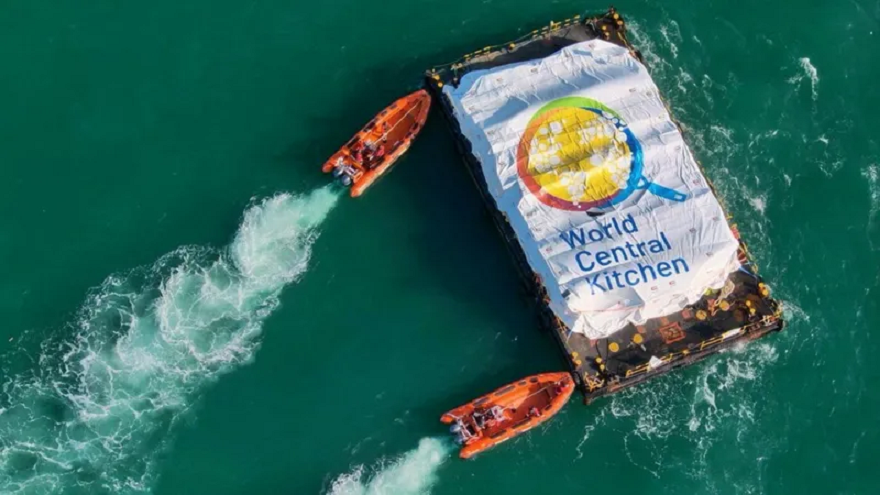
The first ship towing a barge of humanitarian aid to Gaza has unloaded supplies onto the shore.
The Spanish ship Open Arms left Cyprus on Tuesday with 200 tonnes of food desperately needed for Gaza, which the UN says is on the brink of famine.
Videos posted online show a crane moving crates from the barge to lorries waiting on a purpose-built jetty.
It marks the start of a trial to see if sea deliveries are effective, after air and land deliveries proved difficult.
World Central Kitchen (WCK), which supplied the food, carried out the mission in co-operation with the United Arab Emirates (UAE), to deliver the barge’s cargo of rice, flour, legumes, canned vegetables and canned proteins
Gaza has no functioning port, so a jetty stemming from the shoreline was built by WCK’s team. How the food will be distributed in Gaza remains unclear.
WCK’s founder, celebrity chef José Andrés wroteon X (formerly Twitter) that all the food aid from the barge had been loaded into 12 lorries. “We did it!” he wrote, adding that this was a test to see if they could bring even more aid in the next shipment – up to “thousands of tons a week”.
In a statement, Israel said the Open Arms vessel and its cargo were inspected in Cyprus, and that Israel Defense Forces (IDF) troops had been deployed to secure the shoreline.
The Open Arms charity, which operates the ship, shared the crane video late on Friday, as teams worked through the night to get the aid onto dry land. This delivery has been highly anticipated since the ship set off from a port in Larnaca on Tuesday.
If this sea mission is deemed a success, other aid ships will likely follow as part of an international effort to get more aid into Gaza. The ships would use a newly opened sea route to travel directly to the region.
Separately, the US is planning to build its own floating dock off the coast to boost sea deliveries. The White House says it could see two million meals a day enter Gaza, but while a military ship is en route with equipment on board to build the dock, questions remain about the logistics of the plan.
Military operations and the breakdown of social order have severely hampered aid distribution, while Gaza’s own food production has been severely affected, with farms, bakeries and factories destroyed or inaccessible.
The quickest, most effective way to get aid into the territory is by road, but aid agencies say Israeli restrictions mean a fraction of what is needed is getting in.
The World Food Programme had to temporarily pause its land deliveries after convoys came under gunfire and looting. And an air drop turned deadly last week when five people were reportedly killed when a parachute failed and they were hit by the aid package.
The UN has warned that famine is “almost inevitable” in Gaza without urgent action, and the EU’s foreign policy chief Josep Borrell has accused Israel of creating a man made disaster and using starvation as a weapon of war.
Israel has vehemently denied it is to blame for Gaza’s food shortages as it is allowing aid through two crossings in the south. Instead, it has blamed aid agencies of logistical failures.
Negotiations for a ceasefire in Gaza are ongoing on Friday, with Israel dismissing the Hamas’ latest ceasefire proposal.
Hamas said it gave mediators a “comprehensive vision” of a truce, but Israeli Prime Minister Benjamin Netanyahu called this “unrealistic”.
The war began when Hamas gunmen attacked southern Israel on 7 October, killing about 1,200 people and seizing 253 hostages. More than 31,400 people have been killed in Gaza since then, the Hamas-run health ministry says.
(BBC)












The United States military says that two service members have been killed and four medically evacuated following an Iranian missile and drone attack in Jordan.
In a statement shared on Saturday, US Central Command (CENTCOM), which oversees US military operations in the Middle East, said that one service member remains missing following an Iranian strike on Friday.
“On July 17, two US service members in Jordan were killed in action as US Central Command (CENTCOM) and partner forces defended against Iranian ballistic missile and drone attacks. Additionally, one service member is currently missing in action,” the statement reads.
“Four American service members were medically evacuated to Jordanian hospitals. They have since been discharged. Other personnel who were evaluated for minor injuries have returned to duty.
“Out of respect for the families, CENTCOM will withhold additional information, including the identities of the fallen warriors, until 24 hours after the next of kin have been notified.”
The statement appears to be the first US confirmation of fatalities resulting from renewed Iranian strikes on US forces, following the breakdown of a memorandum of understanding (MoU) that temporarily paused fighting between the US and Israel, and Iran.
Responding to the deaths of the two service members, US Defence Secretary Pete Hegseth said that “their sacrifice only stiffens our resolve”.
CENTCOM later announced that it was launching retaliatory airstrikes against Iran at President Trump’s direction.
[Aljazeera]
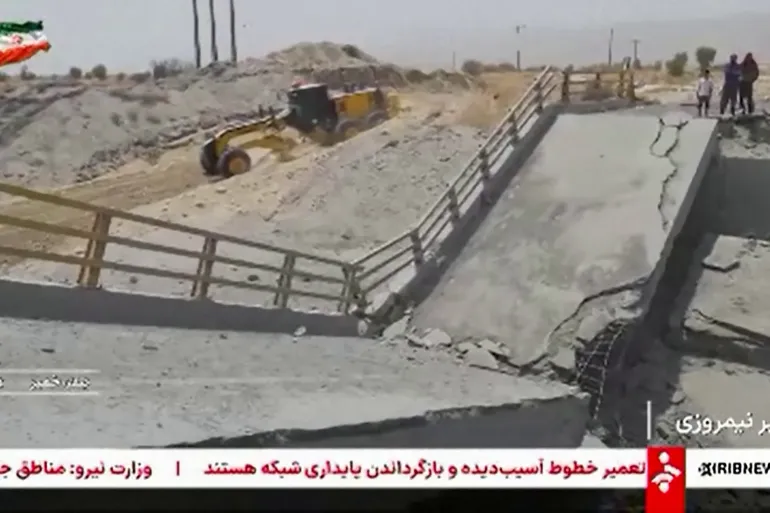
A seventh consecutive night of attacks by United States forces on targets across Iran has left 10,000 people without water after a desalination plant was hit, with Iran retaliating by launching another wave of drones and missiles at US-allied Gulf states.
Hamzeh Pour, chief executive of the Hormozgan Water and Wastewater Company, was quoted by the Tasnim news agency on Saturday as saying that a seawater pumping station and a power transformer at the Bunji desalination plant in Jask in southern Iran were “completely destroyed”, depriving 20 villages of water.
Iran’s retaliation also targeted civilian infrastructure, a war crime under international humanitarian law.
In the early hours of Saturday, Kuwait announced the closure of its airspace and said two power and water desalination plants were hit by Iranian attacks. Several Kuwaiti firefighters were wounded while responding to a fire sparked by the strikes, the country’s firefighting force said.
Air raid sirens also sounded repeatedly in Bahrain, where authorities urged residents to seek shelter.
In Jordan, authorities said they intercepted 10 Iranian ballistic missiles.
Iran’s Islamic Revolutionary Guard Corps (IRGC) said its naval forces had targeted a US military fuel pier at Kuwait’s al-Ahmadi port and a US warplane assembly site at Bahrain’s Sheikh Isa Air Base. The IRGC also said it attacked a US base in Azraq in Jordan, claiming to have destroyed two American fighter jets.
The Iranian attacks came after the US military’s Central Command, or CENTCOM, announced it had carried another wave of overnight strikes targeting “surveillance sites, military logistics infrastructure, underground weapons storage, and maritime capabilities” in Iran.
[Aljazeera]
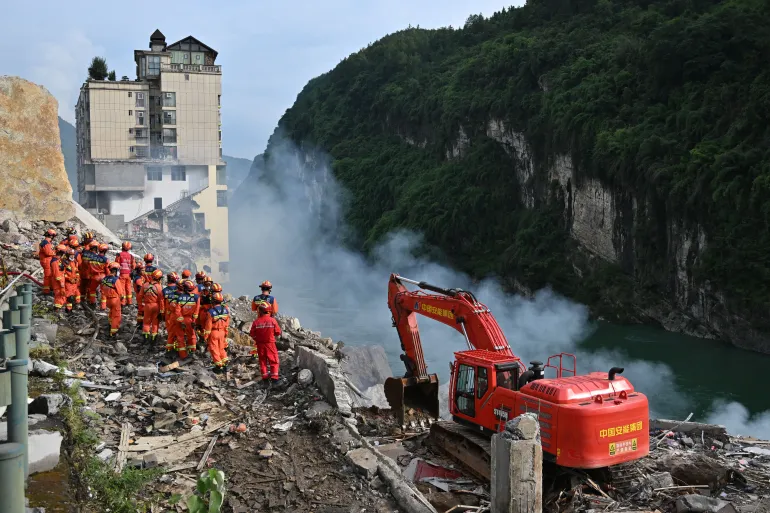
Rescuers are rushing to locate dozens of people missing in the southwestern Chinese city of Chongqing, after a deadly landslide buried homes in the area, according to Chinese authorities.
The landslide took place around 9:10am (01:10 GMT) on Friday in Chongqing’s Pengshui county, killing eight people, leaving 34 unaccounted for and displacing more than 1,100, reported state media.
Footage shared by China’s CCTV broadcaster showed a huge buildup of rocks and dirt covering part of a residential and commercial street at the bottom of a mountain in the region.
Ten people have been rescued from the debris, including two who are seriously injured, reported China’s state-run Xinhua news agency.
Water, electricity and gas supplies were cut off within a one-kilometre (0.6-mile) radius of the landslide to prevent further disruptions. More than 800 rescuers have gone to the site, reported CCTV.

Authorities said they sent more than 8,000 disaster relief items to Chongqing, including tents, folding beds and family emergency kits.
Pengshui county is located in the southeast part of Chongqing, bordering the provinces of Hubei and Guizhou.
The area where the landslide happened is known for “unpredictable” steep terrain, a local official told a news conference, adding that dangerous rocks remain along the sides of the cliff.
The government has allocated 50 million yuan ($7.36m) in natural disaster relief funds to support the rescue and relief operations and to provide assistance to affected residents, the Ministry of Finance and the Ministry of Emergency Management said.
[Aljazeera]

Charted Computer Institute of Sri Lanka to be established
Drug Dependent Persons (Treatment and Rehabilitation) Act No 54 of 2007 to be amendmend
Mrs. O. T. M. I. Thilakarathne appointed to the Post of Surveyor General
Purchase of 600 buses for intercity / long distance services of the Sri Lanka Transport Board
Protection of Historical, Cultural, and Traditional Intellectual Property related to the Kandy Esala Perahera
Development of roads which are not under the Road Development Authority

‘Dates have the highest sugar content to fight Coronavirus’

Sunday Island 27 December – Headlines

#SundayIsland 17th December – Headlines

Sunday Island – 28th March

Sunday Island Headlines – 21 March

Sunday Island – 21st February – Headlines
-
 Business3 days ago
‘Giving up was never an option’: The fisherman who fought back after losing millions in SL
-

 Features3 days ago
Two memorable excerpts from a former SLAF commander’s memoir
-

 Latest News3 days ago
Davis cup Asia/Oceania Group IV 2026 to be held in Colombo from 20th to 25th July
-

 Features3 days ago
Erdoğan’s New Republic
-

 Life style3 days ago
Taste of the Swiss Alps comes to Colombo
-

 Features7 days ago
Dirty Money
-

 News4 days ago
Dengue outbreak gallops ahead: Infections surpasses 73,455, leaving 50 dead
-

 News4 days ago
Evidence recorded in money laundering case against Yoshitha Rajapaksa