
Latest News
Biden unveils Israeli proposal to end Gaza war

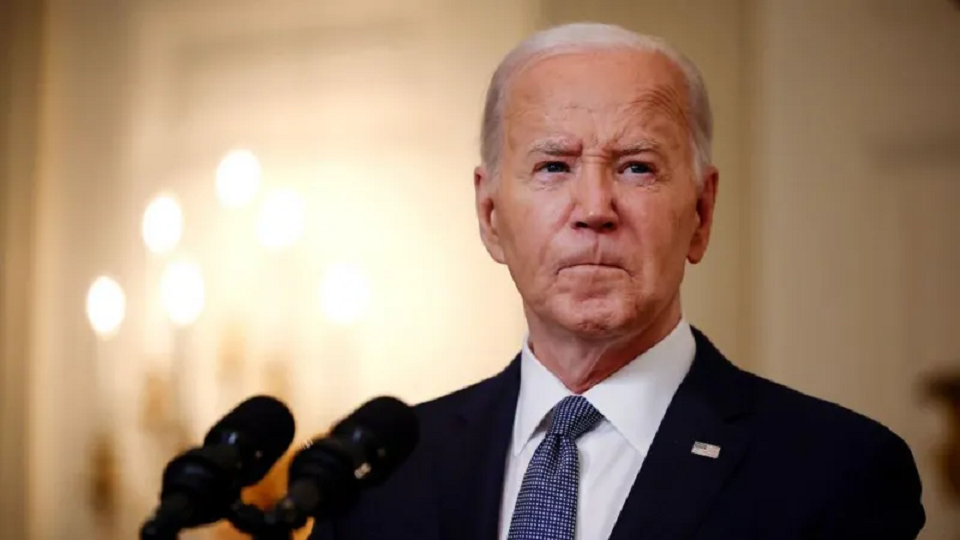
US President Joe Biden has urged Hamas to accept a new Israeli proposal to end the conflict in Gaza, saying that “it’s time for this war to end”.
The three-part proposal would begin with a six-week ceasefire in which the Israel Defense Forces (IDF) would withdraw from populated areas of Gaza.
There would also be a “surge” of humanitarian aid, as well as an exchange of some hostages for Palestinian prisoners.
The deal would eventually lead to a permanent “cessation of hostilities” and a major reconstruction plan for Gaza.
Hamas said it views the proposal “positively”.
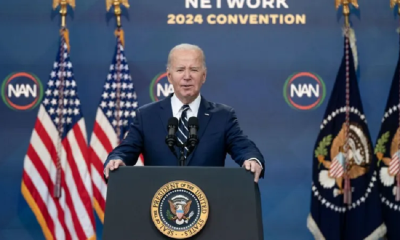
Speaking at the White House on Friday, Mr Biden said that the first phase of the proposed plan would include a “full and complete ceasefire”, the withdrawal of IDF forces from populated areas and the exchange of hostages for Palestinian prisoners.
“This is truly a decisive moment,” he said. “Hamas says it wants a ceasefire. This deal is an opportunity to prove whether they really mean it.”
The ceasefire, he added, would allow more humanitarian aid to reach the beleaguered territory, with “600 trucks carrying aid into Gaza every single day”.
The second phase would see all remaining living hostages returned, including male soldiers. The ceasefire would then become “the cessation of hostilities, permanently.”
Among those who have urged Hamas to agree to the proposal was UK Foreign Secretary David Cameron, who said on X that the group “must accept this deal so we can see a stop in the fighting”.
“We’ve long argued a stop in the fighting can be turned into a permanent peace if we are all prepared to take the right steps,” Lord Cameron added. “Let’s seize this moment and bring this conflict to an end.”
UN Secretary General Antonio Guterres also welcomed the development in a post to X, formerly known as Twitter. He said the world had “witnessed too much suffering and destruction in Gaza” and said it was “time to stop”.
“I welcome President Biden’s initiative and encourage all parties to seize this opportunity for a ceasefire, release of all hostages, guaranteed unhindered humanitarian access and ultimately a durable peace in the Middle East,” he added.
In his speech, Mr Biden acknowledged that negotiations between phases one and two would be difficult.
As recently as a few days ago, Israeli Prime Minister Benjamin Netanyahu was letting it be known that he was implacably opposed to agreeing to end the war as part of a ceasefire deal – making Mr Biden’s reference to the war’s end particularly significant.
While the plan includes many of the details from previous, ultimately failed rounds of talks, the US calls for a permanent ceasefire appear to be a significant concession designed to try and draw Hamas back to negotiations on terms they have already said they would agree to. A permanent ceasefire has been one of the group’s key demands.
The third phase of the proposal would see the final remains of any deceased Israeli hostages returned, as well as a “major reconstruction plan” with US and international assistance to rebuild homes, schools and hospitals.
In his remarks, Mr Biden acknowledged that some Israelis – including officials within Israel’s government – would likely be opposed to the proposal.
“I’ve urged the leadership in Israel to stand behind this deal,” he said. “Regardless of whatever political pressure comes.
The US president also directly addressed the Israeli people, telling them that “we can’t lose this moment”.
Notably, Mr Biden said that Hamas has now been degraded to the extent that it can no longer repeat an attack such as that which its fighters conducted on 7 October – a likely signal to the Israelis that Washington sees the war as done.
In a statement, Prime Minister Netanyahu insisted that the war would not end until its objectives were achieved, including the return of all hostages and the elimination of Hamas’ military and governing capabilities. He said the latest plan would allow Israel to uphold these principles.
Hamas, for its part, said that it views the proposal “positively” because of its call for a permanent ceasefire, the withdrawal of Israeli forces from Gaza, reconstruction and the exchange of prisoners.
The group said it was ready to “deal positively and constructively” to any proposal centred on a permanent ceasefire, provided that Israel “declares its explicit commitment to that”.
Another Palestinian official familiar with the negotiations who has seen the new Israeli proposal said that the document did not include a guarantee that the war will end, nor that IDF troops would withdraw from Gaza completely.
The proposal has been transmitted to Hamas through mediators based in Qatar.
Meanwhile, US Secretary of State Antony Blinken called his counterparts in Jordan, Saudi Arabia and Turkey to try to build a wider support for the proposal.
Mr Blinken “emphasized that Hamas should accept the deal and that every country with a relationship with Hamas should press it to do so without delay,” state department spokesman Matthew Miller said on Friday night.
Faced with mounting civilian casualties in Gaza, President Biden has faced growing domestic criticism over the level of US support for Israel, and calls to do more to encourage the warring sides to negotiate.
Earlier this week, however, the White House said that it does not believe that Israeli operations in Rafah amount to a “major ground operation” that could cross a red line and trigger a possible change in US policy.
The statement came after an Israeli air strike and resulting fire killed at least 45 Palestinians on Sunday.
In a separate announcement on Friday, US lawmakers from both sides of the political spectrum formally invited Mr Netanyahu to address Congress in Washington.
It is unclear when the address would take place.
More than 36,000 have been killed across Gaza since the start of the conflict, according to the Hamas-run health ministry.
The war began in October when Hamas gunmen launched an unprecedented attack on Israel, killing about 1,200 people and taking 252 back to Gaza as hostages.
-BBC-









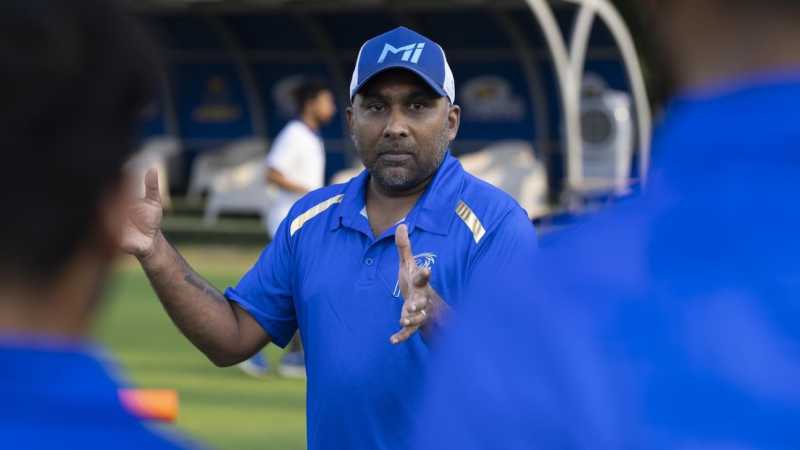
Mumbai Indians and their IPL head coach Mahela Jayawardene have parted ways ahead of the 2027 auction. Jayawardene was the MI head coach for the last two seasons, in his second stint with the franchise in that position. He had previously served in that role from 2017 to 2022.
“Mumbai Indians has been a very special part of my journey for over a decade now,” Jayawardene said in an MI statement. “The players, coaching team, the incredible support of the #OneFamily and above all the fans have made this an experience I will always treasure. Together, we have shared some unforgettable moments, overcome challenges and built something we can all be proud of. I want to sincerely thank Mrs. Nita Ambani and Akash Ambani for their unwavering trust, support and friendship over the years. I leave with immense pride in what we have achieved together and will always carry a special place in my heart for MI. I wish the team every success in the years ahead.”
Cricinfo has learned that the question of a possible change in coaching staff came up during the 2026 season review in August, when both the player leadership group and the franchise agreed they needed to look for a change. It is understood Jayawardene, too, agreed with the viewpoint of bringing in younger coaches to bring in fresh perspectives.
The new coach will have the choice of taking a call on the rest of the existing MI coaching staff which includes Kieron Pollard (assistant coach) and Paras Mhambrey (bowling coach).
Jayawardene’ departure leaves MI’s team management in a tricky position, with captain Hardik Pandya also under the spotlight after their second-from-bottom finish in IPL 2026. Not long after MI finished with just four wins from 14 games, rumours of a Hardik trade began circulating in reports and social media. Hardik’s individual performance also didn’t inspire much confidence: he took just four wickets in 10 games and scored 206 runs from 10 innings, striking at 138.25 with a high score of 40.
Jayawardene took over as the MI head coach before IPL 2025, replacing Mark Boucher. Before that, Jayawardene had served as their global head of performance from 2022 to 2024. In that position, Jayawardene had also overseen MI’s three other franchises – MI Emirates in the ILT20, MI New York in MLC and MI Cape Town in SA20.
In his first stint as head coach, Jayawardene won three IPL titles. The second one was less successful, with MI finishing fourth on the league table in 2025 before losing in Qualifier 2, and ninth in 2026.
“Mahela has made a significant contribution to Mumbai Indians over the years,” MI owner Nita Ambani said, “His calm leadership, integrity and deep love for the game have meant so much to us. On behalf of the entire MI family, I want to thank Mahela for his immense contribution and unwavering commitment over the years. We will always cherish the journey we have shared and the memories we have created together. Mahela will always be a part of our #OneFamily, and we wish him every happiness and success in the journey ahead.”
MI now need to look for a head coach with under a month left for the IPL retention deadline – November 15. The IPL auction is expected to take place around a month later in Goa.
MI last won the IPL in 2020 when they became the first team to successfully defend their title. Both trophy wins came under Jayawardene.
(Cricinfo)

The Rose Bowl, which has been awarded to the winner of ODI series between the women’s teams of Australia and New Zealand since 1985, has now been expanded to include T20Is as well.
New Zealand’s three match T20I tour of Australia, which begins on Sunday at the North Sydney Oval, will be the first T20I edition of the Rose Bowl. The teams will get to face off again for the trophy in March 2027 when they meet again for three ODIs, also in Australia.
For Rose Bowl series that include matches in both white-ball formats, the trophy will go to the team with the most wins overall. In case of a drawn series, the current holder will retain the trophy.
“The Rose Bowl is a prestigious trophy that holds a lot of meaning to current and past players, and it’s a series we’ve always taken a lot of pride in competing in,”Catherine Campbell, NZC’s chief cricket operations officer and a former New Zealand player, said. “With so much T20I cricket now being played, this is a brilliant opportunity to keep the Rose Bowl relevant and to build on the history between us and our Australian rivals.”
New Zealand captain Melie Kerr was excited by the broadening of opportunities to compete for the Rose Bowl.
“We’re all aware of what the Rose Bowl represents and the importance it holds in the White Ferns whakapapa [genealogy],” said Kerr. “Great players and teams have fought for it over the years and we’d love the opportunity to claim our own piece of that history.”
Australia have held the Rose Bowl continuously since wresting it back from New Zealand in 2000. Since that 3-0 win, Australia have won 18 times with one series – in 2008-09 – shared 2-2. Overall, Australia have won 26 of the 31 ODI series played for the Rose Bowl, with New Zealand winning three times and three series drawn.
North Sydney will host all three T20Is of the upcoming Rose Bowl series, on October 18, 20 and 22.
[Cricinfo]

US President Donald Trump claims the US Navy’s “effective” blockade has stopped all Iranian ships from crossing the Strait of Hormuz.
Iran’s Islamic Revolutionary Guard Corps (IRGC) navy says a supertanker carrying more than two million barrels of crude oil has struck a sea mine while attempting to cross the Strait of Hormuz through an “unauthorised” route.
The collision caused a huge explosion and a major fire on board the vessel, the IRGC said in a statement reported by semi-official Tasnim news agency.
It alleged that the tanker had turned off all tracking and radar systems, attempting to pass through the strait using deception and with US military support.
‘The Strait of Hormuz is closed’, the IRGC navy warned, adding that vessels violating Iranian regulations would face severe consequences for relying on US backing.
[Aljazeera]

Mumbai Indians and head coach Mahela Jayawardene part ways

Review of progress in reforms and modernisation of key state revenue-collecting institutions

Rose Bowl expanded to include Australia vs New Zealand T20Is

Trump claims US Navy blockade stops Iranian ships in Hormuz

Showers above 75 mm are likely at some places in the Western, Sabaragamuwa, Central and North-central provinces and in Trincomalee and Mullaitivu districts

Cut power bills by 3-5%, don’t hike them, consumers demand

‘Dates have the highest sugar content to fight Coronavirus’

Sunday Island 27 December – Headlines

#SundayIsland 17th December – Headlines

Sunday Island – 28th March

Sunday Island Headlines – 21 March

Sunday Island – 21st February – Headlines
-

 News7 days ago
Sri Lanka escalates anti-graft drive with Shiranthi’s jailing
-

 News7 days ago
Iranian ships stranded, Lanka fears US sanctions
-

 Latest News6 days ago
Farhan and Sadaqat help Pakistan seal series in style
-

 Latest News4 days ago
Nissanka’s return headlines Sri Lanka’s Test squad against Pakistan
-

 Features6 days ago
Intake 16: 45 years of duty and honour
-
 News6 days ago
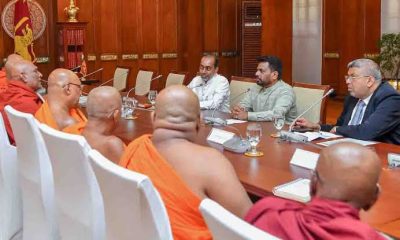
Malwathu Chapter issues statement on talks with President over Gnanasara Thera’s robes
-

 News7 days ago
Navi Pillay’s Lankan affairs in focus as she wins 2026 Nobel Peace Prize
-

 News6 days ago
CP alleges NPP has taken the blame for illegal US sanctions on Iranian vessels