Connect with us

Foreign News

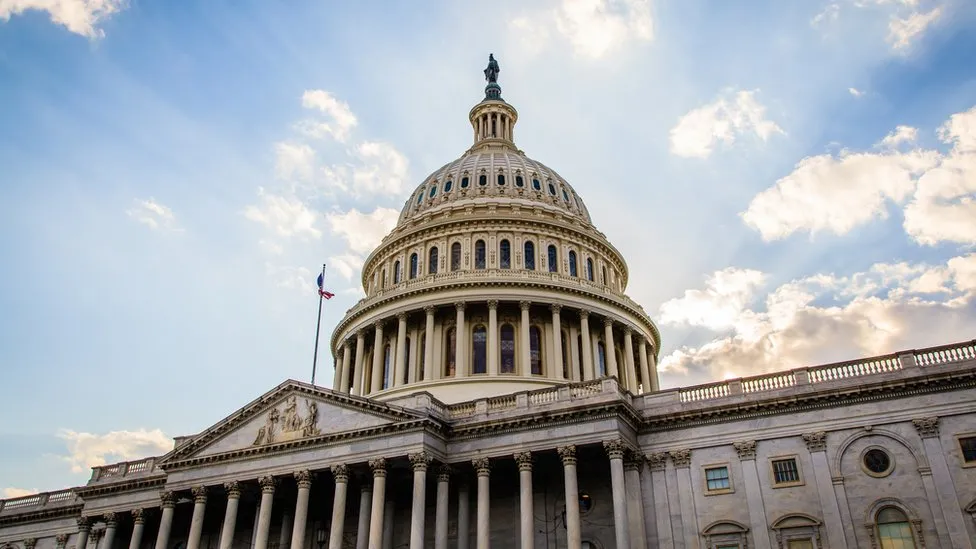
Senate’s $95bn for Ukraine, Israel and Taiwan faces uphill battle in House

Published

on

The US Senate has approved a $95bn (£75.2bn) aid package for Ukraine, Israel and Taiwan after months of political wrangling.

While Democrats were in favour of passing the bill, Republicans were divided and previously voted it down. The package includes $60bn for Kyiv, $14bn for Israel’s war against Hamas and $10bn for humanitarian aid in conflict zones, including in Gaza.

The bill will now go to the House, where its fate is uncertain.

The package, which also includes more than $4bn in funds for Indo-Pacific allies, passed the Senate despite criticism from Republican House Speaker Mike Johnson and former President Donald Trump. Lawmakers voted 70 to 29 to approve the package. Twenty-two Republicans, including Senate Minority Leader Mitch McConnell, joined most Democrats to vote for the legislation.

“History settles every account,” Mr McConnell, a Kentucky senator, said in a statement following the vote. “And today, on the value of American leadership and strength, history will record that the Senate did not blink.”

Ukraine’s leader said he was “grateful” to senators. “For us in Ukraine, continued US assistance helps to save human lives from Russian terror. It means that life will continue in our cities and will triumph over war,” President Volodymyr Zelensky wrote in a post on X, formerly Twitter.

The vote came after an all-night Senate session during which several Republican opponents made speeches in a bid to slow down the process. “Shouldn’t we try to fix our own country first?” Senator Rand Paul of Kentucky said on Monday. Some left-wing lawmakers, including Democrat Jeff Merkley of Oregon and independent Bernie Sanders of Vermont, also voted against the bill, citing concerns about supporting Israel’s bombing of Gaza.

The aid package is a stripped-down version of a $118bn package that Senate Republicans voted down last week.

Republicans had initially demanded that any foreign aid be tied to more security measures at the southern border. But after Mr Trump came out against the border provisions, Republicans were divided on the package. Some lawmakers suggested border measures could be added back into the current version of the legislation.

Mr Johnson suggested in a statement on Monday night the new bill would not pass the Republican-controlled House of Representatives without such provisions. “House Republicans were crystal clear from the very beginning of discussions that any so-called national security supplemental legislation must recognise that national security begins at our own border,” he said.

The Louisiana congressman said lawmakers “should have gone back to the drawing board” with the legislation to focus on border security.

With Senate passage of the aid bill stripped of immigration measures, Mr Johnson and the House Republican leadership will have to decide whether to bring the package to a vote in that chamber, attempt to amend it and send it back to the Senate, or to ignore it entirely.

That last option could prompt those House Republicans who support Ukraine military assistance to join Democrats in filing a discharge petition. This is a rare parliamentary procedure that would circumvent Mr Johnson and force a vote.

Some on the left may baulk at the military aid for Israel in the package, however, making such a manoeuvre – which requires the support of a majority of the House – more difficult.

After the Senate vote, Mr Johnson said his chamber “will have to continue to work its own will on these important matters”. He could divide the different pieces of aid into separate components, or add conservative US immigration reforms. Mr Johnson will be hard-pressed to convince his narrow House majority, which is sharply divided on aid to Ukraine, to follow his lead, however.

Democratic Senate Majority Leader Chuck Schumer, meanwhile, hailed the passage of the bill on Tuesday. He said the Senate was “telling Putin he will regret the day he questioned America’s resolve”.

President Joe Biden applauded the measure, too, saying it would allow the US “to stand up for Ukraine’s freedom and support its ability to defend itself against Russia’s aggression”.

The US is one of the largest providers of aid to Ukraine. The White House asked Congress months ago to pass a bill that included foreign aid.

This could be Congress’s last shot at passing Ukraine aid for the foreseeable future, and Ukraine has warned it may not be able to successfully defend itself against Russia without Washington’s backing.

(BBC)



Continue Reading
Click to comment

Leave a Reply

Your email address will not be published. Required fields are marked *

Foreign News

Deadly border fighting breaks out between Pakistan and Afghanistan

Published

on

By

Fighting broke out close to the Afghan border city of Spin Boldak, which has seen deadly clashes in recent months (pictured October 2025) [BBC]

Border clashes have erupted again between Pakistan and Afghanistan’s Taliban forces, with each sides accusing the other of breaking a fragile ceasefire.

Residents fled the Afghan city of Spin Boldak overnight, which lies along the 1,600-mile (2,600 km) border between the two countries.

A medical worker in the nearby city of Kandahar told BBC Pashto that four bodies had been brought to a local hospital. Four other people were wounded. Three were reportedly wounded in Pakistan.

There has been sporadic fighting between the two countries in recent months, while Afghanistan’s Taliban government has also accused Pakistan of carrying out air strikes inside the country.

Both sides have confirmed they exchanged fire overnight but each blamed the other for initiating the four hours of fighting.

Mosharraf Zaidi, a spokesperson for Pakistan’s Prime Minister Shehbaz Sharif, accused the Taliban of “unprovoked firing”.

The statement continued: “An immediate, befitting & intense response has been given by our armed forces. Pakistan remains fully alert & committed to ensuring its territorial integrity & the safety our citizens.”

Meanwhile, a Taliban spokesperson said Pakistan had “once again initiated attacks” and said it was “forced to respond”.

Residents on the Afghan side of the border said the exchange of fire started at around 22:30 (18:00 GMT) on Friday.

Footage from the area showed a large number of Afghans fleeing on foot and in vehicles.

Ali Mohammed Haqmal, head of Kandahar’s information department, said Pakistan’s forces had attacked with “light and heavy artillery” and civilian homes had been hit by mortar fire.

The latest clashes came less than two months after both sides agreed to a ceasefire mediated by Qatar and Turkey.

It ended more than a week of fighting in which dozens were killed – the worst clashes between Pakistan and the Taliban since the group returned to power in 2021 – though tensions have remained high.

The government in Islamabad has long accused Afghanistan’s ruling Taliban of giving shelter to armed groups which carry out attacks in Pakistan.

The Taliban government denies the accusation and has accused Pakistan of blaming others for their “own security failures”.

The Pakistan Taliban have carried out at least 600 attacks on Pakistani forces over the past year, according to the Armed Conflict Location & Event Data Project.

Last week delegations from both sides met in Saudi Arabia for a fourth round of negotiations on a wider peace settlement, but did not reach an agreement.

Sources familiar with the talks told BBC News that both sides had agreed to continue with the ceasefire.

[BBC]

Continue Reading

Foreign News

Ireland among countries boycotting Eurovision after Israel allowed to compete

Published

on

By

Singer Yuval Raphael, who survived the 7 October Hamas attack in 2023, represented Israel at this year's Eurovision [BBC]

Ireland, Spain, the Netherlands and Slovenia will boycott the 2026 Eurovision Song Contest, after Israel was allowed to compete.

They were among a number of countries who had called for Israel to be excluded over the war in Gaza, as well as accusations of unfair voting practices.

Spanish broadcaster RTVE led calls for a secret ballot on the issue at a meeting in Geneva. It said organisers denied that request – a decision that “increased [our] distrust of the festival’s organisation”.

Ireland’s RTÉ said it felt that its “participation remains unconscionable given the appalling loss of lives in Gaza and the humanitarian crisis there which continues to put the lives of so many civilians at risk.”

Spain is one of Eurovision’s “Big Five” countries along with France, Germany, Italy and the UK.

Their artists are allowed straight into the final, as their broadcasters provide the largest financial contribution to the EBU.

Approximately 50 broadcasters, including the BBC, attended a meeting of the European Broadcasting Union (EBU) on Thursday to discuss the future of the contest, which is watched by more than 150 million people each year.

They were asked to back new rules intended to discourage governments and third parties from organising voting campaigns for their acts, after allegations that Israel unfairly boosted its entrant, Yuval Raphael, this year.

BBC News understands that voting to accept those measures was tied to a clause whereby members agreed not to proceed with a vote on Israel’s participation.

“This vote means that all EBU Members who wish to participate in the Eurovision Song Contest 2026 and agree to comply with the new rules are eligible to take part,” the EBU said.

[BBC]


Continue Reading

Foreign News

Oil, defence and geopolitics: Why Putin is visiting Modi in Delhi

Published

on

By

Modi and Putin share a warm relationship [BBC]

Russian President Vladimir Putin is starting a two-day visit to India, where he will meet Prime Minister Narendra Modi and attend an annual summit held by both countries.

Delhi and Moscow are expected to sign a number of deals during the visit, which comes months after the US increased pressure on India to stop buying Russian oil.

It also comes as US President Donald Trump’s administration holds a series of talks with Russia and Ukraine in an attempt to end the war.

India and Russia have been close allies for decades and Putin and Modi share a warm relationship. Here’s a look at why they both need each other – and what to watch for as they meet.

Why are relations with India key for the Kremlin?

Well, for a start, look at the numbers:

  • a population of nearly a billion and a half.
  • economic growth exceeding 8%. India is the world’s fastest growing major economy.

That makes it a hugely attractive market for Russian goods and resources – especially oil.

India is the world’s third largest consumer of crude oil and has been buying large volumes from Russia. That wasn’t always the case. Before the Kremlin’s full-scale invasion of Ukraine, only 2.5% of India’s oil imports were Russian.

That figure jumped to 35% as India took advantage of Russian price discounts prompted by sanctions against Moscow and Russia’s restricted access to the European market.

India was happy. Washington less so.

Earlier this year, the Trump administration slapped an additional 25% tariff on Indian goods, arguing that by purchasing oil from Russia, India was helping to fund the Kremlin’s war chest. Orders from India for Russian oil have since dropped. President Putin will be keen for India to keep buying.

For Moscow, weapons sales to India are another priority and have been since Soviet times. Ahead of Putin’s visit, there were reports that India plans to purchase state-of-the-art Russian fighter jets and air defence systems.

Russia, hit by a labour shortage, also sees India as a valuable source of skilled workers.

But there’s geopolitics at play, too.

The Kremlin enjoys demonstrating that Western efforts to isolate it over the war in Ukraine have failed.

Flying to India and meeting Prime Minister Modi is one way of doing that.

So is travelling to China and holding talks with Xi Jinping, as Putin did three months ago. He met Modi on the same trip. The image of the three leaders smiling and chatting together sent a clear message that, despite the war in Ukraine, Moscow has powerful allies who support the concept of a “multi-polar world”.

Russia lauds its “no limits partnership” with China.

It is just as vocal about its “special and privileged strategic partnership” with India.

That is a stark contrast to Moscow’s strained relationship with the European Union.

“I think the Kremlin is sure that the West, including Europe, totally failed,” believes Novaya Gazeta columnist Andrei Kolesnikov.

“We are not isolated, because we have connections to Asia and the Global South. Economically, this is the future. In that sense Russia returned as the main actor in these parts of the globe, like the Soviet Union. But even the Soviet Union had special channels and connections to the US, West Germany and France. It had a multi-vector policy.

“But now we are totally isolated from Europe. This is unprecedented. Our philosophers always said that Russia was a part of Europe. Now we’re not. This is a big failure and a big loss. I’m sure that part of Russia’s political and entrepreneurial class is dreaming of returning to Europe and of doing business not only with China and India.”

This week, though, expect to hear about Russia-India friendship, trade deals and increased economic cooperation between Moscow and Delhi.

Getty Images Russian S400 drives on their way to Red Square during the general rehearsal of Victory Day military parade marking the 80th anniversary of the victory over Nazi Germany in World War II, at Red Square in Moscow, Russia on 7 May 2025
Weapon sales to India are a priority for Russia [BBC]

Putin’s visit to Delhi is coming at a crucial time for Modi and India’s global ambitions.

India-Russia ties go back to the Soviet era and have endured irrespective of the changing geopolitical landscape.

Putin has arguably put more time and energy into this relationship than other Russian leaders before him.

As for Modi, despite coming under intense pressure from Western governments to criticise Russia over its war in Ukraine, he maintained that dialogue was the only way to resolve the conflict.

This was India’s “strategic autonomy” at play – with Modi occupying a particular place in the geopolitical order where he held close ties with Moscow while maintaining his relationship with the West at the same time.

That worked – until Trump returned to the White House. India-US ties have hit an all time low in recent months as the two countries have failed to resolve the tariff deadlock.

In this context, Putin’s visit assumes more significance for Modi than ever before because it will test India’s geopolitical autonomy. He will be walking the proverbial diplomatic tightrope here.

Modi would want to show Indians at home and in the wider world that he still counts Putin as his ally and hasn’t given into pressure from Trump, whom he has earlier called his “true friend”.

But he has also faced pressure from his allies in Europe – just this week, the German, French and UK ambassadors in India wrote a rare joint article in a major newspaper criticising Russia’s stance on Ukraine.

And so, Modi will have to ensure that the strengthening of India-Russia ties does not overshadow ongoing trade talks with the US and his partnership with Europe.

“For India, the challenge is strategic balance – protecting autonomy while navigating pressure from Washington and dependence on Moscow,” said the Global Trade Research Initiative (GTRI), a Delhi-based think-tank.

Getty Images U.S. President Donald Trump delivers remarks during a meeting with New York City Mayor-elect Zohran Mamdani in the Oval Office of the White House on November 21, 2025 in Washington, DC
President Trump has imposed an additional 25% tariff on India as penalty for buying Russian oil [BBC]

Modi’s other priority will be to unlock the potential of bilateral trade between India and Russia.

Analysts have often said that the economic relationship between the two strong allies has underperformed for decades.

Their bilateral trade rose to $68.72bn at the end of March 2025, up from just $8.1bn in 2020. This was largely due to India sharply increasing discounted Russian oil purchases. This has skewed the balance heavily in favour of Russia and that is something Modi would want to correct.

With Indian firms already reducing oil purchases from Russia to avoid sanctions from Washington, the two countries will look at other areas to boost trade.

Defence is the easiest pick. India’s defence imports from Russia reduced to 36% between 2020 and 2024, from the peaks of 72% in 2010-2015 and 55% between 2015 and 2019, according to Stockholm International Peace Research Institute.

This was largely due to India’s attempt to diversify its defence portfolio and boost domestic manufacturing.

But a closer look at these numbers tells a different story. Several Indian defence platforms still rely heavily on Russia. Many of its 29 air force squadrons use Russian Sukhoi-30 jets.

India’s limited armed conflict with Pakistan in May this year proved the indispensable role of Russian platforms like the S-400 air defence systems in its armed forces but it also showed the vulnerabilities that the country urgently needs to fix.

Reports suggest that India wants to buy the upgraded S-500 systems and the Su-57 fifth-generation fighter jet. Pakistan’s purchase of the China-made J-35 fifth-generation stealth fighter has not gone unnoticed in Delhi, and it would want to secure a comparable jet as soon as possible.

But Russia is already facing a shortage of critical components due to sanctions and the war in Ukraine. The deadline to deliver some units of the S-400 have reportedly been delayed to 2026. Modi will seek some guarantees on timelines with Putin.

Modi would also want Russia’s economy to open space for Indian products to fix the massive trade imbalance.

“Consumer-oriented and high-visibility categories remain marginal: smartphones ($75.9m), shrimp ($75.7m), meat ($63m) and garments at just $20.94m underscore India’s limited penetration in Russia’s retail markets and electronics value chains despite geopolitical churn,” GTRI said.

Modi aims to position Indian goods in Russia’s market, especially once the war ends and Moscow is reintegrated into the global economy.

He would seek to lessen trade dependence on oil and defence, aiming for a deal that strengthens ties with Russia while leaving room to deepen relations with the West.

“Putin’s visit is not a nostalgic return to Cold War diplomacy. It is a negotiation over risk, supply chains and economic insulation. A modest outcome will secure oil and defence; an ambitious one will reshape regional economics,” GTRI said.

[BBC]

Continue Reading

Trending