
Latest News
Nissanka’s unbeaten 210 outplays Omarzai, Nabi tons as Sri Lanka clinch opener

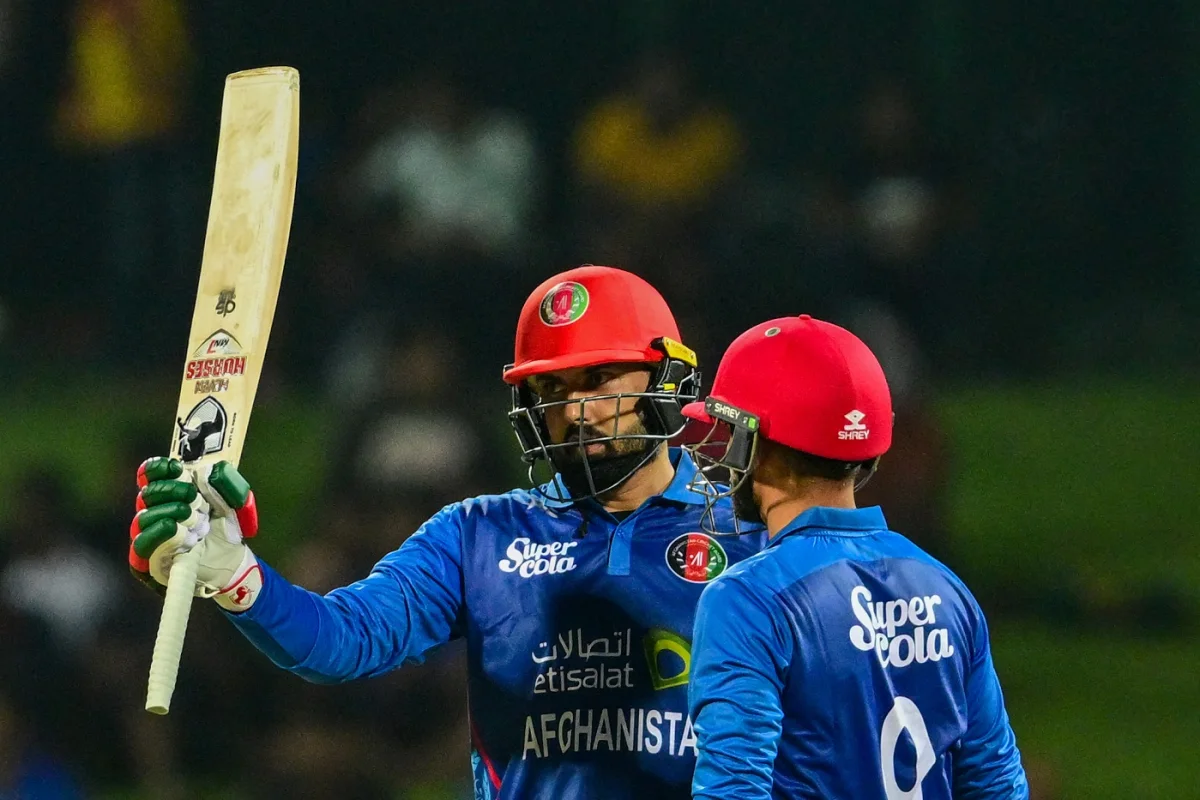
Pathum Nissanka’s historic double ton ensured Sri Lanka withstood a spirited Afghanistan counterattack to record a 42-run victory in the first ODI at Pallekele and take a 1-0 lead in the three-match series.
That Afghanistan even got that close was down to a record 242-run stand between Azmatullah Omarazi and Mohammad Nabi the second-highest sixth-wicket stand in ODI history. Omarazai ended on a 115-ball 149, while Nabi scored 136 off 130, as Afghanistan fell short but with their heads held high.
It would leave them wondering perhaps what might have been had there been more substantial contributions from their top order, but in a chase of the mammoth 382-run target set by Sri Lanka, many fell wanting in searching for a fast start.
Pramod Madushan did the most damage sending three of Afghanistan’s top four packing inside the first powerplay. The right-handed Rahmanullah Gurbaz and the left-handed Hashmatullah Shahidi were both done in by in-duckers, Madushan adept at moving the ball both ways – either through the air or off the surface.
In between the two he had Ibrahim Zadran caught at slip, and returned later in the game to break the stand between Nabi and Omarzai. He finished with figures of 4 for 75.
With Dushmantha Chameera accounting for the scalps of Rahmat Shah and Gulbadin Naib at the other end, Afghanistan found themselves staring down the barrel of an ignominious defeat, having stumbled to 55 for 5 midway through the ninth over.
But that was when the fightback began, as the pair of Omarzai and Nabi resolved early on to take the game as deep as possible.
Brief scores:
Sri Lanka 381 for 3 in 50 overs (Pathum Nissanka 210*, Avishka Fernando 88, Sadeera Samarawickrama 44; Fareed Ahmad 2-79) beat Afghanistan 339 for 6 in 50 overs (Azmatullah Omarzai 149, Mohammad Nabi 136; Pramodh Madushan 4-75, Dushmantha Chameera 2-55) by 42 runs
(Cricinfo)











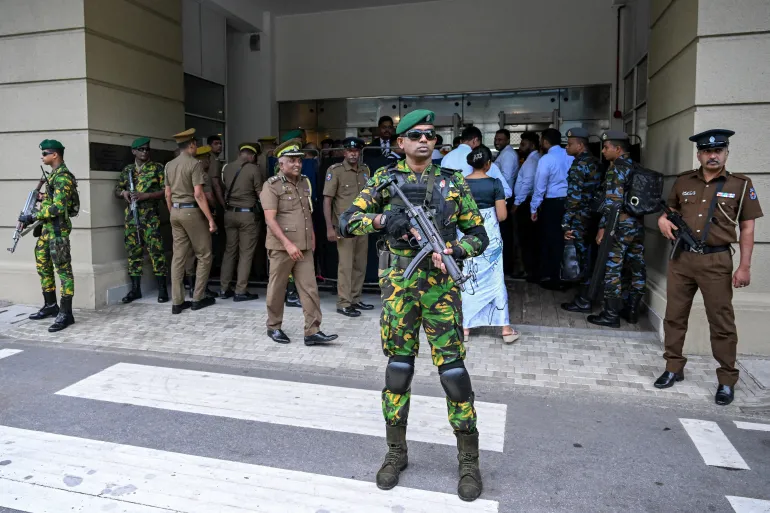
The High Court has convicted 14 of the 24 men accused of being directly involved in the 2019 Easter Sunday bombings, which killed 279 people.
The three-judge bench read out its decision on Tuesday after a five-year trial and said sentencing would take place later, the AFP news agency reported.
The charges included murder and conspiracy to commit terrorism.
Nine others were acquitted, while another defendant was found guilty of only some of the charges, the court said.
[Aljazeera]
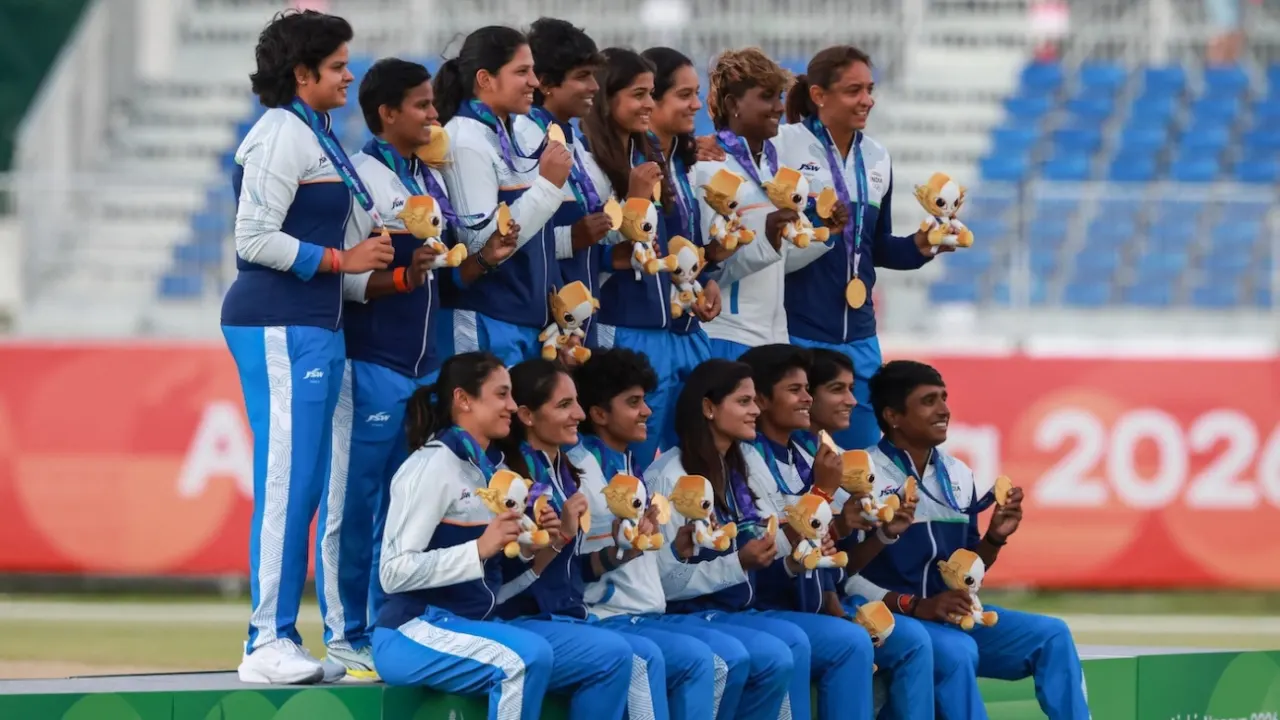
India thrashed Sri Lanka by 147 runs in the Asian Games women’s cricket competition final in Nisshin to win the country’s first gold medal of the multi-sport event, with Smriri Mandhana, Shafali Verma, Richa Ghosh and the bowling group starring in the dominant display. That made it back-to-back gold medals for India in the event after their triumph in 2023.
Mandhana and Shafali laid the foundation of the win for India with a 99-run opening stand after they opted to bat, with Mandhana finishing on 79 off 45 balls. Ghosh then provided the finishing touches, making 49 not out off 22 balls to power India to 216 for 3, the highest Asian Games innings total.
Sri Lanka couldn’t get anywhere near India’s firepower as they struggled against spin. Chamari Athapaththu fought with a 21-ball 29, but they folded for a paltry 69 – just two runs more than what India managed in their powerplay – to lose another final to India in the space of ten days after going down in the Asia Cup title contest.
The match unfolded similarly to that game in Dubai. Mandhana in particular was at her menacing best, starting off with two boundaries off Sugandika Kumari in the first over and then launching three sixes to different parts of the ground. She first rocked back to Sugandika’s short delivery outside off and cleared mid-on with ease. Sugandika then went fuller and strayed onto the pads, allowing Mandhana to whip it over square leg for another six. And in the next over, she stepped down the track and carved Mithali Ayodhya over cover for her third six of the day.
Shafali then joined in the fun, taking Athapaththu for two sixes, pulling a short ball over deep midwicket before driving a floated delivery over mid-off. Mandhana rounded off the over by flat-batting a back-of-a-length delivery just beyond long-on for another six, much to Athapaththu’s frustration. India were going at over 11 at that point, posting 67 for no loss at the end of the powerplay.
Fours and sixes came frequently with Mandhana continuing to be the more aggressive of the two, bringing up her fifty off 30 balls in the tenth over. Shafali survived a stumping scare in the same over but couldn’t cash in on the chance as she top-edged a shot to Kawya Kavindi at short third off Chamudi Praboda for 48 off 29 balls.
Sri Lanka briefly managed to stem the flow of runs, conceding just one boundary in 19 balls, but that period did not last long. Harmanpreet Kaur and Mandhana started finding the gaps soon, though the India captain’s stay did not last long as she departed for a 17-ball 19.
Ghosh walked out at No. 4 and helped India pick up the pace again, taking on Praboda for two boundaries while Mandhana continued to attack at the other end. Mandhana went on to clobber two more sixes before falling in an attempt to go big, miscuing a length delivery from Sugandika while looking to clear deep-backward square-leg.
With 200 in sight, Ghosh took charge as she helped India plunder 19 runs, including two fours and a six, off Kavindi’s over before launching two more sixes off Ayodhya in the next, pulling a half-tracker over deep midwicket before moving across to club another full delivery over cow corner. Ayodhya also conceded five wides in the over. Ghosh capped the innings with another boundary as India finished on 216.
Sri Lanka were facing a daunting target, but it was not the brightest of starts for India on the field either. After Shreyanka Patil dropped a regulation catch off Imesha Dulani at backward point in the first over, Athapaththu looked in good touch as she scored two boundaries off Nandani Sharma in the second.
Harmanpreet then turned to India’s go-to part-time spin option – Shafali – and she delivered instantly, deceiving Dulani in flight, with Ghosh completing the stumping. She claimed her second wicket in her next over, with a loopy delivery that Hasini Perera sliced to cover point.
Sri Lanka found boundaries against the faster bowlers but could barely keep up with the required run rate, moving to 41 for 2 at the end of the powerplay. India then turned to spin for the rest of the innings, and Sri Lanka’s chase quickly unravelled.
Deepti Sharma ended their slim hopes when she had Athapaththu miscuing to long-off in the seventh over. Patil then had Harshitha Samarawickrama caught and bowled for a duck, before N Shree Charani dismissed Hansima Karunaratne for 1 after another miscued slog.
Deepti then added a second wicket when Kavisha Dilhari spooned a drive back to her, leaving Sri Lanka six down and in deep, deep trouble.
The result all but decided by then, and India continued to strike at regular intervals with Sri Lanka offering no resistance, barring a six and a four from Kaushini Nuthyanganam, whose wicket brought Sri Lanka’s innings to an end in the 16th over. Deepti finished with figures of 3 for 6, while Shafali, Shree Charani and Patil bagged two each.
Scores:
India Women 216 for 3 in 20 overs (Shafali Verma 48, Smriti Mandhana 79, Harmanpreet Kur 19, Richa Ghosh 49; SugandikaKumari 1-49, Kavisha Dilhari 1-35, Chamudi Praboda 1-34) beat Sri Lanka 69 in 15.4 overs (Chamari Athapaththu 29, Kavisha Dilhari 11, Kaushini Nuthyangana 14; Deepti Sharma 3-06, Shafali Verma 2-03, Shreyanka Patil 2-9, N Shree Charani 2-13) by 147 runs
[Cricinfo]
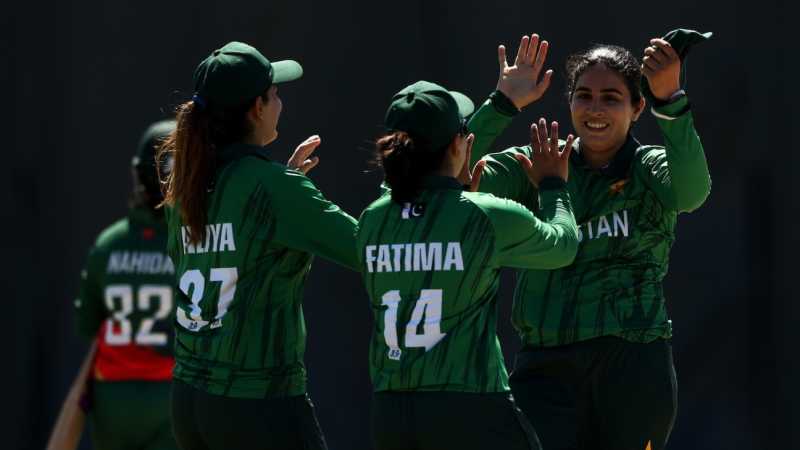
At 67 for 5 in the 12th over, Pakistan were under the cosh against Bqngladesh in their bronze-medal playoff at the Asian Games women’s competition. That’s when Fatima Sana walked out, slammed 45 in 30 balls, and gave Pakistan 145, which was 31 too many for Bangladesh, especially after Umm-e-Hani picked up three top- and middle-order wickets to end with 3 for 10 from her four overs.
Bangladesh’s big concern, of late and in general, has been the number of dot balls they play out in a typical T20 innings. In this game, it was a marginal improvement from the loss to India in the semi-final – they had 43 dot balls here compared to 61 in that game. But it was still fewer than the 48 they bowled to Pakistan in the first half. The difference was Sana, who scored at 150.00 to change the complexion of the contest.
Pakistan’s start had been decent, thanks to Gull Feroza, after they won the toss and opted to bat. Feroza and Shawaal Zulfiqar added 46 in 41 balls before being separated in the seventh over. The one to be dismissed was Feroza, who had scored 31 in 23 balls. Zulfiqar batted on before becoming the third batter to fall, having struggled to 17 off 27 balls. And the wickets kept falling, Shorna Akter picking up two of them to leave Pakistan in a mess with five batters gone.
Sana had a solid stand for the sixth wicket with Aliya Riyaz, who scored 25 in 22 balls and added 67 with Sana in just 43 balls. The control Bangladesh had was gone with the two hitting five sixes between them.
The target for Bangladesh, which looked like it might be in the region of 100, was suddenly closer to 150. And the chase never took off. Umm-e-Hani struck in the third over, then in the fifth over, and again in the 16th over. By then, Bangladesh were floundering: 77 for 5 with under five overs to go.
The resistance came from senior pro Sharmin Akther, who scored an unbeaten 46 in 45 balls, but there was nothing around her, and Pakistan ran out comfortable, 31-run victors.
Scores:
Pakistan women 145 for 8 in 20 overs (Shawaal Zulfiqar 17, Fatima Sana 45, Gull Feroza 31, Aliya Riyaz 25; Sanija Akter Meghla 1-28, Nahida Akter 2-21, Shorna Akter 2-16, Ritu Moni 2-27) beat Bangladesh women 114 for 7 in 20 overs (Dilara Akter 12, Nigar Sultana 25, Sharmin Akhter 46*, Nahida Akter 10*; Tasmia Rubab 1-25, Fatima Sana 1-25, Umm-e-Hani 3-10, Nashra Sandhu 1-19, Ayesha Zafar 1-10) by 31 runs
(Cricinfo)

High Court convicts 14 over deadly Easter bombings

Mandhana, Shafali and Ghosh lead dominant India to Asian Games gold

Fatima Sana and Umm-e-Hani secure bronze for Pakistan in Asian Games

India bat first in Asian games womens cricket final

Showers about 100mm will occur in the Western, Sabaragamuwa, Central and North-western provinces and in Galle and Matara Districts

Govt. confident of 2/3 majority despite NPP split speculation

‘Dates have the highest sugar content to fight Coronavirus’

Sunday Island 27 December – Headlines

#SundayIsland 17th December – Headlines

Sunday Island – 28th March

Sunday Island Headlines – 21 March

Sunday Island – 21st February – Headlines
-

 News6 days ago
US embassy won’t comment on IGP’s probe into joint drug raid
-

 News4 days ago
Shanakiyan urges urgent action over reported death sentence for Lankan in Saudi Arabia
-

 News5 days ago
Bid for Basil’s extradition nears final stage: Police
-

 Business6 days ago
All-new Bolero MaXX unveiled in Sri Lanka
-

 News3 days ago
Namal Rajapaksa Buddhist gambit fails, bail denied
-

 Opinion6 days ago
A journalist who wrote across the divide
-

 Editorial7 days ago
More fuel price shocks shrouded in secrecy
-

 Features3 days ago
Why the spelling Sri Lankan names in English vary