
Business
Oil prices steady despite Middle East tensions, but risks are rising

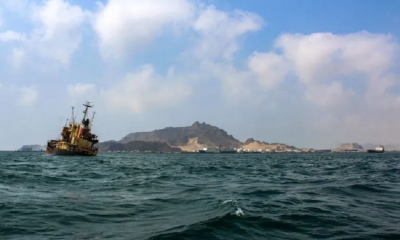
In recent weeks, missile and drone attacks on cargo ships crossing the Red Sea have caused the biggest disruption to global trade since the COVID-19 pandemic. Despite delayed supplies, however, oil prices have remained surprisingly stable.
In response to Israel’s war on Gaza, Houthi rebels – the Iran-aligned Shia movement that controls northern Yemen and its western coastline – have launched a wave of assaults on ships in the Red Sea. By targeting vessels with perceived links to Israel, they are attempting to force Tel Aviv to stop the war and admit full humanitarian aid into Gaza. Houthis have launched at least 26 separate attacks since November 19 on merchant freighters.
Though no ships have yet been sunk, the United States recently dispatched a multinational naval task force to the region. On December 31, American Navy helicopters killed 10 Houthi fighters and sank three of the group’s speedboats.
The following day, Iran dispatched its Alborz warship to the Red Sea, compounding an already volatile situation. The government did not provide information on the vessel’s mission.
On Wednesday, Houthi rebels fired their largest barrage of projectiles yet, forcing an engagement with US and British naval forces. On Thursday night, the US and UK led a bombing campaign against multiple Houthi facilities in Yemen.
While Brent crude briefly topped $80 per barrel after Thursday’s air strikes, oil prices have mostly trended sideways in recent weeks. Market fundamentals suggest a balanced, or slightly surplus, market. And until there is a clear threat to global supply, traders appear to have relegated tensions in the Middle East to background noise.
Houthi activity has so far been concentrated in the narrow strait of Bab al-Mandab, which connects the Gulf of Aden to the Red Sea. Approximately 50 ships sail through the strait every day, heading to and from the Suez Canal – a central artery for global trade.
Some of the world’s largest shipping companies have suspended transit in the region, forcing vessels to sail around the Cape of Good Hope in Southern Africa. The lengthier route has raised freight rates due to higher fuel, crew and insurance costs.
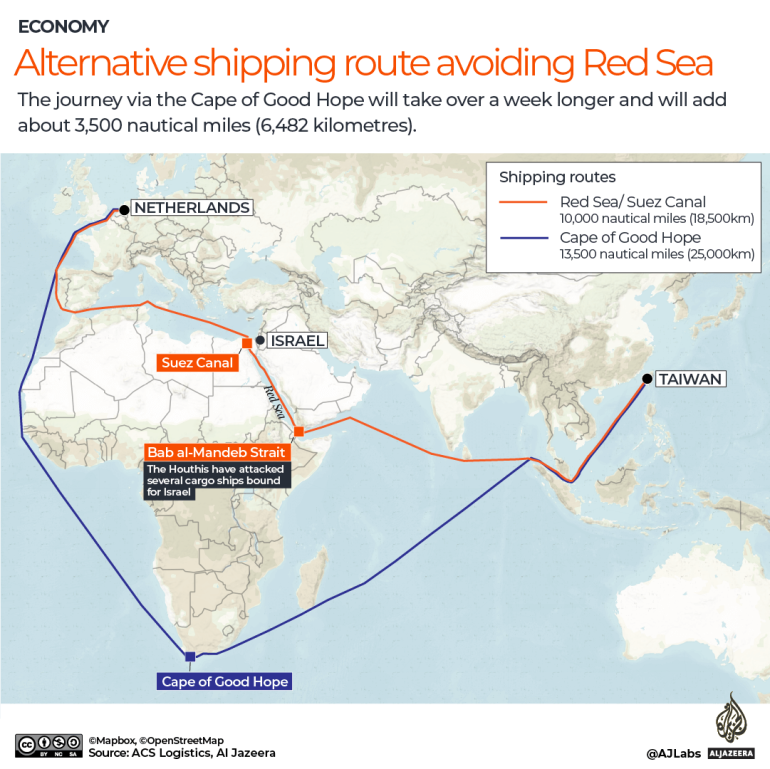
According to Clarksons, a shipbroker, roughly 24,000 vessels crossed the Suez Canal last year. That amounts to one-tenth of global trade, including 10 percent of seaborne oil and 8 percent of liquefied natural gas.
Ships travelling through the Suez Canal have taken on greater strategic significance since the war in Ukraine, as Russian sanctions have made Europe more dependent on oil from the Middle East, which supplies one-third of the world’s Brent crude, the international benchmark.
“The region is an important channel for freight, representing almost one-third of global container capacity. As such, Houthi-linked bottlenecks pose a new risk to inflation,” said Rahul Sharan, a senior manager for maritime consultancy Drewry.
“We’ve seen hundreds of vessels rerouted from the Suez Canal in recent months. We don’t yet have visibility on which industries have been most severely affected, but consumer goods costs could rise if oil and gas prices increase.”
Despite diverting supplies from the Suez Canal, tensions in the Red Sea have so far had a muted impact on energy prices. “We’ve seen plenty of volatility, so geopolitical risks are being considered. But not enough to lift prices,” says energy trader Mohammed Yagoub.
“The truth is that headline fatigue has set in. There’s been a lot of coverage on tensions in the Red Sea, especially today. But global supplies have remained broadly steady in recent weeks,” Yagoub told Al Jazeera.
“You have to remember that the oil can still travel around Africa, as well as from ports in western Saudi Arabia, bypassing the need to cross Bab al-Mandeb.” The Houthis, he said, were also unlikely to attack ships from friendly oil and gas-producing countries in the region.
There are other factors at play – recent record US production, the lifting of oil sanctions in Venezuela and tepid global demand, Yagoub added.
However, looking ahead, he warned that “tensions in Iran, especially around Hormuz, could move the needle on prices.”
Approximately 17 million barrels of crude oil, nearly one-sixth of global supply, are transported on a daily basis through the Strait of Hormuz, between the Arabian Gulf and the Gulf of Oman. If Iran became actively engaged in the conflict, Tehran could threaten to close this vital channel.
Any such closure could see crude prices surge by 20 percent in a month and higher thereafter, according to Callum Bruce, an analyst at Goldman Sachs. “It would be a huge, huge shock. For now, though, the implied market probability of that happening is less than 1 percent,” he said. Tehran has appeared reluctant to engage in military conflict with the US military and its economy remains fragile.
Bruce pointed out that “oil traders will continue paying close attention to activity in the Middle East. Gaza is ground zero. Then, you have the Red Sea. Tensions across the region have also ratcheted up in recent weeks.”
On January 2, senior Hamas leader Saleh al-Arouri was killed in Beirut by an Israeli drone raid following three months of hostilities at the Lebanon-Israel border. It was the first air raid on Beirut since 2006.
This past week, Israel assassinated a Hezbollah commander in south Lebanon, while Hezbollah, which has Iranian support, struck a sensitive Israeli base with rockets. Meanwhile, Iran-backed groups in Iraq have stepped up attacks on US military bases.
For his part, US President Joe Biden has said he is keen to prevent the war on Gaza from spiralling into an all-out regional conflagration, though the bombing of Yemen has been viewed by the Houthis as an escalation. On Sunday, US Secretary of State Anthony Blinken was dispatched to the Middle East on a diplomatic trip for the fourth time in three months.
“Israel’s war with Hamas seems to have energised already existing tensions,” said Bruce. “And while US naval activity in the Red Sea provoked headlines, economic essentials are continuing to dictate oil prices.”
Mohammed Yagoub added, “It’s true that mega-trends are pre-occupying traders. But the likelihood of a regional conflict will increase the longer the fighting in Gaza persists. Yemen is proving that. So, you could make the case that oil traders are too sanguine right now.”
(Aljazeera)







‘Sri Lanka recorded a growth of five percent or more but due to the Middle East crisis this growth rate could be expected to drop. However, this decline could be managed effectively through the adoption of prudent policy adjustments, Central Bank Governor Dr. Nandalal Weerasinghe said at the monthly CBSL monetary policy review meeting. The meet was held at the CBSL head office in Colombo yesterday.
The Governor said that the CBSL had decided to increase the Overnight Policy Rate (OPR) by 100 basis points, bringing it to 8.75 percent.
Following this adjustment, the Standing Deposit Facility Rate (SDFR) and the Standing Lending Facility Rate (SLFR), which are linked to the OPR, have been increased to 8.25 percent and 9.25 percent, respectively. The decision comes after a careful evaluation of evolving domestic and global macroeconomic conditions, Dr Weerasinghe explained.
Dr. Weerasinghe added: ‘The tightening of the monetary policy stance is primarily driven by mounting inflationary pressures. Heightened geopolitical tensions in the Middle East have kept global commodity prices, especially petroleum, elevated.
‘This has led to sharp upward adjustments in domestic energy prices, pushing Sri Lanka’s year-on-year headline inflation to 5.4 percent in April 2026.
‘While the recent spike is largely supply-driven, strengthening domestic demand, evidenced by continued credit expansion, credit-driven imports and robust economic activity—has further accelerated short-term inflation expectations.
‘The external sector has also faced amplified headwinds in recent weeks. A widening merchandise trade deficit, driven by increased fuel import costs and a slowdown in tourism earnings, resulted in a modest external current account surplus for the first quarter of 2026.
‘Additionally, speculative activities led to notable depreciation pressures on the Sri Lankan rupee, though conditions have since stabilized. Despite these pressures and ongoing foreign debt servicing, Sri Lanka’s Gross Official Reserves stood at a resilient USD 6.8 billion by the end of April 2026, a figure that includes a swap facility from the People’s Bank of China.
‘Looking ahead, headline inflation is projected to remain above the Central Bank’s target of 5 percent in the near term before stabilizing.
‘To counter potential second-round effects on inflation from energy price hikes and unchecked private sector credit growth, the Board deemed a restrictive policy stance necessary to maintain long-term domestic price stability. Upcoming multilateral inflows and government stabilization measures are expected to support the external sector and we will continue to monitor incoming data ahead of the next scheduled monetary policy review on July 22, 2026.’
By Hiran H Senewiratne

A new tilapia culture-based production and semi-processing centre launched in Iranamadu, Kilinochchi, is expected to boost climate-resilient aquaculture, strengthen rural livelihoods and create sustainable employment opportunities for women in Sri Lanka’s Northern Province.
The facility, launched by the International Labour Organization in partnership with Cargills (Ceylon) PLC and supported by the Government of Norway, is being hailed as a significant milestone in inclusive economic development and inland fisheries advancement.
Located in the Iranamadu freshwater fisheries hub, the centre has been established under the ILO’s Promoting Advancement of Vulnerable Persons and Enterprises (PAVE) Project, aimed at promoting climate-resilient livelihoods among vulnerable communities, particularly women and persons with disabilities.
Speaking at the launch, ILO Country Director for Sri Lanka and the Maldives, Joni Simpson, said the initiative demonstrated the power of partnerships in advancing social justice and decent employment.
“This processing centre represents what can be achieved when communities, government, development partners and the private sector work together. It contributes not only to strengthening aquaculture value chains but also to expanding access to decent and productive employment, especially for women and marginalized groups,” she said.
The centre is expected to generate new jobs in fish handling, processing and quality assurance while providing training in food safety standards, value addition and enterprise development. Officials said this would significantly increase women’s participation in the aquaculture value chain in the Northern Province.
Representing the Norwegian Government, Tormod Nuland said Norway’s continued support for livelihood projects in the North reflected its commitment to gender equality, inclusivity and climate resilience.
“Illustrating the success of long-standing cooperation with the ILO, the new tilapia processing unit is a key initiative that will help strengthen socio-economic conditions for communities in the Northern Province,” he said.
Cargills officials noted that the project marked the company’s first major venture into inland fisheries development after years of engagement with agricultural and dairy farming communities in the North.
Group Manager Agribusiness at Cargills, Haridas Fernando, said the company saw immense potential in developing the tilapia industry as an affordable and nutritious protein source for Sri Lankan consumers.
“We are pleased to partner with the ILO on this important initiative to support the inland fisheries sector while strengthening livelihoods for small-scale fishing communities,” he said.
The initiative also strengthens market access for the Iranamadu Freshwater Fishermen’s Cooperative Society by linking smallholder fisher communities with private sector markets and national retail networks.
Officials said the project would continue under the ILO’s Generating Resilient Opportunities for Work (GROW) programme, funded by the Governments of Australia and Norway, with the aim of expanding climate-resilient and market-oriented livelihood systems across the Northern Province.
The GROW project builds on more than a decade of interventions under the ILO’s Jobs for Peace and Resilience Programme and focuses on sustainable employment creation, private sector partnerships and social empowerment for vulnerable communities.
By Ifham Nizam

As West Asian tensions continued to simmer, the All Share Price Index moved down by 189.63 points, while the more liquid S&P SL20 went down by 36.97 points.
Turnover stood at Rs 4.93 billion with four crossings. Those crossings were: Softlogic Life Insurance 33.8 million shares crossed to the tune of Rs 3 billion at a per share value of Rs 92, HNB 316,889 shares crossed for Rs 125.2 million; its shares traded at Rs 395, HNB (Non-Voting) 318,199 shares crossed to the tune of Rs 105 million; its shares sold at Rs 330 and Lanka IOC 200,000 shares crossed for Rs 27.7 million; its shares traded at Rs 138.50.
In the retail market companies that mainly contributed to the turnover were; LOLC Holdings Rs 116.5 million (207 900 shares traded), Softlogic Life Insurance Rs 112.3 million (1.2 million shares traded), Commercial Bank 78.2 million (380,000 shares traded), Overseas Reality Rs 64 million (1.3 million shares traded), Sampath Bank Rs 48.9 million (340,000 shares traded), CIC Holdings (Non-Voting) Rs 46.5 million (1.7 million shares traded) and JKH Rs 46 million (2.3 million shares traded). During the day 94.3 million share volumes changed hands in 22097 transactions.
It is said that 75 percent of the turnover came from Softlogic Life Insurance which amounted to more than Rs 3 billion. Therefore, the Insurance sector led the market while the banking sector, especially Commercial Bank and HNB, performed well.
Main contributors to the ASPI were DFCC Bank (up 0.75 percent at Rs 135.00 ), Lanka Ashok Leyland (up 7.38 percent at Rs 3,050.00 ), and Tokyo Cement Company (Lanka) (up 2.00 percent at Rs 92.00 ).
Hayleys (down 1.78 percent at 234.00 rupees), Melstacorp (down 0.53 percent at Rs 186.25 ), Sunshine Holdings (down 3.49 percent at Rs 30.40), LB Finance (down 3.44 percent at Rs 161.25 ), and Dialog Axiata (down 1.25 percent at Rs 39.40 ) were top negative contributors.
Lanka Ashok Leyland announced a first and final proposed dividend of Rs 30 per share for the financial year ended March 31, 2026.
The Lighthouse Hotel has also declared a final dividend of Rs 3 per share for the financial year ended March 31, 2026, subject to shareholder approval at its Annual General Meeting on June 30, 2026.
Yesterday the rupee was quoted at Rs322.00/323.50 to the US dollar in the spot market , stronger from Rs 325.50/327.00 the previous day, dealers said, while bond yields were quoted higher following the rate hike.
The telegraphic transfer rate for Sri Lanka’s rupee against the US dollar was 321.50 buying, 330.50 selling.
By Hiran H Senewiratne

Banking sector claims its integrity intact despite ‘isolated incidents of fraud’

Rivers remain mostly normal despite overnight rains; one basin on alert

MAC Holdings donates Rs. 5 million to ‘Rebuilding Sri Lanka’ Fund

Move to postpone PC polls: Cabinet spokesman contradicts JVP Gen. Sec.

Over 300 busted for possession of narcotics during Sri Pada season

Mendis handed white-ball reins

‘Dates have the highest sugar content to fight Coronavirus’

Sunday Island 27 December – Headlines

#SundayIsland 17th December – Headlines

Sunday Island – 28th March

Sunday Island Headlines – 21 March

Sunday Island – 21st February – Headlines
-
 Opinion6 days ago
Murder of Ehelepola family, Bogambara Wewa and Sightings of Wangediya
-

 Business5 days ago
Historic launch of CCWE Fashion Week & International Summit 2026
-

 News6 days ago
Steps underway to safeguard Sri Lanka’s maritime heritage
-

 News2 days ago
Police probe underway to ascertain links between criminals deported from UAE and local politicians
-

 Features3 days ago
The NPP’s pivot to the past
-

 News3 days ago
All-New GRAVITE launches at LKR 6.99 Mn
-

 Editorial6 days ago
A play without its protagonist
-

 Opinion5 days ago
The need to reform Buddhist ecclesiastical order