
Features
How Hamas built a force to attack Israel on 7 October

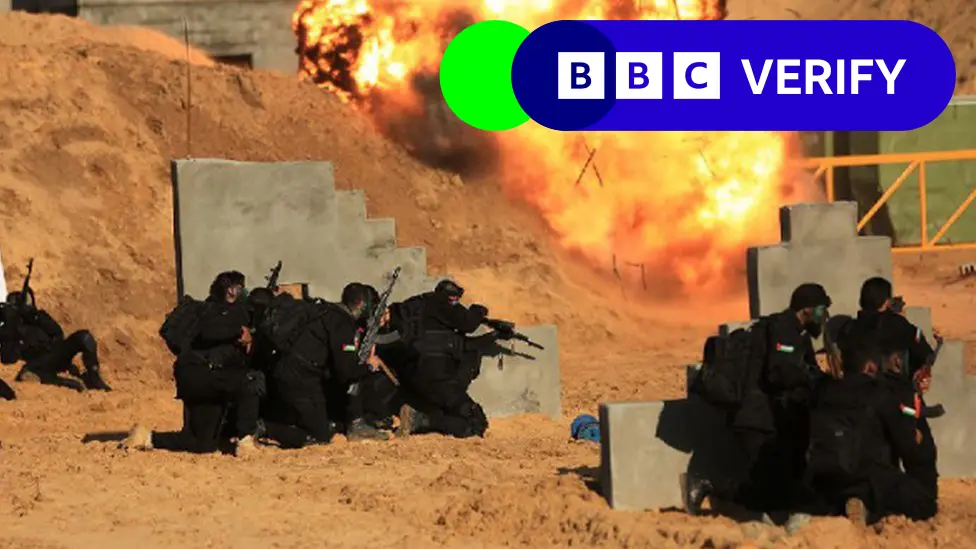
Five armed Palestinian groups joined Hamas in the deadly 7 October attack on Israel after training together in military-style exercises from 2020 onwards, BBC News analysis shows.
The groups carried out joint drills in Gaza which closely resembled the tactics used during the deadly assault – including at a site less than 1km (0.6 miles) from the barrier with Israel – and posted them on social media.
They practised hostage-taking, raiding compounds and breaching Israel’s defences during these exercises, the last of which was held just 25 days before the attack.
BBC Arabic and BBC Verify have collated evidence which shows how Hamas brought together Gaza’s factions to hone their combat methods – and ultimately execute a raid into Israel which has plunged the region into war.
‘A sign of unity’
On 29 December 2020, Hamas’s overall leader Ismail Haniyeh declared the first of four drills codenamed Strong Pillar a “strong message and a sign of unity” between Gaza’s various armed factions.
As the most powerful of Gaza’s armed groups, Hamas was the dominant force in a coalition which brought together 10 other Palestinian factions in a war games-style exercise overseen by a “joint operation room”.
Prior to 2018, Hamas had formally coordinated with Palestinian Islamic Jihad (PIJ), Gaza’s second largest armed faction and – like Hamas – a proscribed terrorist organisation in the UK and other countries.
Hamas had also fought alongside other groups in previous conflicts, but the 2020 drill was billed in propaganda as evidence a wider array of groups were being unified.
Hamas’s leader said the first drill reflected the “permanent readiness” of the armed factions.
The 2020 exercise was the first of four joint drills held over three years, each of which was documented in polished videos posted on public social media channels.
The BBC has visually identified 10 groups, including PIJ, by their distinctive headbands and emblems training alongside Hamas during the Strong Pillar drills in footage posted on the messaging app Telegram.
Following the 7 October attack, five of the groups went on to post videos claiming to show them taking part in the assault. Three others issued written statements on Telegram claiming to have participated.
The role of these groups has come into sharp focus as pressure builds on Hamas to find dozens of women and children believed to have been taken as captives from Israel into Gaza by other factions on 7 October. Three groups – PIJ, the Mujahideen Brigades and Al-Nasser Salah al-Deen Brigades – claim to have seized Israeli hostages on that day.
Efforts to extend the temporary truce in Gaza were said to be hinging on Hamas locating those hostages. The structure was set up in 2018 to coordinate Gaza’s armed factions under a central command.

While these groups are drawn from a broad ideological spectrum ranging from hard-line Islamist to relatively secular, all shared a willingness to use violence against Israel.
Hamas statements repeatedly stressed the theme of unity between Gaza’s disparate armed groups. The group suggested they were equal partners in the joint drills, whilst it continued to play a leading role in the plans to attack Israel. Footage from the first drill shows masked commanders in a bunker appearing to conduct the exercise, and begins with a volley of rocket fire.
It cuts to heavily armed fighters overrunning a mocked-up tank marked with an Israeli flag, detaining a crew member and dragging him away as a prisoner, as well as raiding buildings.
We know from videos and harrowing witness statements that both tactics were used to capture soldiers and target civilians on 7 October, when around 1,200 people were killed and an estimated 240 hostages were taken.
Telling the world
The second Strong Pillar drill was held almost exactly one year later.
Ayman Nofal, a commander in the Izzedine al-Qassam Brigades – the official name for Hamas’s armed wing – said the aim of the exercise on 26 December 2021 was to “affirm the unity of the resistance factions”.
He said the drills would “tell the enemy that the walls and engineering measures on the borders of Gaza will not protect them”.
Another Hamas statement said the “joint military manoeuvres” were designed to “simulate the liberation of settlements near Gaza” – which is how the group refers to Israeli communities.
The exercise was repeated on 28 December 2022, and propaganda images of fighters practising clearing buildings and overrunning tanks in what appears to be a replica of a military base were published to mark the event.

The exercises were reported on in Israel, so it’s inconceivable they were not being closely monitored by the country’s extensive intelligence agencies.
The Israel Defense Forces (IDF) have previously carried out air strikes to disrupt Hamas’s training activities. In April 2023, they bombed the site used for the first Strong Pillar drill.
Weeks before the attacks, female surveillance soldiers near the Gaza border reportedly warned of unusually high drone activity and that Hamas was training to take over observation posts with replicas of their positions.
But, according to reports in the Israeli media, they say they were ignored. Brigadier General Amir Avivi, a former IDF deputy commander in Gaza, told the BBC: “There was a lot of intelligence that they were doing this training – after all, the videos are public, and this was happening just hundreds of metres from the fence (with Israel).”
But he said while the military knew about the drills, they “didn’t see what they were training for”.
The IDF said they “eliminated” Nofal on 17 October 2023, the first senior Hamas military leader to be killed during the conflict.

Hiding in plain sight
Hamas went to great lengths to make sure the drills were realistic.
In 2022, fighters practised storming a mock Israeli military base built just 2.6km (1.6 miles) from the Erez crossing, a route between Gaza and Israel controlled by the IDF.
BBC Verify has pinpointed the site in the far north of Gaza, just 800m (0.5 miles) from the barrier, by matching geographic features seen in the training footage to aerial images of the area. As of November 2023, the site was still visible on Bing Maps.
The training camp was within 1.6km (1 mile) of an Israeli observation tower and an elevated observation box, elements in a security barrier Israel has spent hundreds of millions of dollars constructing.

The mock base is on land dug several metres below ground level, so it may not have been immediately visible to any nearby Israeli patrols – but the smoke rising from the explosions surely would have been, and the IDF is known to use aerial surveillance.
Hamas used this site to practise storming buildings, taking hostages at gunpoint and destroying security barriers.
BBC Verify has used publicly available information – including satellite imagery – to locate 14 training sites at nine different locations across Gaza.
They even trained twice at a site less than 1.6 km (1 mile) from the United Nations’ aid agency distribution centre, and which was visible in the background of an official video published by the agency in December 2022.

Land, sea and air
On 10 September 2023, the so-called joint committee room published images on its dedicated Telegram channel of men in military uniforms carrying out surveillance of military installations along the Gaza barrier.
Two days later, the fourth Strong Pillar military exercise was staged, and by 7 October, all the tactics that would be deployed in the unprecedented attack had been rehearsed.
Fighters were filmed riding in the same type of white Toyota pickup trucks which were seen roaming through southern Israel the following month.
The propaganda video shows gunmen raiding mock buildings and firing at dummy targets inside, as well as training to storm a beach using a boat and underwater divers. Israel has said it repelled attempted Hamas boat landings on its shores on 7 October.

However, Hamas did not publicise its training with motorcycles and paragliders as part of the Strong Pillar propaganda.
A training video posted by Hamas three days after 7 October shows fences and barriers being demolished to allow motorcycles to pass through, a tactic they used to reach communities in southern Israel. We have not identified similar earlier videos.
Footage of fighters using paragliding equipment was also not published until the 7 October attack was under way.
In a training video shared on the day of the attack, gunmen are seen landing in a mock kibbutz at an airstrip we have located to a site north of Rafah in southern Gaza.
BBC Verify established it was recorded some time before 25 August 2022, and was stored in a computer file titled Eagle Squadron, the name Hamas uses for its aerial division – suggesting the paragliders plan was in the works for over a year.

The element of surprise
Before 7 October, Hamas was thought to have about 30,000 fighters in the Gaza Strip, according to reports quoting IDF commanders. It was also thought that Hamas could draw on several thousands of fighters from smaller groups.
Hamas is by far the most powerful of the Palestinian armed groups, even without the support of other factions – suggesting its interest in galvanising the factions was driven by an attempt to secure broad support within Gaza at least as much as bolstering its own numbers.
The IDF has previously estimated 1,500 fighters joined the 7 October raids. The Times of Israel reported earlier this month the IDF now believes the number was closer to 3,000.
Whatever the true number, it means only a relatively small fraction of the total number of armed operatives in Gaza took part. It is not possible to verify precise numbers for how many fighters from smaller groups took part in the attack or the Strong Pillar drills.
While Hamas was building cross-faction support in the build-up to the attack, Hisham Jaber, a former Brigadier General in the Lebanese army who is now a security analyst at the Middle East Centre for Studies and Research, said he believed only Hamas was aware of the ultimate plan, and it was “probable they]asked other factions to join on the day”.
Andreas Krieg, a senior lecturer in security studies at Kings College London, told the BBC: “While there was centralised planning, execution was de-centralised, with each squad operationalising the plan as they saw fit.”
He said he had spoken to people inside Hamas who were surprised by the weakness of Israel’s defences, and assessed militants likely bypassed Israel’s surveillance technology by communicating offline.
Hugh Lovatt, a Middle East analyst at the European Council on Foreign Relations, said Israel would have been aware of the joint training drills but “reached the wrong conclusion”, assessing they amounted to the “standard” activity of paramilitary groups in the Palestinian territories, rather than being “indicative of a looming large-scale attack”.
Asked about the issues raised in this article, the Israel Defense Forces said it was “currently focused on eliminating the threat from the terrorist organisation Hamas” and questions about any potential failures “will be looked into in a later stage”.
It could be several years until Israel formally reckons with whether it missed opportunities to prevent the 7 October massacre. The ramifications for its military, intelligence services and government could be seismic.
(BBC)









The apparent suicide of an Assistant Director of the External Resources Department (ERD) of the Ministry of Finance, who was among the four officials suspended over the alleged USD 2.5 million cyber fraud, adds personal tragedy to a growing public concern about the overall competence of the NPP government and its stubborn inability to come clean and explain not infrequent infringements of government protocols and procedures. Indeed, there have been too many of them one after another and they cannot all be ‘disappeared’ by claims of inexperience, suggestions of innocence, or assertions of honesty. April 1971 was called Sri Lanka’s politically cruellest month. April 2026 has been quite a cruel month for the NPP government.
That four suspended senior officials, two Directors, an Assistant Director and Additional Director, over cyber fraud is symptomatic of the rot at the head of the civil service. Besides the USD 2.5 million (Rs 800 million) the cyber fraud at the Treasury, there was a bank fraud at the National Development Bank to the tune of Rs. 13.2 billion, the largest by far in the country. While the cyber fraud shows Sri Lanka is fast maturing in cyber crimes as in other increasingly wired economies, the NDB is fraud has been described as yet another instance of turmoil that Sri Lanka’s financial sector regularly goes through.
To wit, the 2002 collapse of the Pramuka Savings and Development Bank and the 2006 bankruptcy of the Golden Key Credit Card Company. Except the NDB has a substantial government role in it, and despite the assurances by the Central Bank that the NDB’s total assets, customer accounts and capital adequacy are safe and well regulated, the shock of the scandal cannot be minimized. Five bank officials, including a manager, an executive assistant and a bank assistant, are involved in the racket and in custody.
A fraud of a different kind involving coal importation has rocked the power industry triggering belated resignations of the Energy Minister and the Ministry Secretary. The former is an Electrical Engineer and the latter an Electrical Engineering Professor. The two should have known better and done better. A Commission of Inquiry has been set up to probe the entire coal saga from its beginning to now.
Previous to these, there was the furtive release last year of 323 containers from the safe harbour of the customs. The containers had been red-flagged by computer for inspection, but was released through human intervention. Unlike the other three scams, the container release had direct government involvement in it and the ostensible reason was to relieve the port of congestion. But no one has provided any explanation as to why a specific set of 323 red-flagged containers were picked for free passage.
Cumulatively the four scandals scream about the rot that permeates the whole continuum of the economy from the private sector to government departments. It seems quite acceptable nowadays to judge bureaucrats by the shade of the government that appointed them. The NPP has been taken to task for blaming Rajapaksa officials and Wickremesinghe officials for the faults of the NPP government. By that token, when this government gets its turn to go out of office, its successors will be blaming NPP officials for the new government’s difficulties.
Already, the government’s pick for the Treasury Secretary, Harshana Sooriyapperuma, is under fire from all fronts for all reasons. This appointment is straight out of the playbook for Central Bank Governor appointment that started with Chandrika Kumaratunga and later vigorously acted out by Mahinda Rajapaksa and Ranil Wickremesinghe. This new Secretary appears to be among a quite few professional beneficiaries out of the JVP-NPP fusion, but they could be assigned to contribute to and benefit from positions where they have prior experience and cause least harm. Not for high-level apprenticing at the Treasury or the Central Bank. The country has seen enough of the Cabraals and the Mahendrans. Now there is a Sooriyapperuma, perhaps with a more nationalistic flavour but not necessarily with the requisite competence. Where is the JVP/NPP difference – at least in style, even if not in substance?
Whose Responsibility?
Legacy blaming of government officials is certainly new, and it might be a stretch but it is also not far fetched. Blaming government officials is the upside version of the old school of taking political responsibility. That is when ministers take responsibility for serious government failures even if officials are the ones who really screwed it up. Now ministers blame officials and the previous governments who appointed them. Political resignation of ministers is a time honoured British and Commonwealth traditions. This tradition is being upended by the insistence on the resignation of everyone except the minister. Only lying to parliament is serious enough for a minister to resign; for everything else it is the officials who take the blame and with it the sack.
In Britain, ministers resign for a host of reasons. Policy and political differences account for most. The hapless current British Prime Minister has already suffered resignations of 13 ministers in less than two years. The clownish Boris Johnson had nearly 50 of them bolt from his stables, while Margaret Thatcher had the fewest of them, but one of them – that of the very, very mild mannered Sir Geoffrey Howe – forced Thatcher herself to resign.
Australia has a strong tradition of ministerial resignations. Of the 99 resignations since 1901, 37 have been over differences with the Prime Minister, 20 over policy, and 18 for unsavoury reasons: pecuniary interest, abuse of financial privileges, and misleading parliament. Serious train accidents trigger resignations by railway ministers, and India has had a number of them, including the 1956 resignation of Lal Bahadur Shastri who resigned from the Nehru Cabinet in 1956 after two bridge collapsing accidents in the present Telangana and then then State of Madras, now Tamil Nadu. Quiet and competent, Shastri became India’s Prime Minister after Nehru’s death in 1964 and served until his untimely death two years later. Such resignations were symbolic acts of taking moral responsibility, over and above fiduciary accountability.
There have not been many, rather any, principled resignations in Sri Lanka. SWRD Bandaranaike threatened resignation during the State Council days, but did not follow through. He later resigned very dramatically from the first UNP government, but for a very political reason – that of forming his own party and to form his own government – which he did, in 1956, but not quite the way he would have – to the manner born – liked to. But SWRD and Dudley Senanayake, like his father DS, were men of honour and honesty. It was SWRD’s refusal to favour licensing of vested interests in the shipping business and sugar production that allegedly led to his assassination. We are in qualitatively in different times now. And not just in Sri Lanka.
Whither NPP?
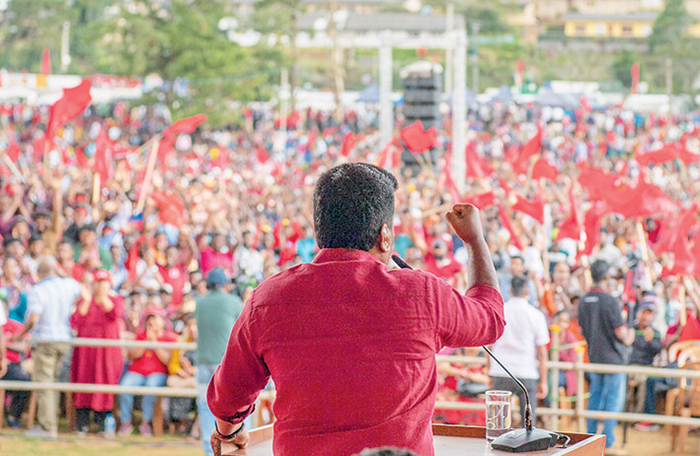
The recent high-level NPP resignations were neither spontaneous nor morally persuasive. And the fiduciary part, if at all, is yet to come. The only retribution so far is the unfortunate suicide of a former Assistant Director of the External Resources Department. That is a personal tragedy but it does not answer any of the public questions. The President’s May Day speech in Nuwara Eliya, going by its first reports, is full of fighting past misdoings, but nary a word about the current ongoings. Holding a May Day rally in Nuwara Eliya as opposed to Colombo is in itself revealing.
The President and the NPP have a strong rapport with the Malaiayaka Tamils. That is positive for the latter, but if only the President would also help them by holding the Provincial Council elections without delay. The point being, the Malaiayaka Tamils are the biggest unintended beneficiaries of the Provincial Councils. They have been able to use their restored citizenship and voting rights to directly represent themselves in the Provincial Council and the local bodies of the Central Province where they have the most numbers. The continued shutting down of the Provincial Council is depriving them again of their democratic rights. Be that as it may.
In his May Day speech President Anura Kumara Dissanayake spoke about “intensifying legal action against corruption and organized crime,” and claimed that “a series of high-profile cases are moving through the courts under strengthened state institutions.” But he made no mention of the daylight robbery going on in the economic departments of the state, and how his administration is planning to tackle that.
Digital financial fraud is a fast growing business with multiple manifestations, including information stealing and hijacking, accessing accounts, faking identities, compromising emails, and all manner of commercial scams. Even advanced countries are having their hands full in dealing with smart digital thieves. Inasmuch as the NPP government is gung ho about digitizing Sri Lanka, it should also demonstrate how it plans to measure up to emerging digital thieves in the country. Are the sleuths who seem very adept in chasing the alleged abuses like that of Ranil Wickremasinghe, as capable in tackling the more artful digital fraudsters? That is the question.
What is worrisome is the recent reported incident involving a ‘home protest’ by a political provocateur targeting the residence of the Treasury Secretary and the “shit attack” retaliation against him allegedly by government supporters. Both actions are bad and it is pointless arguing which is worse. But it is up to the government to preserve public order and decorum without provocations and retaliations. Clean Sri Lanka should have no place for public dissemination of human waste.
Whither NPP? – is a timely question and the answer to it depends on how the NPP government handles itself going forward. It is still a young government, but it also showing signs of old age that emerge when a government promises too much and delivers too little. All the scams that are now preoccupying public commentaries may not be traceable to any or all of the cabinet ministers. That has been a feature of all previous governments this century. But the NPP’s fault has been its stubbornness not to acknowledge misdoings no matter who caused them, to come clean with all the information, and to give the public the comfort that the government knows what it is doing. This has to change, but whether it will is the question.
by Rajan Philips
As the Centre for Poverty Analysis marks a quarter century of work, Sri Lanka has cause to reflect on what independent research has meant for the country’s most vulnerable communities.
In May 2001, nine professionals working on poverty-related issues in Sri Lanka came together around a shared conviction: that this country needed an institution willing to look at poverty honestly, to gather evidence that policymakers need but rarely seek, and to make sure the people most affected by poverty were never reduced to abstractions in a government report. That conviction became the Centre for Poverty Analysis, known as CEPA.
Twenty-five years later, CEPA stands as Sri Lanka’s leading independent think tank on poverty and development, with a team of thirty researchers and a portfolio that spans six thematic areas. The country it works in looks very different from the one it was founded in. Sri Lanka has lived through the end of a decades-long civil war, a tsunami that reshaped entire coastlines, a global pandemic, and the worst economic crisis since independence. Each of these upheavals changed the face of poverty in Sri Lanka. None of them changed the need to understand it.
A think tank with a point of view
CEPA is an independent, not-for-profit organisation. It does not represent any government or political interest, and from the beginning it has operated on the principle that its research must be honest regardless of who funds it.
At the heart of everything CEPA does is a belief that most people in public life share but rarely say plainly: poverty is not inevitable. It is the result of failures in policy, in systems, and in the choices made by those with the power to make different ones. It is the conviction that determines what CEPA studies, how it communicates what it finds, and who it considers its ultimate audience.
What the research has shown
When CEPA began, poverty in Sri Lanka was understood largely as a development challenge: a story of individuals and households left behind by the mainstream. Over two and a half decades, that picture has become considerably more complex. Poverty is woven into failures of policy, infrastructure, social norms, and economic systems, and addressing any one of them requires understanding all the others.
CEPA’s research spans six areas: social protection and basic services; natural resources and climate change; livelihoods, employment and migration; social cohesion and reconciliation; gender and development; and, added more recently in response to the economic crisis, growth and economic transformation. The work within each of these areas has consistently brought to light realities that were being overlooked entirely.
Research on period poverty in estate communities found that girls were losing weeks of schooling every year because of stigma and a lack of basic facilities. What looked like an individual problem turned out to be a structural one, and one with a direct cost to educational outcomes. Research on the care economy made visible the vast unpaid labour that sustains Sri Lankan households, work that never appears in economic planning because it is never counted. Work on post-war communities gave voice to people in Trincomalee, in the North and East, whose experiences of recovery looked nothing like the national narrative.
On the international stage, CEPA has worked with the Asian Development Bank, UN Women, the International Labour Organization, UNDP, the World Bank, and ODI Global, among others. It has contributed to national biodiversity and climate plans, supported the evaluation of major development programmes, and provided technical expertise across a wide range of policy areas. All of its research is published in Sinhala, Tamil, and English, a commitment to ensuring the work reaches the communities it is about.
When the crisis forced a rethink
The 2022 economic collapse changed the nature of the problem. What had long been a development story, about communities left behind by the mainstream, had become a macroeconomic one. Debt default, spiralling inflation, a collapsing currency, and economic contraction were not pushing people gradually toward poverty. They were pulling millions across the poverty line at once.
In response, CEPA deepened its focus on economic transformation and growth. In partnership with ODI Global, the organisation convened an independent growth study group whose findings were published as Sustaining Transformative Growth in Sri Lanka, 2025 to 2030, a policy roadmap for sustainable and inclusive recovery. Seminars were held at the University of Peradeniya and the University of Ruhuna to take the research to academic communities directly. The work put into sharper focus something CEPA had argued for years: that poverty cannot be addressed without addressing the economic conditions that produce it.
The conversation at twenty-five
To mark its anniversary, CEPA is hosting an International Conference on Poverty and Development in Times of Crisis on 7 and 8 May 2026 at Cinnamon Grand Colombo, in collaboration with the Asian Development Bank. Researchers, policymakers, practitioners, and scholars from Sri Lanka and the wider region will gather to ask the questions this moment demands: what does poverty mean in a world of compounding crises? What does development require when economic shocks, climate change, and geopolitical uncertainty arrive at the same time? And who bears the cost when policy fails?
Sri Lanka in 2026 is a country in recovery, but the recovery is uneven. Millions who fell into poverty during the crisis years have not yet regained their footing. The decisions being made now, on trade, social protection, investment, and climate, will determine who benefits and who continues to be left behind. These are the questions CEPA was founded to engage, and twenty-five years on, they remain as pressing as ever.
CEPA was founded in 2001 on the belief that independent, honest research is one of the most valuable contributions an institution can make to a country. Thirty people carry that work forward today. Sri Lanka has changed beyond recognition over the past quarter century, and poverty has shifted with it. The founding belief, that poverty is a failure and not a fate, has carried through every crisis, every study, and every generation of the team.
by Rebecca Jayatissa, Communications Professional – CEPA
My role in drumming up aid and investment flows following war victory
Up to now MR’s tenure had marked a commendable level of economic growth. Most countries that come out of long wars enter a period of growth since outlays on the military can be curtailed and capital and manpower can be invested in development projects. Lending agencies and investors too are more inclined to cooperate with a government that had restored peace to the land. Accordingly several highway projects, work on ports and airports, transport and power were undertaken adding to a rapid growth of GDP. At his stage there was little interference in decision making by kinsmen and political favourites which became the bane of MR’s second term leading finally to his defeat in 2015.
While my formal appointment was as the Minister of Public Administration and Home Affairs, PB Jayasundera and Lalith Weeratunga suggested to MR that my services as an interlocutor with international agencies had become necessary. Accordingly I was appointed the Deputy Minister of Finance in addition to the portfolio of Public Administration. MR summoned me to Kandy where he was holding a political meeting and administered the oath of office as his deputy. He then dispatched me the following day to Washington to act on his behalf at IMF meetings.
As de facto Minister of International Monetary Cooperation, I worked with the Secretary to the Treasury PB Jayasundera and Governer of the Central Bank Ajit Nivard Cabraal in interacting with the IMF, the World Bank and the ADB. At the same time I joined MR’s delegations on his official trips abroad which were basically attempts to draw much needed funding into the country. Among all these attempts the most important was our request to the IMF for a standby arrangement to the tune of US dollars 2.6 billion.
This called for very close interaction with the staffers of the IMF going all the way up to the Director General who at that time was Dominique Strauss Kahn, one-time Minister of Finance of France and a towering personality with strong progressive views. Unfortunately he later got embroiled in a sex scandal and had to retire. We were lucky to have a DG who could stand up to the US which still was hung up with our ethnic war issues. However I must say that the US Treasury officials we negotiated with were professionals who reported favourably about our case.
Indeed our economy was not as problematic as that of several other developing countries that they examined. In my regular visits to the US Treasury in Washington I was received with much goodwill. Even Mrs. Yellen, the powerful Treasury Secretary, was always available to meet with us and warn us about the emerging problems with interest rates. I was even given entry to their Treasury printing division where dollars are printed and packaged every day. A quaint custom there is that all Treasury employees are paid every month with newly printed dollar notes.
Why was an IMF programme so important to us at this juncture? In the first place the terms and conditions attached to repayment of the loan were concessionary. It also was a signal to the financial community that our economy was under surveillance in terms of the charter of the IMF and that investments could be made with confidence. It was also a signal to the private financial sector that it could confidently lend to us under the umbrella of the IMF.
The approval of an IMF loan which is given in tranches takes time unless political considerations, particularly of the US, leads to quick decision making. The specialist group appointed by the IMF as the study team preparing a presentation to the Board made several visits to Sri Lanka and had an office in the Central Bank. The Governor and I interacted closely with them and the IMF representative in Colombo. The first of these representatives was Anup Singh who was a great friend of mine. He later went on to head an important division of the IMF. Subsequent appointees also worked with us in a positive way and the Ministry of Finance and the IMF had excellent relations at the staff level.
The best depiction of that collaboration was the approval of the USD 2.6 billion stand by arrangement and the disbursements which began immediately. Nivard Cabraal and I had several discussions in Washington to facilitate this decision particularly with Dr. Kato the Japanese head of the Asia division. We also had the strong support of Kalpana Kochar, the head of the South Asia division. The IMF deal coming soon after ending the northern war constituted a strong signal from the global community that we were back in their good books. When I informed MR of the IMF decision he was delighted. He added however that he knew it would turn out that way all along. I was flabbergasted when he told me that he had a “mole” who was a minor employee in Strauss Kahn’s cabinet who was from “down south” in Sri Lanka. She had kept him informed of the progress of our application.
Presidential election 2010
The presidential election was due to be held in late 2011. However on November 23, 2009 MR announced that the election will be held on January 26, 2010. He decided to go to the polls before the expiry of his full term to capitalize on his popularity. At the same time he did not want to give his opponent time to find his feet in the new political environment.
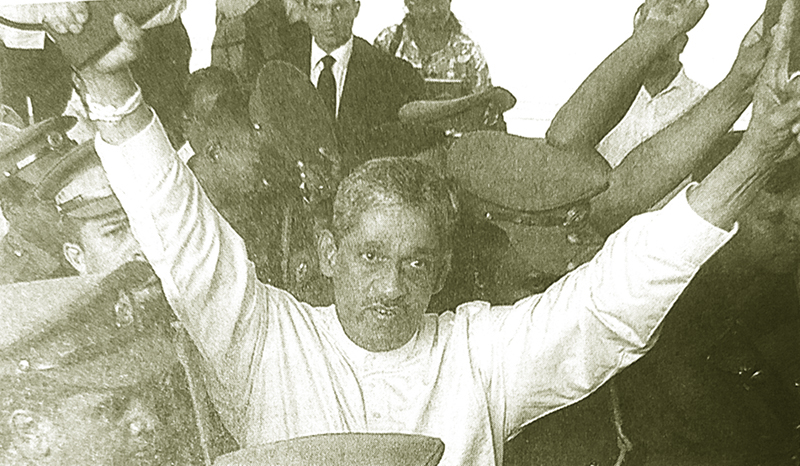
The two main contenders were incumbent President Mahinda Rajapaksa and his former Army Commander Sarath Fonseka. Fonseka who believed that he had been willfully sidelined by the Rajapaksas accepted the offer of the Opposition parties to be their “common candidate”. He resigned from his post of CDS and entered the fray under the “swan” symbol which then received the endorsement of the UNP, JVP and the minority parties. It is significant that even the Tamil parties preferred him to MR.
It was a bitterly fought election though MR had the benefit of incumbency, heavy financing and a reputation as a leader who had ended the fratricidal war. Both parties undertook a publicity contest which was unique in our electoral history. MR and his party had the advantage of emerging victorious in a local council election which was held soon after the war was won. This gave him the confidence that the party machinery was well oiled. He was contesting an election in which he was the firm favourite notwithstanding the fact that SF was the best possible choice for the Opposition under the prevailing circumstances.
Election campaign
This election campaign saw the most vicious contest between two antagonists who had been close to each other earlier. Both had a sense of betrayal by the other after collaborating to achieve a victory over the LTTE which many had thought impossible. Mahinda had tried to woo SF but when he failed he unleashed a “no holds barred” attack on his former commander. Even at the start of the campaign an attempt was made to deny SF a large building in the heart of Colombo for his headquarters. A relative of SF’s wife who had a hotel and a conference hall came to his rescue. The benefactor was earmarked for retribution by the Rajapaksa juggernaut which was being managed by MRs children who were now overseeing the fathers election campaign.
I was invited to be present when several advertising companies were asked to make a pitch for the well funded effort of the MR camp. Decisions taken by family members could not be challenged even though Namal tried his best to balance the discussion and prevent the professional advertising personnel from walking out. SFs campaign was underpinned by the UNP but half way through they lost the initiative because it appeared that their leader Ranil was afraid of promoting a new leader who would take the limelight away from him. Minority parties and the JVP on the other hand worked hard for SF and carried the brunt of the campaign. But they were no match for the well oiled political machine of the Rajapaksas who were riding a wave of popularity after winning the Northern war.
The animus that prevailed in this campaign was best seen in the manner of the physical violence unleashed on SF and his top staff after the results were announced. They had taken refuge in a hotel after the announcement of the results to avoid revenge attacks. It did not succeed. An army officer who had a personal grudge against SF was detailed to harass his former chief in a shameful manner. The UNP did not fight back and it was left to Hakeem the Muslim Congress leader, to protest this behaviour which was unprecedented in our political history.
This was clearly not MRs initiative since he had always taken the ups and downs of politics in his stride. But this episode created such a bad impression that Maithripala Sirisena who contested MR in the next Presidential election said publicly that he was afraid that if he lost the election he would have been six feet under. He was in hiding in Kurunegala when the election result in which he was declared the winner was announced. SF was charged in court soon after and sentenced to hard labour. This was the first time that a political rival of national stature had been subjected to such a savage act of revenge.
The result
The final result was a comfortable victory for MR though his challenger had performed better than anticipated by many observers. The final turnout was of 10,495,451 voters or 74.5 percent of the 14,088,500 registered voters. This was a high percentage testifying to the keen interest that was evoked by this Presidential election which was first held after the Northern victory. The result was as follows;
Mahinda Rajapaksa [SLFP] 6,015,934 [57.88 percent] Sarath Fonseka [NDF] 4,173,185 [40.15 percent]
MR had cleared the 50 percent barrier very comfortably unlike in 2005 when he barely managed to avoid a second count. What was seen very clearly from the results was that MR had swept the polls in all the districts save in the Northern and Eastern provinces which went solidly to SF The only exception was the district of Nuwara Eliya which though in the Central Province has a multi-ethnic composition. It is also to be noted that SF fared well in Colombo and other urbanized areas which were won with a comparatively smaller majority by MR.
Parliamentary election 2010
MR has always been unafraid of elections. This time around he was keen to go to the Parliamentary polls early as he was sure of a resounding victory. I had earlier decided that I would not contest because I would be reaching the age of 71 at the time of election and 76 by the close of that Parliament. Another important consideration was that my nephew Dilum was the SLFP organizer for Senkadagala and would contest that seat at the forthcoming election. It would be unwise and unseemly for two Amunugamas to contest from the same party in the same district.
I had planned to retire and campaign for Dilum who would have a longer tenure. If by my entering the fray Dilum was left out it would be a pity in terms of the long time plans of the party and of my nephew. I had therefore informed MR that had no intention of contesting the elections of 2010. MR had however told my friend Nimal Siripala de Silva that he would like to have me as a nominated MP. This was mainly because three of his closest advisors – PB Jayasundera, Lalith Weeratunga and especially Sunimal Fernando – had prevailed upon him to allocate the post of Minister of Education in his forthcoming Cabinet to me. They had a blueprint for educational reform and wanted me to steer it in the coming years. Such was the understanding when one evening I received a telephone call from MR asking me to come immediately to Temple Trees. I went there to find him in earnest conversation with DM Jayaratne and Anuruddha Ratwatte. All three asked me to change my mind and lead the SLFP team in the forthcoming election.
MR said that earlier he had agreed to Jayaratne’s request to contest the election as the district leader of the SLFP. But he had later backed out of this arrangement as his children had pleaded with him not to enter the fray. He had said that his daughter had fallen at his feet and prayed that he should withdraw. MR had then consulted Anuruddha who also had declined saying that his son Lohan wished to contest in his stead. I replied that I too had a similar problem since my nephew Dilum was contesting the Senkadagala seat.
However they all unanimously said that this problem could be overlooked in view of the fact that the Mahanayakas had specifically requested that I should be made the Kandy leader. They all piously assured the President that they would canvass for me and said that I should not let down the party at this juncture. MR added that the Rajapaksas – Chamal and Namal – were contesting from Hambantota district and that too was an uncle-nephew combination. So I agreed to this request from the three senior most members of the party and went back home to plan an election campaign which I had not envisaged even a day before. I had to rewind my electoral machine and plan a campaign in which my main concern was to ensure that Dilum will not be left behind in the rat race.
Notwithstanding MRs assurances it was not easy for two members from the same family to win an election in which the party could win only seven or eight seats from the district. This was especially so because the minorities tend to vote with the UNP in Kandy. Only a few families could boast of having their members elected simultaneously to Parliament. To the best of my knowledge only TB Ilangaratne and his wife Tamara were elected together in Kandy district [in 1970] In 1977 they were both defeated.
Furthermore Kandy had a reputation for rejecting its leaders who had a national profile. Thus George E de Silva A. Ratnayake, Illangaratne and Kobbekaduwa had tasted defeat at varying times. Both Anuruddha and Jayaratne had opted out when their progeny – Lohan and Anuradha insisted on contesting the 2010 election. In Ratnapura district when Pavithra Wanniarachchi and her father contested the latter fared badly in the polls and could not enter Parliament. I was aware of the risk that I was taking especially when I found that both seniors who were keen to have me contest suddenly turned lukewarm as they were eyeing a seat as nominated MPs.
My victory and entry Into the cabinet would reduce their chances. In fact after my victory to which Anuruddha contributed little, he was dropped by MR from the national list which in effect meant the end of his political career. Jayaratne was nominated instead and he held cabinet office till he fell badly ill and was incapacitated.
The contest in Kandy
It was a difficult contest because one candidate who had not done well in earlier elections played the caste card in a disgraceful manner. He also used goon squads to intimidate voters, particularly the large number of estate workers who would usually have voted as dictated by their party – the CWC. Mano Ganesan – MP from Colombo, who attempted to establish a base of voters among the Tamil community, was not allowed to campaign in this electorate due to thuggery and he had to get back to his Colombo constituency. Violence was directed also at other candidates who however had enough to do in other electorates and tended to avoid their tormentor. But his violent behaviour reached its peak on election day when goons invaded the booths that did not favour him and began stuffing ballot boxes. Since he had ensured that subservient police officers were attached to his electorate they looked on while the mayhem continued.
Not only the agents of other candidates but also the public servants who manned the booths complained to me as the district party leader about such unlawful behaviour. I therefore contacted the Elections Commissioner Dissanayake and requested him to annul the result in the booths where the Returning Officers had indicated that there was foul play. Dissanayake immediately held an inquiry and withheld the results of about twelve booths in that electorate which had been tampered with. This decision sent shock waves in the country.
MR was furious with this errant candidate as he had taken the shine off a splendid victory that he and his party had achieved. The Elections Commissioner had fixed a new date for a poll in those contested voting centres and we had to get back to electioneering. This cancellation of a poll was unprecedented and drew national attention to the misdemeanours of that candidate who had up to then got away with his violent tactics. Several editorials and cartoons appeared in the press which severely embarrassed the party.
After I informed MR and Gotabaya of this situation they authorized the army to set up a camp in the heart of the town to ensure a peacefull poll. I was allocated a squad of armed soldiers as there was a threat to my life. I took up residence in an estate bungalow belonging to my friend Irvin Weerakkody and directed operations from there. A large number of people who had been intimidated by this candidate came to me, some in the secrecy of the night, to pledge support. I was particularly touched when “Tambi” Thondaman telephoned me to say that MR had spoken to him and that he was instructing his local organization to back me in the forthcoming poll.
All this was helpful for me to gather a sufficient number of votes from the Nawalapitiya electorate which ensured that both Dilum and I would enter Parliament. Special mention must be made of my supporters from Galagedera, Kandy and Senkadagala who came to Nawalpitiya by bus, car, motor cycle and train to go house to house canvassing and thwart the efforts of the local candidate to keep us out of the winners list. He was crestfallen and later apologized to me in Parliament in the presence of several party leaders. Needless to say MR was not pleased at these developments which detracted from his outstanding Parliamentary victory.
(The Sarath Amunugama autobiography is available at the Vijitha Yapa Bookshop)
(Excerpted from volume 3 of the Sarath Amunugama autobiography)

Zalmi favourites in final but Kingsmen arrive with odds-defying juju
Showers will occur at several places in the Western, Sabaragamuwa, Central, North-western, North-central and Eastern provinces and in Badulla, Galle and Matara districts after 2.00 pm.

Easter Sunday Case: Ex-SIS Chief concealed intel, former Defence Secy tells court

NCPA gets up to seven child violence complaints daily

AKD’s May Day vow: Crackdown looms as corrupt face day of reckoning

Israel, Lanka hold talks on strengthening bilateral cooperation

‘Dates have the highest sugar content to fight Coronavirus’

Sunday Island 27 December – Headlines

#SundayIsland 17th December – Headlines

Sunday Island – 28th March

Sunday Island Headlines – 21 March

Sunday Island – 21st February – Headlines
-
 News5 days ago
Treasury chief’s citizenship details sought from Australia
-

 News7 days ago
BIA drug bust: 25 monks including three masterminds arrested
-

 News4 days ago
Rooftop Solar at Crossroads as Sri Lanka Shifts to Distributed Energy Future
-

 News7 days ago
Banks alert customers to phishing attacks
-
 News6 days ago
Govt. assures UN of readiness to introduce ‘vetting process’ for troops on overseas missions
-
 News3 days ago
“Three-in-one blood pressure pill can significantly reduce risk of recurrent strokes”
-

 Business6 days ago
ADB-backed grid upgrade tender signals next phase of Sri Lanka’s energy transition
-

 News5 days ago
Central Province one before last in AL results