
Features
How Hamas built a force to attack Israel on 7 October

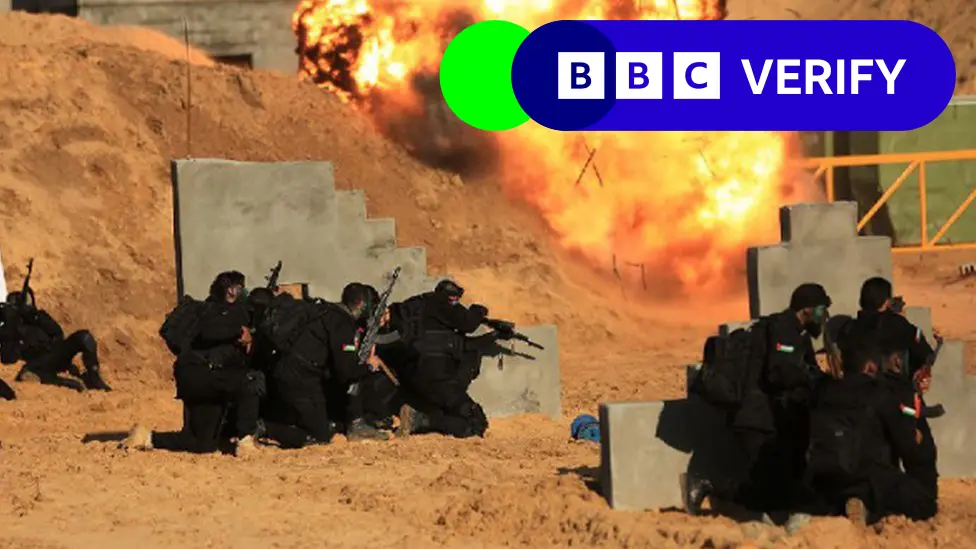
Five armed Palestinian groups joined Hamas in the deadly 7 October attack on Israel after training together in military-style exercises from 2020 onwards, BBC News analysis shows.
The groups carried out joint drills in Gaza which closely resembled the tactics used during the deadly assault – including at a site less than 1km (0.6 miles) from the barrier with Israel – and posted them on social media.
They practised hostage-taking, raiding compounds and breaching Israel’s defences during these exercises, the last of which was held just 25 days before the attack.
BBC Arabic and BBC Verify have collated evidence which shows how Hamas brought together Gaza’s factions to hone their combat methods – and ultimately execute a raid into Israel which has plunged the region into war.
‘A sign of unity’
On 29 December 2020, Hamas’s overall leader Ismail Haniyeh declared the first of four drills codenamed Strong Pillar a “strong message and a sign of unity” between Gaza’s various armed factions.
As the most powerful of Gaza’s armed groups, Hamas was the dominant force in a coalition which brought together 10 other Palestinian factions in a war games-style exercise overseen by a “joint operation room”.
Prior to 2018, Hamas had formally coordinated with Palestinian Islamic Jihad (PIJ), Gaza’s second largest armed faction and – like Hamas – a proscribed terrorist organisation in the UK and other countries.
Hamas had also fought alongside other groups in previous conflicts, but the 2020 drill was billed in propaganda as evidence a wider array of groups were being unified.
Hamas’s leader said the first drill reflected the “permanent readiness” of the armed factions.
The 2020 exercise was the first of four joint drills held over three years, each of which was documented in polished videos posted on public social media channels.
The BBC has visually identified 10 groups, including PIJ, by their distinctive headbands and emblems training alongside Hamas during the Strong Pillar drills in footage posted on the messaging app Telegram.
Following the 7 October attack, five of the groups went on to post videos claiming to show them taking part in the assault. Three others issued written statements on Telegram claiming to have participated.
The role of these groups has come into sharp focus as pressure builds on Hamas to find dozens of women and children believed to have been taken as captives from Israel into Gaza by other factions on 7 October. Three groups – PIJ, the Mujahideen Brigades and Al-Nasser Salah al-Deen Brigades – claim to have seized Israeli hostages on that day.
Efforts to extend the temporary truce in Gaza were said to be hinging on Hamas locating those hostages. The structure was set up in 2018 to coordinate Gaza’s armed factions under a central command.

While these groups are drawn from a broad ideological spectrum ranging from hard-line Islamist to relatively secular, all shared a willingness to use violence against Israel.
Hamas statements repeatedly stressed the theme of unity between Gaza’s disparate armed groups. The group suggested they were equal partners in the joint drills, whilst it continued to play a leading role in the plans to attack Israel. Footage from the first drill shows masked commanders in a bunker appearing to conduct the exercise, and begins with a volley of rocket fire.
It cuts to heavily armed fighters overrunning a mocked-up tank marked with an Israeli flag, detaining a crew member and dragging him away as a prisoner, as well as raiding buildings.
We know from videos and harrowing witness statements that both tactics were used to capture soldiers and target civilians on 7 October, when around 1,200 people were killed and an estimated 240 hostages were taken.
Telling the world
The second Strong Pillar drill was held almost exactly one year later.
Ayman Nofal, a commander in the Izzedine al-Qassam Brigades – the official name for Hamas’s armed wing – said the aim of the exercise on 26 December 2021 was to “affirm the unity of the resistance factions”.
He said the drills would “tell the enemy that the walls and engineering measures on the borders of Gaza will not protect them”.
Another Hamas statement said the “joint military manoeuvres” were designed to “simulate the liberation of settlements near Gaza” – which is how the group refers to Israeli communities.
The exercise was repeated on 28 December 2022, and propaganda images of fighters practising clearing buildings and overrunning tanks in what appears to be a replica of a military base were published to mark the event.

The exercises were reported on in Israel, so it’s inconceivable they were not being closely monitored by the country’s extensive intelligence agencies.
The Israel Defense Forces (IDF) have previously carried out air strikes to disrupt Hamas’s training activities. In April 2023, they bombed the site used for the first Strong Pillar drill.
Weeks before the attacks, female surveillance soldiers near the Gaza border reportedly warned of unusually high drone activity and that Hamas was training to take over observation posts with replicas of their positions.
But, according to reports in the Israeli media, they say they were ignored. Brigadier General Amir Avivi, a former IDF deputy commander in Gaza, told the BBC: “There was a lot of intelligence that they were doing this training – after all, the videos are public, and this was happening just hundreds of metres from the fence (with Israel).”
But he said while the military knew about the drills, they “didn’t see what they were training for”.
The IDF said they “eliminated” Nofal on 17 October 2023, the first senior Hamas military leader to be killed during the conflict.

Hiding in plain sight
Hamas went to great lengths to make sure the drills were realistic.
In 2022, fighters practised storming a mock Israeli military base built just 2.6km (1.6 miles) from the Erez crossing, a route between Gaza and Israel controlled by the IDF.
BBC Verify has pinpointed the site in the far north of Gaza, just 800m (0.5 miles) from the barrier, by matching geographic features seen in the training footage to aerial images of the area. As of November 2023, the site was still visible on Bing Maps.
The training camp was within 1.6km (1 mile) of an Israeli observation tower and an elevated observation box, elements in a security barrier Israel has spent hundreds of millions of dollars constructing.

The mock base is on land dug several metres below ground level, so it may not have been immediately visible to any nearby Israeli patrols – but the smoke rising from the explosions surely would have been, and the IDF is known to use aerial surveillance.
Hamas used this site to practise storming buildings, taking hostages at gunpoint and destroying security barriers.
BBC Verify has used publicly available information – including satellite imagery – to locate 14 training sites at nine different locations across Gaza.
They even trained twice at a site less than 1.6 km (1 mile) from the United Nations’ aid agency distribution centre, and which was visible in the background of an official video published by the agency in December 2022.

Land, sea and air
On 10 September 2023, the so-called joint committee room published images on its dedicated Telegram channel of men in military uniforms carrying out surveillance of military installations along the Gaza barrier.
Two days later, the fourth Strong Pillar military exercise was staged, and by 7 October, all the tactics that would be deployed in the unprecedented attack had been rehearsed.
Fighters were filmed riding in the same type of white Toyota pickup trucks which were seen roaming through southern Israel the following month.
The propaganda video shows gunmen raiding mock buildings and firing at dummy targets inside, as well as training to storm a beach using a boat and underwater divers. Israel has said it repelled attempted Hamas boat landings on its shores on 7 October.

However, Hamas did not publicise its training with motorcycles and paragliders as part of the Strong Pillar propaganda.
A training video posted by Hamas three days after 7 October shows fences and barriers being demolished to allow motorcycles to pass through, a tactic they used to reach communities in southern Israel. We have not identified similar earlier videos.
Footage of fighters using paragliding equipment was also not published until the 7 October attack was under way.
In a training video shared on the day of the attack, gunmen are seen landing in a mock kibbutz at an airstrip we have located to a site north of Rafah in southern Gaza.
BBC Verify established it was recorded some time before 25 August 2022, and was stored in a computer file titled Eagle Squadron, the name Hamas uses for its aerial division – suggesting the paragliders plan was in the works for over a year.

The element of surprise
Before 7 October, Hamas was thought to have about 30,000 fighters in the Gaza Strip, according to reports quoting IDF commanders. It was also thought that Hamas could draw on several thousands of fighters from smaller groups.
Hamas is by far the most powerful of the Palestinian armed groups, even without the support of other factions – suggesting its interest in galvanising the factions was driven by an attempt to secure broad support within Gaza at least as much as bolstering its own numbers.
The IDF has previously estimated 1,500 fighters joined the 7 October raids. The Times of Israel reported earlier this month the IDF now believes the number was closer to 3,000.
Whatever the true number, it means only a relatively small fraction of the total number of armed operatives in Gaza took part. It is not possible to verify precise numbers for how many fighters from smaller groups took part in the attack or the Strong Pillar drills.
While Hamas was building cross-faction support in the build-up to the attack, Hisham Jaber, a former Brigadier General in the Lebanese army who is now a security analyst at the Middle East Centre for Studies and Research, said he believed only Hamas was aware of the ultimate plan, and it was “probable they]asked other factions to join on the day”.
Andreas Krieg, a senior lecturer in security studies at Kings College London, told the BBC: “While there was centralised planning, execution was de-centralised, with each squad operationalising the plan as they saw fit.”
He said he had spoken to people inside Hamas who were surprised by the weakness of Israel’s defences, and assessed militants likely bypassed Israel’s surveillance technology by communicating offline.
Hugh Lovatt, a Middle East analyst at the European Council on Foreign Relations, said Israel would have been aware of the joint training drills but “reached the wrong conclusion”, assessing they amounted to the “standard” activity of paramilitary groups in the Palestinian territories, rather than being “indicative of a looming large-scale attack”.
Asked about the issues raised in this article, the Israel Defense Forces said it was “currently focused on eliminating the threat from the terrorist organisation Hamas” and questions about any potential failures “will be looked into in a later stage”.
It could be several years until Israel formally reckons with whether it missed opportunities to prevent the 7 October massacre. The ramifications for its military, intelligence services and government could be seismic.
(BBC)








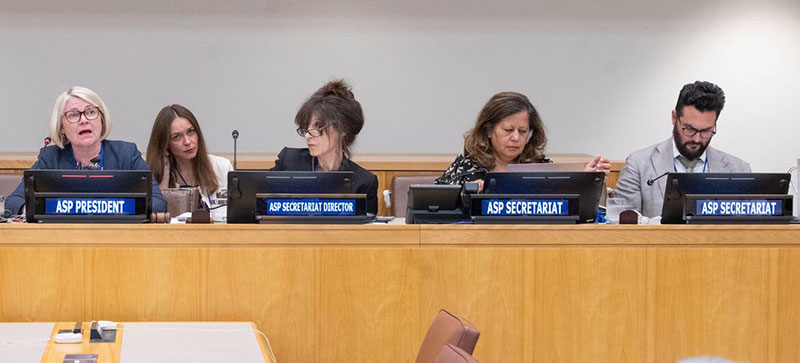
 US Secretary of State Marco Rubio’s warning to the International Criminal Court (ICC) was stark: ‘Either the ICC will end its threats, or we will end the ICC.’ It followed US central administration accusations that the court was unfairly targeting Americans on the basis of trumped-up war crimes charges.
However, a new plethora of sanctions has been clamped on the ICC by the US, which in turn has spurred accusations by sections of the world that the latter has unleashed an ‘assault’ on the international legal order.
What some of the sanctions would mean for the ICC was outlined by Rubio: ‘We will ban transactions with this rogue court, cutting off their resources and crippling their ability to operate against us.’
The ICC has shown consistency of purpose over the years. Despite some operational constraints it has indicted a large number of political strongmen from around the world, accused of war crimes and other governance excesses that come under its purview. Two such recent figures are: Russian President Vladimir Putin and Israeli Prime Minister Benjamin Netanyahu.
Rather than enjoy a mere nominal presence in the world community, the ICC has proved its effectiveness by detaining and bringing to justice scores of VIP politicians and others of their ilk who have been found guilty of human rights abuses and kindred excesses that come within the terms of reference of the ICC.
Accordingly, the international justice system would be stymied considerably as a result of the ICC being dis-empowered, particularly financially. Needless to say, potential and real perpetrators of the species of crime coming under the jurisdiction of the ICC would stand to gain most from such anarchic tendencies. That is, political repression globally would be enabled to enjoy a new lease of life.
A detailing of the types of crime coming under the purview of the ICC provides an idea of what it would cost the international community if the ICC’s operations are gravely hampered. They are mainly: genocide, war crimes, crimes against humanity and the crime of aggression.
That is, the part of the world to be worst affected would be the global South, since the latter is awash with the mentioned crimes. Needless to say, a chronically-disaffected South will sooner rather than later undermine the well being of the world dangerously. The world is already being put through these paces.
At the time of writing, ‘illegal migrants’ from the South, for example, are aggravating many a Western economy’s woes, besides creating for them acute law and order issues. The fact that these migrants’ presence goes on to become a virtual test of the migrant receiving states’ ability to forge domestic social inclusion in the face of jingoistic protests by mainly white supremacist groups is evidence of the latter. As is known, the US, to take just one example, has been up against this crisis for quite a while.
Accordingly, it will be in the best interests of the West if ‘illegal’ migrant arrivals on their shores are stemmed. If the socio-political and economic problems assailing the South are effectively managed through North-South collaborative, ‘trouble-shooting’ efforts the causes leading to ‘illegal’ migration and connected issues could be resolved at source as it were. For, it is the aggravation of the South’s material questions that lays the basis for the emergence of repressive and anti-democratic regimes in the hemisphere.
Until such time that the aforementioned issues in North-South relations are visited afresh and addressed urgently, a vibrantly functioning ICC would be needed. For, the latter would prove a deterrent to Southern political and military strongmen, highly prone to power abuse and like excesses, from coming into being in the wake of the South’s chronic material woes and the wars and conflicts that result from them.
It stands to reason then that the US would be acting in its own interests by enabling the ICC to perpetuate its mandate without hindrance. For a crop of issues that impinges negatively on internal law and order would be defused.
Meanwhile, there needs to be a meeting of minds among the rest of the West to put back in place a North-South dialogue process aimed at reducing some of the economic pressures that are weighing on the South.
Since economics usually drives politics it will be in the interests of the world community to scrutinizingly re-visit North-South issues of the past and put in place economic relief packages for Southern publics that would enable them to tide over their material hardships rather than permit the latter to aggravate into social disaffection and eventually armed militancy. It is the latter juncture that paves the way for the emergence of authoritarian rulers in the South who then go on to be a blight on their publics.
Accordingly, the Southern-based global development thinking of the past that envisaged a more equitable world economic order needs to be seen as an urgent need. That is, NAM’s international development paradigms need to be resuscitated to the extent possible.
It is unlikely that rightist governments of the West, such as the current Republican administration in the US, would find these projects feasible, but democratic states of Europe, led by perhaps the UK, are likely to think otherwise. For it would not be beneficial for the democratic world to be having on their hands repressive governments in the South who would be gravitating towards the major military and economic actors of the South, such as Iran and North Korea, who tend to be in constant power struggles with the West.
However, until such time that the mentioned, pro-people initiatives are given serious thought the ICC would need to be enabled by the international community to be in place comfortably and carry on with its mandate of bringing repressive rulers to book. Besides the ICC should pave the way for the peoples of the developing world to enjoy some substantial respite from the political repression and even terror which tend to be their lot.
Meanwhile, the wars of West Asia are relentlessly aggravating the economic hardships of people everywhere, driving the point home to enlightened sections that there is no alternative to peacemaking. A challenge is to convert the US under President Trump to this line of thinking.

 This week, I give you five simple, time-tested homemade remedies that help reduce the appearance of blemishes, control excess shine and leave your skin feeling softer and smoother.
The Honey and Lemon Brightening Dab:
For stubborn blemish marks, this is a classic. Mix one teaspoon of pure bee honey with three to four drops of fresh lemon juice. Apply gently, only on the affected spots, and leave for 10 minutes before rinsing with lukewarm water. While honey soothes and softens, lemon helps to brighten naturally. Use twice a week in the evening.
Besan and Rose Water Oil-Control Pack:
An ideal remedy to combat shine, especially on the T-zone. Take two teaspoons of besan (gram flour) and mix with sufficient rose water to form a smooth paste. Add a pinch of turmeric for its antiseptic goodness. Apply evenly, keep for 15 minutes and wash off. It absorbs excess oil without over-drying, leaving a beautiful matte finish.
Aloe Vera and Cucumber Ice Soother:
Blend fresh aloe vera gel with the juice of a grated cucumber and freeze the mixture in an ice tray. Each morning, wrap one cube in a soft muslin cloth and gently rub over a cleansed face for 30 seconds. It calms, tightens pores and imparts a baby-soft smoothness.
Oatmeal and Curd Gentle Polish:
Roughness and old blemish marks need gentle exfoliation. Combine one tablespoon of finely powdered oatmeal with one tablespoon of fresh curd (yoghurt). Massage very gently, in circular motions, for one minute, leave for five minutes and rinse. It removes dead cells and unveils softer, clearer skin.
Multani Mitti and Green Tea Magic Mask:
Brew some green tea and allow it to cool completely. Mix one and a half teaspoons of Multani Mitti (Fuller’s Earth) with the tea water to make a fine paste. Apply for 10 to 12 minutes – do not let it dry and crack completely – and wash off. It draws out impurities, fades blemishes and bestows a fresh, shine-free glow.
A Gentle Reminder:
As with any natural remedy, always do a patch test on your inner arm first. For those with oily or combination skin, avoid heavy coconut oil application and harsh scrubbing, as they tend to aggravate shine and blemishes.

 Dream of performing on a world stage? Well, here is your unique, golden opportunity!
The World Championships of Performing Arts (WCOPA) — the one and only official “Talent Olympics” — is the world’s premier global platform for aspiring singers, dancers, actors, models, instrumentalists, etc., to compete, shine and be discovered!
And, yes, this world stage is open to YOU, Sri Lankans living in Sri Lanka and overseas!
Held annually in glittering Las Vegas, WCOPA brings together over 70 countries, all competing for Gold, Silver and Bronze Medals, just like the traditional Olympics.

Lakisha Bernard: Will represent Team Sri Lanka at WCOPA 2027
Outstanding performers vie for the coveted titles of Junior and Senior Grand Champion Performer of the World, with winners and standout participants awarded over $500,000 in scholarships, cash awards and prizes to catapult their education and careers!
Sri Lanka is already making waves! At WCOPA 2026, Natharie Wickramasinghe, representing Team Sri Lanka, made the nation proud by winning a Bronze Medal in the Ethnic/Folklore Dance category!

Lakisha: Accomplished freelance Model and Fashion Design graduate
Recruitment for this prestigious competition is handled through a system of scouts and licensed National Directors — and this is where our very own Chris Rajendra, now based in Las Vegas, and National Director for Team Sri Lanka, comes into the scene.
If you are a singer, dancer, actor, model, instrumentalist — if you have talent burning inside you — contact Chris Rajendra today for registration and, who knows, you may find yourself in Las Vegas, and proudly draped in the Sri Lankan flag, at WCOPA 2027!
The contact address is: Chris Rajendra, wcopa.nationaldirector.sl@gmail.com
or chris.rajendra@gmail.com
Meanwhile, a star is born for 2027, in the form of Lakisha Bernard who is all set to represent Team Sri Lanka at WCOPA 2027.
Originally hailing from the sun-drenched coastal city of Colombo and now carving out her creative career in Canada, 22-year-old Lakisha is stepping into the international spotlight.
This accomplished freelance Model and Fashion Design graduate has officially been appointed as the Team Sri Lanka Promoter for Canada as she prepares to represent Team Sri Lanka at WCOPA in Las Vegas.
Lakisha brings a unique blend of high-fashion sensibility, captivating camera presence and expert garment design to the Team.
Having built her career, from local college shoots to high-glamour concepts, Lakisha’s inspiring journey embodies the true spirit of cultural bridge-building and creative resilience, bringing immense pride and recognition to Sri Lanka on the global stage.
WCOPA 2027 will be held at the legendary Westgate Hotel & Casino, Las Vegas, from 12th to 20th July – the very same iconic arena where the late, great Elvis Presley himself performed!
Your moment is now. Your stage is Las Vegas, so hurry and contact Chris Rajendra.

Showers or thundershowers will occur at most parts of the island

Prison rules to be revised over monks’ attire

AC President recuses himself from hearing prison attire case pertaining to Gnanasara Thera

Court orders steps to obtain INTERPOL Red Notice against Basil

CID informs Fort Magistrate’s Court investigation into money laundering case against Namal completed

No force used to make Gnanasara Thera wear prison garb – Prisons

‘Dates have the highest sugar content to fight Coronavirus’

Sunday Island 27 December – Headlines

#SundayIsland 17th December – Headlines

Sunday Island – 28th March

Sunday Island Headlines – 21 March

Sunday Island – 21st February – Headlines
-

 News6 days ago
NDB fraud Rs 60mn more than reported
-

 News6 days ago
Removing monk’s robes matter for Sangha to decide: Mahanayake Theras
-

 News4 days ago
Sri Lanka escalates anti-graft drive with Shiranthi’s jailing
-

 News5 days ago
NPP govt. reminded of its responsibilities as US warship leaves Colombo
-
 Latest News5 days ago
Farhan, Sadaqat help Pakistan ace 183 chase to go 1-0 up
-
 News6 days ago
BHC, Colombo: “LTTE remains a proscribed org. in the UK”
-

 Latest News3 days ago
Farhan and Sadaqat help Pakistan seal series in style
-

 News4 days ago
Iranian ships stranded, Lanka fears US sanctions