
Latest News
South Africa go top as New Zealand slump to third straight defeat


One of the advantages of a long-drawn league phase is that teams have an opportunity to make up for indifferent starts. But New Zealand are finding out the converse can be true as well. A third straight loss amid a series of injuries in the camp threatens to throw their World Cup campaign off the rails.
If the loss to Australia in Dharamsala was heartbreaking, this one to South Africa in Pune was outright demoralising. The bowlers were sent on a leather hunt as Quinton de Kock and Rassie van der Dussen plundered centuries, and David Miller added more salt to the wounds with a blistering 30-ball 53 not out as South Africa posted 357 for 4; the last 10 overs alone brought them 119 runs.
In reply, New Zealand’s top order unraveled against South Africa’s quality pace attack under lights. Marco Jasen’s extra bounce accounted for Devon Conway and Rachin Ravindra, Will Young was out nicking behind off Gerald Coetzee, and Kagiso Rabada had Tom Latham chipping one to cover.
Daryl Mitchell kept hope flickering, oozing class and confidence as he played a couple of gorgeous on-drives, but his dismissal while looking to hit out against Keshav Maharaj in the 19th over opened the floodgates. The game became staggeringly one-sided as New Zealand petered to 167 all out, with only Glenn Phillips offering any resistance to make 60.
The defeat, and the quantum of it, was massive from a tournament’s standpoint, with New Zealand now slipping back to potentially enter a logjam for fourth place, which Pakistan, Afghanistan and Sri Lanka are all eyeing. Few would have expected New Zealand to cave in the manner they did, even after South Africa had set them 358.
New Zealand’s capitulation was a sharp contrast to how things panned out for South Africa after they were put into bat.
Temba Bavuma was the early aggressor, crunching two cover drives off Matt Henry in the fourth over to kick the innings into gear. De Kock was largely subdued and fidgety early on, and even copped a blow to the shoulder from a Trent Boult bouncer in the ninth over. At that point, South Africa’s innings had barely gotten out of second gear. Having roughed up de Kock, Boult had sent Bavuma back with a sucker ball, a full one that had him nicking low to Mitchell at slip.
It could have been wickets in back-to-back overs for New Zealand had Phillips latched on to a screamer at backward point off Tim Southee. That we’re even talking about it being a chance was down to his brilliance – anticipating de Kock’s cut and taking two steps to his right before flinging himself full-stretch to go one-handed. De Kock was on 12 off 24 at that point.
At the other end, van der Dussen helped himself to a pull to begin proceedings as Southee, coming in for the first game of his fourth World Cup, seemed erratic and down on pace to begin with. For much of the first 100 runs in their 200-run stand, de Kock and van der Dussen were steady and calculating, playing themselves into a position from which they could tee off in the back 15. It’s a plan that worked to the T for them, and perhaps much more easily than they may have anticipated because New Zealand had a massive hole to fill midway through.
Henry pulled his hamstring halfway through his sixth over, the 27th of the innings, to leave Ravindra, James Neesham and Phillips to bowl 14.3 overs between them. De Kock and van der Dussen accelerated knowing fully well that New Zealand needed to back-load their part-timers.
The first sign of de Kock breaking the shackles came in the 16th over when he got stuck into Southee. He followed an imperious pull in front of square for four by walloping a six over the bowler’s head. De Kock had another slice of luck soon after when he chipped Phillips into the leg side, with the ball falling between three fielders. De Kock soon brought up his half-century off 62 deliveries and van der Dussen followed suit, getting there off 61.
New Zealand’s cup of woe was far from over. Neesham, one of the part-timers called on to make up overs, suffered a blow of his own when he was struck flush on the thumb by a de Kock straight drive. On 95, de Kock should have been run out off the same delivery when he was sent back even as the ball deflected to Mitchell Santner at cover. The batter had given up hope when Santner fired a throw at the bowler’s end, but it missed the stumps. De Kock soon brought up his hundred – his fourth of this World Cup, which left him one behind Rohit Sharma’s record of five in a single edition – by getting inside the line and helping a pull deep beyond the fine leg fence for six. He reached the century off 103 balls, and seemed to be revving up for a big finish.
At the other end, the industrious van der Dussen brought out cute reverse paddles and sweeps to throw New Zealand’s spinners off gear. The second-wicket pair had added 200 at better than a run-a-ball when de Kock picked out point to give Southee a wicket in the 40th over. It’s at this point that South Africa pulled out a surprise move, pushing Miller up the order, seemingly to keep the left-right combination going, and he tore into the bowling at the death to get to his half-century in 29 balls. Neesham went for 69 off his 5.3 overs, and conceded 18 in the 50th.
While New Zealand walked off knowing they had a big chase, there was a sense that the game was still in the balance given how well they had batted in big chases against England and Australia. But their hopes were dashed by a South African attack that made you wonder if this was the same surface New Zealand had bowled on.
After the top order was blown away, Phillips delayed the inevitable, getting in some batting time amid a lower-order collapse. By the end, New Zealand were so desperate to minimise the damage to their net run rate that an injured Henry hobbled out to bat and gave Phillips company for 5.1 overs, in the process adding 34 for the final wicket. However, even that didn’t quite diminish the magnitude of the defeat, which, all told, was a proper pasting.
Brief Scores:
South Africa 357/4 in 50 overs (Rassie van der Dussen 133, Quinton de Kock 114, Temba Bauvma 24, David Miller 53; Tim Southee 2-77) beat New Zealand 167 in 35.3 overs (Will Young 33, Daryl Mitchell 24, Glenn Phillips 60; Marco Jansen 3-31, Gerald Coetzee 2-41, Keshav Maharaj 4-46)by 190 runs

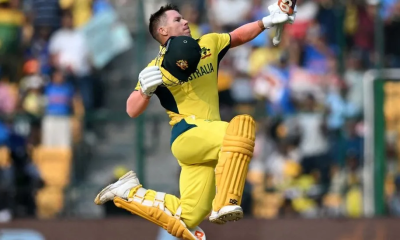



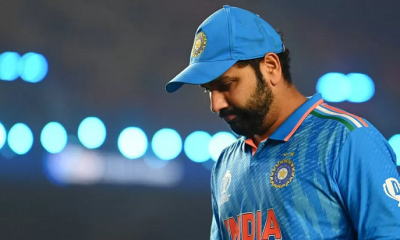



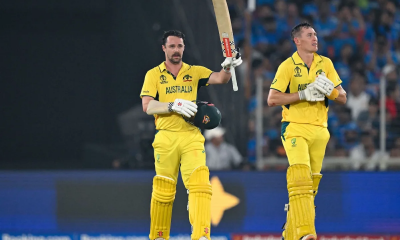

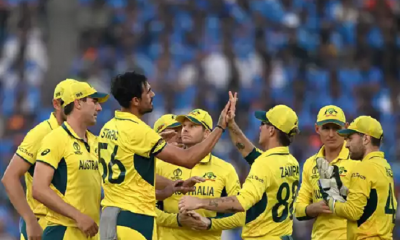

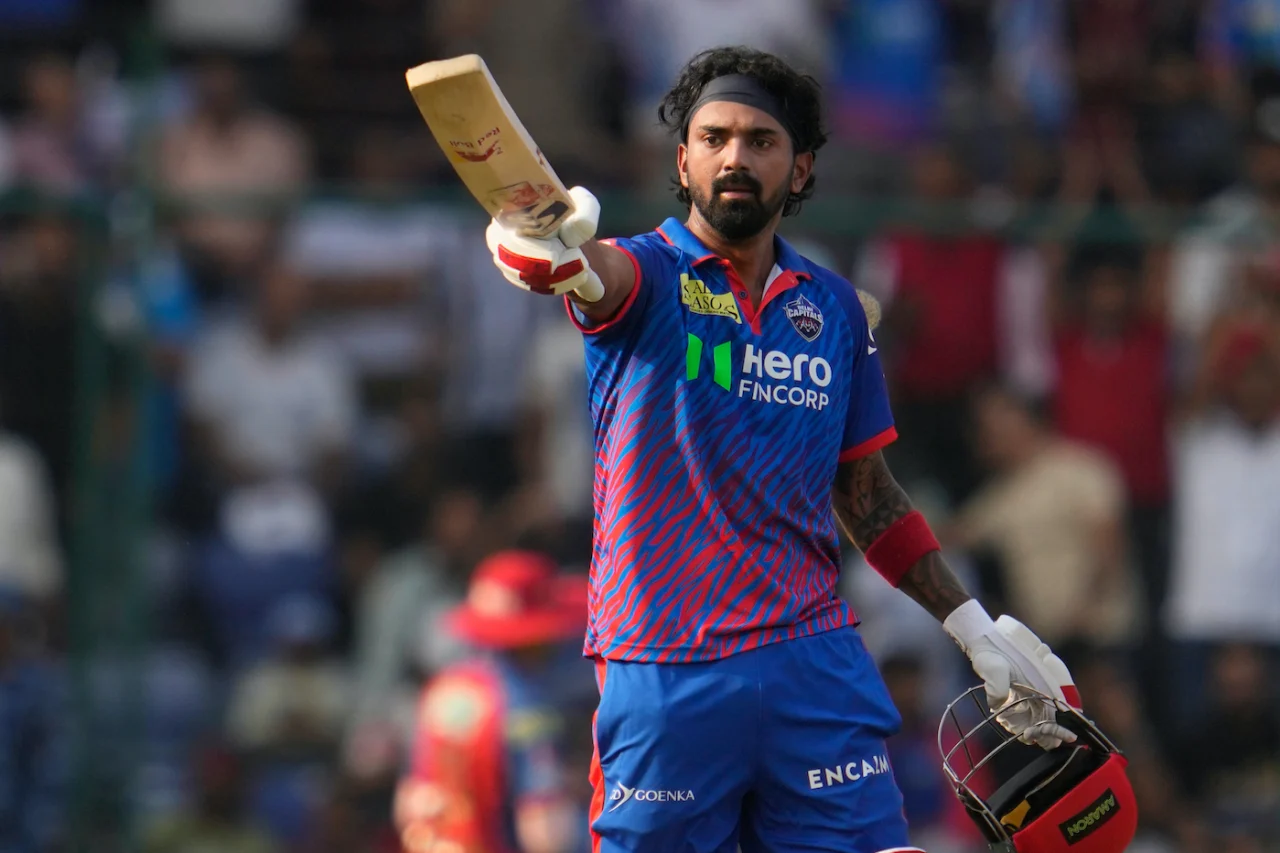
Punjab Kings (PBKS) overpowered Delhi Capitals (DC) and pulled off the highest successful T20 chase in an IPL bash where 265 met 264. They mowed down the target with six wickets and seven balls to spare. The opening blitz from Priyansh Arya and Prabhsimran Singh – they hit 116 together in the powerplay – and captain Shreyas Iyer’s chancy yet composed 71 not out off 36 balls upstaged KL Rahukl’s unbeaten 152 off 67 balls on a flat Delhi pitch.
Before the start of the chase, ESPNcricinfo’s Forecaster had PBKS’ win probability pegged at 14.83%. It zoomed up to 65.35% after Arya and Prabhsimran went on a ruthless boundary-hitting spree in the powerplay. Both openers fell in successive overs to spin, but Shreyas then took charge of the chase and increased that count to 100%.
Rahul’s knock could’ve been cut short on 12 had Shashank Singh not dropped a regulation catch at deep square leg. Shashank lost his shape and ended up knocking the ball away to the boundary. After dropping at least three chances in their previous game against Lucknow Super Giants (LSG), Shashank spilled another chance on Saturday, leaving coach Ricky Ponting upset in the dugout.
Shashank fumbled again in the fifth over of the powerplay, running to his right from sweeper cover and letting the ball roll into the boundary. By the time the powerplay ended, DC ran away to 68 for 1, their highest powerplay score this season.
Rahul was responsible for 35 of those from 16 balls, having repeatedly hit the ball over the top. Rana was also quick off the blocks, moving to 22 off 13 balls. Prabhsimran and Arya later made those powerplay scores look pedestrian.
In the past, Rahul often slowed down after the powerplay, but on Saturday, he didn’t allow the momentum to let up. He step-hit Yuzvendra Chahal for six over long-on in the seventh over and proceeded to step out of his crease and pick the legspinner away for back-to-back fours in the 11th over. By then, Rahul had already raised his half-century off 26 balls. He got another life on 51 when he popped up a return catch, but Vijaykumar Vyshak couldn’t hold onto it.
Rahul went on to bring up his fastest IPL century, off 47 balls. He reached the landmark with a drilled drive down the ground off Marco Jansen in the 15th over. He celebrated by crossing his arms in the form of an ‘X’ and had more than 28,000 fans at the Arun Jaitley Stadium celebrating with him.
At the other end, Nitish Rana looked set to bring up a hundred of his own until Xavier Bartlett had him caught by Shreyas at mid-off for 91 off 44 balls to snap a 220-run stand – the highest for DC. In the 11 balls prior to his dismissal, Rana had cracked 44 off the Australia quick, including a sequence of 6,4,4,4,4,6 in the 12th over that cost PBKS 28 runs.
Rana wasn’t as fluent against Chahal, but Rahul had made up for it at the other end. Rahul went from 100 to 150 in just 19 balls. He got there with a superbly controlled upper cut off a lifter from Arshdeep Singh on the penultimate ball of the innings.
Rahul became the first Indian to score 150 or more in the IPL and third overall behind only Chris Gayle’s 175* against Pune Warriors India (PWI) in 2013 and Brendon McCullum’s 158* against Royal Challengers Bangalore (RCB) in 2008. He batted through 20 overs and vaulted DC to their highest total. At the innings break, Rahul was so knackered that he was panting for breath through his interview on a 41-degree day in Delhi.
Prabhsimran and Delhi boy, Arya, then left the crowd breathless in the chase with their unfettered assault in the powerplay. It began with Arya pumping a fairly blameless length delivery on off from Auqib Nabi over midwidcket for six and ended with four by Prabhsimran, which propelled PBKS to 116 for 0 in six overs. It was the second-highest powerplay score in the history of the IPL, falling nine short of levelling the record set by Sunrisers Hyderabad (SRH) against DC at this very venue in 2024.
PBKS had passed fifty in the third over when Arya crunched Axar Patel for six and then Prabhsimran muscled them past hundred in the final over of the powerplay with an over full of fours against seamer Mukesh Kumar.
DC clawed back into the contest when their spinners Axar and Kuldeep Yadav dismissed PBKS’ openers in the seventh and eighth overs. Kuldeep struck again in the tenth over when he stormed through Cooper Connolly’s defences with a zippy wrong’un, leaving PBKS at 145 for 3 in the tenth over. Shreyas then managed the chase so well that PBKS ended up winning with more than an over to spare.
Shreyas got cracking when he pumped legspinner Vipraj Nigam into the sight screen in the 11th over. Nigam had come into the DC side as a concussion sub for Lungi Ngidi, who was taken to the hospital in an ambulance after suffering a blow to his head while attempting a catch off Arya at mid-off. Nigam created a chance to dismiss Shreyas on 28, but Karun Nair, who came in as a fielding sub, dropped a sitter at long-off in the 15th over. Two balls later, Nair dropped Shreyas once again, this time at long-on off Kuldeep.
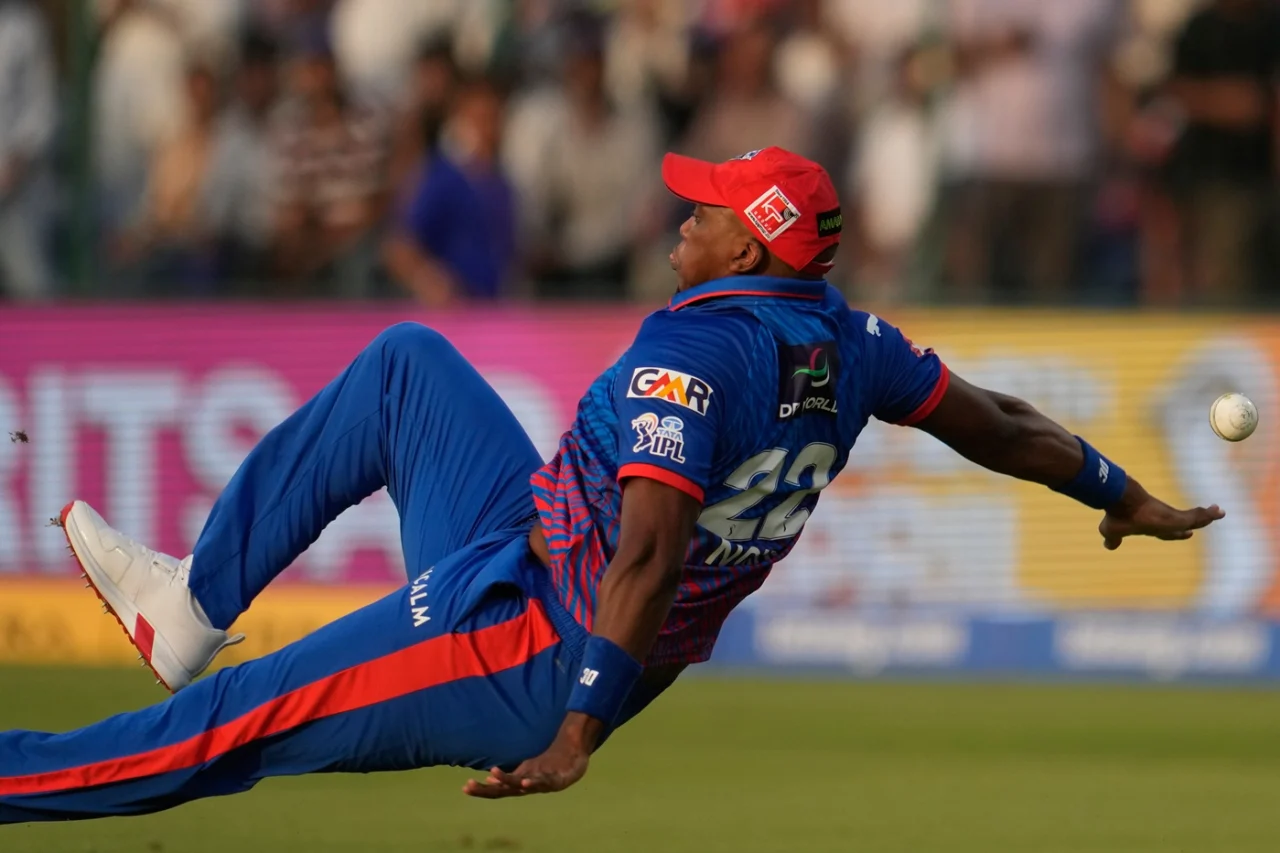
Lungi Ngidi banged his head on the ground while he looked to take a catch [Cricinfo]
Shreyas went 4,6,6 off the next three legal balls to tilt the game PBKS’ way. The second six over long-on brought Shreyas a half-century off 26 balls. He also lined up T Natarajan for a brace of sixes to rush PBKS home along with Shashank.
Brief scores:
Punjab Kings 265 for 4 in 18.5 overs (Priyansh Arya 43, Prabhsimran Singh 76, Cooper Connolly 17, Shreyas Iyer 71*, Nehal Wadhera 25, Shashank Singh 19*; Axar Patel 1-44, Kuldeep Yadav 2-46, Vipraj Nigam 1-24) beat Delhi Capitals 264 for 2 in 20 overs (Pathum Nissanka 11, KL Rahul 152*, Nitish Rana, 91; Arshdeep 1-49, Xavier Bartlett 1-69) by six wickets
Latest News
Heat Index at Caution Level in the Northern, North-central, North-western, Western, Sabaragamuwa, Southern, and Eastern provinces and in Monaragala district during the day time
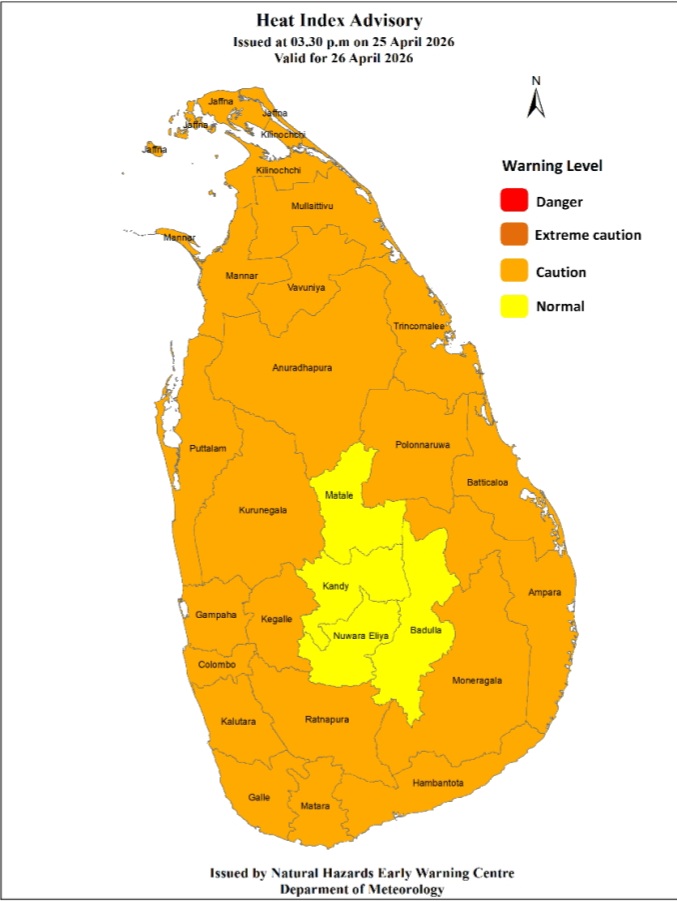
Warm Weather Advisory
Issued by the Natural Hazards Early Warning Centre
Issued at 3.30 p.m. on 25 April 2026, valid for 26 April 2026.
The Heat index, the temperature felt on the human body is likely to increase up to ‘Caution level’ at some places in the Northern, North-central, North-western, Western, Sabaragamuwa, Southern, and Eastern provinces and in Monaragala district during the day time.
The Heat Index Forecast is calculated by using relative humidity and maximum temperature and this is the condition that is felt on your body. This is not the forecast of maximum temperature. It is generated by the Department of Meteorology for the next day period and prepared by using global numerical weather prediction model data.

Effect of the heat index on human body is mentioned in the above table and it is prepared on the advice of the Ministry of Health and Indigenous Medical Services.
ACTION REQUIRED
Job sites: Stay hydrated and takes breaks in the shade as often as possible.
Indoors: Check up on the elderly and the sick.
Vehicles: Never leave children unattended.
Outdoors: Limit strenuous outdoor activities, find shade and stay hydrated.
Dress: Wear lightweight and white or light-colored clothing.
Note:
In addition, please refer to advisories issued by the Disaster Preparedness & Response Division, Ministry of Health in this regard as well. For further clarifications please contact 011-744649
Latest News
Advisory for Severe Lightning issued For Western, Sabaragamuwa and North-western province
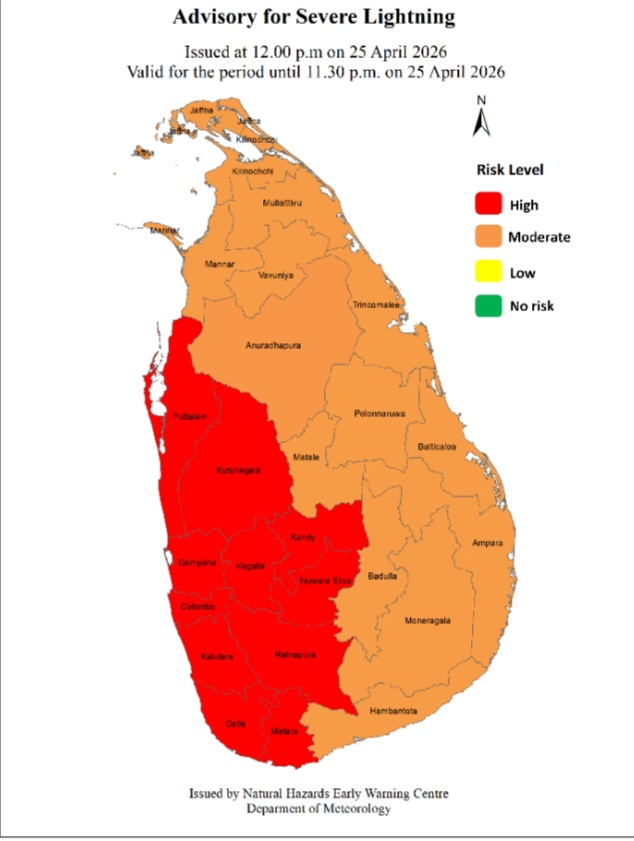
Advisory for Severe Lightning
Issued by the Natural Hazards Early Warning Centre
Issued at 12.00 noon 25 April 2026 valid for the period until 11.30 p.m. 25 April 2026
Thundershowers accompanied with severe lightning are likely to occur in the Western, Sabaragamuwa and North-western provinces and Galle, Matara, Kandy and Nuwara-Eliya
districts after 1.00 p.m.
There may be temporary localized strong winds during thundershowers. General public is kindly requested to take adequate precautions to minimize damages caused by lightning
activity.
ACTION REQUIRED:
The Department of Meteorology advises that
people should:
• Seek shelter, preferably indoors and never under trees.
• Avoid open areas such as paddy fields, tea plantations and open water bodies during thunderstorms.
• Avoid using wired telephones and connected electric appliances during thunderstorms.
• Avoid using open vehicles, such as bicycles, tractors and boats etc.
• Beware of fallen trees and power lines.
• For emergency assistance contact the local disaster management authorities.

Prabhsimran, Shreyas upstage Rahul’s 152* to mow down record T20 chase

Showers expected in the Western, Sabaragamuwa and North-western provinces and in Galle, Matara, Kandy and Nuwara-Eliya districts after 2.00 pm.

Heat Index at Caution Level in the Northern, North-central, North-western, Western, Sabaragamuwa, Southern, and Eastern provinces and in Monaragala district during the day time

Sagarika derailment disrupts coastal rail line; services to resume in two days

PHIs launch Vesak ‘Dansal’ safety registration drive

Measles resurfaces, health officials sound alarm

‘Dates have the highest sugar content to fight Coronavirus’

Sunday Island 27 December – Headlines

#SundayIsland 17th December – Headlines

Sunday Island – 28th March

Sunday Island Headlines – 21 March

Sunday Island – 21st February – Headlines
-

 News5 days ago
Rs 13 bn NDB fraud: Int’l forensic audit ordered
-

 Opinion6 days ago
Shutting roof top solar panels – a crime
-

 News3 days ago
Lanka faces crisis of conscience over fate of animals: Call for compassion, law reform, and ethical responsibility
-

 News2 days ago
No cyber hack: Fintech expert exposes shocking legacy flaws that led to $2.5 million theft
-

 News2 days ago
Whistleblowers ask Treasury Chief to resign over theft of USD 2.5 mn
-

 News6 days ago
Church calls for Deputy Defence Minister’s removal, establishment of Independent Prosecutor’s Office
-

 News3 days ago
USD 2 mn bribe: CID ordered to arrest Shasheendra R, warrant issued against ex-SriLankan CEO’s wife
-

 Features6 days ago
The Digital Pulse: How AI is redefining health care in Sri Lanka?