
Features
The Last of the Mohicans


Capt Elmo Jayawardena
elmojay1@gmail.com
The lane down Nugegoda which is in the outskirts of Colombo, is named Mudaliar Avenue. Two left turns after that would bring you to number 1/8. This is Uncle Siri and Aunty Olga’s domain. Sadly, she passed away. As Uncle Siri says, “she went to heaven in 2021”, a sentiment whispered softly sounding more like a person finding it impossible to fill the huge empty space she left. Perhaps painful heartstrings may be tugging when he mentions her. Sixty eight years is a very long time to share a blissfully happy life and lose your soul partner.Now Lionel Sirimane is alone.
He is 103 years old and is a classic example for those of us who have gone beyond 75 and are pre-occupied contemplating when the bell will knell for us. Let’s take a look at this wonderful man who greets every day that dawns with a positive awakening and makes the best of it. He is on Facebook, a real fast bunny with emails and up to date with aviation technology and is well aware of what is happening in our planet. On a sunny day you would see him mowing his lawn and he scoots out driving his Suzuki to Keell’s Supermarket to buy knick-knacks and groceries. Not bad at all Uncle Siri, you do show junior oldies like me how to count our blessings.
Uncle Siri was born on January 31, in 1920 in Kurunegala and studied at the Catholic College in Kotahena. He completed his SSC and left school join the Technical College in, Colombo and learned shorthand and typewriting and got employed as a typist.
That was the beginning, common to most of the young of that era. He then applied to the Fleet Air Arm was selected to the an aviation related trade. In 1942 he was sent to RNAS school (Royal Navy Air Service) in Maharagama which was called ‘HMS Bherunda’. It was a four-month course and Uncle Siri passed out of that institution as an aircraft electrician.
There were many young men entering aviation who had their baptism in Maharagama, and they were mainly riggers, electricians and fitters. And so started Lionel Sirimanne’s career in aviation which lasted 36 years in multiple roles that were connected to aeroplanes.
His first posting in Fleet Air Arm was at the Katukurunda Airport where some Italian prisoners of war had concreted the temporary metallic runway to a length of 3,300 feet. At this time the Katukurunda airfield was operating as a Royal Air Force base named ‘Ukussa’ with a reasonably equipped aeronautical repair center.
RAF pilots, engineers and WRENS were all billeted in different huts in the vicinity and so were the mechanics.
Electrician Sirimanne started working on aeroplanes specializing in electrical systems and radio transmitters. They had all types of war kites that came to this airfield, some on regular operations and some for repairs. The types they treated at Katukurunda at times were rather way past their prime such as Swordfish, Barracuda dive bombers rigged with torpedoes, Fairly Fulmars and Sea-Fire Fighters etc.
The work consisted of checking serviceability, repairs and modifications on aircraft brought to the single large hangar.
“Wiring in those aircraft were rather primitive circuits for landing gear, bomb release and Megger tests on circuits” says Uncle Siri. “The most important part was always the condition of the batteries,” he emphasizes to me giving me a 103-year-old smile with a ‘you see’ nod of his head.
Subsequently more modern aeroplanes too came to Katukurunda such as Grumman Martlets, Corsair fighters and Hellcats. Uncle Siri worked on them all. He was a master-craftsman comfortable with all types of electrical malfunctions in an airplane. The boy from Kurunegala had learned a valuable trade related to aeroplanes.
By this time the war ended and the participants, the winners and the losers both breathed a huge sigh of relief.
Lionel Sirimanne left Katukurunda and found employment in the radio section of the Department of Post and Telegraph. From there, he was sent to the Ratmalana Airport to repair communication facilities and navigational aids at the aerodrome.”I came to know the first Air Traffic Controller, Mr Maurice Jansz and he advised me to learn Morse Code and get a PMG’s License to operate radio communications.
He was a kind man who later became my good friend. There was talk of a new national airline being formed and the word was out that they will be needing pilots, engineers and flight radio officers. Sirimanne hastened to learn his da da da and di di da di (- – – and ..-.) codes of the alphabet and passed his exams to become a radio officer. In 1947, Uncle Siri joined Air Ceylon as a flight radio officer and worked on charter flights.
His major break came when Air Ceylon undertook to do a Colombo to Sydney flight manned by a full Ceylonese crew. Lionel Sirimanne was slotted as the second radio officer under the senior Head of Communications, Mr John Vedavanam, a very kind professional gentleman who I too had the privilege of knowing personally when I was a fledgling pilot.
Air Ceylon flew its first commercial flight to Jaffna and onwards to Madras on December 10, 1947. In the 40s commercial aviation in Asia was at its infancy. The navigational facilities were at best mediocre, and their reliability was at most times questionable. The pilots communicated with aerodromes on VHF which may have had a possible maximum range of 200 miles at best.
The rest of the communication was on HF which had extended range but was not easy to operate. The flight radio officer is the one who handled all the extended communications and assisted in map reading and dead reckoning aircraft positions in navigation.
In the early 50s the Muslim community in Ceylon chartered a DC-3 from the national carrier to fly them to Jeddah for their annual pilgrimage to Mecca. The company did not have charts to fly this unknown route. They had very capable crews but certainly were lacking in the ‘know-how’ of flying in the isolated skies over rugged desert land.
The RAF pilots operating out of Katunayake were well versed in long-range flying and they had all the charts covering Asia and the Middle East. Air Ceylon picked a capable crew and sent them to Katunayake to obtain all the charts pertaining to the journey and they were given a thorough briefing for the route by the RAF. The plan was to fly from Ratmalana to Bombay and then to Karachi and do a ‘night-stop’.
The next day they were to fly to Salala in Oman as a pit stop to refuel and then fly on to Aden for another night-stop. The final leg was to fly along the Red Sea to Jeddah. From there the pilgrims would travel by road transport to Mecca. The crew was Capt Peter Fernando, Capt Emil Jayawardena, Flight Engineer G V Perera and Radio Officer Lionel Sirimanne.
“Flying from Karachi to Salala we faced a very dangerous situation” Uncle Siri explained. “Salala was completely covered with clouds, eight Octas of it and we could not descend as the visibility would be zero once we get into the cloud layer. There were mountains surrounding the airfield. The worst was, the airport radio beacon the only landing aid was not working and so also the communication equipment,” he sighed and continued. “It was a total dead end, nothing to see except clouds and no communication and no radio beacon to guide us to the airport.
But the pilots were very clever. They were both ‘seat of the pants’ flyers with excellent situational awareness. The airport was by the coast and east of that was the Arabian Sea. We flew eastwards till we were sure we were over the water and descended through the cloud till we saw the sea and a fishing boat. We were below 1,000 feet by then. We turned 180 degrees and backtracked the way we came. Just then the radio beacon came alive pointing to where the airport was, and the VHF radio started working. We managed to land safely in Salala,” explained Uncle Siri.
“The signal of the DC-3 arrival had not reached the Salala Airport and the RAF staff manning the airfield had closed the airport and gone for a sea bath as they were not expecting any aircraft to land in Salala that day. They were enjoying the beach and the Arabian Sea when they heard an aircraft circling the cloud covered sky and realized someone was trying to land in Salala. They ran and got into their vehicle and drove as fast as they could to the airport and switched on the communications and the navigational equipment.
“We refueled and were ready to depart and the RAF staff gifted us two cases of beer for the serious mistake they made closing the airport. The rest of the trip to Aden and Jeddah and the return flight was uneventful.”
The pilot in me always wondered how these ancient Mohicans flew their magnificent old aeroplanes with such limited technology and survived the sky? They carved the path for us to follow, and the aviation fraternity owes them at least the remembrance.
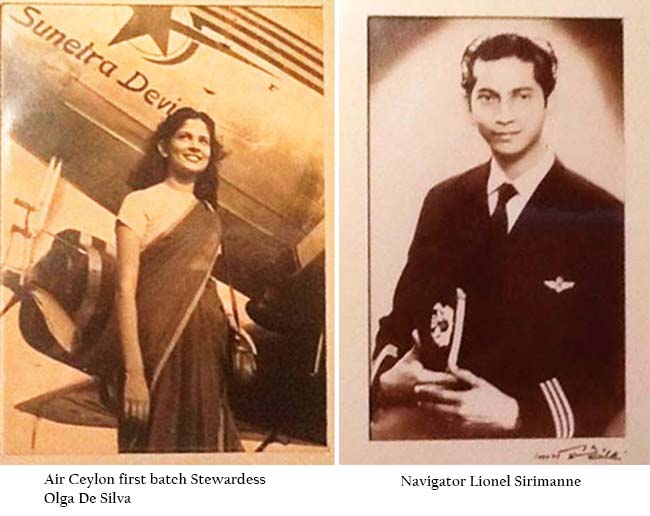
Back to Uncle Siri. In 1954 he got married to Olga de Silva who was a flight stewardess with Air Ceylon. She had joined the company in the first batch of cabin crew recruited by the national airline. Uncle Siri and Aunty Olga had an exceptionally wonderful marriage and raised two sons and a daughter, Sunil, Laksen and Minoli who always adored their parents.
I had met the senior Sirimannes when I was young and re-connected with them again in 2012 when I was writing the 100-year-old history of aviation in Sri Lanka. Uncle Siri was hale and hearty, but Aunty Olga was wheelchair bound. My wife and I at times visited them and shared a few lunches with palatable conversation. Of course, the subject was always aeroplanes and the people who flew them in bygone years. They knew stories that we loved to hear as they both had flown as fellow crew members with my father who was a DC-3 Captain.
The year 1955 was a new chapter for Mr Sirimanne. He was seconded to KLM along with a few others to work as flight crew. He started as a radio officer and operated on DC-4, DC-6, DC-7, Lockheed Constellations and Electras. The routes covered the whole world. The ‘Flying Dutchman’ flew everywhere. Aviation communication and en route Air Traffic Control steadily became more sophisticated and the Radio Officers became redundant Internationally.
Uncle Siri shifted seats and became a Flight Navigator sponsored by KLM. A whole new world of Astro Navigation opened to him. It is a poetic art of calculating an aircraft’s position by measuring the elevation of a star and its azimuth and using an almanac to draw a possible location. Mark St Helaya method was used for celestial navigation work. This was also how they navigated the sailing ships of the new world. Modified and improved versions came to aeroplanes and specialized navigators used their sextants to accurately plot aircraft positions.
This is what Navigator Sirimanne did from 1957 to 1961 flying mainly the Atlantic on KLM’s triple rudder Allison engine powered Super Constellations. He may have used popular navigational stars such as Aldebaran from Taurus, or Sirius from the leg of Orion and the ever-popular Altair to cross the Atlantic from Amsterdam to New York. The navigators picked their stars and pre calculated positions of the aircraft and waited for the calculated time to use the periscopic sextant and measure the stars.
The Lockheed Constellation flew around 18,000 ft and often the Atlantic sky was cloud laden leaving no possibility to see stars to make calculations. I too flew the same route crossing the Atlantic many times on Jumbo Jets. On such flights we pressed a few buttons and commanded the aeroplane to go to New York and back with pinpoint accuracy navigating from FMS (Flight Management System) equipment. We were blessed. Uncle Siri crossed the Atlantic looking perhaps at the same stars that Christopher Columbus used to navigate the Santa Maria.

The last of the original Mohicans Lionel Sirimanne
Three cheers to you Uncle Siri, I certainly envy you for that serene act of shooting stars with a sextant from an aeroplane.
The Navigator returned home after six years of flying with KLM. He was back in Air Ceylon and worked as an aircraft electrical engineer and moved to jets when the Trident 1E came into service in 1969. He also qualified to sign Qantas and BOAC planes that landed in Katunayake. Air Ceylon stopped operations in 1979 with the birth of Air Lanka and Uncle Siri said his fond farewell to aviation after 36 long years. He has had his moments and was left with memories of wonderful aeroplanes he flew with unforgettable crew members.
Lionel Sirimanne was a well experienced and efficient Flight Radio Officer. He found alternate employment to man the communications in ships and switched to being a sailing radio officer in the Merchant Navy. Sailor Sirimanne went all over the world traversing the popular sea routes and heading to ports in the Atlantic, the Mediterranean, the Black Sea, the Indian Ocean, almost all seas except the Pacific.
In 1986 he said good-bye to his working life, just so he could be home with his lovely wife Aunty Olga. Home was the aviator from the skies and home was the sailor from the seas. The children had flown the nest to pitch their tents in foreign lands and Uncle Siri and Aunty Olga settled in good old Sri Lanka to a well-deserved restful twilight.
“It is only at the going down of the sun one would know how beautiful the day has been.” The Sirimanne couple enjoyed their time together thanking the good lord that gifted them a beautiful life. I saw them in 2012, Uncle Siri was 92 and Aunty Olga a tad behind. True the sun was disappearing from the horizon but there was enough light still to paint in clear pastel colours the remainder of their lives.
The final ‘good-bye’ of Aunty Olga must have been extremely difficult for Uncle Siri to accept. But he still keeps on batting, loved and adored by his children and their friends. At 103, I do not think there is any friend of his vintage walking this planet. That must be sad, but he makes the best of it still, doing little household chores and pruning his white-leafed shoe flower plants in the yard.
He sure is an admirable example for the elderly, a man who has the wisdom of words to share with the younger generations on how precious life is and how lucky we are to count our blessings. Off and on he would meet another old pelican like me, and he still lights up bright when the conversation shifts to old aeroplanes and old pilots who flew them who are not with us anymore.
“Such is life” says Uncle Siri, the Face Book and email ‘fast bunny’ who drives his little Suzuki and mows his lawn on a sunny day.


Features
‘There are no private universities in Sri Lanka’ – some considerations for higher education reform
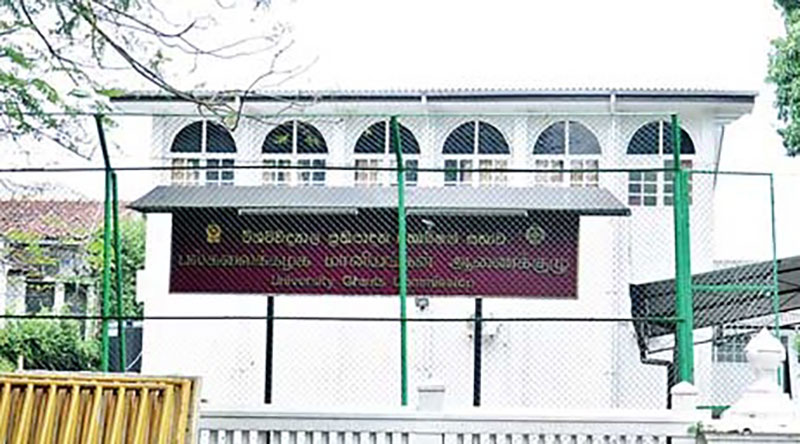
 Academics involved in education policy like to say that there is no such thing as a private university in Sri Lanka. The only ‘universities’ in the country are state universities; anything else offering degrees is a private higher education institution (HEI). This position is technically accurate. Yet, in the discourse and imagination of the public, private universities are very real – people teach in them, students register in them, families pay fees, and such degree holders enter job markets in Sri Lanka and outside.
For decades, activists concerned for public higher education have ignored or resisted looking at private HEIs, as if such scrutiny would taint them. Others have worked in both types of institutions, carrying practices from each to the other. The apex body governing state universities, the UGC, has, meanwhile, ignored the concept of conflict of interest and appointed individuals in private higher education in committees and leadership positions. It is unsurprising then that some of the ideologies informing private higher education appear in reform agendas in the state sector.
This is a good time then to consider the varying types of private HEIs around us, and to take a look at some of the issues within them in the hope that higher education reform agendas will include private, as well as state higher education.
What is a ‘private university’?
First, some clarifications. In the public imaginary, a ‘private university’ is typically an institution that provides a foreign or local degree for which the student makes a payment. But this broad classification encompasses a host of diverse institutions and types of degrees which I detail below.
The Non-State Higher Education Division (NSHE) of the Ministry of Education has recognised 295 degrees by 32 institutions. Most of these are private companies and include a handful of established, well-known private HEIs that are ‘university like’. The degrees are local degrees conferred by the institutions accredited by the NSHE Division. While private HEIs conferring local degrees must be accredited by the NSHE Division, there appears to be no legal consequence for not doing so. In addition, there are several permutations of the private degree that miss the net of this Division and the Standing Committee on Accreditation and Quality Assurance (SCAQA) that assists this Division.
For one, degrees conferred by foreign universities offered, via these same private HEIs, are not vetted by the NSHE Division. Secondly, there is a growing plethora of private HEIs which have either no physical presence locally or only a dubious presence. The University Grants Commission has notified the public, through their website, that foreign universities listed in the Commonwealth Universities Yearbook and the World Higher Education Database are recognised, but refrained from giving any other details – which degrees? Offered by what modes? These details are not known. Some of the foreign universities in the lists may be legitimate entities in their own land but the degrees conferred locally, in their name, may not adhere to curriculum or teaching specifications of the NSHE Division or the UGC.
Another troubling phenomenon is the ‘top up degree’, which appears to work on the same principle as that of a pre-paid mobile connection: if I have a Diploma or an HND of a sort, I am eligible to complete a course of study which provides me with a degree, usually from a foreign university. The idea that someone who does not initially qualify for a degree programme should be able to work their way towards one is a progressive notion. This is the concept that open and distance learning (ODL) was based on initially, but which is now sadly exploited. ODL models are expected to provide opportunity for learning for those who may be excluded from traditional learning institutions. In Sri Lanka, however, we have seen ODL become a marketplace offering easy to obtain, for-fee qualifications by institutions with little commitment to superior teaching and learning.
Finally, a perusal of the many types of private HEIs and their varied degrees bring to mind another question – how should the private degrees, provided by state institutions (that are not educational institutions), be regulated? Who should do so?
All of these create a host of problems for the public – for hopeful students and parents and trusting employers. For the higher education sector, recruitment of academic staff, too, has become difficult due to this plethora of ambiguous higher education qualifications, as I discussed in a previous Kuppi article (‘Recruiting academics to state universities’).
Some issues in private HEIs – a bellwether for change in state universities
In this second part of this article, I will discuss some aspects of work in private HEIs – albeit the more established institutions – given that such issues may appear in reform agendas in future.
Across state universities, all permanent staff of a specific category are paid according to the same criteria. The picture is not so clear when it comes to private HEIs since they are different entities legally, typically companies. Private HEIs have salary scales and financial incentives that are different to each other. The more established private HEIs reportedly have attractive renumeration packages, possibly a reason for academics of state universities migrating eagerly to such institutions during sabbatical years and on retirement. This may not of course be the case with other less established, or improperly registered HEIs of which we know little. Academic staff of these more accepted private HEIs seem to value the high financial remuneration they receive (in comparison to state universities) as something that makes their work rewarding.
Attractive remuneration is important to sustain the good life and is at times seen as the institution’s way of encouraging good work. Yet, this has implications for the future of the institution: to continue to deliver on promised financial packages, institutions must continue to have large profit margins. One strategy has been to enroll multiple cohorts of students per year, even up to three or four intakes per year. This can result in exploitative work conditions, since staff must cater to all these cohorts in that same year. If there is inadequate staff, employees are further burdened. On the other hand, if there is a sudden drop in enrolments (degrees can go out of fashion) unexpected layoffs occur. Similar to other sectors that employ short-term contract staff – including state universities – in private HEIs, too, individual teachers, who are on short term contracts that need regular renewal, can feel pressured to work under difficult or exploitative conditions.
At the same time, even in the more established private HEIs, work norms differ from those of state universities in that they include promotional work that keeps the institution’s name in the eye of the public. The Marketing (or similarly named) unit comes up in conversations as one of the most important departments. It appears to weigh in on decision-making related to the number of staff, the amount of re-sits per exams, and other pedagogically important matters. This is a worrying example of how financial rationales interfere with pedagogically or academically sound processes, resulting in problematic results in the classroom. On the plus side, junior colleagues, who had experience in both state and private HEIs, also felt that they faced less harassment in private HEIs – primarily due to the private HEIs ability to take swift action in reported cases of harassment. This is a real indictment on state institutions and their reluctance to address chronic issues of harassment in our universities.
Yet, while we hear much about problems in state universities, we hardly hear of problems that staff in private HEIs face. One rationale for a lack of public expressions by staff is that expressions of discontent might lead to trouble given the importance of reputation for private HEIs. The worry about reputational damage is a growing concern in state universities, too, as evidenced by social media policies and internal conversations on reputational damage, consequent to negative publicity. Institutional worries of reputational damage are harmful in the long run since these impact not only freedom of expression by student and staff, but also research that is possible in and about the education sector.
Some thoughts at the end…
A close look at the private higher education sector is important given its strong presence in the country. Impending reform needs to regulate this diverse array of higher education offerings in the private sector, as well as the state institutions that offer privately-funded options of higher education (a topic for a separate Kuppi on its own). It is time we carefully considered how to build a whole system of higher education out of this broken mess.
Kaushalya Perera is a senior lecturer at the University of Colombo.
Kuppi is a politics and pedagogy happening on the margins of the lecture hall that parodies, subverts, and simultaneously reaffirms social hierarchies.

Singer Nish Peiris is set to take the next big step in her music journey.
The talented vocalist, who has been seen and heard in the scene here for a short while, and was also featured with the now-defunct band, Inner Vision, has announced that she will be fully committing to her solo career, after completing her degree this year.
“I’m finishing my degree this year, and after that I’ll be fully committing to my solo music career,” Nish told The Island.
“I’ve already got a few tours lined up for next year, so I’m really excited for what’s ahead.”
Fans, no doubt, will remember Nish for her smooth voice and stage presence, and the good news is that she is now ready to chart her own path and bring new music to audiences at home and abroad.
With tours already planned for 2027, the year 2026 promises to be an exciting year for the young artiste as she steps into the spotlight on her own.
We wish Nish every success in this new chapter!
 While Sri Lankan music lovers, in Dubai, are eagerly looking forward to being a part of the action on Saturday, 25th July, with Rajiv Sebastian in the limelight, Sri Lankans, in Toronto, Canada, are equally excited and are anxiously awaiting the arrival of Sri Lanka’s famous singer/entertainer Sohan Weerasinghe.
Having done the needful with The X-Periments, the legendary performer has now embarked on an exciting new chapter – a solo career – and Toronto, Canada, will see him do the needful, on Friday, 31st July, 2026, from 8.00 pm to 12.00 am, at the Angus Glen Golf Club.

Sohan Weerasinghe: In Canada, and ready to do the needful on 31st July
Reports indicate that it’s a ‘sold out’ event – naturally with Sohan in the spotlight.

Gamini Hemalal: Creating all the excitement for Sri Lankans in Toronto
Having built his reputation through years of unforgettable performances, and hits that became part of our musical fabric, Sohan is ready to bring his own vision, sound, and stories directly to the audience, in Toronto, Canada, backed by the phenomenal Toronto Ceymphony Live Band.
Says Gamini Hemalal, who has been instrumental in reviving the Sri Lankan entertainment scene, in that part of the world:
“The countdown begins for the most exclusive musical event of the summer! Join us for a premium night of incredible music, elite hospitality, and a lavish buffet as the legendary Sohan Weerasinghe takes the stage live in Toronto!
“This is a high-end event, designed for those who appreciate exceptional entertainment and great food.”
Gamini, who is also a member of the Toronto Ceymphony Live Band, mentioned that it’s going to be an intimate musical evening with the celebrated Sohan Weerasinghe.
From packed auditoriums to intimate shows, Sohan continues to prove why he remains one of Sri Lanka’s most beloved entertainers.
For decades, Sohan Weerasinghe has been a household name in Sri Lankan entertainment.
Known for his captivating smooth voice and charismatic stage presence, Canada will experience it all on Friday, 31st July.
Next on the list of events, Gamini Hemal is working on, is Halloween night and he says “what we plan to do will be very interesting and unique … with a surprise guest star, as well!”

Trump slaps 50% tariffs on Canada and Carney vows to ‘intensify’ trade talks

Showers will occur in the Western, Sabaragamuwa and North-western provinces and in Kandy, Nuwara-Eliya, Galle and Matara districts

Move to extend judges’ retirement ages could damage Sri Lanka’s global image, warns Prof. Peiris

Dengue surge infects 76,000, claims about 53 lives

SC dismisses challenge to gender change procedures

BASL urges Justice Minister not to amend Constitution to increase retirement ages of superior court judges

‘Dates have the highest sugar content to fight Coronavirus’

Sunday Island 27 December – Headlines

#SundayIsland 17th December – Headlines

Sunday Island – 28th March

Sunday Island Headlines – 21 March

Sunday Island – 21st February – Headlines
-
 Business2 days ago
‘Giving up was never an option’: The fisherman who fought back after losing millions in SL
-
 Features2 days ago
Two memorable excerpts from a former SLAF commander’s memoir
-
 Latest News3 days ago
Davis cup Asia/Oceania Group IV 2026 to be held in Colombo from 20th to 25th July
-
 Features2 days ago
Erdoğan’s New Republic
-
 Life style2 days ago
Taste of the Swiss Alps comes to Colombo
-
 Features6 days ago
Dirty Money
-
 News3 days ago
Dengue outbreak gallops ahead: Infections surpasses 73,455, leaving 50 dead
-
 News3 days ago
Evidence recorded in money laundering case against Yoshitha Rajapaksa