
Features
Middle East Imbroglio: Two Wars Fifty Years Apart


by Rajan Philips
Shlomo Ben-Ami, Israeli academic, Oxford historian, and Foreign Minister of Israel in Ehud Barak’s government, has provided one of the more even handed assessments of the current situation in Israel. In an opinion piece, published in Canada’s Globe and Mail, and entitled, “The destructive hubris of Benjamin Netanyahu,” Dr. Ben-Ami writes that “Mr. Netanyahu’s hubris met its nemesis in the form of Hamas’s brutality.” One cannot separate Mr. Netanyahu’s self-serving intransigence towards the Palestinians throughout his time in office as Prime Minister, from the biggest attack on Israel in 50 years that was launched by Hamas last Saturday, October 7. It was a day after the 50th anniversary of the 1973 war against Isarel that was started with some surprise by Egypt and Syria.
There are comparisons being made between the two clashes 50 years apart. Comparisons range from historical symbolism to contextual differences to geopolitical fallouts. John Rapley, Political Economist, Cambridge, has noted that while the 1973 war transformed the global economy by creating the petroleum crisis, the current war is unlikely to have similarly far reaching impacts. The embargo on oil shipment (from the Middle East to the US), imposed by the Arab countries in retaliation to US support of Israel, argues Prof. Rapley, set off a series of events that changed the world economic order.
While the end of the Bretton Wood system of fixed exchange rates had already begun, the petroleum crisis accelerated the end of postwar prosperity in the west, triggered the new phenomenon of stagflation, and led to the start of the war on inflation by Central Banks. The world economy is now different, far more widespread and diverse, and far less dependent on oil.
The current skirmish will have its economic fallout with oil price increases but nowhere near the crisis of the 1970s, unless the situation escalates into a full-scale conflict between Israel and Iran. While Iran is widely suspected in the west to be the hidden hand behind Hamas’s incursion into Israel, there is also general acknowledgment that there is no evidence of Iran’s involvement. And the US that has already declared its solidarity with Israel and is escalating its aircraft carrier presence in the region while sending ammunition to Israel, will also likely be a deterrent against any regional escalation of the crisis.
Aftermaths of 1973
The west’s declining dependence on Middle Eastern oil may also have been a factor in the Palestinian problem becoming a lesser concern in the foreign policy considerations of the west in general, and particularly in the US. But there have been other and more significant developments that have pushed the Palestinian question to the back-burner. The experience of the 1973 war led to Israel and Arab countries working towards bilateral rapprochements and the pursuit of a parallel peace process between Israel and the Palestinians. The linkage between Palestinian liberation and Arab leadership was beginning to get attenuated, if not totally severed.
The 1978/79 Camp David Accords between Egypt and Israel, although controversial and divisive, significantly changed the course of Middle Eastern politics. The Oslo Peace Accords of 1993 and 1995 between Israel and the Palestinians were another landmark achievement even though they were frustrated from reaching the elusive final settlement. Even the gains of the Peace Accords, the establishment of the Palestinian National Authority and limited Palestinian self-government in the West Bank and the Gaza Strip were frustrated from reaching their full potentials.
There was also opposition to the Oslo Accords among both the Palestinians and the Israelis. The redoubtable Ishrak Rabin, the Israeli Prime Minister who signed the Oslo Accords with PLO’s Yasser Arafat, paid with his life for pursuing peace, gunned down by a right-wing lunatic. From a Palestinian standpoint, the great Edward Said pungently described the Oslo Accords as “Palestinian Versailles.”
The disagreements over the Peace Accords gave the new Palestinian militants, especially Hamas, considerable advantage over the old Palestinian Liberation Organization (PLO), which came to be identified as a corrupt and upstart establishment. On the Israeli side, the right-wing forces were on the ascent and during Benjamin Netanyahu’s long spell as Prime Minister, even the paltry Oslo gains were not only stymied, but also reversed.
The unfolding tragedy was given a farcical fillip when Donald Trump became US President while Netanyahu was at the height of his powers as Israeli Prime Minister. Between them, they ignored the Palestinians, symbolically and substantively, and set about cultivating bilateral agreements between Arab countries and Israel for ultimately profiting business interests.
The famous or infamous Abraham Accords, usually credited to Donald Trump and his son-in-law Jarred Kushner, became the new framework for Arab-Israeli normalization while excluding the Palestinians. In September 2020, two months before Trump’s defeat by Joe Biden in the US presidential elections, the United Arab Emirates and Bahrain became the first Arab countries to formally recognize Israel’s sovereignty and open diplomatic relations with the Jewish state. Morocco and Sudan followed while Trump was still in office after the defeat and was busy plotting the January 6 uprising.
Warnings Ignored
The new Biden Administration continued the initiative, but chose to jettison the title “Abraham Accords” and use “normalization agreements” instead. The State Department also made it clear that Arab-Israeli normalization is “not a substitute for Israeli-Palestinian peace,” and expressed the hope that the new normalization agreements will “contribute to tangible progress towards the goal of advancing a negotiated peace between Israelis and Palestinians.” But all hopes were dashed when Netanyahu returned as Prime Minister in December 2022 (after being out of office from June 2021) and cobbled together the most right-wing and incompetent government in Israel’s history.
Netanyahu’s return to power has been possible only because of the concessions he made to right-wing fringe parties, and satisfying his new coalition partners has come at the heavy price of alienating the Palestinians and aggravating their conditions in the West Bank and in Gaza. In addition to allowing Jewish takeover of Palestinian lands and the spread of illegal Jewish settlements, the Netanyahu government also provoked the Palestinians by infringing sacred Muslim areas within Jerusalem.
All the while, Mr. Netanyahu was trying to expand the Abraham Accords with far flung countries like Indonesia, Niger, Mauritania, and Somalia, in addition to finalizing the more prized normalization with Saudi Arabia next door. And he kept ignoring warnings from the Americans and Saudis, even when they came jointly from Secretary of State Anthony Blinken and Saudi Foreign Minister Prince Faisal bin Farham.
In June of this year, the US Secretary of State travelled to Saudi Arabia for bilateral discussions on what a New York Times report called a “smorgasbord of issues: Iran, Sudan, the Islamic State, regional infrastructure, clean energy and the potential normalization of Saudi-Israel relations.” The larger purpose, of course, was to stem Saudi Arabia from tilting too much towards China and Russia.
Later in June, Mr. Blinken and Prince Farham participated at a Council on Foreign Relations event in New York. As reported by CNN, both men stressed that the expansion of Arab Israeli normalization will not be possible in a climate of rising Israeli-Palestinian tensions. Mr. Blinken said that he had raised this issue in conversations with Prime Minister Netanyahu and his Foreign Minister Eli Cohen. For his part, the Saudi Foreign Minister added that while normalization would in the broader interest of the region, the benefits would be limited if the challenge of “finding a pathway to peace for the Palestinian people” were not addressed at the same time.
Whether these warnings were not strong enough, or whether the Netanyahu government would not have heeded them anyway, no one foresaw that they would come true so quickly and with such ferocity. The Netanyahu government is already under fire for the massive intelligence failure that left the government and the military totally clueless about what Hamas must have been planning for quite some time and what it would all of a sudden unleash.
The circumstances of Netanyahu’s return to power and his efforts to muzzle the judiciary have divided the country through the middle, and the attack on Israel by Hamas may have unified the country behind its now beleaguered Prime Minister. The government has formally declared war on Hamas, and has promised to take “significant military steps” to destroy the “military and governing capabilities” of Hamas, which according to Mr. Netanyahu will prevent Hamas from “threatening Israelis for many years.”
The punishment of Hamas will continue until there is nothing left to punish, or the punishment extends too long and leads to too much suffering to test the sensibilities of proportionality. Whether Hamas deserves the punishment it is getting is a moot question because deserving has nothing to do with this. It was going to get punished anyway, and Hamas would have had no illusions about escaping punishment when it embarked on its biggest and most horrific incursion in its 45 year history.
Prime Minister Netanyahu and his government will have their own problems. Their governing mandate will now be limited to punishing Hamas. Beyond that, they will be under intense scrutiny for any and all of their actions. That in itself could be an opening for a new phase in the tortuous history of Israeli-Palestinian relations.
World Reactions
According to an analysis of “International Reactions to the Hamas Attack on Israel,” undertaken by researchers at The Washington Institute for Near East Policy (see map on this page), about 100 countries have reacted to the unfolding situation in Israel and in Gaza. Forty four countries are said to have condemned Hamas, while most of the Arab countries have blamed Israel for the attacks. Most of Africa has not expressed a public position, while China and a number of ASEAN countries in Asia, Turkey and Saudi Arabia in the Middle East, Russia in Eastern Europe, South Africa, and Mexico and Chile in the Americas, are condemning all violence.
India has joined the ranks of the west supporting Israel, along with Brazil and Argentina, exposing new cleavages among the BRICS countries. Of the original BRICS members, Brazil and India are supporting Israel, while Russia, China and South Africa are grouped against all violence. As the Washington Institute’s map shows, world reactions are literally all over the map, and there is no single group of countries that can claim to speak for the ‘world,’ let alone act on behalf of the world.
The west’s rhetoric of speaking for the world is practically limited to NATO countries, which are now more than occasionally joined by India as part of its ‘all-aligned’ approach to international affairs. The expression of solidarity with Israel is meaningless in practical terms because there is no country threatening war against Israel, and there is no country that can stop Israel from pulverizing Gaza (40 km by 10 km land-strip habitat for two million Palestinians) for the sake of punishing Hamas.








iyadasa Advisor to the Ministry of Science & Technology and a Board of Directors of Sri Lanka Atomic Energy Regulatory Council A value chain management consultant to www.vivonta.lk
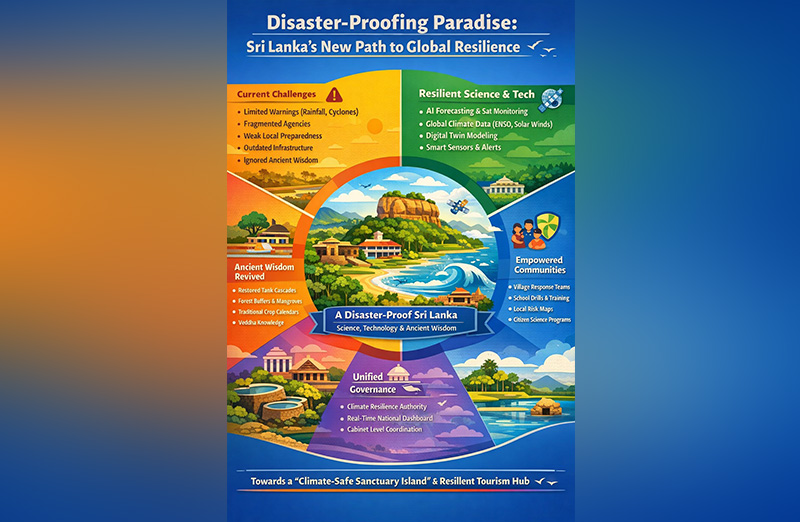
As climate shocks multiply worldwide from unseasonal droughts and flash floods to cyclones that now carry unpredictable fury Sri Lanka, long known for its lush biodiversity and heritage, stands at a crossroads. We can either remain locked in a reactive cycle of warnings and recovery, or boldly transform into the world’s first disaster-proof tropical nation — a secure haven for citizens and a trusted destination for global travelers.
The Presidential declaration to transition within one year from a limited, rainfall-and-cyclone-dependent warning system to a full-spectrum, science-enabled resilience model is not only historic — it’s urgent. This policy shift marks the beginning of a new era: one where nature, technology, ancient wisdom, and community preparedness work in harmony to protect every Sri Lankan village and every visiting tourist.
The Current System’s Fatal Gaps
Today, Sri Lanka’s disaster management system is dangerously underpowered for the accelerating climate era. Our primary reliance is on monsoon rainfall tracking and cyclone alerts — helpful, but inadequate in the face of multi-hazard threats such as flash floods, landslides, droughts, lightning storms, and urban inundation.
Institutions are fragmented; responsibilities crisscross between agencies, often with unclear mandates and slow decision cycles. Community-level preparedness is minimal — nearly half of households lack basic knowledge on what to do when a disaster strikes. Infrastructure in key regions is outdated, with urban drains, tank sluices, and bunds built for rainfall patterns of the 1960s, not today’s intense cloudbursts or sea-level rise.
Critically, Sri Lanka is not yet integrated with global planetary systems — solar winds, El Niño cycles, Indian Ocean Dipole shifts — despite clear evidence that these invisible climate forces shape our rainfall, storm intensity, and drought rhythms. Worse, we have lost touch with our ancestral systems of environmental management — from tank cascades to forest sanctuaries — that sustained this island for over two millennia.
This system, in short, is outdated, siloed, and reactive. And it must change.
A New Vision for Disaster-Proof Sri Lanka
Under the new policy shift, Sri Lanka will adopt a complete resilience architecture that transforms climate disaster prevention into a national development strategy. This system rests on five interlinked pillars:
Science and Predictive Intelligence
We will move beyond surface-level forecasting. A new national climate intelligence platform will integrate:
AI-driven pattern recognition of rainfall and flood events
Global data from solar activity, ocean oscillations (ENSO, MJO, IOD)
High-resolution digital twins of floodplains and cities
Real-time satellite feeds on cyclone trajectory and ocean heat
The adverse impacts of global warming—such as sea-level rise, the proliferation of pests and diseases affecting human health and food production, and the change of functionality of chlorophyll—must be systematically captured, rigorously analysed, and addressed through proactive, advance decision-making.
This fusion of local and global data will allow days to weeks of anticipatory action, rather than hours of late alerts.
Advanced Technology and Early Warning Infrastructure
Cell-broadcast alerts in all three national languages, expanded weather radar, flood-sensing drones, and tsunami-resilient siren networks will be deployed. Community-level sensors in key river basins and tanks will monitor and report in real-time. Infrastructure projects will now embed climate-risk metrics — from cyclone-proof buildings to sea-level-ready roads.
Governance Overhaul
A new centralised authority — Sri Lanka Climate & Earth Systems Resilience Authority — will consolidate environmental, meteorological, Geological, hydrological, and disaster functions. It will report directly to the Cabinet with a real-time national dashboard. District Disaster Units will be upgraded with GN-level digital coordination. Climate literacy will be declared a national priority.
People Power and Community Preparedness
We will train 25,000 village-level disaster wardens and first responders. Schools will run annual drills for floods, cyclones, tsunamis and landslides. Every community will map its local hazard zones and co-create its own resilience plan. A national climate citizenship programme will reward youth and civil organisations contributing to early warning systems, reforestation (riverbank, slopy land and catchment areas) , or tech solutions.
Reviving Ancient Ecological Wisdom
Sri Lanka’s ancestors engineered tank cascades that regulated floods, stored water, and cooled microclimates. Forest belts protected valleys; sacred groves were biodiversity reservoirs. This policy revives those systems:
Restoring 10,000 hectares of tank ecosystems
Conserving coastal mangroves and reintroducing stone spillways
Integrating traditional seasonal calendars with AI forecasts
Recognising Vedda knowledge of climate shifts as part of national risk strategy
Our past and future must align, or both will be lost.
A Global Destination for Resilient Tourism
Climate-conscious travelers increasingly seek safe, secure, and sustainable destinations. Under this policy, Sri Lanka will position itself as the world’s first “climate-safe sanctuary island” — a place where:
Resorts are cyclone- and tsunami-resilient
Tourists receive live hazard updates via mobile apps
World Heritage Sites are protected by environmental buffers
Visitors can witness tank restoration, ancient climate engineering, and modern AI in action
Sri Lanka will invite scientists, startups, and resilience investors to join our innovation ecosystem — building eco-tourism that’s disaster-proof by design.
Resilience as a National Identity
This shift is not just about floods or cyclones. It is about redefining our identity. To be Sri Lankan must mean to live in harmony with nature and to be ready for its changes. Our ancestors did it. The science now supports it. The time has come.
Let us turn Sri Lanka into the world’s first climate-resilient heritage island — where ancient wisdom meets cutting-edge science, and every citizen stands protected under one shield: a disaster-proof nation.

Why is national identity so important for a people? AI provides us with an answer worth understanding critically (Caveat: Even AI wisdom should be subjected to the Buddha’s advice to the young Kalamas):
‘A strong sense of identity is crucial for a people as it fosters belonging, builds self-worth, guides behaviour, and provides resilience, allowing individuals to feel connected, make meaningful choices aligned with their values, and maintain mental well-being even amidst societal changes or challenges, acting as a foundation for individual and collective strength. It defines “who we are” culturally and personally, driving shared narratives, pride, political action, and healthier relationships by grounding people in common values, traditions, and a sense of purpose.’
Ethnic Sinhalese who form about 75% of the Sri Lankan population have such a unique identity secured by the binding medium of their Buddhist faith. It is significant that 93% of them still remain Buddhist (according to 2024 statistics/wikipedia), professing Theravada Buddhism, after four and a half centuries of coercive Christianising European occupation that ended in 1948. The Sinhalese are a unique ancient island people with a 2500 year long recorded history, their own language and country, and their deeply evolved Buddhist cultural identity.
Buddhism can be defined, rather paradoxically, as a non-religious religion, an eminently practical ethical-philosophy based on mind cultivation, wisdom and universal compassion. It is an ethico-spiritual value system that prioritises human reason and unaided (i.e., unassisted by any divine or supernatural intervention) escape from suffering through self-realisation. Sri Lanka’s benignly dominant Buddhist socio-cultural background naturally allows unrestricted freedom of religion, belief or non-belief for all its citizens, and makes the country a safe spiritual haven for them. The island’s Buddha Sasana (Dispensation of the Buddha) is the inalienable civilisational treasure that our ancestors of two and a half millennia have bequeathed to us. It is this enduring basis of our identity as a nation which bestows on us the personal and societal benefits of inestimable value mentioned in the AI summary given at the beginning of this essay.
It was this inherent national identity that the Sri Lankan contestant at the 72nd Miss World 2025 pageant held in Hyderabad, India, in May last year, Anudi Gunasekera, proudly showcased before the world, during her initial self-introduction. She started off with a verse from the Dhammapada (a Pali Buddhist text), which she explained as meaning “Refrain from all evil and cultivate good”. She declared, “And I believe that’s my purpose in life”. Anudi also mentioned that Sri Lanka had gone through a lot “from conflicts to natural disasters, pandemics, economic crises….”, adding, “and yet, my people remain hopeful, strong, and resilient….”.
“Ayubowan! I am Anudi Gunasekera from Sri Lanka. It is with immense pride that I represent my Motherland, a nation of resilience, timeless beauty, and a proud history, Sri Lanka.
“I come from Anuradhapura, Sri Lanka’s first capital, and UNESCO World Heritage site, with its history and its legacy of sacred monuments and stupas…….”.
The “inspiring words” that Anudi quoted are from the Dhammapada (Verse 183), which runs, in English translation: “To avoid all evil/To cultivate good/and to cleanse one’s mind -/this is the teaching of the Buddhas”. That verse is so significant because it defines the basic ‘teaching of the Buddhas’ (i.e., Buddha Sasana; this is how Walpole Rahula Thera defines Buddha Sasana in his celebrated introduction to Buddhism ‘What the Buddha Taught’ first published in1959).
Twenty-five year old Anudi Gunasekera is an alumna of the University of Kelaniya, where she earned a bachelor’s degree in International Studies. She is planning to do a Master’s in the same field. Her ambition is to join the foreign service in Sri Lanka. Gen Z’er Anudi is already actively engaged in social service. The Saheli Foundation is her own initiative launched to address period poverty (i.e., lack of access to proper sanitation facilities, hygiene and health education, etc.) especially among women and post-puberty girls of low-income classes in rural and urban Sri Lanka.
Young Anudi is primarily inspired by her patriotic devotion to ‘my Motherland, a nation of resilience, timeless beauty, and a proud history, Sri Lanka’. In post-independence Sri Lanka, thousands of young men and women of her age have constantly dedicated themselves, oftentimes making the supreme sacrifice, motivated by a sense of national identity, by the thought ‘This is our beloved Motherland, these are our beloved people’.
The rescue and recovery of Sri Lanka from the evil aftermath of a decade of subversive ‘Aragalaya’ mayhem is waiting to be achieved, in every sphere of national engagement, including, for example, economics, communications, culture and politics, by the enlightened Anudi Gunasekeras and their male counterparts of the Gen Z, but not by the demented old stragglers lingering in the political arena listening to the unnerving rattle of “Time’s winged chariot hurrying near”, nor by the baila blaring monks at propaganda rallies.
Politically active monks (Buddhist bhikkhus) are only a handful out of the Maha Sangha (the general body of Buddhist bhikkhus) in Sri Lanka, who numbered just over 42,000 in 2024. The vast majority of monks spend their time quietly attending to their monastic duties. Buddhism upholds social and emotional virtues such as universal compassion, empathy, tolerance and forgiveness that protect a society from the evils of tribalism, religious bigotry and death-dealing religious piety.
Not all monks who express or promote political opinions should be censured. I choose to condemn only those few monks who abuse the yellow robe as a shield in their narrow partisan politics. I cannot bring myself to disapprove of the many socially active monks, who are articulating the genuine problems that the Buddha Sasana is facing today. The two bhikkhus who are the most despised monks in the commercial media these days are Galaboda-aththe Gnanasara and Ampitiye Sumanaratana Theras. They have a problem with their mood swings. They have long been whistleblowers trying to raise awareness respectively, about spreading religious fundamentalism, especially, violent Islamic Jihadism, in the country and about the vandalising of the Buddhist archaeological heritage sites of the north and east provinces. The two middle-aged monks (Gnanasara and Sumanaratana) belong to this respectable category. Though they are relentlessly attacked in the social media or hardly given any positive coverage of the service they are doing, they do nothing more than try to persuade the rulers to take appropriate action to resolve those problems while not trespassing on the rights of people of other faiths.
These monks have to rely on lay political leaders to do the needful, without themselves taking part in sectarian politics in the manner of ordinary members of the secular society. Their generally demonised social image is due, in my opinion, to three main reasons among others: 1) spreading misinformation and disinformation about them by those who do not like what they are saying and doing, 2) their own lack of verbal restraint, and 3) their being virtually abandoned to the wolves by the temporal and spiritual authorities.
(To be continued)
By Rohana R. Wasala ✍️

 ‘Adapt, shrink or die’ – thus runs the warning issued by the Trump administration to UN humanitarian agencies with brute insensitivity in the wake of its recent decision to drastically reduce to $2bn its humanitarian aid to the UN system. This is a substantial climb down from the $17bn the US usually provided to the UN for its humanitarian operations.
Considering that the US has hitherto been the UN’s biggest aid provider, it need hardly be said that the US decision would pose a daunting challenge to the UN’s humanitarian operations around the world. This would indeed mean that, among other things, people living in poverty and stifling material hardships, in particularly the Southern hemisphere, could dramatically increase. Coming on top of the US decision to bring to an end USAID operations, the poor of the world could be said to have been left to their devices as a consequence of these morally insensitive policy rethinks of the Trump administration.
Earlier, the UN had warned that it would be compelled to reduce its aid programs in the face of ‘the deepest funding cuts ever.’ In fact the UN is on record as requesting the world for $23bn for its 2026 aid operations.
If this UN appeal happens to go unheeded, the possibilities are that the UN would not be in a position to uphold the status it has hitherto held as the world’s foremost humanitarian aid provider. It would not be incorrect to state that a substantial part of the rationale for the UN’s existence could come in for questioning if its humanitarian identity is thus eroded.
Inherent in these developments is a challenge for those sections of the international community that wish to stand up and be counted as humanists and the ‘Conscience of the World.’ A responsibility is cast on them to not only keep the UN system going but to also ensure its increased efficiency as a humanitarian aid provider to particularly the poorest of the poor.
It is unfortunate that the US is increasingly opting for a position of international isolation. Such a policy position was adopted by it in the decades leading to World War Two and the consequences for the world as a result of this policy posture were most disquieting. For instance, it opened the door to the flourishing of dictatorial regimes in the West, such as that led by Adolph Hitler in Germany, which nearly paved the way for the subjugation of a good part of Europe by the Nazis.
If the US had not intervened militarily in the war on the side of the Allies, the West would have faced the distressing prospect of coming under the sway of the Nazis and as a result earned indefinite political and military repression. By entering World War Two the US helped to ward off these bleak outcomes and indeed helped the major democracies of Western Europe to hold their own and thrive against fascism and dictatorial rule.
Republican administrations in the US in particular have not proved the greatest defenders of democratic rule the world over, but by helping to keep the international power balance in favour of democracy and fundamental human rights they could keep under a tight leash fascism and linked anti-democratic forces even in contemporary times. Russia’s invasion and continued occupation of parts of Ukraine reminds us starkly that the democracy versus fascism battle is far from over.
Right now, the US needs to remain on the side of the rest of the West very firmly, lest fascism enjoys another unfettered lease of life through the absence of countervailing and substantial military and political power.
However, by reducing its financial support for the UN and backing away from sustaining its humanitarian programs the world over the US could be laying the ground work for an aggravation of poverty in the South in particular and its accompaniments, such as, political repression, runaway social discontent and anarchy.
What should not go unnoticed by the US is the fact that peace and social stability in the South and the flourishing of the same conditions in the global North are symbiotically linked, although not so apparent at first blush. For instance, if illegal migration from the South to the US is a major problem for the US today, it is because poor countries are not receiving development assistance from the UN system to the required degree. Such deprivation on the part of the South leads to aggravating social discontent in the latter and consequences such as illegal migratory movements from South to North.
Accordingly, it will be in the North’s best interests to ensure that the South is not deprived of sustained development assistance since the latter is an essential condition for social contentment and stable governance, which factors in turn would guard against the emergence of phenomena such as illegal migration.
Meanwhile, democratic sections of the rest of the world in particular need to consider it a matter of conscience to ensure the sustenance and flourishing of the UN system. To be sure, the UN system is considerably flawed but at present it could be called the most equitable and fair among international development organizations and the most far-flung one. Without it world poverty would have proved unmanageable along with the ills that come along with it.
Dehumanizing poverty is an indictment on humanity. It stands to reason that the world community should rally round the UN and ensure its survival lest the abomination which is poverty flourishes. In this undertaking the world needs to stand united. Ambiguities on this score could be self-defeating for the world community.
For example, all groupings of countries that could demonstrate economic muscle need to figure prominently in this initiative. One such grouping is BRICS. Inasmuch as the US and the West should shrug aside Realpolitik considerations in this enterprise, the same goes for organizations such as BRICS.
The arrival at the above international consensus would be greatly facilitated by stepped up dialogue among states on the continued importance of the UN system. Fresh efforts to speed-up UN reform would prove major catalysts in bringing about these positive changes as well. Also requiring to be shunned is the blind pursuit of narrow national interests.

CEB demands 11.57 percent power tariff hike in first quarter

Health Minister sends letter of demand for one billion rupees in damages

One killed, two injured in shooting at Kaduwela

SLTB introduces digital solution to halt malpractices

A question of power

Land dispute brings death to three in a knife attack that also left a fourth in hospital

‘Dates have the highest sugar content to fight Coronavirus’

Sunday Island 27 December – Headlines

#SundayIsland 17th December – Headlines

Sunday Island – 28th March

Sunday Island Headlines – 21 March

Sunday Island – 21st February – Headlines
-

 Sports5 days ago
Gurusinha’s Boxing Day hundred celebrated in Melbourne
-
 News3 days ago
Leading the Nation’s Connectivity Recovery Amid Unprecedented Challenges
-

 Sports6 days ago
Time to close the Dickwella chapter
-

 Features4 days ago
It’s all over for Maxi Rozairo
-

 News6 days ago
Environmentalists warn Sri Lanka’s ecological safeguards are failing
-

 News4 days ago
Dr. Bellana: “I was removed as NHSL Deputy Director for exposing Rs. 900 mn fraud”
-
 News3 days ago
Dons on warpath over alleged undue interference in university governance
-
 Features6 days ago
Digambaram draws a broad brush canvas of SL’s existing political situation