
News
Amnesty International: Indian govt. weaponising terrorism financing watchdog recommendations against civil society


Indian authorities are exploiting the recommendations of a global terrorism financing and money laundering watchdog to target civil society groups and activists and deliberately hinder their work, said Amnesty International in a new briefing released today.
“Weaponizing counter-terrorism: India’s exploitation of terrorism financing assessments to target civil society” reveals how the recommendations of the Financial Action Task Force (FATF)—a global body responsible for tackling terrorism financing and money laundering—have been abused by the Indian authorities to bring in draconian laws in a coordinated campaign to stifle the non-profit sector. These laws are in turn used to bring terrorism-related charges and, amongst other things, to prevent organizations and activists from accessing essential funds.
“Under the guise of combatting terrorism, the Indian government has leveraged the Financial Action Task Force’s recommendations to tighten its arsenal of financial and counter-terrorism laws which are routinely misused to target and silence critics. The FATF must hold the Indian authorities accountable for the persistent weaponization of its recommendations,” said Aakar Patel, chair of the board at Amnesty International India.
“By abusing these laws, the authorities in India have failed to comply with both FATF standards and international human rights law.”
“(We are) surviving just to fight the legal cases”
Non-governmental organisations in India require a “foreign contribution licence” to access foreign funds as established by the Foreign Contribution (Regulation) Act (FCRA). The introduction of this bill in 2006 coincided with India becoming an observer state of the FATF. Later in 2010, amendments were made to the act to improve India’s ‘non-compliant’ status. Since then, however, and specifically in the last ten years, more than 20,600 NGOs have had their licences cancelled with nearly 6,000 of these cancellations occurring since the beginning of 2022.
In a survey by Amnesty International, 11 out of 16 NGOs (working on issues relating to minorities, marginalised groups and climate change) confirmed the arbitrary renunciation of their foreign contribution licences through suspensions, cancellations, and non-renewals. The organisations said that the authorities provided only vague reasons, including accusing them of “bringing disrepute to public institutions”, “working against public or national interest” or alluding to their human rights work. Most of the groups Amnesty International spoke to said they have had to reduce their staff by 50 to 80 percent, drastically affecting the scope of their work. “Almost all our programmes have been shut down … [We are] surviving just to fight the legal cases that have been filed against us,” one activist said.
The 2020 and earlier amendments to the FCRA, however, do not conform with FATF’s Recommendation 8, which requires that laws and regulations target only those Non-Profit Organizations that a country has identified — through a careful, targeted “risk-based” analysis — as vulnerable to terrorism financing abuse.
None of the NGOs Amnesty International spoke with were contacted for a “risk-assessment” by the Indian government, despite FATF having specifically highlighted the lack of outreach in its 2010 and 2013 Mutual Evaluation Reports. Such actions also do not meet the guidelines laid down by the FATF’s interpretative note on Recommendation 8 which aims to minimize the unintended consequences faced by the non-profit sector by calling for specific and targeted counter-terrorism measures.
“Our board and staff have resigned out of fear”
The enactment of the Prevention of Money Laundering Act, 2002 (PMLA) and the 2012 amendments to the Unlawful Activities (Prevention) Act (UAPA), India’s main counter-terrorism law, were among the pre-conditions to India becoming the 34th member of the FATF.
Over time, amendments to these laws, based on the FATF’s recommendations in India’s last evaluations in 2010 and 2013, led to FATF changing India’s rating from “Non-Compliant” to “Largely Compliant”.
However, United Nations’ special rapporteurs have repeatedly called out the contentious and overbroad provisions of UAPA which both violate international human rights law and standards and contradict the FATF’s own guiding principles. The Indian authorities have ignored all such calls and have continued to apply these laws in a discriminatory manner against dissenting voices such as Muslim student activist Umar Khalid, Kashmiri human rights activist Khurram Parvez, journalist Irfan Mehraj and 16 others (in the Bhima Koregaon case), ten of whom continue to be detained since 2018 without trial on allegations of ‘funding terrorism’, amongst other charges. The PMLA has also been used to target Amnesty International forcing the organisation to halt its operations in the country in September 2020.
“The motivation behind these measures is purely political and designed to create an environment hostile to international organisations. The FATF must not allow these laws to be used by the Indian authorities to systematically erode the rights to freedom of association and freedom of expression in the country, particularly of civil society actors and religious minorities,” said Aakar Patel.
Amnesty International recommends that the UAPA, PMLA and FCRA should be repealed or significantly amended to bring them in line with International human rights standards. Most importantly, not-for-profit organisations, including the ones that have faced adverse actions under the three laws, must be consulted in the FATF’s upcoming assessment of India. The Indian authorities must ensure that the exercise of the rights to freedom of expression, association and assembly are effectively protected.
The Financial Action Task Force (FATF), of which India has been a member since 2010, is an intergovernmental body with 37 member states mandated to tackle global money laundering and terrorist financing. It advances its work through a set of recommendations – comprised of 40 internationally endorsed global standards – to guide national authorities’ implementation of “legal, regulatory and operational measures for combating money laundering, terrorist financing and other related threats to the integrity of the financial system.”
The publication of the new briefing by Amnesty International comes ahead of India’s fourth round of the mutual evaluation process of the Financial Action Task Force (FATF) in November 2023.









Latest News
Sun directly overhead Mannar, Periyamadu, Puliyankulam, Welioya and Pulmoddai about 12.11 noon today (30)


The sun is going to be directly over the latitudes of Sri Lanka from 28th of August to 07th of September due to its apparent southward relative motion.
The nearest places of Sri Lanka over which the sun is overhead today (30) are Mannar, Periyamadu, Puliyankulam, Welioya and
Pulmoddai about 12.11 noon.

(AFP) Sri Lanka’s maritime authorities were monitoring a fleet of 11 US-sanctioned Iranian oil tankers just off the island’s southern coast, the foreign minister said Wednesday.
The tankers were spotted close to the Galle harbour where an Iranian frigate, IRIS Dena, was sunk by a US submarine in March, killing 104 sailors. Sri Lanka’s navy rescued 32 Iranian sailors from that frigate.
Iranian vessels have been in limbo, unable to return to their home port because of a US blockade.
Sri Lanka’s Foreign minister Vijitha Herath said the tankers were in international waters where they had freedom of navigation.
“These ships are away from our territorial waters… we have no hold on them, nor have we facilitated them,” Herath told AFP.
The military deployed reconnaissance aircraft and patrol boats to monitor the vessels outside Sri Lanka’s 12-nautical-mile territorial waters, a military official told AFP on condition of anonymity.
“There is no indication of any ship-to-ship transfer of oil or illegal discharge of pollutants, so there is no basis for Sri Lankan authorities to take action against them,” the official said.
Many Iranian merchant vessels moved east towards the Strait of Malacca and Singapore due to US sanctions, while several remained near Sri Lankan waters, authorities said.
Sri Lankan officials said Washington had not formally notified Colombo about sanctioned Iranian-flagged vessels
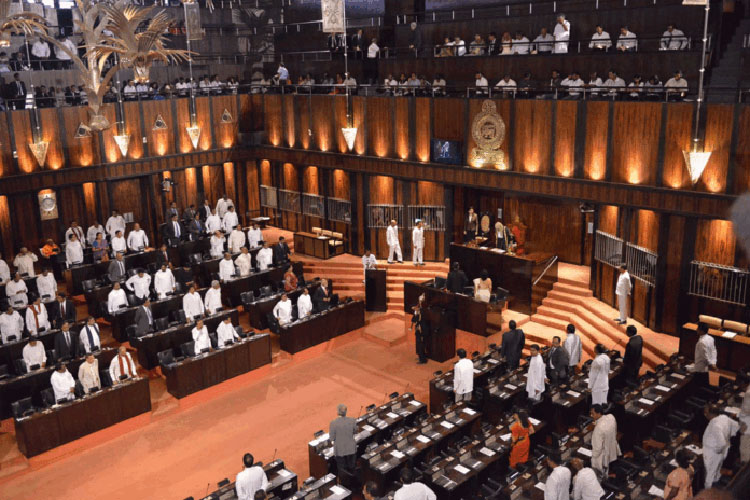
Parliament is to debate next Wednesday the Government’s proposal to abolish the post of Chief of Defence Staff (CDS), with the Second Reading of the Chief of Defence Staff (Repeal) Bill scheduled for September 9.
The Bill seeks to repeal the Chief of Defence Staff Act No. 35 of 2009, which was introduced shortly after the end of the armed conflict.
According to Secretary General of Parliament Kushani Rohanadeera, Parliament will meet from September 8 to 11, with the business for the week approved by the Committee on Parliamentary Business chaired by Speaker Dr. Jagath Wickramaratne.
The debate on the Chief of Defence Staff (Repeal) Bill is scheduled to take place from 11.30 a.m. to 5 p.m. on Wednesday, following questions to the Prime Minister and other parliamentary business.
The CDS post was established under the 2009 Act as part of the country’s higher defence command structure.
On Tuesday, September 8, the House will consider two Orders published in Extraordinary Gazettes under the Motor Traffic Act from 11.30 a.m. to 5 p.m., followed by an Opposition motion at the adjournment.
On Thursday, September 10, Parliament will debate a Resolution under the Women’s Empowerment Act.
The final sitting day of the week, Friday, September 11, has been allocated from 11.30 a.m. to 5.30 p.m. for several Private Members’ Motions.
The motions will cover issues including regulation of the petroleum, fuel and water industries, measures to increase the birth rate, protection of the Diyagama Forest, pension deductions affecting Pirivena teachers, food-crop cultivation in mountainous areas, development of the Kithul industry and the establishment of a Faculty of Medicine at South Eastern University.
Questions at the adjournment will be taken up at the end of each sitting day.

Voting closes in Iceland’s knife-edge EU referendum

Showers in the Sabaragamuwa, Western and North-western provinces and in Galle, Matara, Kandy and Nuwara-Eliya districts

Sun directly overhead Mannar, Periyamadu, Puliyankulam, Welioya and Pulmoddai about 12.11 noon today (30)

Lanka tracks 11 US-sanctioned Iranian tankers off coast

House to debate abolition of Chief of Defence Staff post

Mass graves tragic evidence of failed states – Rathnayake

‘Dates have the highest sugar content to fight Coronavirus’

Sunday Island 27 December – Headlines

#SundayIsland 17th December – Headlines

Sunday Island – 28th March

Sunday Island Headlines – 21 March

Sunday Island – 21st February – Headlines
-

 News5 days ago
Missing doctor’s body found in Mahiyanganaya
-
 News5 days ago
Australia declines to release Finance Secy Suriyapperuma’s citizenship details
-

 News5 days ago
22A: BASL suggests CJ recuse himself from hearing petitions
-

 News2 days ago
Eight politicians in drug kingpin probe
-

 Editorial6 days ago
Govts. drag feet as undergrads age
-
 Features4 days ago
Insights from Chieftains of Uva: Genealogy of two Kandyan Families – Part II
-

 Features4 days ago
Export diversification: Missing the wood for the trees – Part I
-

 Features2 days ago
Redefining ageing in Sri Lanka