
Features
Mid-East violence underscores need for Two-State solution

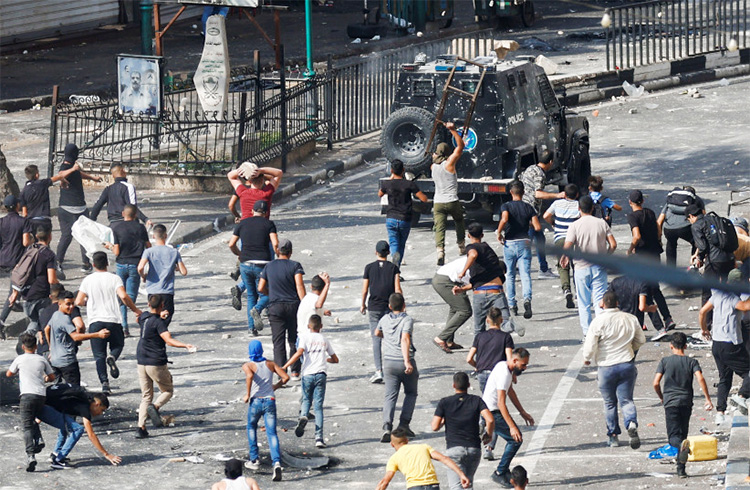
 The current spurt in the spiral of violence in the Middle East could easily lead the concerned observer to conclude fatalistically that the bloody conflict is not at all amenable to a political solution. Yet, all stakeholders to the Middle East problem need to inquire as to whether the exploration of all peaceful options has arrived at an insurmountable dead-end.
Increasing fatalities in the vicious circle of violence necessitate this crucial query, besides other weighty considerations. The international community, one believes, needs to take fresh stock of the Middle East situation and renew efforts to work out a negotiated solution to the wasting conflict.
It should come as a matter of comfort that scores of countries today support what has come to be known as the ‘Two-State solution’ to the Middle East imbroglio. That is, the creation in the contested territories of two states, an Israeli state and a Palestinian state, that would, hopefully, peacefully co-exist. No solution could be more equitable or fair, since the communities concerned have been dispossessed. A study of the history of these principal groups would reveal as much.
Sri Lanka has traditionally staunchly defended the cause of Palestinian statehood and quite rightly. Such a policy position is grounded in the belief that the Palestinian people have been dispossessed over the past decades and there is no doubting the historical record on this score. But what is equally true is that the Israelis too have not possessed a ‘homeland’ in modern times.
Until the early decades of the last century the Israelis were, more or less, a displaced people. We wonder whether Sri Lankan governments over the years have come to realize this. Defending the Palestinian cause is the correct position to take but what needs equal emphasis is the ‘Two-State solution’ that has the potential to address the concerns of the contending parties equitably, provided it is worked out judiciously. Sri Lanka needs to defend the latter policy position more enthusiastically and visibly.
Sri Lanka could very well be ‘on the wrong side of history’ by not supporting the cause of a fair solution to the Middle East conflict, read the ‘Two-State solution’, with visible vigour and audibility. Over the years, more and more UN member states have granted diplomatic recognition to Israeli and are interacting with it on numerous legitimate planes.
As of December 2020, some 165 out of the 193 member states of the UN system had accorded diplomatic recognition to Israel. It is also of interest to note that by 2020, Israel had established diplomatic relations with four Arab League states. They are: Bahrain, the UAE, Sudan and Morocco.
It is no secret that Sri Lanka has been relating to Israel in a number of important areas of interest over the past few years. Israel proved most handy for Sri Lanka in the area of arms purchases during the Lankan state’s 30-year war with the separatist LTTE. Since then, Israel has been of immense help as a provider of employment for Sri Lankans in a number of spheres, besides supporting Sri Lanka in areas, such as, agricultural development and water management, to name just a couple of such forms of assistance. What, then, prevents Sri Lanka from advocating the ‘Two- State solution’ robustly in the forums of the world?
In fact, these times of stepped-up violence in the contested regions of the Middle East could be considered as putting the rest of the world on notice as well that it is lagging in the task of helping to work towards a negotiated solution to the conflict.
Needless to say, the US could play a major role in this peace undertaking because, being Israel’s most powerful ally in the international community, it could bring much pressure to bear on the Israeli government to see the merits of a political solution and convince it of the need to work consistently towards the realization of such a settlement.
However, to begin with, the US would need to impress on Israel that it would need to drastically curtail its settlement activities in the contested territories, since such expansionist projects are a storm centre in the conflict. Concrete measures would need to be taken by the US and other well-meaning members of the world community to render costly for Israel further settlement activities that tend to aggravate security-related fears of the Palestinian community.
Moreover, the overall objective of the peace initiative should be to eliminate the keenly felt security concerns of the major communities concerned. It ought to be plain to see that it is these nagging worries that are compelling the more militant sections among each community to view each other with fear and to resort to arms to resolve such anxieties.
This is a matter for the West as well as those sections of the international community who mean the Israelis and Palestinians well. Another ground-breaking peace initiative seems to be needed which would take off from where the Oslo peace process left off.
Essentially, such a peace enterprise should aim at establishing two neighbouring states that would feel secure in each other’s company. State boundaries would need to be neatly re-demarcated and considered inviolable by both states. Needless to say, this would prove a steep, uphill task but one that would need to be undertaken if a measure of peace is to be brought to the Middle East. It is a challenge for all well-meaning states in the current world order. Accordingly, all peace makers are required to stand up and be counted without further delay because the spiral of violence in the Middle East seems to be intensifying by the day.
Ideally, any future peace effort would need to be grounded on core democratic values. That is, any future peace package should be seen as meeting the just, democratic aspirations of the communities concerned. It goes without saying such an enterprise could only be advanced by the forces of democracy within the main social groups.
Unfortunately, the present Israeli government does not measure-up to all these requirements. But the current public unrest in Israel linked to preserving the independence of the country’s higher judiciary and connected issues, highlights the fact that pro-democracy forces in Israel are vibrant and strong. The durability of peace in the region would also depend on how effectively these forces of democracy are made party to it.




 There is a short story by Gabriel García Márquez, Nobel laureate, master of the human comedy and its agonies, called “I Just Want to Use the Telephone.” A woman breaks down on a Spanish highway, hitches a lift to the nearest town, and simply wants to make a telephone call to tell her husband she will be late. What follows is a Kafkaesque nightmare of misunderstanding, and catastrophic bureaucratic misinterpretation that swallows her whole life. She ends up committed to an asylum. She never makes the call.
Another Nobel laureate, Milan Kundera’s The Joke, in which a Czech student writes a postcard with a harmless witticism, and the machinery of misinterpretation grinds his entire existence to dust. Two writers, two languages, two very different political contexts, and the same essential theme: the terrifying consequences of systems that refuse to think, administered by officials who refuse to listen, imposed on individuals who simply wanted something simple and ordinary.
I thought of both of them, sitting in Room 20 of the Department of Immigration and Emigration (DIE) in Battaramulla, on a perfectly ordinary morning, waiting. I just wanted to get it stamped.
The Stamp
The matter was, on its face, trivially simple. My passport carries an information page stating it is valid until 30 March 2028. It also carries, on the following page, an endorsement, a condition, restricting the passport’s validity to five years, expiring 30 March 2023. This restriction had been imposed, I was informed, because at the time of issuance I did not possess a National Identity Card (NIC) issued by the Department of Registration of Persons (DRP). Once I obtained the NIC, I was told, the condition could be cancelled by a simple further stamp. A straightforward administrative correction. A bureaucratic afterthought.
So, I arrived at the Department of Immigration and Emigration, the DIE, an acronym one cannot help but notice carries its own dark poetry, with the relevant form, the relevant fee, and my NIC. I submitted my application at approximately nine o’clock in the morning. The officer directed me to wait. I waited.
Modern technology is a mercy in such moments. The smartphone, that great time killer, allows us to read, to write, to attend to correspondence, to think. I attended to productive work. The waiting room filled and thinned and filled again around me. The morning gave way to afternoon.
The call came at around four o’clock in the afternoon, a full seven hours, hungry, thirsty, anxious waiting, for a stamp. My NIC had been referred for verification to the DRP which is located in the same building, different floor though, the verification had taken seven hours to travel vertically between floors and return. My passport was finally stamped. The restricting condition was cancelled. I was free to go. Seven hours. One building. Two floors. A stamp.
The Geography of Absurdity
Let us be precise about the geometry of this situation, because precision is what bureaucracy demands of citizens while refusing it for itself.
The information that one department needed from the other, confirmation that a national identity card bearing a specific number belonged to a specific person, is information that both departments already hold, in files, in databases, in the digital records that both institutions have been building for years.
That information was not retrieved electronically. It was not confirmed through an intranet query that would have taken thirty seconds. It was not verified through any of the digital systems that Sri Lanka’s Digital National Strategy 2030 promises to build, or that the World Bank’s $50 million Digital Transformation Project, approved in December 2025, is supposed to finance, or that President Dissanayake, who is himself the minister responsible for digitisation, has repeatedly pledged to accelerate. The information was physically transported, on paper or on foot or through some process that consumed seven hours, between two offices in the same building.
A Retired Banker’s Letter and a Nation’s Pattern
I am not alone in this observation, and I am not the first to make it in print. A well-known retired banker wrote to the letters pages of a national newspaper not long ago with a complaint that has since circulated widely among the professional and business community. His concern was the unnecessary duplication of bureaucratic processes in Sri Lanka’s government agencies, the requirement to submit the same information repeatedly to different departments that have no mechanism for sharing it with each other.
His example was instructive: a company that changes its registered address must deal separately with the Registrar of Companies (RC) and the Inland Revenue Department (IRD), resubmitting information that both institutions already hold. Two forms, two queues, two sets of fees, two sets of officials who will each process the same fact, that the company has moved, in complete ignorance of the other’s proceedings. He contrasted this with South Korea, where customs efficiency and trade facilitation have been systematically modernised, and where single-window processes allow firms to submit information once and have it flow automatically to all relevant authorities.
The contrast is not merely between administrative cultures. It is between two different philosophies of what government is for. In the South Korean conception, and in Singapore’s, and in Estonia’s, and in the many countries that have successfully digitised their public services, government exists to process the citizen’s legitimate needs with minimum friction. In the Sri Lankan conception, as it is actually practised rather than rhetorically proclaimed, the citizen exists to process the government’s requirements, repeatedly, in person, in queues, with multiple original documents, at multiple counters, on multiple occasions, regardless of how many times the same information has already been submitted.
This is not a trivial inconvenience. It is a structural tax on every productive citizen and every legitimate enterprise in the country.
The Rhetoric and the Reality
Digitalisation is, on paper, precisely the intervention that would have prevented my seven-hour wait: a delay that a single intranet query, a database check, or a digital confirmation could have eliminated. The technology is not exotic. The conceptual framework already exists. The international funding is arriving (USD50 Mn from the World Bank). The President has made the speeches.
That lagging did not happen because Sri Lanka lacked talent, the Senior Advisor to the President on Digitalization, Dr. Hans Wijayasuriya, has stated that Sri Lanka already possesses 75% of the necessary skills to build a strong digital economy. It happened because institutional culture, interdepartmental rivalry, and the chronic prioritisation of process over outcome have conspired to keep the citizen in the queue long after the queue should have ceased to exist.
The Innocent and the System
Here is the cruellest feature of the Sri Lankan bureaucratic condition, and the one that García Márquez and Kundera both understood with novelist’s precision: the systems are designed, or have calcified into designs, that punish the innocent for the sins of the guilty.
The five-year restriction on my passport existed because some applicants, in the past, had submitted fraudulent identity documents to obtain passports. The solution was to restrict all passports issued without NIC verification, regardless of the individual applicant’s circumstances, regardless of whether there was any evidence of fraud, regardless of the disproportionate cost imposed on genuine citizens. A few bad actors found a loophole. The system’s response was to close the loophole by inconveniencing everyone else, permanently, until they proved themselves worthy of having the loophole closed in their particular case.
This is the bureaucratic logic that produced the waiting room in Battaramulla. It is also the logic that produced the multiple-submission requirement for company address changes, and the interminable queue at every government counter in every district of the island. The system never trusts the citizen. The citizen must always prove, again and again, what has already been proved. And the cost of that proof, in time, in money, in lost productive hours, in the quiet erosion of civic dignity, is paid not by the officials who designed the system, nor by the fraudsters whose behaviour prompted it, but by the ordinary person who just wanted something simple.
What a Stamp Can Tell You About a Nation
There is a measure used by international organisations to assess the quality of governance in a given country. It asks, among other things, how many days it takes to start a business, how many procedures are required to register property, how many agencies a citizen must visit to accomplish a routine administrative task. Sri Lanka’s scores on these measures have been a source of persistent embarrassment.
The first is genuine inter-agency data sharing, not a pilot project, not a working committee, not a memorandum of understanding that sits unimplemented, but a functioning intranet infrastructure through which the DRP’s identity records are accessible to the DIE, through which the RC’s records are accessible to the IRD, through which the citizen’s information, once submitted anywhere in the system, does not need to be submitted again. The World Bank project promises exactly this. It must be delivered.
The second is a single-window principle applied without exception to all citizen services. If a process requires verification from another agency, that verification is the government’s problem to obtain, not the citizens’. The citizen submits once. The system talks to itself.
The third, and this is the hardest, because it requires not technology but culture, is the genuine subordination of process to outcome. The process exists to serve the citizen’s legitimate need. When it ceases to do so, the process is broken, not the citizen.
García Márquez’s woman never made her telephone call.
Kundera’s student never recovered from his postcard joke.
I got my stamp — eventually.
(The writer, a senior Chartered Accountant and professional banker, is Professor at SLIIT, Malabe. The views and opinions expressed in this article are personal.)
The world marked World Otter Day 2026 recently. Conservationists are warning that Sri Lanka’s rapidly disappearing wetlands, polluted waterways and unplanned development are placing increasing pressure on one of the island’s most elusive freshwater predators, the Eurasian otter (Lutra lutra).
The species, locally known as “Diya Balla”, is the only otter found in Sri Lanka and is regarded as a key indicator of healthy freshwater ecosystems. Yet despite its ecological importance, experts say the animal remains poorly studied and largely overlooked in national conservation planning.
Naturalist and conservationist Chaminda Jayasekara, who has spent years documenting otters in Sri Lanka, said the species is facing mounting environmental pressures across the island.
Speaking to The Island, Jayasekara said habitat destruction, chemical pollution, road kills, sand mining, and increasing human disturbance are fragmenting the waterways on which otters depend.
“Otters are extremely sensitive animals. When wetlands are degraded or rivers become polluted, they disappear very quickly. Their survival is directly linked to the health of freshwater ecosystems,” he said.
Jayasekara, who specialised in MSc Environmental Management at the University of Hertfordshire, noted that while the species has been recorded across Sri Lanka’s wet zone, dry zone and coastal wetlands, scientific data on population numbers and distribution remain limited.
According to him, the decline of wetlands has become one of the most serious environmental issues facing Sri Lanka. Marshes, mangroves, irrigation tanks and riverine habitats are increasingly being altered by urban expansion, tourism infrastructure, encroachment and agricultural runoff.
He warns that the loss of these habitats not only threatens otters, but also weakens flood control systems, freshwater security and biodiversity resilience at a time when climate-related disasters are becoming more frequent.
Jayasekara said otters play a vital ecological role by helping maintain balanced fish populations and healthy aquatic ecosystems.
“When otters thrive, it tells us the river system is functioning properly. Their presence is a sign that water quality, fish diversity and habitat conditions remain healthy,” he explained.
One of the best-known locations for otter sightings in Sri Lanka is Aranga Pond, within the Horton Plains National Park, where the species has adapted to the island’s cold montane ecosystem.
However, conservationists stress that even protected areas are not immune to broader environmental degradation occurring outside park boundaries.
Jayasekara’s own work on otters gained prominence through long-term conservation efforts at Jetwing Vil Uyana, where a former degraded chena landscape was restored into a functioning wetland ecosystem.
The restored habitat eventually attracted Eurasian otters, fishing cats, grey slender lorises and numerous wetland bird species.
Over 14 years, Jayasekara carried out field observations, camera trapping and awareness programmes involving hotel staff, surrounding schools and local communities.
“What happened at Vil Uyana clearly showed that habitat restoration works. If degraded ecosystems are given time to recover, wildlife can return naturally,” he said.
He added that wetland restoration should become a central component of Sri Lanka’s environmental policy, particularly as climate change intensifies droughts, floods and biodiversity loss.
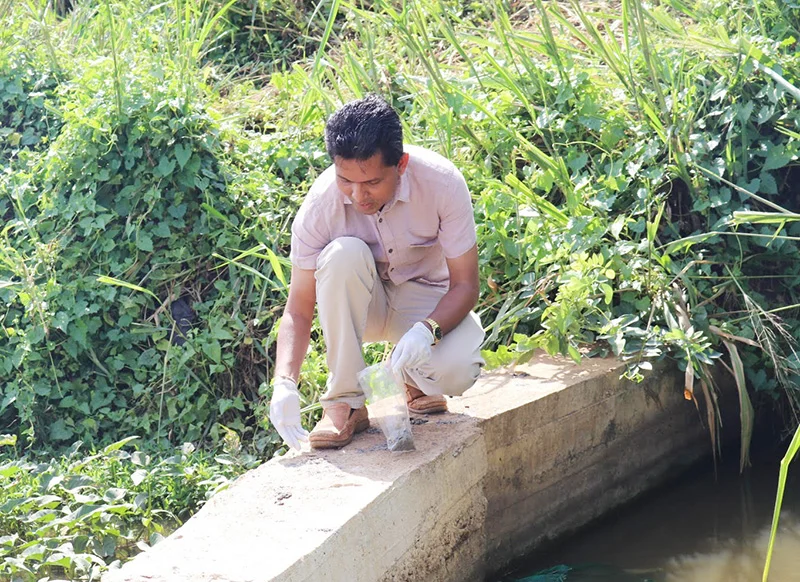
Chaminda collecting scat for research purposes in Sigiriya
He says wetlands are among the planet’s most productive ecosystems, functioning as natural water filters and carbon sinks while providing breeding grounds for fish, amphibians and aquatic mammals.
Yet globally, wetlands are disappearing at an alarming rate, and Sri Lanka is no exception.
Conservation groups have repeatedly warned that illegal waste disposal, pesticide contamination and poorly planned infrastructure projects are severely affecting freshwater ecosystems throughout the country.
Jayasekara also highlighted the importance of stronger environmental education and community participation in conservation.
“Awareness is still very limited. Many people living close to wetlands do not realise the ecological importance of otters or the threats they face,” he said.
According to him, involving local communities in conservation monitoring is essential if Sri Lanka hopes to safeguard the species in the long term.
He also pointed to the growing international interest in otter conservation.
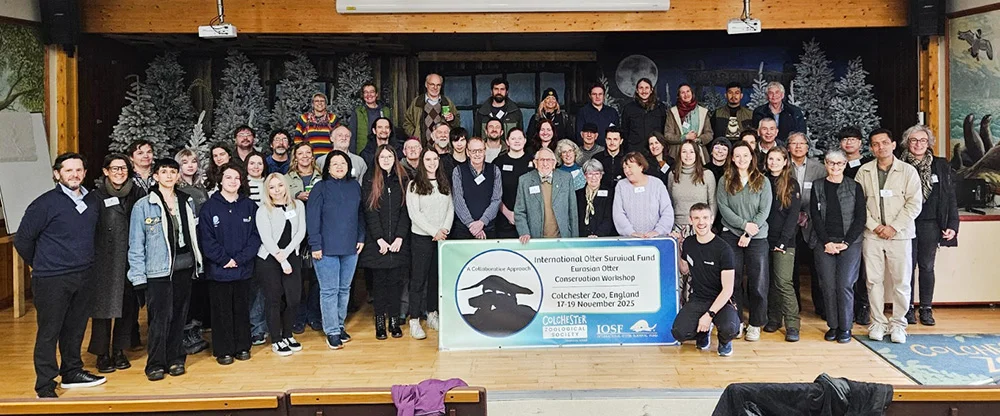
In November 2025, Jayasekara represented Sri Lanka at the International Eurasian Otter Conservation Workshop held at Colchester Zoo and organised by the International Otter Survival Fund.
The workshop brought together nearly 100 researchers, conservationists and wildlife experts from 33 countries to discuss emerging threats facing Eurasian otter populations.
Jayasekara presented Sri Lanka’s experience under the theme Rewilding Through Hospitality, focusing on how habitat restoration and sustainable tourism practices at Vil Uyana contributed to otter conservation.
“The international response was extremely encouraging. Many delegates were surprised that a tourism property in Sri Lanka had quietly carried out wetland conservation work for more than a decade,” he said.
Discussions at the workshop also examined wider environmental concerns including river pollution, declining fish stocks, illegal killings and habitat fragmentation affecting otter populations across Europe and Asia.
New conservation technologies such as AI-assisted wildlife tracking and environmental DNA surveys were also highlighted as emerging tools for monitoring elusive species.
Jayasekara said Sri Lanka urgently requires more scientific surveys, stronger environmental law enforcement and greater investment in freshwater conservation research.
He warned that unless wetlands and waterways are protected, several lesser-known freshwater species could face severe decline in the coming decades.
Environmentalists say otter conservation should not be viewed in isolation but as part of a broader effort to protect entire freshwater ecosystems that millions of Sri Lankans depend on for drinking water, irrigation and livelihoods.
He further noted that healthy wetlands also strengthen climate resilience by absorbing floodwaters, reducing soil erosion and supporting groundwater recharge.
As Sri Lanka experiences increasingly erratic weather patterns linked to climate change, conservationists argue that protecting wetlands is becoming both an ecological and economic necessity.
Jayasekara believes Sri Lanka still has an opportunity to become a regional example in balancing tourism, biodiversity conservation and habitat restoration.
“The otter teaches us an important lesson,” he said. “If rivers are protected and wetlands are respected, nature has an incredible ability to recover.”
This year’s observance of World Otter Day 2026 is, therefore, serving not only as a celebration of one of the world’s most charismatic mammals, but also as a reminder of the urgent need to conserve the fragile freshwater ecosystems upon which both wildlife and human communities ultimately depend.

Eurasian otter
By Ifham Nizam
In their Vesak messages this year, President Anura Kumara Dissanayake and Prime Minister Harini Amarasuriya highlighted the values of reconciliation, coexistence and justice as essential to Sri Lanka’s future. President Dissanayake emphasised that Buddhism’s teachings remain deeply relevant to contemporary society and described Vesak as a symbol of “mutual understanding, unity and coexistence among all communities” and of reconciliation itself. Prime Minister Amarasuriya similarly called for the building of a society in which justice is assured to all irrespective of caste, race or religion. These messages were not merely religious aspirations, they were a direct challenge to the most serious failures in Sri Lanka’s post-independence history. These include the three-decade-long war, its human rights violations and the inability to implement a political solution.
These have been and continue to be the challenges that have prevented Sri Lanka from reaching its full potential. Added to this have been the persistence of social and economic inequalities that continue to marginalise communities at the bottom of the social hierarchy. One of the most enduring examples of such injustice is the experience of the Malaiyaha Tamil community. The scale of the original exclusion is worth understanding clearly. According to the 1946 Census, the Malaiyaha Tamil community numbered approximately 780,600 persons and constituted 11.73 percent of the country’s population making them the second largest ethnic community, larger than the Sri Lankan Tamil community who numbered 733,700 or 11.02 percent of the population at the time
The denial of citizenship and voting rights to the Malaiyaha Tamil community was the first major injustice inflicted on an ethnic minority in post-independence Sri Lanka. The consequences were devastating and long-lasting. A community that had contributed enormously to the country’s economy through its labour on the plantations was excluded from political participation and denied basic rights. This was a political and moral failure that cast a long shadow over the country’s post-independence history. Responsibility for that injustice needs to be shared widely. Political leaders across ethnic lines failed to resist it. The result was the marginalisation of a community whose contribution to national prosperity far exceeded the recognition it received. Today, nearly eight decades later, Sri Lanka has an opportunity to correct that historic wrong but only if economic reform is matched by genuine social inclusion.
Longstanding Grievances
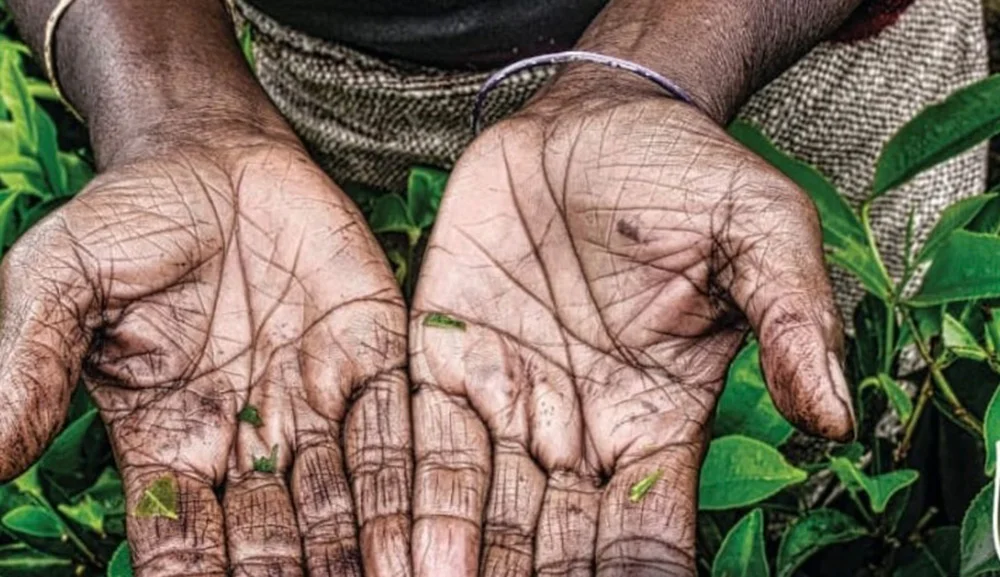
The NPP government has repeatedly acknowledged the need to address the longstanding grievances of the Malaiyaha Tamil people. In its election manifesto, the NPP pledged to improve living conditions in plantation areas, strengthen land and housing rights, ensure equal access to education and public services, and integrate plantation communities more fully into national development. The NPP’s Nuwara Eliya Declaration of 2023 similarly recognised that the plantation community had suffered generations of exclusion and promised measures to address disparities in housing, land ownership, infrastructure, education and economic opportunity. The need for such action is plain to see. While citizenship issues have largely been resolved over time, the socio-economic consequences of decades of exclusion remain deeply entrenched and continue to shape daily life in plantation communities. A conference organised by the Institute of Social Development to mark International Tea Day on May 21 at the BMICH brought out this and many other salient issues. Headed by P Muthulingam the organisation has advocated for the rights of the Malaiyaha Tamil people for the past 35 years to be equal citizens who enjoy social and economic justice.
The central problem facing many plantation workers is the low level of income they receive. Daily wages remain among the lowest in the country relative to the difficulty and intensity of the work. Plantation labour continues to depend heavily on methods that have changed little over generations. Productivity remains low compared to competing tea-producing countries — not because workers lack capability, but because sustained investment in their welfare, skills and economic mobility has been withheld. Workers consequently remain trapped in a cycle of low wages and limited economic mobility. Their housing situation compounds these difficulties. Many plantation families continue to live in housing owned either by plantation companies or the state. Lack of secure ownership limits their ability to accumulate assets, access credit or make independent decisions regarding their future. When Cyclone Ditwah damaged plantation housing, it exposed the inability of those living in that housing to access state compensation as they did not own the housing in which they lived.
The problems extend beyond the central highlands. Plantation workers living in private estates and smallholdings in other parts of the country face similar challenges. A recent Amnesty International report documented serious abuses affecting Malaiyaha Tamil workers in private tea estates in the Southern Province. These include wage withholding, debt dependency, restrictions on movement and intimidation and practices the report argued correspond to internationally recognised indicators of forced labour. These findings are not peripheral. They reveal that the structural exclusion of the Malaiyaha Tamil community is not a relic of the past but an active, ongoing condition. Economic vulnerability and social marginalisation continue to leave many plantation workers without effective protection or access to justice. It is against this backdrop that the government’s recent plantation reform initiative assumes special significance.
Second Phase
The government has announced the second phase of a programme to make underutilised plantation lands and assets available for investment. The objective is to transform underperforming assets into productive enterprises capable of generating employment, attracting investment and revitalising regional economies. The programme seeks to modernise the plantation sector, improve productivity and create new opportunities in tourism, renewable energy and export-oriented industries. These objectives are necessary and welcome. However, economic reform alone will not be sufficient and Sri Lanka’s own history provides the warning. Previous rounds of plantation modernisation pursued productivity gains without addressing the structural disempowerment of the people at the centre of the industry. The result was investment that generated wealth without distributing it. The workers who produced the wealth were once again treated as labour inputs rather than as beneficiaries. If the current reform follows the same logic, it risks reproducing the same failure.
For reform to succeed, plantation workers must be recognised not merely as a labour force but as stakeholders with rights, aspirations and a legitimate claim to share in the benefits of development. Housing ownership, secure land tenure, quality education, vocational training and entrepreneurship need to be built into the reform process from the outset. The government’s commitments to the Malaiyaha Tamil community therefore need to be incorporated into every stage of the reform process. On the contentious question of land, the government should consider establishing an independent national land commission. Such a body should include respected government officials, professionals and representatives from all ethnic and religious communities. It should review land policy comprehensively, develop transparent principles for allocation and use, ensure fairness in decision making and provide a trusted mechanism for resolving disputes. A credible land commission would help build public confidence that land reforms are being undertaken in the national interest rather than for the benefit of particular groups.
The correction of historic injustices should not be viewed as a concession to one community. It should be understood as an investment in national unity, because societies do not become stronger by maintaining the exclusion of those they have wronged. On the contrary, they become stronger by ending it. The first great injustice committed against an ethnic minority after independence cannot be undone. But its consequences can be addressed, and doing so would strengthen reconciliation, enhance social cohesion and bring Sri Lanka closer to the vision of a country in which all communities live with equal dignity and equal hope. This is what the Vesak messages of the President and Prime Minister promised. The plantation reform now underway is the moment to make good on that promise not in words alone, but in sustained policy that endures beyond any single government and reaches the people who have waited longest for it.
by Jehan Perera

Battling Australia force series decider as questions grow for Pakistan

West Indies bowl vs Sri Lanka, Hetmyer not in the XI

Implementation of water supply projects in small town and rural areas.
Cabinet nod to submit Import and Export (Control) Regulations No. 04 of 2026 to Parliament for its concurrence
Declaration of Elephant Migratory Corridors to minimize HEC in Monaragala and Hambantota districts

Qualifier Maja Chwalinska extends dream French Open run

‘Dates have the highest sugar content to fight Coronavirus’

Sunday Island 27 December – Headlines

#SundayIsland 17th December – Headlines

Sunday Island – 28th March

Sunday Island Headlines – 21 March

Sunday Island – 21st February – Headlines
-
 News5 days ago
IMF urges Lanka not to meddle with exchange rate
-
 Business6 days ago
Sri Lanka’s construction industry losing ground while no one watches
-
 Business3 days ago
IMF’s unstated rate:Sri Lanka’s $695m loan costs about 5.33% per annum
-

 News2 days ago
Lankan duo emerge winners in Latin dance championship held in Blackpool, UK
-
 News5 days ago
State of emergency extended
-

 Features6 days ago
The Division Bell Mystery
-
 News3 days ago
UNP challenges NPP move to amend Vihara – Devalagam Act
-
 Features4 days ago
Are threats to Buddha Sasana external or from within?