
Business
CSE makes move to invigorate listing process


The Colombo Stock Exchange (CSE) has launched an action plan to address key areas relating to the process of listing a company on the CSE with the objective of enhancing its efficiency thereby better serving the funding requirements of companies belonging to both state and private sectors. The action plan will further simplify the process, eliminate any redundant approval steps, reduce documentation and improve the time to market for companies’ new and follow-on offerings of equity and debt.
Measures have already been taken to change listing criteria by offering a wider choice of listing options for companies, further amend the listing rules to enable a simplified process in addition to carrying out changes to internal infrastructure of the CSE to ensure a smoother process workflow.
Commenting on the new plan to streamline the listing process, CSE Chairman Dumith Fernando said “Increasing the number of companies listed on the exchange is one of the CSE’s key strategic objectives. We have to make exponential progress on this front. As businesses approach the post-COVID period, it is likely that funding will be a top priority and we have versatile options available to address the different funding requirements of corporates. We have put in place systems and processes to cater to an ever-evolving business landscape in Sri Lanka and we stand ready to meet the requirements of our corporate stakeholders. We strongly believe that the steps we are taking to simplify the listing process would attract more companies to raise capital through the CSE helping them unlock value and create wealth for their shareholder.”The CSE has already commenced stakeholder engagement to obtain feedback to carry out further improvements to the CSE’s overall Listing process.
Improvements expected from this new CSE plan include the reduction of documentation that have to be submitted with the Listing Application and the removal of certain disclosures in the Prospectus/Introductory Document. In this connection, the CSE would commence discussions with the Securities and Exchange Commission of Sri Lanka (SEC) to streamline the current dual approval process.
Another significant change by the CSE is the introduction of a ‘Single Window’ customer relationship unit that will be set up within the CSE to identify potential listing candidate companies, work with such companies and assist them through the listing process. This will make it easier for companies and their advisors to understand and address any problems faced in the process through a single point of contact.
With the objective of further enhancing the transparency of the listing process, an online tracking tool for all listing applications that have been submitted to the CSE will also be introduced, which would provide Issuers with more transparency in tracking the status of their respective applications and understanding which parties hold primary responsibility at each step of the process.
The CSE now offers equity or debt based fundraising options for companies of all sizes, from large conglomerates to SMEs, through versatile listing platforms such as the Main, Diri Savi and Empower Boards.


Janashakthi Life, the flagship company of JXG (Janashakthi Group), delivered a strong first-half performance in 2026, with Gross Written Premiums (GWP) increasing by 36% year-on-year to Rs. 5.11 billion. The Company’s growth significantly outpaced the industry’s 20.8% growth during the period, reflecting continued demand for its life insurance solutions and progress in expanding its customer base and strengthening its market presence.
The Company’s balance sheet also continued to expand, with total assets increasing to Rs. 41.14 billion as at Q2 2026, compared to Rs. 40.37 billion at the end of 2025. The growth reflects the continued scale of the business and provides a stronger platform to serve an expanding policyholder base while investing in the capabilities required to support its next phase of growth.
During the first half, Janashakthi Life paid Rs. 2.24 billion in claims and benefits, reaffirming its commitment to supporting policyholders when it matters most. These payments provide essential financial support at critical moments in the lives of individuals and families, highlighting the vital role of life insurance in protecting their financial wellbeing and long-term security.
The Company remained profitable during the period, recording Profit Before Tax (PBT) of Rs. 271 million, excluding the surplus transfer for the period. With the declaration of the surplus transfer, profitability is expected to be substantially higher. Janashakthi Life remains focused on strengthening earnings quality, managing costs effectively, and translating business growth into sustained improvements in overall performance.
Annika Senanayake, Chairperson of Janashakthi Insurance PLC, said, “The performance in the first half reflects the strength of Janashakthi Life’s business and the opportunities that exist to further develop the life insurance market in Sri Lanka. We remain focused on building a business that combines sustainable growth with sound fundamentals, while making insurance more accessible to a wider segment of the population. As part of JXG, Janashakthi Life is well positioned to leverage the Group’s financial services ecosystem and continue strengthening its position in the market.”
Ravi Liyanage, Director/CEO of Janashakthi Insurance PLC, said, “The first half delivered strong growth across key areas of the business, with GWP increasing 36% to Rs. 5.11 billion. In all key segments, namely regular business, group life business and single premium business, the Company has outperformed the industry significantly, demonstrating its market challenger behaviour. The Company is strengthening its stability, crossing LKR 41 billion in assets under management. Our focus now is on building on this momentum through stronger distribution, improved productivity and disciplined cost management, while continuing to enhance the customer experience by providing an unmatched service throughout the lifespan of the service contract.”
The first-half performance provides a strong platform for Janashakthi Life to build on its growth plans for the remainder of the year. The Company will continue to focus on expanding access to life insurance, strengthening customer relationships and developing solutions that respond to changing financial priorities.
With GWP growth significantly ahead of the industry, a growing asset base and increased claims and benefits delivered to policyholders, Janashakthi Life continues to build scale across its core operations. The Company remains focused on disciplined growth, stronger execution and improving the quality of its performance, with the objective of creating sustainable value for policyholders, shareholders and the wider business.
Further reinforcing its strong market standing, Janashakthi Life was recognised among Sri Lanka’s 50 Best Workplaces™ for 2026 by Great Place To Work® Sri Lanka and was also named among Brand Finance’s Sri Lanka 100 Most Valuable Brands. These recognitions reflect the Company’s continued focus on building a strong brand, delivering value to customers and creating a high-performing organisation. (JXG)
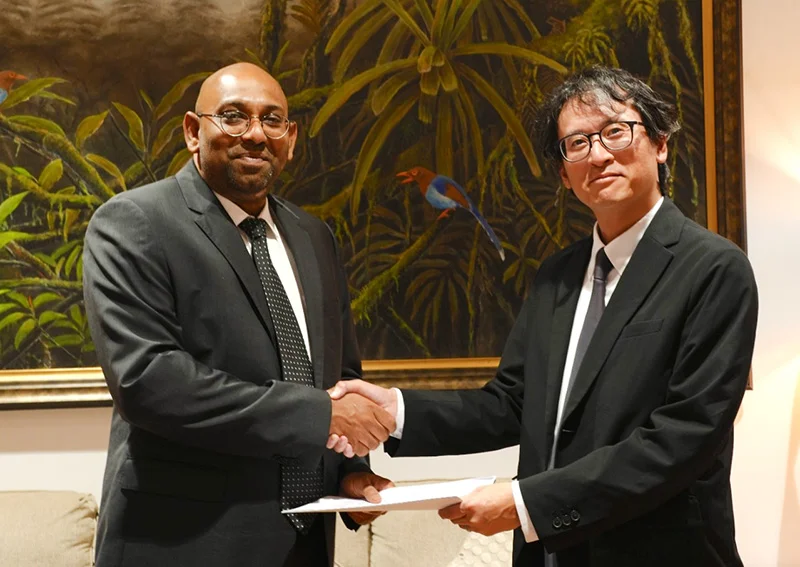
Major Japanese business group sees long-term potential in Hunas Holdings as the two organisations explore new opportunities for growth in Sri Lanka
Hunas Holdings PLC is entering a new phase of growth through a collaborative partnership with CCH Co., Ltd. (CCH INC.), a major Tokyo-based business group with experience across business process outsourcing (BPO), in-house services, investment, mergers and acquisitions, and business development.
The partnership follows a period in which Hunas Holdings maintained a measured approach to new investments amid volatile market conditions, focusing on identifying the right opportunities and international relationships capable of creating sustainable long-term value.
Founded in Japan in 2008, CCH has grown into a significant and diversified business group with interests across multiple industries. Its approach combines investment with M&A, business development and operational expertise, enabling the company to play an active role in the businesses and markets it enters.
For CCH, the partnership represents an opportunity to bring this experience to Sri Lanka through Hunas Holdings, an established local group with a strong platform and long-term growth ambitions.
Yoshihiko Tanabe, Director of CCH Co., Ltd., said: “Through our discussions with Hunas Holdings, we see a company with strong foundations, local expertise and a clear ambition for growth. We believe there is meaningful potential in bringing the strengths of CCH and Hunas Holdings together. I am excited about this partnership, and particularly about some of the projects and opportunities we are already exploring together. There is much to look forward to soon”
For Hunas Holdings, the collaboration marks a renewed chapter of investment and international partnership, while for CCH, it reflects confidence in Hunas Holdings and the opportunities presented by the Sri Lankan market.

Dr. Harini Amarasuriya, Prime Minister of Sri Lanka, will deliver the keynote address at a special session on day 2 of the Sri Lanka Economic & Investment Summit 2026 organised by The Ceylon Chamber of Commerce, titled “Nation Building in the Digital Age”, on 13 October 2026 at the Shangri-La Colombo.
The session will examine how Sri Lanka can use artificial intelligence, digital transformation, innovation and education to accelerate economic growth, improve productivity and build a knowledge-driven economy. As technology reshapes industries and the nature of work, the discussion will focus on how Sri Lanka can develop the capabilities needed to remain competitive and create opportunities for future generations.
The Prime Minister will be joined by Waruna Sri Dhanapala, Secretary, Ministry of Digital Economy; Prof. Roshan Ragel, Senior Lecturer in Computer Engineering, University of Peradeniya; and Sanjay Shah, Founder and CEO, Elevante AI, who together will add perspectives from government, academia, and industry. Vinod Hirdaramani, Chairman of Hirdaramani Group and Deputy Vice Chairperson of The Ceylon Chamber of Commerce, will moderate the session.
The discussion will look at the opportunities and challenges presented by emerging technologies, including artificial intelligence and automation, and their potential to transform industries and create new areas of economic activity. It will also consider the role of digitalisation in improving public services and supporting entrepreneurship.
Education and skills development will be another important part of the conversation, particularly as the demand for new capabilities grows alongside technological change. The panel will consider how Sri Lanka can prepare its workforce for future jobs while developing an environment that supports innovation and technology-led businesses.
The session will also look beyond technology itself to the wider conditions needed for a digital economy to grow. Policy, investment, infrastructure, education and collaboration between government, industry and academia will all have a role in determining how effectively Sri Lanka can turn technological change into economic opportunity.
Held under the theme “Positioning Sri Lanka in a Changing Global Economy: Resilience, Reform, and the Future of Economic Policy,” SLEIS 2026 will offer perspectives from senior policymakers, business leaders, investors and international experts over two days of discussions on Sri Lanka’s economic direction, investment opportunities and the reforms needed to support future growth.
Registrations are now open at https://sleis.chamber.lk/. For more information, contact Alikie on 011 558 8805 (alikie@chamber.lk) or Shanuka on 0701082541 (events.division@chamber.lk).

Sun directly overhead Madampe, Thorayaya, Thotagamuwa, Rattota and Kalavanchikudy about 12.09 noon today (03)

Afternoon thundershowers in the Northern, North-central, Eastern and Uva provinces in next few days, starting from today (03).

22A: SC urged to suspend hearing, appoint full bench

Govt. seeks NATO assistance

Recent ‘Ice’ detection at the Colombo Port made on US intelligence – Embassy

Sri Lanka launches National Food Safety Policy with support from FAO and EU

‘Dates have the highest sugar content to fight Coronavirus’

Sunday Island 27 December – Headlines

#SundayIsland 17th December – Headlines

Sunday Island – 28th March

Sunday Island Headlines – 21 March

Sunday Island – 21st February – Headlines
-

 News6 days ago
Eight politicians in drug kingpin probe
-

 Features4 days ago
“Wrap Me Up in My Blazer”— A Gentlemanly Bradby Reminiscence
-

 Business6 days ago
Sri Lanka opens up: A new season of direct connectivity
-

 Features3 days ago
When Sri Lankan stories find their own voice
-

 Features6 days ago
Redefining ageing in Sri Lanka
-

 Editorial6 days ago
The toxic legacy of two lakes
-

 Business6 days ago
Jaffna Teaching Hospital secures lifeline water supply via ADB-funded Thalaiyadi sea water desalination plant
-

 Features4 days ago
JVP/NPP government as seen from outside by Lionel Bopage now domiciled in Australia