
News
GL: ‘Aswesuma’ flawed, fresh scheme needed


frowns on privileged status to wealthy investors, bid to restore dissolved LG bodies
By Shamindra Ferdinando
Top Opposition Spokesman Prof. G. L. Peiris yesterday (02) demanded that the government cancel, what he called, the deeply flawed ‘Aswesuma’ social security project, to pave the way for a fresh scheme. Addressing the media at the Nawala Office of the breakaway SLPP faction, Nidahasa Janatha Sabhawa, the former External Affairs Minister dealt with the passage of the resolution on the ‘Domestic Debt Optimisation’ (DDO) in Parliament, the previous day, a move to amend three Acts in order to give the subject Minister (Prime Minister Dinesh Gunawardena) powers to restore dissolved local government authorities and ‘Aswesuma’
that caused countrywide turmoil.
Pointing out that several SLPP members had skipped Saturday’s vote on the resolution on DDO, National List lawmaker emphasized that the Wickremesinghe-Rajapaksa government unfairly burdened the Employees Trust Fund (EPF). Having repeatedly assured that the EPF with funds amounting to Rs 3 trillion wouldn’t be undermined in the DDO process, the government had targeted the country’s largest fund, Prof. Peiris said. That was nothing but a cruel attack on those struggling to make ends meet, the academic said.
The resolution received 122 votes while 62 voted against. Forty-two MPs abstained.However, the government conveniently left out wealthy investors who had no hesitation in taking advantage of the country’s predicament, the former minister said.
After Governor of the Central Bank Dr. Nandalal Weerasinghe declared bankruptcy in April 2022, wealthy financiers had invested in sovereign bonds at extortionate rates of interest. “Their motive was to make use of the perilous state of our economy to make a killing. They sought unconscionable profits in as short a time as possible. While the rates payable to these wealthy investors are left untouched, interest to be earned by the working people who are beneficiaries of the EPF has been reduced by the rate of income tax payable by the EPF being increased from 14 pc to 30 percent if fund declined to participate in the seriously flawed DDO exercise,” Prof. Peiris said.
The people should realise that the EPF’s participation was therefore not voluntary but enforced Prof. Peiris said. Therefore, the government strategy is not consistent with social equity, the dissident SLPPer said.
Prof. Peiris said the DDO process had been placed under the control of Finance Minister Ranil Wickremesinghe.Commenting on the raging controversy over the ‘Aswesuma’ programme, Prof. Peiris said that disruption that had been caused by ill-advised government was so much, the project couldn’t be repaired under any circumstances. There couldn’t be any other option than cancelling the announced list of beneficiaries and launching a fresh initiative as soon as possible to identify those who really required government assistance.
Pointing out that there had been well over half a mn public appeals and complaints in this regard, Prof. Peiris asked the government not to shift the blame to officials but to accept responsibility and initiate what he called a scientific examination of the poor with required technical expertise.
Those who planned to replace ‘Samurdhi’ with ‘Aswesuma’ ended up with egg on their face for want of a cohesive plan to identify the needy. The ex-minister dismissed a recent government declaration that remedial measures would be taken once appeals and complaints were received by July 10 as propaganda. “The system is so inconsistent with requirements, it cannot be salvaged by patchwork,” the MP said.
The senior politician said that the SLPP should be ashamed that one of its National List MPs, Jayantha Kategoda proposed to empower the Minister of Local Government to restore dissolved Local Government authorities. Declaring SLPP rebels’ intention to challenge the government move in the Supreme Court, Prof. Peiris said that the ruling SLPP and UNP with just one MP in parliament were trying to skip elections at all levels.







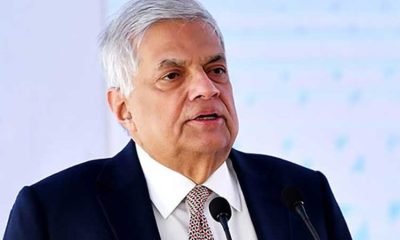

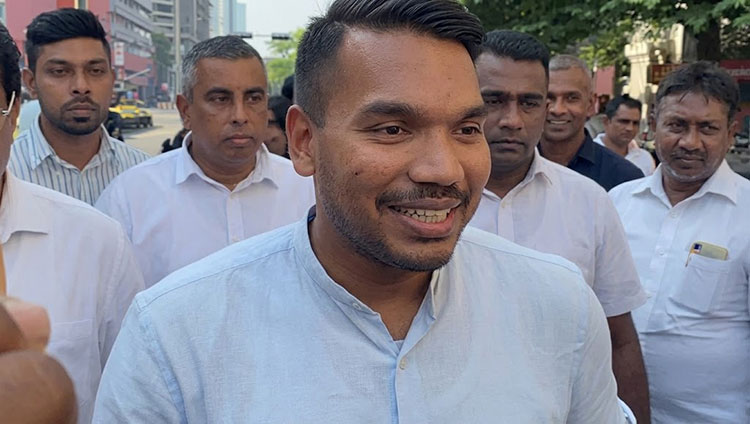
Sri Lanka Podujana Peramuna (SLPP) Member of Parliament Namal Rajapaksa has been arrested by the Commission to Investigate Allegations of Bribery or Corruption (CIABOC).
Namal Rajapaksa had been summoned by CIABOC to provide a statement in connection with investigations into the controversial Airbus deal. He was subsequently arrested by CIABOC after recording his statement for over 5 hours.
Latest News
Sun directly overhead Nittambuwa, Algama, Malwana, Aranayake, Meegahakiula and Panamkadu about 12.09 noon today (04)


The sun is going to be directly over the latitudes of Sri Lanka from 28th of August to 07th of September due to its apparent southward relative motion.
The nearest places of Sri Lanka over which the sun is overhead today (04) are Nittambuwa, Algama, Malwana, Aranayake, Meegahakiula and Panamkadu about 12.09 noon.
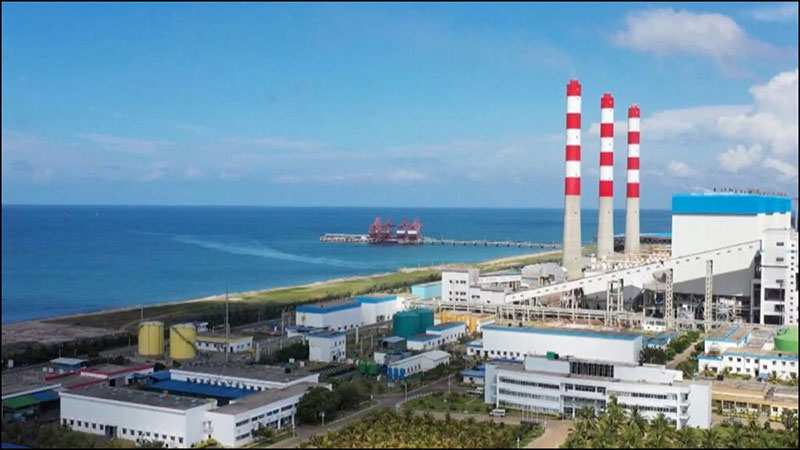
Plant’s output cut from 270 MW to 140 MW amidst dwindling stocks; energy analysts warn system remains “at a razor’s edge”
By Ifham Nizam
The Norochcholai coal-fired power plant is now digging into the last dredges of its coal stock, with two operational units forced to slash generation from around 270 MW to just 140 MW on Sunday as the plant ran critically short of fuel, according to independent energy analysts and sources familiar with the National System Operator (NSO).
The sudden reduction of approximately 130 MW in coal generation has once again exposed the fragile state of the country’s power supply arrangements, with the plant understood to have coal stocks sufficient only until Friday night.
“This is not how a coal plant is expected to operate. They are digging up the last dredges of coal from the plant,” an independent energy analyst told The Island.
The analyst questioned why the units had been allowed to reach this stage without earlier intervention, arguing that at least one unit should have been deloaded around 10 days ago to conserve the remaining coal.
Had that been done, the analyst said, the country could also have reduced its dependence on more expensive diesel-fired generation during the period when
coal stocks were being conserved.
The latest NSO generation figures highlight the continuing pressure on the system.
Around 7 p.m. on Sunday, when the night peak was reached, total demand stood at 2,552.7 MW. Coal contributed only 282 MW, while major hydro accounted for 1,215.8 MW and thermal-oil generation for 791.9 MW.
The night peak of 2,552.7 MW was substantially higher than the daytime peak of 2,246 MW, according to the NSO Generation Summary for August 30.
The most immediate concern is the remaining coal stock at Norochcholai.
Sources said the plant has coal only to Friday night, making the timing of the next shipment critical.
The first shipment under the emergency arrangement is expected to arrive on Friday, September 4, but the coal unloading will have to begin on the same day if
the power plant is to continue operating without further significant deloading.
That creates another potential vulnerability, with rough sea conditions posing an additional challenge to unloading operations.
Energy sector sources said that even the arrival of the September 4 shipment would not completely eliminate the danger.
The next shipment under the new coal tender would need to commence unloading around September 15. Any significant delay beyond that could again force the Norochcholai units to operate at reduced output.
“We are still at a razor’s edge”
The independent energy analyst said the situation should not be viewed merely as a question of whether a particular vessel arrives on time.
The situation also means that any further reduction in coal generation could have a direct impact on the use of oil-fired power generation, potentially increasing the cost of electricity generation.
The latest NSO figures already show the important role being played by thermal-oil generation during the evening peak, when demand rises sharply.
The analyst questioned the rationale behind allowing the coal units to continue operating at higher loading until stocks reached critically low levels instead of taking measures earlier to stretch the available inventory.

SLPP MP Namal Rajapaksa arrested by CIABOC

Devapathiraja clinch U15 Division I title with 33-run win over Royal

Mandhana’s record ton powers India into semi-finals

Sun directly overhead Nittambuwa, Algama, Malwana, Aranayake, Meegahakiula and Panamkadu about 12.09 noon today (04)

Showers expected in the Uva, Central and Eastern provinces and in Polonnaruwa and Mullaittivu districts after 2.00 p.m

Norochcholai digs into dwindling coal stocks, two units slash generation

‘Dates have the highest sugar content to fight Coronavirus’

Sunday Island 27 December – Headlines

#SundayIsland 17th December – Headlines

Sunday Island – 28th March

Sunday Island Headlines – 21 March

Sunday Island – 21st February – Headlines
-

 Features6 days ago
“Wrap Me Up in My Blazer”— A Gentlemanly Bradby Reminiscence
-

 Features5 days ago
When Sri Lankan stories find their own voice
-
 Features6 days ago
JVP/NPP government as seen from outside by Lionel Bopage now domiciled in Australia
-

 News5 days ago
BASL takes exception to Justice Ganepola being denied a place in SC
-

 Editorial7 days ago
Govt. trying to dupe UN Rapporteur?
-
 Features6 days ago
Prof. Savitri Goonesekere: What has she done?
-

 News2 days ago
Denied of promotion to SC despite vacancies, justice Gurusinghe retires
-

 Features6 days ago
World Trade Politics: Canada rebuffs Trump’s tariff blackmail