
News
Canada supports new ‘Enabling Access to Justice for Victim Survivors of SGBV’ project in Lanka


Despite national policy achievements, violence against women in Sri Lanka is pervasive and exists in the family, the workplace and the community. This is largely due to prevailing inequality between genders steeped in social norms and women being socially and economically disadvantaged, United Nations Population Fund (UNFPA) in Sri Lanka said in a release.
One in five (20.4%) women in Sri Lanka have experienced sexual and/or physical violence by an intimate partner in their lifetime; and 1 in 4 women (24.9%) have experienced sexual and/or physical violence since the age of 15 (UNFPA, 2019). But only over one third (37.3%) and one fifth (21.6%) of victims sought support respectively from the police and health care centers.
To bring about a justice sector approach to addressing sexual and gender-based violence (SGBV) against women and girls, and gender minorities in the country, the United Nations Development Programme (UNDP) in coordination with the UNFPA in Sri Lanka working together with the Ministry of Justice (MoJ) will design and implement the ‘Enabling Access to Justice for Victim-Survivors of Sexual and Gender Based Violence (SGBV) in Sri Lanka’ project with funding from the Government of Canada. The five-year project launched today will empower women, girls and gender minorities, including victim survivors of SGBV to access justice, demand and receive better services, and work towards a society free of SGBV.
The proposed interventions of the project aims at creating transformative change through a whole of country approach working together with key stakeholders in the formal justice system and law enforcement. These efforts will be supplemented by working with the health and medical sectors, and ministerial agencies on women’s affairs, while also working closely with civil society organizations, primarily women’s rights organizations (WROs) at national level, and ensuring outreach by working with WROs from across the country at a district, divisional and community level.
To mark the commencement of the project, a launch event took place this morning with the participation of high-level representatives from the partner organizations and multi-sectoral stakeholders that will be engaged through the project.
Speaking at the event, Minister of Justice Wijeyadasa Rajapakshe stated, “Victims not only suffer by the offender, but also by society at large. Hence, if no equal and quick reparation is available under the justice sector starting from the initial complaint, it is a great shame. As the main stakeholder of the justice system, judiciary, legal counsel, investigators, quasi-judicial officers and family counsellors, we have a great responsibility cast upon our shoulders in ensuring these victims are safeguarded.”
The project is designed and will be delivered within the framework and guidance of the Government of Canada’s Feminist International Assistance Policy (FIAP) which commits to contribute to global efforts to eradicate poverty around the world by addressing inequality, taking into special consideration empowerment of women and girls to reach their full potential to earn their own livelihoods, which will benefit families as well as the economic growth of their communities and countries.
Eric Walsh, High Commissioner for Canada in Sri Lanka and Maldives noted that support to this initiative in Sri Lanka is part of Canada’s broad policy commitment to addressing unacceptably high rates of sexual and gender-based violence (SGBV) globally.
Through partnerships and collaborations with multi sectoral stakeholders, the project will operationalize new and innovative approaches, engaging men and boys to prevent SGBV, while enabling gender responsive legal aid, a post-shelter economic support program and breaking the bias on underlying behavior and norms within the society. Sensitive and practical legal and support systems will set in place approaches that are proven effective, yet new to Sri Lanka .
Highlighting UNDP’s lead role in pushing this agenda, Azusa Kubota, Resident Representative, UNDP in Sri Lanka stated, “This project will build on UNDP’s global experience in addressing the SGBV and ongoing initiatives in supporting the justice sector in Sri Lanka. We are grateful for this multistakeholder partnership that brings the Ministry of Justice, justice sector institutions, civil society actors and UNFPA, with the funding support of the Government of Canada. This project will allow us to apply a wholistic set of tools. We must promote a collective responsibility to deliver better services for the most vulnerable and marginalized victims, and further build partnerships to comprehensively address SGBV through the overall empowerment of women.”
The project serves as an instrument to bring the efforts currently invested with Sri Lanka’s Multisectoral SGBV Action Plan 2016-2020, supported by UNDP in line with Canada’s policy, and its ongoing review led by UNDP and UNFPA, while also framing its work within the commitments of the Sri Lanka Gender Equality and Women’s Empowerment Policy being formulated by the Ministry of Women’s Affairs with oversight from the Parliamentary Select Committee on Gender Equality supported by UNFPA.
Speaking to the importance of this project, Kunle Adeniyi, UNFPA Representative for Sri Lanka and Country Director for the Maldives noted, “This project adopts a survivor centric approach, where women and girls are provided with the essential protection and care services that limit their vulnerability to violence and ensure they have access to the necessary care and support that is essential for maintaining their health and dignity as well as providing a critical element for access to justice for survivors of violence “
Resulting from wide consultations that have taken place, the new ‘Enabling Access to Justice for Victim-Survivors of Sexual and Gender Based Violence (SGBV) in Sri Lanka’ project has been designed to be victim survivor-centric and is anchored in the pillars of enforcement, services and prevention. With an ambition to make the justice pathway safe, inclusive and equipped to enforce policies and provide access to justice to victim survivors; the project seeks to ensure that service providers are capacitated- with resources to provide better services to victim survivors; and to address harmful social norms through prevention measures informed by diverse voices. Thus, creating agency for women, girls and gender minorities to access the justice system and live a life free from the threat and fear of violence.












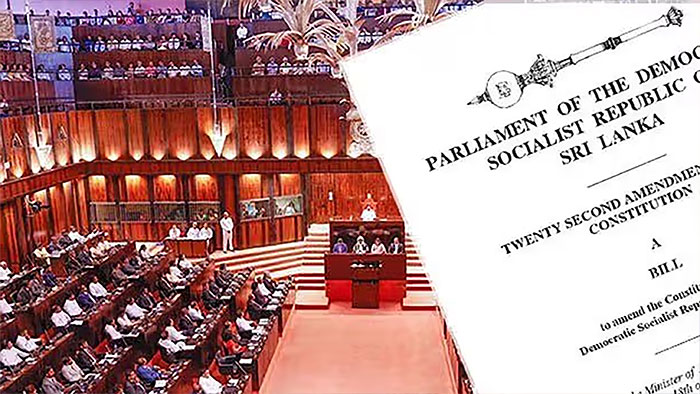
Parliament yesterday passed the Twenty-Second Amendment to the Constitution Bill and the Judicature (Amendment) Bill with two-thirds majorities, with 158 MPs voting in favour and 63 against each Bill.
The Illankai Tamil Arasu Kadchi (ITAK) and Sri Lanka Muslim Congress (SLMC) voted with the SJB against the Bills.
NDF MPs Ravi Karunanayake and Faizer Musthapha and SJB Badulla District MP Nayana Wasalathilaka were not present when the votes were taken.
The final vote on the Judicature (Amendment) Bill was announced at around 8.08 p.m. after Opposition MPs called for divisions on its clauses during the Committee Stage.
The votes followed a two-day debate which commenced on Thursday (24), after Justice and National Integration Minister Harshana Nanayakkara presented the Bills for their Second Reading.
The Supreme Court’s determination on the Bills was presented to Parliament on Tuesday (22) by Speaker Dr Jagath Wickramaratne. The Court determined that the 22nd Amendment Bill did not require approval at a referendum and could be passed by a special two-thirds majority in Parliament.
The amendment provides for raising the mandatory retirement age of Supreme Court judges from 65 to 67 and that of Court of Appeal judges from 63 to 65. It also provides for the Chief Justice to retire at 67 or after completing six years in office, whichever comes earlier.
The Speaker informed Parliament that the Judicature (Amendment) Bill could be passed by a simple majority.
The SJB opposed the legislation and its MPs attended Parliament dressed in black yesterday. The party also staged a protest at Polduwa Junction, Battaramulla, under the theme “No to 22, which destroys democracy”, with Opposition Leader Sajith Premadasa and several SJB politicians participating.
A valid Taxpayer Identification Number (TIN) Certificate will be required for a range of key transactions in Sri Lanka from November 1, 2026, the Inland Revenue Department (IRD) has announced.
The requirement, introduced under the Inland Revenue (Amendment) Act, No. 11 of 2026, applies to transactions specified under Section 102(3) of the Inland Revenue Act.
Accordingly, individuals will be required to produce a valid TIN Certificate when opening an account at a bank or financial institution, obtaining approval for a building plan, registering or renewing the licence of a motor vehicle, registering land or title to land, registering a business, transferring shares in a company incorporated in Sri Lanka or obtaining a credit card.
In the case of share transfers, both the transferor and transferee will be required to provide TIN certificates.
The IRD said officials handling such transactions had been instructed to ensure that a valid TIN Certificate was submitted before processing or completing the relevant transaction.
The Department advised those who do not already have a TIN to obtain one in advance through its e-Services platform.
It said a printout of the TIN verification result showing the applicant’s National Identity Card number and TIN could also be accepted instead of the certificate.The IRD also reiterated that obtaining a TIN is mandatory for resident individuals aged 18 and above under the applicable provisions.
By Norman Palihawadane
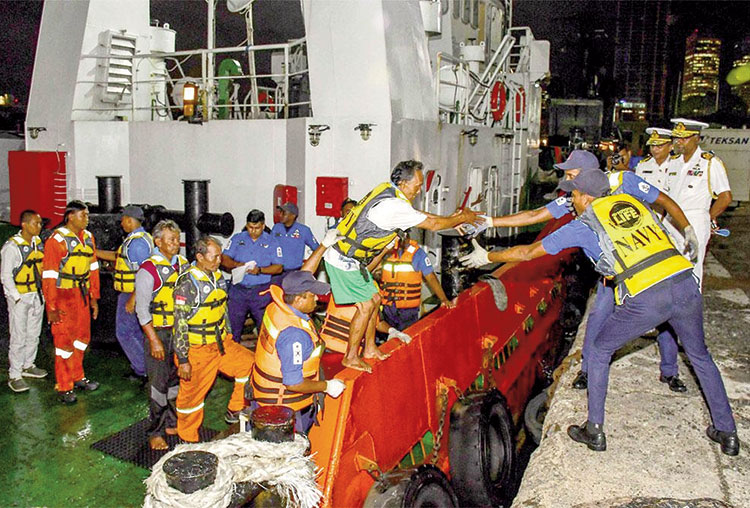
The Sri Lanka Navy brought 25 Indonesian fishermen safely ashore at the Colombo Port on Thursday (24), following a multi-agency rescue operation after their fishing trawler capsized south of Sri Lanka.
The fishermen were aboard the Indonesian-flagged fishing trawler KM Garuda Jaya VI, which capsized on September 22 while in the Australian Search and Rescue Region, leaving the crew in distress at sea.
The merchant vessel MV Moonstone responded to the distress situation and rescued all 25 fishermen from the sea. The vessel subsequently alerted the Maritime Rescue Coordination Centre (MRCC) Colombo about the incident and the rescued crew.
Following the distress alert, the Navy coordinated with MRCC Colombo and deployed two naval craft to bring the survivors safely to shore, with the assistance of relevant authorities.
The 25 fishermen were transferred to the Colombo Port, where they were provided with humanitarian assistance by the Navy.They were subsequently handed over to the Indonesian Embassy in Sri Lanka for further arrangements and onward action.

22A, Judicature Amendment Bills passed with 2/3 majority

TIN mandatory for key transactions from Nov. 1

Navy brings 25 Indonesian fishermen ashore after trawler capsizes

Former Mineral Sands Chairman arrested over recruitment irregularities

Sarana Gunawardena’s wife remanded over alleged bribe

High Posts Committee approves envoy, High Commissioner and SLIC Chairman

‘Dates have the highest sugar content to fight Coronavirus’

Sunday Island 27 December – Headlines

#SundayIsland 17th December – Headlines

Sunday Island – 28th March

Sunday Island Headlines – 21 March

Sunday Island – 21st February – Headlines
-

 News6 days ago
Namal Rajapaksa Buddhist gambit fails, bail denied
-

 Features6 days ago
Why the spelling Sri Lankan names in English vary
-

 Features6 days ago
Three bands, a new identity: Sri Lankan wolf snake recognised as distinct species
-

 Business6 days ago
SLIIT holds largest-ever convocation
-

 News6 days ago
Vehicle prices drop by up to Rs. 1 mn, says importers’ body
-

 News6 days ago
Govt monitors reported Saudi death sentence – Foreign Ministry
-

 Business6 days ago
All-new Bolero MaXX Pik-Up unveiled in Lanka
-

 Business6 days ago
Lanka’s famed beach shack battles demolition