
News
Canada supports new ‘Enabling Access to Justice for Victim Survivors of SGBV’ project in Lanka


Despite national policy achievements, violence against women in Sri Lanka is pervasive and exists in the family, the workplace and the community. This is largely due to prevailing inequality between genders steeped in social norms and women being socially and economically disadvantaged, United Nations Population Fund (UNFPA) in Sri Lanka said in a release.
One in five (20.4%) women in Sri Lanka have experienced sexual and/or physical violence by an intimate partner in their lifetime; and 1 in 4 women (24.9%) have experienced sexual and/or physical violence since the age of 15 (UNFPA, 2019). But only over one third (37.3%) and one fifth (21.6%) of victims sought support respectively from the police and health care centers.
To bring about a justice sector approach to addressing sexual and gender-based violence (SGBV) against women and girls, and gender minorities in the country, the United Nations Development Programme (UNDP) in coordination with the UNFPA in Sri Lanka working together with the Ministry of Justice (MoJ) will design and implement the ‘Enabling Access to Justice for Victim-Survivors of Sexual and Gender Based Violence (SGBV) in Sri Lanka’ project with funding from the Government of Canada. The five-year project launched today will empower women, girls and gender minorities, including victim survivors of SGBV to access justice, demand and receive better services, and work towards a society free of SGBV.
The proposed interventions of the project aims at creating transformative change through a whole of country approach working together with key stakeholders in the formal justice system and law enforcement. These efforts will be supplemented by working with the health and medical sectors, and ministerial agencies on women’s affairs, while also working closely with civil society organizations, primarily women’s rights organizations (WROs) at national level, and ensuring outreach by working with WROs from across the country at a district, divisional and community level.
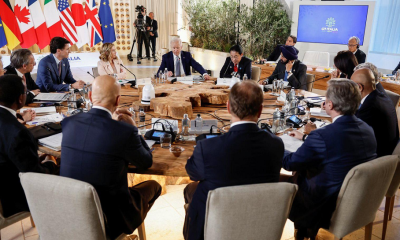
To mark the commencement of the project, a launch event took place this morning with the participation of high-level representatives from the partner organizations and multi-sectoral stakeholders that will be engaged through the project.
Speaking at the event, Minister of Justice Wijeyadasa Rajapakshe stated, “Victims not only suffer by the offender, but also by society at large. Hence, if no equal and quick reparation is available under the justice sector starting from the initial complaint, it is a great shame. As the main stakeholder of the justice system, judiciary, legal counsel, investigators, quasi-judicial officers and family counsellors, we have a great responsibility cast upon our shoulders in ensuring these victims are safeguarded.”
The project is designed and will be delivered within the framework and guidance of the Government of Canada’s Feminist International Assistance Policy (FIAP) which commits to contribute to global efforts to eradicate poverty around the world by addressing inequality, taking into special consideration empowerment of women and girls to reach their full potential to earn their own livelihoods, which will benefit families as well as the economic growth of their communities and countries.
Eric Walsh, High Commissioner for Canada in Sri Lanka and Maldives noted that support to this initiative in Sri Lanka is part of Canada’s broad policy commitment to addressing unacceptably high rates of sexual and gender-based violence (SGBV) globally.
Through partnerships and collaborations with multi sectoral stakeholders, the project will operationalize new and innovative approaches, engaging men and boys to prevent SGBV, while enabling gender responsive legal aid, a post-shelter economic support program and breaking the bias on underlying behavior and norms within the society. Sensitive and practical legal and support systems will set in place approaches that are proven effective, yet new to Sri Lanka .
Highlighting UNDP’s lead role in pushing this agenda, Azusa Kubota, Resident Representative, UNDP in Sri Lanka stated, “This project will build on UNDP’s global experience in addressing the SGBV and ongoing initiatives in supporting the justice sector in Sri Lanka. We are grateful for this multistakeholder partnership that brings the Ministry of Justice, justice sector institutions, civil society actors and UNFPA, with the funding support of the Government of Canada. This project will allow us to apply a wholistic set of tools. We must promote a collective responsibility to deliver better services for the most vulnerable and marginalized victims, and further build partnerships to comprehensively address SGBV through the overall empowerment of women.”
The project serves as an instrument to bring the efforts currently invested with Sri Lanka’s Multisectoral SGBV Action Plan 2016-2020, supported by UNDP in line with Canada’s policy, and its ongoing review led by UNDP and UNFPA, while also framing its work within the commitments of the Sri Lanka Gender Equality and Women’s Empowerment Policy being formulated by the Ministry of Women’s Affairs with oversight from the Parliamentary Select Committee on Gender Equality supported by UNFPA.
Speaking to the importance of this project, Kunle Adeniyi, UNFPA Representative for Sri Lanka and Country Director for the Maldives noted, “This project adopts a survivor centric approach, where women and girls are provided with the essential protection and care services that limit their vulnerability to violence and ensure they have access to the necessary care and support that is essential for maintaining their health and dignity as well as providing a critical element for access to justice for survivors of violence “
Resulting from wide consultations that have taken place, the new ‘Enabling Access to Justice for Victim-Survivors of Sexual and Gender Based Violence (SGBV) in Sri Lanka’ project has been designed to be victim survivor-centric and is anchored in the pillars of enforcement, services and prevention. With an ambition to make the justice pathway safe, inclusive and equipped to enforce policies and provide access to justice to victim survivors; the project seeks to ensure that service providers are capacitated- with resources to provide better services to victim survivors; and to address harmful social norms through prevention measures informed by diverse voices. Thus, creating agency for women, girls and gender minorities to access the justice system and live a life free from the threat and fear of violence.










Latest News
Sun directly overhead Mannar, Periyamadu, Puliyankulam, Welioya and Pulmoddai about 12.11 noon today (30)


The sun is going to be directly over the latitudes of Sri Lanka from 28th of August to 07th of September due to its apparent southward relative motion.
The nearest places of Sri Lanka over which the sun is overhead today (30) are Mannar, Periyamadu, Puliyankulam, Welioya and
Pulmoddai about 12.11 noon.

(AFP) Sri Lanka’s maritime authorities were monitoring a fleet of 11 US-sanctioned Iranian oil tankers just off the island’s southern coast, the foreign minister said Wednesday.
The tankers were spotted close to the Galle harbour where an Iranian frigate, IRIS Dena, was sunk by a US submarine in March, killing 104 sailors. Sri Lanka’s navy rescued 32 Iranian sailors from that frigate.
Iranian vessels have been in limbo, unable to return to their home port because of a US blockade.
Sri Lanka’s Foreign minister Vijitha Herath said the tankers were in international waters where they had freedom of navigation.
“These ships are away from our territorial waters… we have no hold on them, nor have we facilitated them,” Herath told AFP.
The military deployed reconnaissance aircraft and patrol boats to monitor the vessels outside Sri Lanka’s 12-nautical-mile territorial waters, a military official told AFP on condition of anonymity.
“There is no indication of any ship-to-ship transfer of oil or illegal discharge of pollutants, so there is no basis for Sri Lankan authorities to take action against them,” the official said.
Many Iranian merchant vessels moved east towards the Strait of Malacca and Singapore due to US sanctions, while several remained near Sri Lankan waters, authorities said.
Sri Lankan officials said Washington had not formally notified Colombo about sanctioned Iranian-flagged vessels
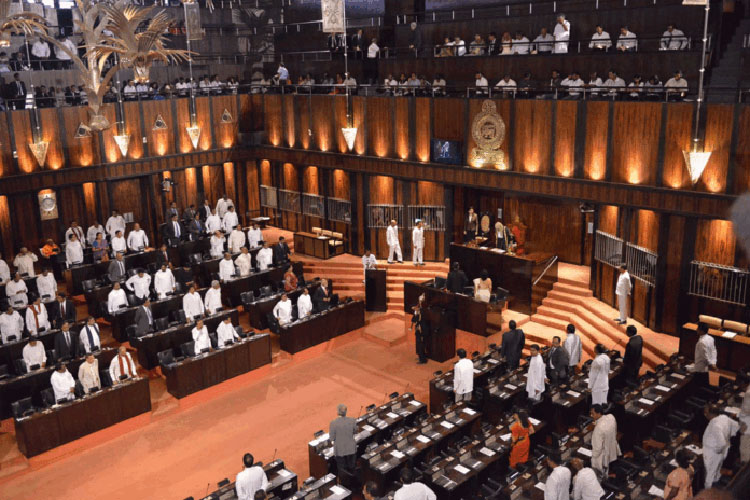
Parliament is to debate next Wednesday the Government’s proposal to abolish the post of Chief of Defence Staff (CDS), with the Second Reading of the Chief of Defence Staff (Repeal) Bill scheduled for September 9.
The Bill seeks to repeal the Chief of Defence Staff Act No. 35 of 2009, which was introduced shortly after the end of the armed conflict.
According to Secretary General of Parliament Kushani Rohanadeera, Parliament will meet from September 8 to 11, with the business for the week approved by the Committee on Parliamentary Business chaired by Speaker Dr. Jagath Wickramaratne.
The debate on the Chief of Defence Staff (Repeal) Bill is scheduled to take place from 11.30 a.m. to 5 p.m. on Wednesday, following questions to the Prime Minister and other parliamentary business.
The CDS post was established under the 2009 Act as part of the country’s higher defence command structure.
On Tuesday, September 8, the House will consider two Orders published in Extraordinary Gazettes under the Motor Traffic Act from 11.30 a.m. to 5 p.m., followed by an Opposition motion at the adjournment.
On Thursday, September 10, Parliament will debate a Resolution under the Women’s Empowerment Act.
The final sitting day of the week, Friday, September 11, has been allocated from 11.30 a.m. to 5.30 p.m. for several Private Members’ Motions.
The motions will cover issues including regulation of the petroleum, fuel and water industries, measures to increase the birth rate, protection of the Diyagama Forest, pension deductions affecting Pirivena teachers, food-crop cultivation in mountainous areas, development of the Kithul industry and the establishment of a Faculty of Medicine at South Eastern University.
Questions at the adjournment will be taken up at the end of each sitting day.

Showers in the Sabaragamuwa, Western and North-western provinces and in Galle, Matara, Kandy and Nuwara-Eliya districts

Sun directly overhead Mannar, Periyamadu, Puliyankulam, Welioya and Pulmoddai about 12.11 noon today (30)

Lanka tracks 11 US-sanctioned Iranian tankers off coast

House to debate abolition of Chief of Defence Staff post

Mass graves tragic evidence of failed states – Rathnayake

Legal avenues explored to bring back Mahendran, aka Harjan Alexander

‘Dates have the highest sugar content to fight Coronavirus’

Sunday Island 27 December – Headlines

#SundayIsland 17th December – Headlines

Sunday Island – 28th March

Sunday Island Headlines – 21 March

Sunday Island – 21st February – Headlines
-

 News5 days ago
Missing doctor’s body found in Mahiyanganaya
-
 News5 days ago
Australia declines to release Finance Secy Suriyapperuma’s citizenship details
-

 News5 days ago
22A: BASL suggests CJ recuse himself from hearing petitions
-

 News2 days ago
Eight politicians in drug kingpin probe
-

 Editorial6 days ago
Govts. drag feet as undergrads age
-
 Features4 days ago
Insights from Chieftains of Uva: Genealogy of two Kandyan Families – Part II
-

 Features4 days ago
Export diversification: Missing the wood for the trees – Part I
-

 Business2 days ago
Sri Lanka opens up: A new season of direct connectivity