
Sports
New Zealand seal 2-0 whitewash despite Sri Lanka’s lower order resistance


Despite a strong resistance by Sri Lanka’s lower order, three wickets apiece by Tim Southee and Blair Tickner helped bundle out the visitors for 358 to help New Zealand clinch the second Test at the Basin Reserve in Wellington by an innings and 58 runs, on Monday. With the win, the hosts also sealed the two-match Test series 2-0.
The visitors, who were asked to follow on after bundling out for 164 in the first innings, in response to New Zealand’s 580 for 4, provided a strong fight for most parts of the first two sessions, led by Dhananjaya de Silva’s 98 – and well supported by Dinesh Chandimal’s 62 and Nishan Madushka’s 39. However, on either side of the two partnerships – for the fifth and sixth wicket respectively – the hosts triggered collapses.
They struck in the first over of the day itself, with Kusal Mendis mistiming a pull off Matt Henry to mid wicket, without adding to the overnight score. The short-ball which got them the success early in the day, was used rather generously by the New Zealanders throughout the day, especially Blair Tickner who filled in that role in the absence of Neil Wagner.
In the fourth over of the day, the other overnight batter – Angelo Matthews – departed pulling Tickner to square leg. Despite losing two wickets early in the day, Sri Lanka continued to be on the offensive, with Chandimal and Dhananjaya taking on the short-pitched attack. The duo stitched a 126-run stand for the fifth wicket, in what proved to be a high-scoring session where Sri Lanka picked 136 runs.
The attacking approach that the two batters maintained also helped them quickly take advantage of the loose deliveries as well. However, late in the morning session, Chandimal eventually fell to the ploy, top-edging a pull off Tickner to the fine leg fielder.
Madushka, on debut, got off the mark by going down the track off Michael Bracewell and hitting the offspinner for a six in the last over before Lunch. He attempted to drive the next delivery, but was tricked by the dip and eventually hit it just short of the fielder. The approach post Lunch though was rather cautious. Against the moving new ball, the batters were tested by Matt Henry and Tim Southee. However, apart from a couple of leg before appeals and a few beating the bat, there wasn’t much threat posed to them.
They slowly kept chipping away at the deficit with a 76-run partnership for the sixth wicket before Madushka fell at the stroke of Tea – yet again dismissed pulling against Tickner, this time caught at mid on.
Sri Lanka’s chances of wiping off the deficit took a massive hit when Dhananjaya was dismissed in the second over after tea. Looking to sweep Michael Bracewell, he got a top edge to the short-leg fielder. Thereafter, the lower order only delayed the inevitable. They kept the New Zealand bowlers at bay for nearly two and a half hours from thereon to hand them the last three wickets, two of which were eventually scalped by Southee.
Kasun Rajitha played out 110 deliveries in the company of Prabath Jayasuriya and Lahiru Kumara, both of whom added 45 balls each. Rajitha’s dismissal – caught at second slip poking at an away-going delivery – ended Sri Lanka’s innings soon after play was extended for the day.
Brief scores:
New Zealand
580/4 decl. in 123 overs (Kane Williamson 215, Henry Nicholls 200n.o.; Kasun Rajitha 2-126)
Sri Lanka
164 all out in 66.5 overs (Dimuth Karunaratne 89; Matt Henry 3-44, Michael Bracewell 3-50) and 358 all out in 142 overs (Dhananjaya de Silva 98, Dinesh Chandimal 62; Tim Southee 3-51, Blair Tickner 3-84)

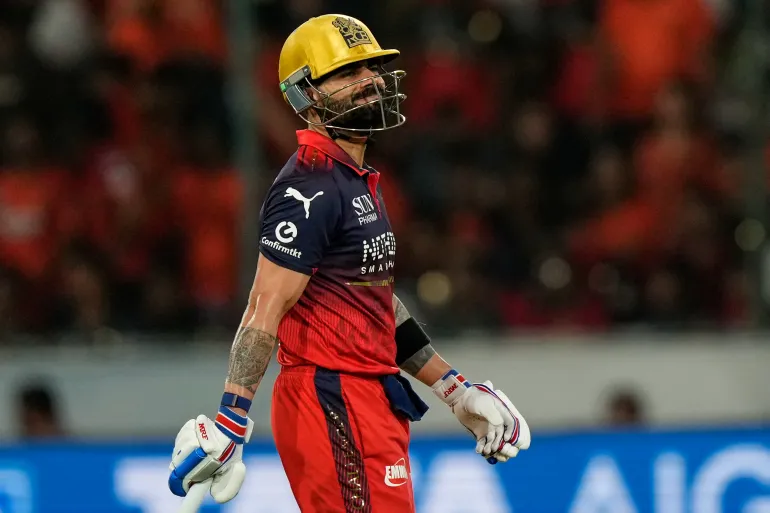
Tempers flared between Virat Kohli and Travis Head in the Indian Premier League, as the former India captain refused to shake hands with the Australian batter after Head’s Sunrisers Hyderabad handed Kohli’s Royal Challengers Bengaluru a crushing 55-run defeat.
The two exchanged heated words when Kohli opened for Bengaluru, looking to chase down a daunting target of 256. During the exchange, a visibly angry Kohli was seen gesturing towards Head to come and bowl.
Kohli also mockingly made the “impact player” substitution gesture, a reference to Head, who is primarily a batter, often being replaced by Hyderabad for a specialist bowler after the Australian finishes batting.
Head did not have much time to take Kohli up on his invite, as the Bengaluru opener fell soon after, scoring 15 off 11 balls. The Australian, however, bowled an over later in the game and dismissed Bengaluru captain Rajat Patidar.
As the teams lined up to shake hands after the match, Head held out his hand but Kohli looked straight ahead and walked past him.
Friday’s win left third-placed Hyderabad on equal points with Bengaluru, but Kohli’s side remained top of the table with a superior net run rate. Both teams have qualified for the IPL playoffs starting Wednesday.
[Aljazeera]
[Cricbuzz]
Latest News
Sunrisers Hyderabad win big but Royal Challengers Bengaaluru, Gujarat Titans seal top two spots

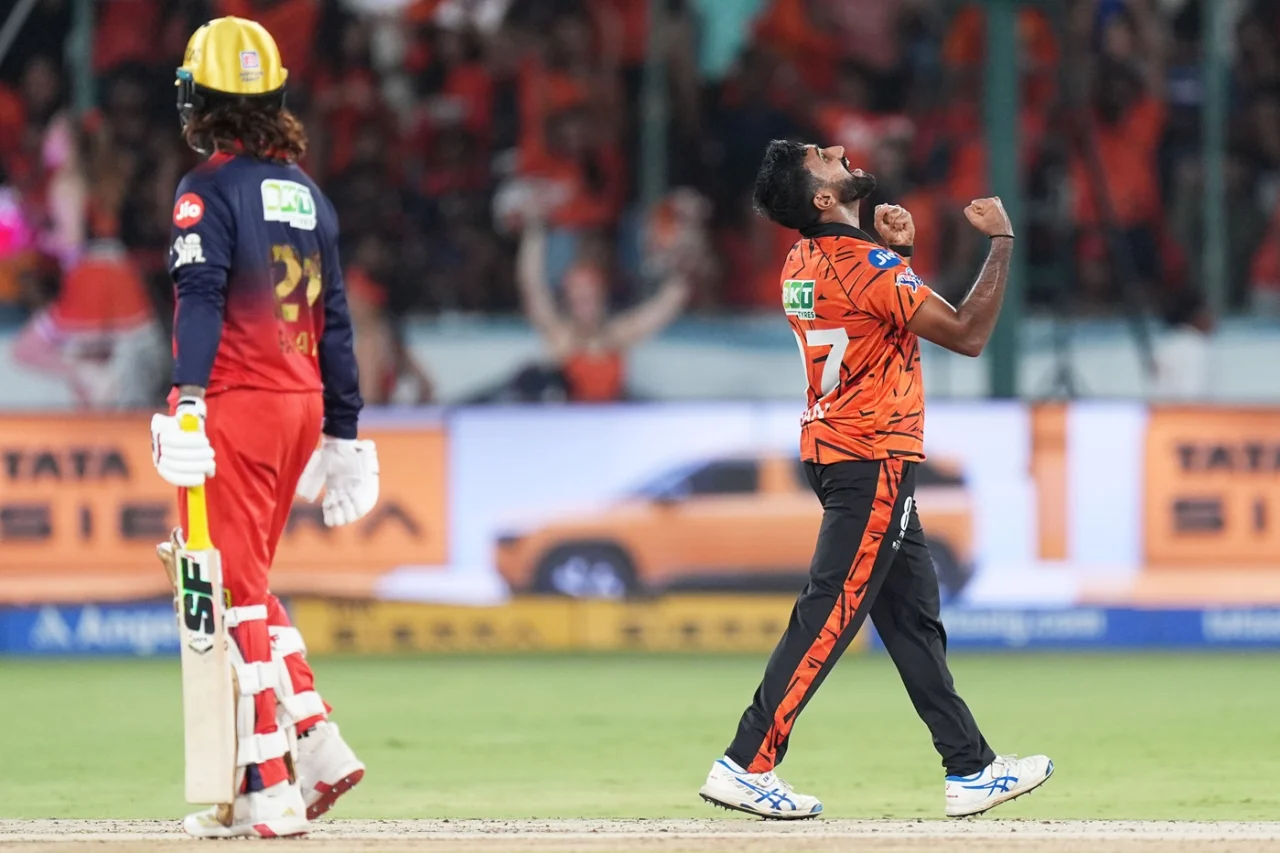
Sunrisers Hyderabad [SRH] won, and yet it didn’t feel like a win. Royal Challengers Bengaluru [RCB] lost, but it didn’t feel like that either. In a nutshell, that’s how Friday night went in Hyderabad as RCB secured a top-two finish – they finished No 1 – despite a 55-run defeat, while SRH remained third.
On the back of half-centuries from Abhishek Sharma, Heinrich Klassen and Ishan Kishan, SRH posted a monster total of 255, but had to restrict RCB to 166 or below for a chance to move into the top two. Rajat Patidar’s 56, Venkatesh Iyer’s 44 and Krunal Pandya’s unbeaten 41 ensured there were no blushes for RCB even as they finished the league stage with a defeat.
That left the top three teams all on 18 points, with Gujarat Titans sandwiched between the two teams at No. 1 and No. 3. Eventually, it came down to net run-rate to decide which team would go to Qualifier 1, and which team would play the Eliminator.
Going into the game, RCB wanted to win but also wanted to ensure they didn’t slip outside the top two should they lose. After SRH pumped 255 for 4 in 20 overs, the equation became clear – RCB had to avoid losing by 90 or more runs.
The start given by their new opener, Venkatesh, calmed the nerves. He gave Pat Cummins a four-six jab in the first over, and saved his best for the fourth over delivered by left-arm wristspinner Shivang Kumar. He punished Shivang for two sixes in one over, with a boundary sandwiched in between. Venkatesh fell for a 19-ball 44 but by then RCB had already scored 60 in 4.3 overs.
Even though Virat Kohli (15) failed to leave a mark in the game with the bat, a spunky 21 from No. 3 Devdutt Padikkal ensured RCB stayed on course for 166 even if the chase looked to get out of hand. Sakib Hussain, who delivered 1 for 31 in four overs, was a major reason why RCB could not push on.
Patidar scored his fourth half-century of the season, staying in from the sixth over to the 19th. His 39-ball 56 included crisp boundaries off Eshan Malinga, Cummins and Harshal Patel, but fell to part-timer Travis Head. Krunal stayed till the end with an unbeaten 41 in 31 balls as RCB finished on a commendable 200 for 4 by the end.
Dropped in the sixth, seventh and eighth overs, Abhishek made full use of the chances RCB’s fielders offered him. On a flat surface with no grass, he did not let purple-cap holder Bhuvneshwar Kumar settle. His early boundaries over the off-side against Bhuvneshwar’s awayswingers moved into his takedown of Suyash Sharma’s googly and Romario Shepherd’s seam-up balls.
Abhishek was finally out in the ninth over, but by then his turbo-charged innings had SRH almost touching triple-digits.
Kishan had three fifties against RCB in his last three outings, and on Friday, he made it four in a row with a 46-ball 79. While Abhishek was going, Kishan took his time to score nine off his first ten balls, but then found his groove.
His best shot of the night was probably the leg-side slog towards the bigger boundary against Krunal in the 11th over, a sign that timing and form continued to be on his side. A sixth 50-plus score for Kishan this season also made IPL 2026 his most prolific as a batter. His sweeps, cuts and pulls allowed SRH to pump 73 runs across overs 11 to 15.
Klaasen’s story was similar, starting off with only five runs in nine balls, but one that was unlocked with his takedown of Josh Hazlewood in the 13th over. One six over cow corner and two more over long-on made Hazlewood leak 27. His effortless loft of Bhuvneshwar over extra cover took him close to yet another landmark, and he brought up his sixth half-century of the season in the 16th over. He fell in the 17th over to a low-arm slinger from Krunal for 52, but not before becoming the first player to cross 600 runs while batting at No. 4 or lower in a T20 tournament.
Nitish Kumar Reddy scored a blazing unbeaten 29 in 12 balls to give SRH a late push. He hit Krunal for two sixes in his first three balls in the crease and then deposited Hazlewood for another.
The late flourish took SRH past 250 while also leaving RCB’s senior seam-bowling pair of Bhuvneshwar and Hazlewood ducking for cover. Hazlewood conceded 55 on the night while Bhuvneshwar leaked 51. They both finished the evening wicketless.
Brief scores:
Sunrisers Hyderabad 255 for 4 in 20 overs (Abhishek Sharma 56, Travis Head 26, Ishan Kishan 79, Heinrich Klaasen 51, Nitish Kumar Reddy 29*; Rasikh Salam 2-52, SuyashSharma 1-36, Krunal Pandya 1-24) beat Royal Challengers Bengaluru 200 for 4 in 20 overs (Venkatesh Iyer 44, Virat Kohli 15, Devdutt Padikkal 21, Rajat Patidar 56, Krunal Pandya 41*, Tim David 15*; Eshan Malinga 2-33, Sakib Hussain 1-31, Travis Head 1-07) by 55 runs
[Cricinfo]

Kohli refuses Head handshake after heated Hyderabad-Bengaluru clash in IPL

Ampara District special Coordination Committee meeting chaired by the President

Landslide Early Warnings issued to the districts of Colombo, Gampaha, Kalutara, Kegalle, Nuwara Eliya and Ratnapura

Most people seeking green cards must now apply from outside US

Tulsi Gabbard to resign as US director of national intelligence

SpaceX launches massive Starship V3 rocket on test flight

‘Dates have the highest sugar content to fight Coronavirus’

Sunday Island 27 December – Headlines

#SundayIsland 17th December – Headlines

Sunday Island – 28th March

Sunday Island Headlines – 21 March

Sunday Island – 21st February – Headlines
-

 Features7 days ago
Sri Lankan Airlines Airbus Scandal and the Death of Kapila Chandrasena and my Brother Rajeewa
-

 News7 days ago
Kapila Chandrasena case: GN phone records under court scrutiny
-
 Features4 days ago
Octopus, Leech, and Snake: How Sri Lanka’s banks feast while the nation starves
-

 News7 days ago
Rupee slide rekindles 2022 crisis fears as inflation risks mount
-

 Business7 days ago
Expansion of PayPal services in Sri Lanka officially announced
-
 News3 days ago
Steps underway to safeguard Sri Lanka’s maritime heritage
-

 News7 days ago
Court orders further arrests in alleged USD 42 Mn NDB fraud case
-
 Opinion3 days ago
Murder of Ehelepola family, Bogambara Wewa and Sightings of Wangediya