
Latest News
Zelensky and allies head to White House for Ukraine talks


US President Donald Trump will host Volodymyr Zelensky today [Monday] for their first meeting since the pair’s heated exchange in the White House earlier this year – but this time the Ukrainian president is bringing European allies.
Nato Secretary General Mark Rutte and UK Prime Minister Sir Keir Starmer are among leaders who will join Zelensky in Washington for talks on how to end the war with Russia.
It follows Trump’s summit with Russian leader Vladimir Putin in Alaska that resulted in the US president dropping a demand for a ceasefire and calling instead for a permanent peace deal.
A US envoy said on Sunday that Putin had agreed to a possible Nato-like security pact for Ukraine.
“BIG PROGRESS ON RUSSIA. STAY TUNED!” Trump posted on his Truth Social platform, without elaborating.
Also heading to Washington for Monday’s meeting are French President Emmanuel Macron, Italian Prime Minister Giorgia Meloni, German Chancellor Friedrich Merz, Finnish President Alexander Stubb and European Commission President Ursula von der Leyen. It is unclear how many of them will go to the White House.
For so many heads of state to travel with such little notice across the Atlantic to what is essentially a wartime crisis meeting appears without precedent in the modern era, underscoring the sky-high stakes.
Diplomatic sources say European officials are concerned that Trump may try to press Zelensky to agree to terms, after the Ukrainian leader was excluded from the Trump-Putin meeting on US soil last Friday.
But US Secretary of State Marco Rubio told the BBC’s US partner CBS that any suggestion Zelensky might be bullied by Trump into accepting a peace deal was a “stupid media narrative”.
Nato leaders also appear eager to avoid a repeat of Zelensky’s February trip to the Oval Office that ended abruptly after an argument with Trump and US Vice-President JD Vance.
The altercation – which saw Trump accuse Zelensky of “gambling with World War Three” – left Washington-Kyiv ties in tatters.
But European leaders have been working diligently behind the scenes since then to mend the relationship. The Ukrainian leader has been coached to talk in terms of deal-making – language that resonates with Trump.
In April, Ukraine signed a minerals agreement that gave the US a financial stake in the country, and Trump and Zelensky spoke privately at the Vatican before Pope Francis’s funeral. Ukraine made clear it was willing to pay for US weapons.
By July, the two leaders had a phone call that the Ukrainian president described as “the best conversation we have had”.
Meanwhile, Trump had begun to express exasperation with Russia’s unrelenting onslaught in Ukraine. He called Putin “absolutely crazy”, drastically shortened his deadline for a peace deal, and threatened economic sanctions on Moscow.
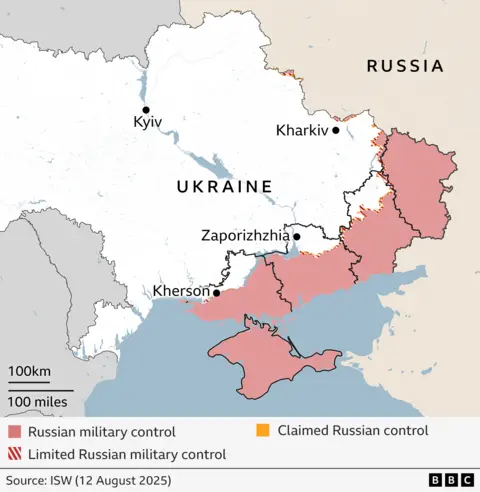
As these deliberations grind on, Russian forces continue to advance on the battlefield. They now occupy almost a fifth of Ukraine since Moscow launched its full scale invasion in February 2022.
A virtual summit was held on Sunday between Zelensky and the so-called coalition of the willing – a group of nations including the UK, France and Germany that have pledged to protect peace in Ukraine once it is achieved.
Afterwards, Emmanuel Macron told reporters their plan was to “present a united front” for Monday’s talks with Trump.
Zelensky and the Nato leaders said they were keen to learn more after US envoy Steve Witkoff told US television that Putin had agreed on Friday to “robust security guarantees that I would describe as game-changing”.
Witkoff said such an agreement could see Europe and the US protect Ukraine from further aggression with a Nato-like defence agreement.
“We were able to win the following concession: that the United States could offer Article 5-like protection, which is one of the real reasons why Ukraine wants to be in Nato,” Witkoff told CNN on Sunday.
Putin has long opposed Ukraine joining Nato, and Witkoff said the arrangement could be an alternative if the Ukrainians “can live with it”.
Article 5 is a principle at the heart of the 32-member transatlantic military alliance that says its members will come to the defence of an ally that is under attack.
Witkoff also told CNN that Russia made “some concessions” around five heavily contested regions of Ukraine.
In talks with European allies after the Alaska summit, Trump said Putin had reiterated that he wants the key Donetsk and Luhansk regions that make up Donbas, eastern Ukraine, according to European officials.
But at Sunday’s virtual summit with Nato leaders, Zelensky stressed that the Ukrainian constitution makes it impossible to give up territory – and that this should only be discussed by the leaders of Ukraine and Russia at a trilateral summit with the US.
The US secretary of state, meanwhile, sought to temper hopes that a deal to end Europe’s deadliest conflict for 80 years could be imminent.
“We’re still a long ways off,” Rubio said on Sunday.
[BBC]

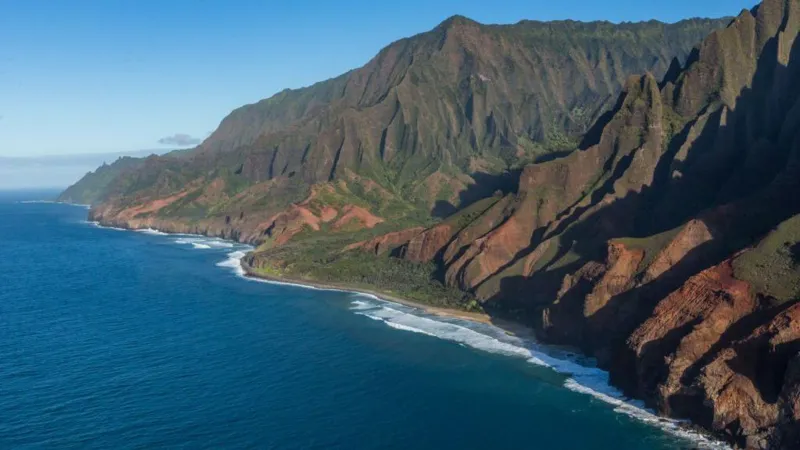
Three people have died after a helicopter crashed off the Hawaiian island of Kauai, police said.
The helicopter was carrying one pilot and four passengers, police said in a statement. Two survivors were taken to a hospital for treatment.
Police said the helicopter was operated by Airborne Aviation, a company whose website advertises “a doors-off thrill seekers adventure tour” of the picturesque island’s waterfalls, canyons, and beaches.
The US Coast Guard said the helicopter crash-landed about 100 yards off Kalalau beach. Authorities have not yet identified the victims.
Police said they responded to an alert of the crash at around 15:45 local time (01:45 GMT), along with the Coast Guard and fire department.
Kauai’s Mayor Derek Kawakami praised the recovery effort, telling local media: “Here on Kaua’i, whenever somebody puts their feet on our soil, they are one of ours.
“We treat them like one of ours, they are a part of our family, and our first responders respond with that spirit in mind.”
Andrew Williams, search and rescue mission co-ordinator for the Coast Guard in Honolulu, said: “We are greatly saddened by the loss of three lives in this helicopter crash and thinking of those individuals’ families and friends.”
Helicopter tours are a popular way for visitors to tour the island, which is where the blockbuster film Jurassic Park was shot.
Airborne Aviation’s 50-minute tour of the island offered a maximum of four passengers and costs $348 (£262) per passenger, according to its website.
BBC News has contacted Airborne Aviation for comment.
The incident is the latest fatal crash in Kauai involving a tour helicopter. Three people were killed when a helicopter operated by a different tour company crashed in July 2024.
The 2024 crash was caused by “an encounter with turbulence due to downdraft winds that resulted in mast bumping and an inflight breakup”, a report by the National Transportation Safety Board said.
[BBC]
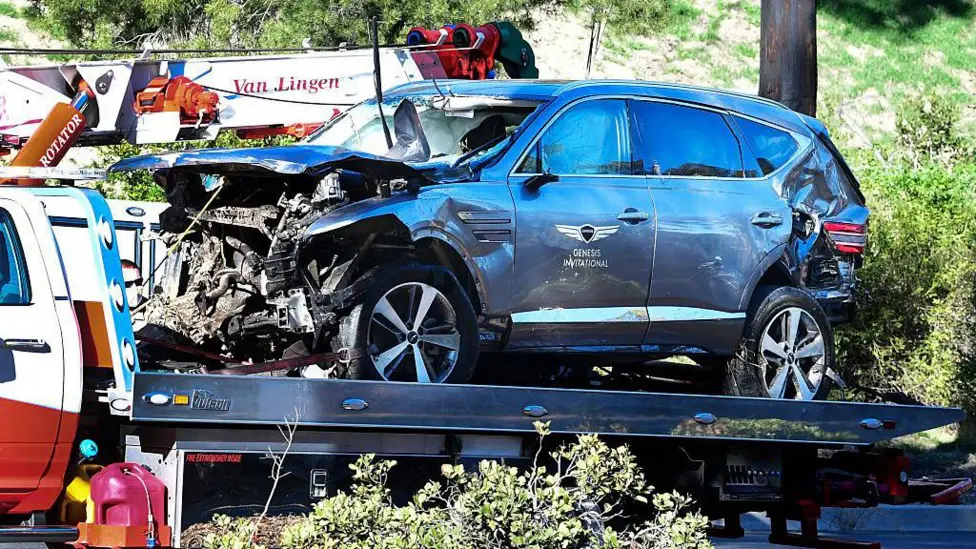
Tiger Woods has been charged with driving under the influence after rolling his car in a crash in Florida, police have confirmed.
The Martin County Sheriff’s Office said the 15-time major champion was also charged with property damage and refusal to submit to a lawful test.
Woods, 50, rolled his Land Rover after clipping a pressure cleaner truck while trying to overtake it at “a high rate of speed”, according to Sheriff John Budensiek.
The golfer, who had to crawl out of the passenger door of his vehicle, passed a breathalyser test after the crash but refused a urine test.
No-one sustained any injuries in the incident which took place on Beach Road in Jupiter Island just before 14:00 local time on Friday (about 19:00 GMT).
Sheriff Budensiek told a news conference: “The DUI investigators came to the scene and Mr Woods did exemplify signs of impairment.
“They did several tests on him. He did explain the injuries and surgeries that he’s had and we did take that into account, but they did some in-depth roadside tests.
“When it was determined, he was placed under arrest and taken to the Martin County jail.
“At the Martin County jail, and even on scene, we were really not suspicious of alcohol being involved in this case and that proved to be true.
“Mr Woods did a breathalyser test with triple zeros, but when it came time for us to ask for a urinary analysis test, he refused.”
Budensiek also said Woods had been “co-operative but was trying not to incriminate himself”.
“He has a right to refuse that test,” added the sheriff. “There is a statute which he will be charged with for refusing to take that test, but we will never get definitive results as to what he was impaired on at the time of the crash.”
US president Donald Trump was asked about the crash on Friday, saying: “I feel so badly. [Woods has] got some difficulty. There was an accident. That’s all I know.
“He’s a very close friend of mine, he’s an amazing person, an amazing man.”
Sheriff Budensiek said Woods would remain in jail for eight hours then be released on bond. The charges are misdemeanours, not felonies.
The BBC has contacted the golfer’s representatives for comment.
This is not the first time Woods has been involved in a car accident – he has played a limited schedule since the serious crash in 2021 that left him with extensive injuries and fortunate to be alive.
In 2017 police officers also found him slumped at the wheel of his parked Mercedes-Benz not far from his Florida home.
A toxicology report found Woods had several legal medications in his system and marijuana’s active ingredient, and he was sentenced to a year’s probation after pleading guilty to reckless driving.
In 2009 Woods hit a fire hydrant, a tree, and several hedges in a bizarre collision outside his home.
The incident sparked accusations of extramarital affairs which led to the end of his seven-year marriage and the loss of lucrative sponsorship deals.
[BBC]
Latest News
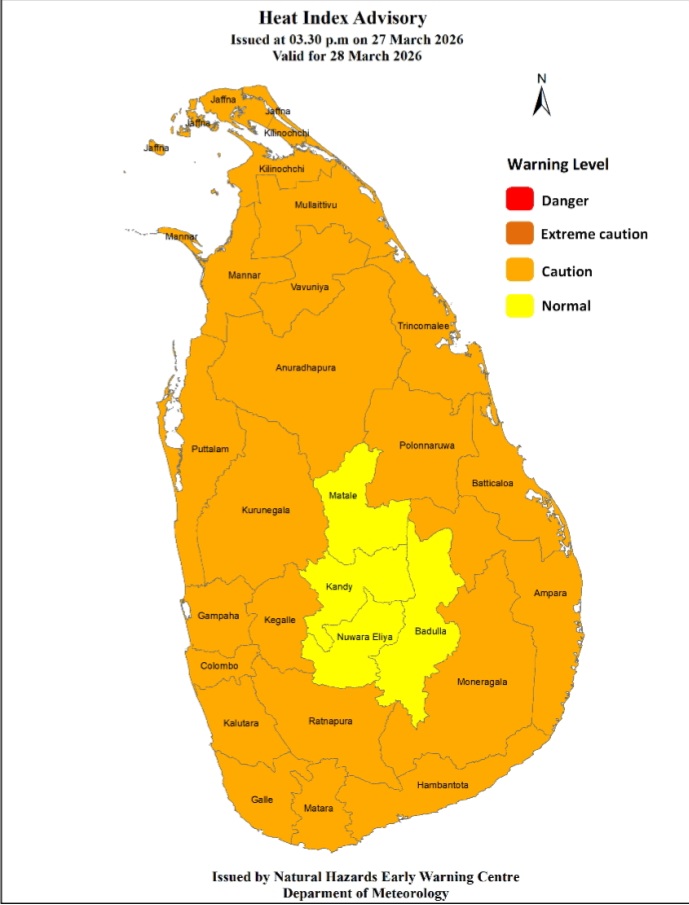
Heat Index at Caution Level in the Western, Sabaragamuwa, Southern, Eastern, North-western, Northern and North-central provinces and in Monaragala district
Warm Weather Advisory
Issued by the Natural Hazards Early Warning Centre of the Department of Meteorology
Issued at 3.30 p.m. on 27 March 2026, valid for 28 March 2026.
The ‘Heat index‘, the temperature felt on human body is likely to increase up to ‘Caution level’ at some places in the Western, Sabaragamuwa, Southern, Eastern, North-western, Northern and North-central provinces and in Monaragala district
The Heat Index Forecast is calculated by using relative humidity and maximum temperature and this is the condition that is felt on your body. This is not the forecast of maximum temperature. It is generated by the Department of Meteorology for the next day period and prepared by using global numerical weather prediction model data.

Effect of the heat index on human body is mentioned in the above table and it is prepared on the advice of the Ministry of Health and Indigenous Medical Services.
ACTION REQUIRED
Job sites: Stay hydrated and takes breaks in the shade as often as possible.
Indoors: Check up on the elderly and the sick.
Vehicles: Never leave children unattended.
Outdoors: Limit strenuous outdoor activities, find shade and stay hydrated.
Dress: Wear lightweight and white or light-colored clothing.
Note:
In addition, please refer to advisories issued by the Disaster Preparedness & Response Division, Ministry of Health in this regard as well. For further clarifications please contact 011-7446491.

Courtesy call by the Heads of Mission- Designate on Prime Minister

Three dead after helicopter crash in Hawaii

Woods charged with driving under influence after crash

Showers may occur at a few places in the Rathnapura, Kaluthara, Galle, and Matara districts during the evening or night

SC finds Keheliya, others, guilty of violating FRs of public through corrupt drug procurement deal

Sajith nudges govt. to follow India’s example in giving relief to consumers by slashing taxes on fuel

‘Dates have the highest sugar content to fight Coronavirus’

Sunday Island 27 December – Headlines

#SundayIsland 17th December – Headlines

Sunday Island – 28th March

Sunday Island Headlines – 21 March

Sunday Island – 21st February – Headlines
-

 News4 days ago
Senior citizens above 70 years to receive March allowances on Thursday (26)
-

 Features6 days ago
Trincomalee oil tank farm: An engineering marvel
-

 Features15 hours ago
A World Order in Crisis: War, Power, and Resistance
-

 News2 days ago
Energy Minister indicted on corruption charges ahead of no-faith motion against him
-

 News3 days ago
US dodges question on AKD’s claim SL denied permission for military aircraft to land
-

 Features6 days ago
The scientist who was finally heard
-

 Business3 days ago
Dialog Unveils Dialog Play Mini with Netflix and Apple TV
-

 Sports2 days ago
SLC to hold EGM in April