
Latest News
Three dead after helicopter crash in Hawaii

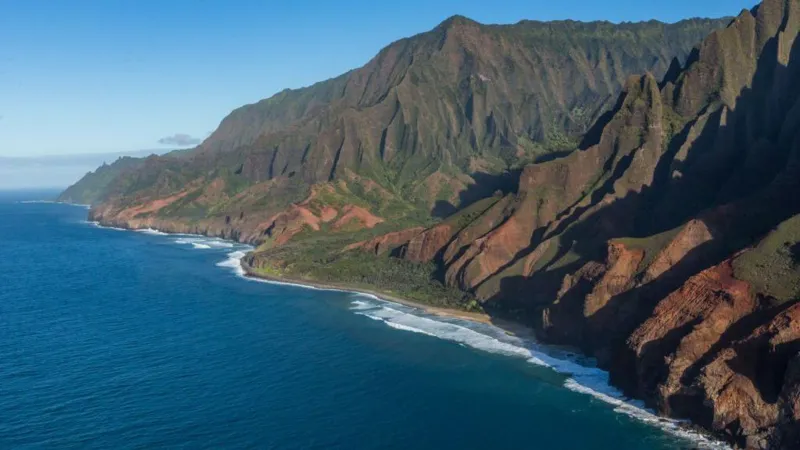
Three people have died after a helicopter crashed off the Hawaiian island of Kauai, police said.
The helicopter was carrying one pilot and four passengers, police said in a statement. Two survivors were taken to a hospital for treatment.
Police said the helicopter was operated by Airborne Aviation, a company whose website advertises “a doors-off thrill seekers adventure tour” of the picturesque island’s waterfalls, canyons, and beaches.
The US Coast Guard said the helicopter crash-landed about 100 yards off Kalalau beach. Authorities have not yet identified the victims.
Police said they responded to an alert of the crash at around 15:45 local time (01:45 GMT), along with the Coast Guard and fire department.
Kauai’s Mayor Derek Kawakami praised the recovery effort, telling local media: “Here on Kaua’i, whenever somebody puts their feet on our soil, they are one of ours.
“We treat them like one of ours, they are a part of our family, and our first responders respond with that spirit in mind.”
Andrew Williams, search and rescue mission co-ordinator for the Coast Guard in Honolulu, said: “We are greatly saddened by the loss of three lives in this helicopter crash and thinking of those individuals’ families and friends.”
Helicopter tours are a popular way for visitors to tour the island, which is where the blockbuster film Jurassic Park was shot.
Airborne Aviation’s 50-minute tour of the island offered a maximum of four passengers and costs $348 (£262) per passenger, according to its website.
BBC News has contacted Airborne Aviation for comment.
The incident is the latest fatal crash in Kauai involving a tour helicopter. Three people were killed when a helicopter operated by a different tour company crashed in July 2024.
The 2024 crash was caused by “an encounter with turbulence due to downdraft winds that resulted in mast bumping and an inflight breakup”, a report by the National Transportation Safety Board said.
[BBC]


Football’s Asian Cup, hosted by Saudi Arabia, could be moved back a year to 2028 following a series of attacks on the country by Yemen’s Houthis.
The continental tournament will be rescheduled “if we need to” but the organisers are in “no hurry” to make a decision, Asian Football Confederation President Sheikh Salman bin Ebrahim Al Khalifa said on Thursday.
The 2027 Asian Cup is supposed to kick off on January 7 in the Saudi cities of Jeddah, Riyadh and al-Khobar.
The kingdom has in recent days come under sustained attack in a dramatic escalation from the Houthis.
“We can wait until the end of November,” Al Khalifa told reporters in Zurich on Wednesday about a decision on the fate of the Asian Cup.
“Things can change very quickly for better or worse in the region, and it is a question of seeing what happens,” he added.
“If we need to make a decision then we will, but we could move back a year to 2028 if we need to.
“But at the moment we are monitoring the situation and everything is on schedule.”
Cristiano Ronaldo’s Al-Nassr saw their Asian Champions League match delayed by an hour on Monday after Saudi Arabia’s Civil Defence said it had intercepted a missile fired towards Riyadh.
Three matches in Saudi domestic football, including one involving Al-Nassr, were postponed this week.
(Aljazeera)
Latest News
Physical development must be matched by the enrichment of people’s inner lives through aesthetics and culture – PM
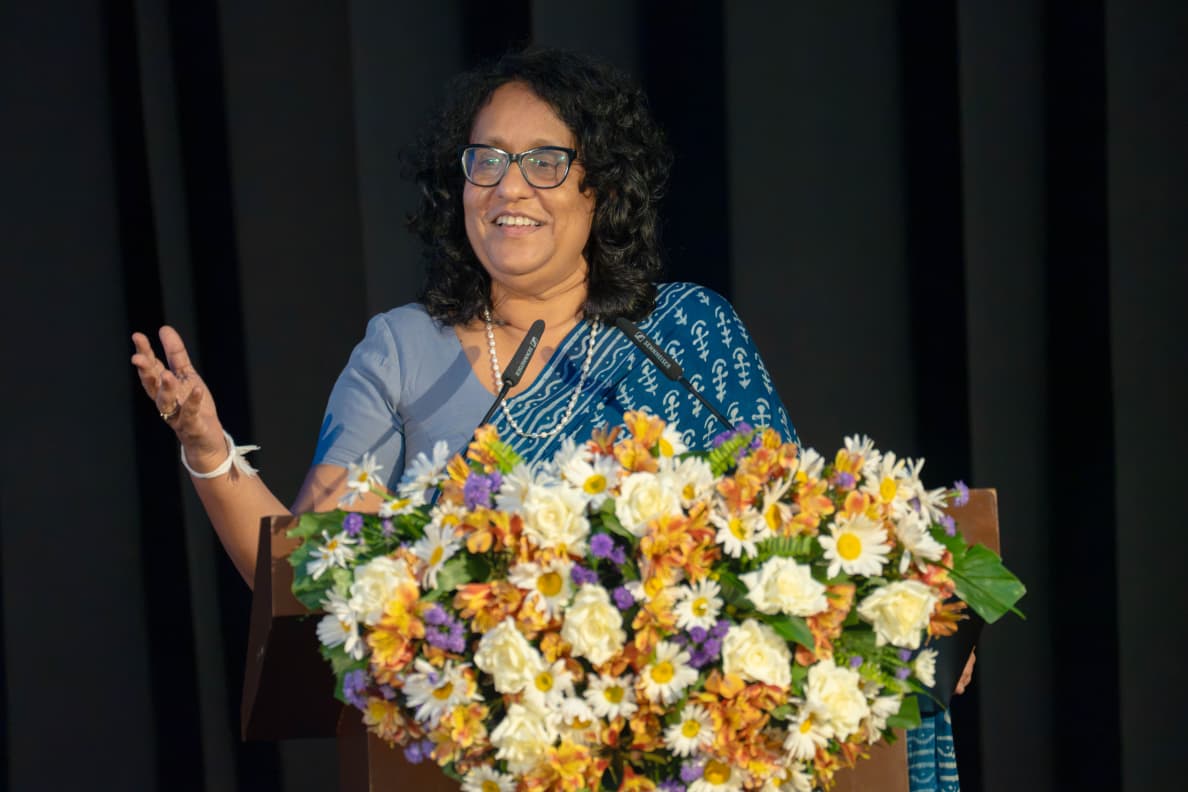
Prime Minister Dr. Harini Amarasuriya stated that while a country develops its roads, buildings and economy, the inner lives of its people must also be enriched through aesthetics, culture and creativity. Development cannot be measured solely by improvements in physical resources, and the empathy and the appreciation of the arts is a key aspiration of the new era of renaissance.
The Prime Minister made these remarks while inaugurating the ’Aluth Wessa’ Cultural Festival and Exhibition, organised jointly by the Kandy District Secretariat, the Department of Cultural Affairs and the Kandyan Cultural Center on 15 October at the Kandy District Secretariat.
During the event, the Prime Minister also presented awards to artists from the Kandy District in recognition of their outstanding contributions to the arts.
Addressing the gathering, the Prime Minister further stated: “Kandy is a place where we can best experience the value of our country’s historical, artistic and cultural heritage. The Temple of the Sacred Tooth Relic, the wood carvings of Embekka, the murals of Degaldoruwa, the Kandyan dance tradition, and the contributions of renowned artists such as Pani Bharath, Dr. Ananda Coomaraswamy and Minnette de Silva have helped shape a distinctive cultural identity unique to Kandy.
During the recent disaster, when the people of Kandy faced immense difficulties, people from districts such as Galle, Matara and Kalutara voluntarily came forward to extend tremendous support. Their empathy and commitment deserve our sincere appreciation. Following the disaster, several initiatives are already progressing rapidly to help Kandy recover and rebuild. These include restoring the Upcountry railway line, repairing damaged houses and rehabilitating historic temples that were destroyed through the Central Cultural Fund. Through our education reforms, we aspire to nurture a generation that goes beyond professional knowledge and skills, developing artistic sensitivity alongside human values and compassion.”
The event was attended by the Most Venerable Naramapanawe Ananda Thero, Anunayake of the Asgiri Chapter of the Siyamopali Maha Nikaya and Chancellor of the University of Kelaniya, along with members of the Maha Sangha and other religious leaders. Also present were Central Province Governor Dr. Suranga Fernando, Members of Parliament Jagath Manuwarana, Thanura Dissanayake, Thushari Jayasinghe and E. M. Basnayake; the Mayor and local councillors, Kandy District Secretary Indika Udawatta, Divisional Secretaries, public officials, artists, parents, and children.
(Prime Minister’s Media Division)
Latest News
Heavy showers above 100 mm are likely at some places in the Western, Sabaragamuwa, Southern, Central, and North-western provinces and in Anuradhapura district.

WEATHER FORECAST FOR 14 OCTOBER 2026
Issued at 05.30 a.m. on 14 October 2026 by the Department of Meteorology
Due to a low-level atmospheric disturbance persisting in the Bay of Bengal near Sri Lanka, cloudy skies and increased rainfall are expected to continue over the island.
Misty conditions can be expected at some places in the Sabaragamuwa, Central and Uva provinces during the early hours of the morning.
Showers or thundershowers will occur at times in the Northern, Eastern, Southern and Western provinces. Showers or thundershowers will occur in other parts of the island after 1.00 p.m.
Heavy showers above 100 mm are likely at some places in the Western, Sabaragamuwa, Southern, Central, and North-western provinces and in Anuradhapura district while fairly heavy showers above 75 mm are likely at some places in other areas of the island.
The general public is kindly requested to take adequate precautions to minimize damage caused by temporary localized strong winds and lightning during thundershowers.

Asian Cup in Saudi Arabia could be postponed by a year amid Houthi attacks

Houthi missile attack on Yemeni presidential palace kills five, minister says

Physical development must be matched by the enrichment of people’s inner lives through aesthetics and culture – PM

Review of the operations of the 1818 Hotline introduced to report drug-related information

Showers in the Western, Southern, Central, Sabaragamuwa, North-Western and Northern provinces and in the Anuradhapura District

SJB: Govt. trying to reappoint Jayakody, who resigned from Cabinet amidst coal scam

‘Dates have the highest sugar content to fight Coronavirus’

Sunday Island 27 December – Headlines

#SundayIsland 17th December – Headlines

Sunday Island – 28th March

Sunday Island Headlines – 21 March

Sunday Island – 21st February – Headlines
-

 News6 days ago
Sri Lanka escalates anti-graft drive with Shiranthi’s jailing
-

 News7 days ago
NPP govt. reminded of its responsibilities as US warship leaves Colombo
-
 Latest News7 days ago
Farhan, Sadaqat help Pakistan ace 183 chase to go 1-0 up
-

 Latest News5 days ago
Farhan and Sadaqat help Pakistan seal series in style
-

 News6 days ago
Iranian ships stranded, Lanka fears US sanctions
-

 Latest News3 days ago
Nissanka’s return headlines Sri Lanka’s Test squad against Pakistan
-
 News7 days ago
Interdicted top House official Kularatne receives special recognition in Mexican Parliament
-

 Features5 days ago
Intake 16: 45 years of duty and honour