
News
Women Parliamentarians’ Caucus calls on all to stand in solidarity with the Global Activism against Gender-Based Violence

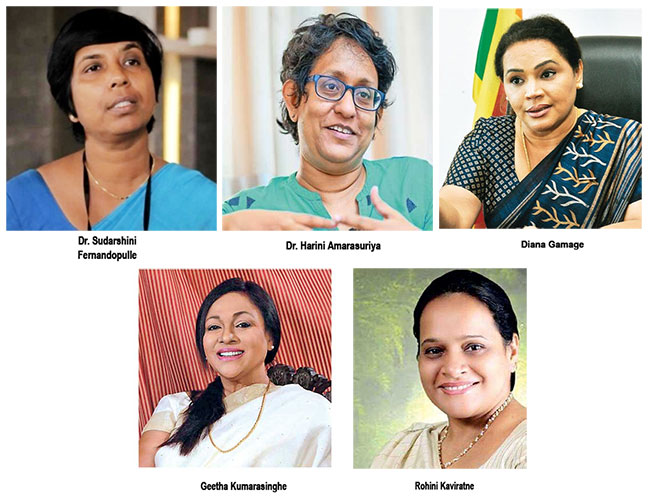
The Women Parliamentarians’ Caucus is calling on all Sri Lankans to pledge solidarity with the Global Activism against Gender-Based Violence (GBV) that will be carrying out a series of advocacy measures during the 16-day campaign against Gender-Based Violence.
The female parliamentarians’ movement has said that while Sri Lanka is facing new vulnerabilities with the current economic crisis, women and girl children are at greater risk.
The Caucus has, in a statement, noted that even prior to the economic crisis, women and the girl child did not enjoy complete freedom, opportunities and safety due to the grave human rights violation of gender-based violence.
The Women’s Wellbeing Survey 2019 conducted by the Department of Census and Statistics reported that during their lifetime, 20 percent of the ever-partnered women have faced physical and/or sexual violence by an intimate partner and that 25 percent of women have experienced physical or sexual violence by a partner or a non-partner after 15 years of age. 18 percent expressed that they were subjected to economic abuse by a partner in their lifetime. 21 percent of the women who experienced violence by a partner had never expressed it to anyone before the interviews.
“The economic crisis has certainly made these already vulnerable individuals at further risk. High inflation rates and the resulting hunger, nutritional crisis, expenditure struggles at homes, rising poverty levels, social unrest, reduction in healthcare assistance including reproductive health and other services would only make women and girls more vulnerable to gender based violence and its resultant adverse impact on them,” the statement said.
The global theme of the campaign 2022 is UNITE! Activism to end violence against women and girls.
“It emphasises that without unity GBV cannot be combatted, thus calling on governments, development partners, CSOs, youth, media and all other stakeholders to come together to fight against GBV. Therefore, the 16 days of activism against GBV is an important advocacy period for our goal to advocate for and ensure equal grounds for women in Sri Lanka.” Dr. Sudarshini Fernandopulle, Chairperson, Women Parliamentarians’ Caucus (WPC) said.
MP Rohini Kaviratne, Deputy Co- Chairperson, WPC said GBV is nothing new to women in Sri Lanka. “We as women have to face it always. But, that doesn’t make it okay. We cannot let it be normalised. As women parliamentarians we always face verbal violence based on our gender. During elections, and whenever someone needs to disgrace us, the most common weapon used is our gender roles and the stereotypical thinking that stigmatised our roles in the public sphere and stepping out of the house to be a leader in politics, as a female parliamentarian. We should fight this. We should fight any form of GBV.”
“Today we enter into this year’s 16 days of global activism against GBV, within this grave context in Sri Lanka. As women parliamentarians, we take it very seriously. We have always sought to bring about, or at least improve gender equality in Sri Lanka as people’s representatives,” Geetha Kumarasinghe, State Minister of Women and Child Affairs said.
“We urge all Sri Lankans to have zero tolerance for any kind of violence or sexual harassment committed against any human being by showing strong aversion coupled with adequate responses expressing zero tolerance for such acts of GBV. It is our indifference that causes the perpetrators to normalize these human rights violations they commit. So, we should act, not be silent and be passive observers,” Diana Gamage, State Minister of Tourism urged.
“We understand that this is an era where society has lost trust in parliamentarians in general. However, despite our party differences, we, as twelve female parliamentarians, stand in unity with the global community to fight against GBV, particularly to empower women in Sri Lanka to stand against GBV,” MP Manjula Dissanayake, Member of WPC commented.
Parliamentarian Dr. Harini Amarasuriya, Member of WPC said the Caucus is in the process of supporting the drafting of a Women’s Bill to be presented to parliament.
“However, we are also conscious that laws alone do not effect change and that there is a lot of work that needs to be done institutionally and politically to ensure that the bill when passed will make a meaningful difference in the lives of women in Sri Lanka,” she added.
To stand in solidarity with this global movement, the female parliamentarians will be carrying out a series of advocacy measures starting from 25th November.
They are conducting two panel discussions on combating GBV on 28th and 29th November and also a press conference on 1st December.
On the day of the press conference, a wristband with the message “Let’s Unite to end Gender Based Violence” will be tied on Parliamentarians as a solidarity measure and all women MPs will be invited to come in Orange attire. This will take place in the recently established Gender and Social Inclusion Section of the Parliament Library which contains publications relevant to gender equality and social inclusion available for reference by all MPs.
All these activities will be carried out hand in hand with the Parliament Communications Department and the Parliament Secretariat in the hope of raising awareness among Parliamentarians and the public against GBV.

Latest News
Heat Index at Caution Level in the Western, Sabaragamuwa, Southern and North-western provinces and in Anuradhapura, Mannar and Vavuniya districts

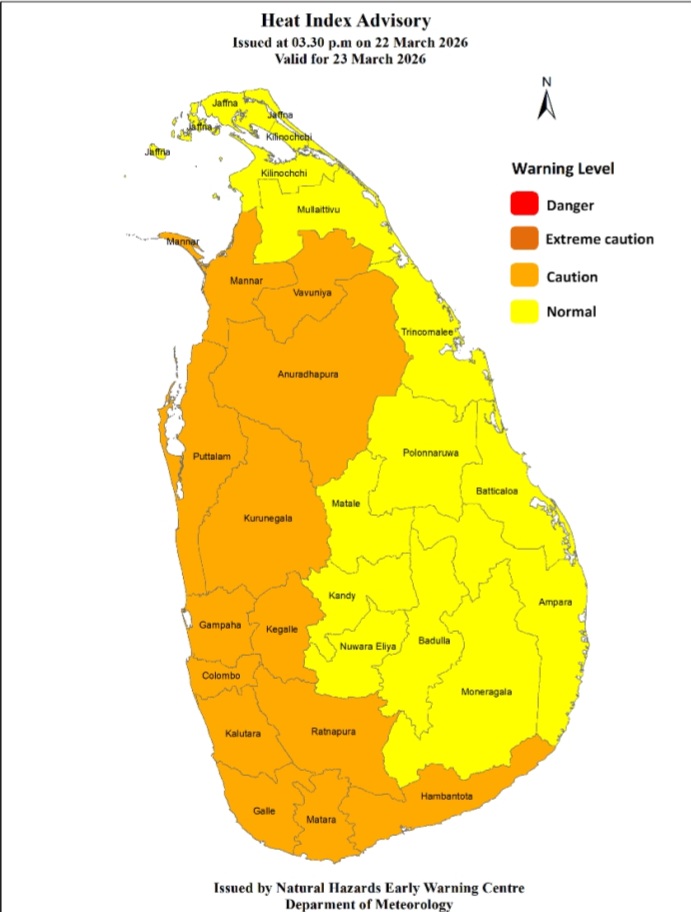
Warm Weather Advisory
Issued by the Natural Hazards Early Warning Centre of the Department of Meteorology
at 3.30 p.m. on 22 March 2026, valid for 23 March 2026.
The Heat index, the temperature felt on human body is likely to increase up to ‘Caution level’ at some places in the Western, Sabaragamuwa, Southern and North-western provinces and in
Anuradhapura, Mannar and Vavuniya districts.
The Heat Index Forecast is calculated by using relative humidity and maximum temperature and this is the condition that is felt on your body. This is not the forecast of maximum temperature. It is generated by the Department of Meteorology for the next day period and prepared by using global numerical weather prediction model data.

Effect of the heat index on human body is mentioned in the above table and it is prepared on the advice of the Ministry of Health and Indigenous Medical Services.
ACTION REQUIRED
Job sites: Stay hydrated and takes breaks in the shade as often as possible.
Indoors: Check up on the elderly and the sick.
Vehicles: Never leave children unattended.
Outdoors: Limit strenuous outdoor activities, find shade and stay hydrated.
Dress: Wear lightweight and white or light-colored clothing.
Note:
In addition, please refer to advisories issued by the Disaster Preparedness & Response Division, Ministry of Health in this regard as well. For further clarifications please contact 011-7446491.


The latest fuel price increases have sparked widespread concern among transport operators and raised questions about the government’s supportive measures. Cabinet Spokesman and Minister Dr Nalinda Jayathissa told a media briefing yesterday that the government was incurring a monthly loss of Rs. 20 billion by maintaining subsidies on fuel. According to the Minister, the state loses Rs. 100 per litre of diesel and Rs. 20 per litre of petrol under the current pricing system, a burden that the Treasury continues to absorb as part of a “supportive mechanism.”
The Ceylon Petroleum Corporation (CPC) revised fuel prices from midnight on March 21, raising the price of a litre of Lanka Auto Diesel by Rs. 79 to Rs. 382, Super Diesel by Rs. 90 to Rs. 443, Octane 95 petrol by Rs. 90 to Rs. 455, and Octane 92 petrol by Rs. 81 to Rs. 398. Lanka Kerosene was increased by Rs. 60,bringing the price to Rs. 255 per litre. Other suppliers, including Sinopec and Lanka IOC, also implemented similar hikes, with Sinopec’s Super Diesel rising sharply by Rs. 219 to Rs. 572 per litre.
The surge in fuel prices has had an immediate impact on public transport. The Chairman of the Lanka Private Bus Owners’ Association, Gamunu Wijerathne, told The Island that 90% of private buses were off the road yesterday (22). He called for a 15% increase in bus fares, raising the minimum fare from Rs. 27 to Rs. 35, warning that services could be suspended if fare adjustments are not approved.
Three-wheeler operators have also pressed for immediate fare revisions. L. Rohana Perera, General Secretary of the National Joint Three-Wheeler and Industrialists’ Association, said the rising fuel costs have made it difficult for drivers to continue operating. The Association has proposed a Rs. 20 increase for the first kilometre fare for all meter-operated three-wheelers and plans to present its concerns to the Presidential Secretariat.
Fuel price monitoring has also intensified amid concerns over potential smuggling. A senior police officer told The Island that intelligence units have been deployed near fuel stations to prevent hoarding. The police suspect that certain fuel station employees and owners could be facilitating stockpiling.
Political leaders have warned that the hikes will ripple across the economy. SJB MP S.M. Marikkar said transport cost increases will drive up the prices of essential goods such as rice and fish, leaving consumers struggling under rising costs.
Import and export container transportation charges will be increased by 20% from midnight yesterday (22) due to the recent fuel price hike, according to the Container Transport Vehicle Owners’ Association.
The latest increases follow two rounds of price hikes since March 9, driven by surging global oil prices amid the Middle East conflict. Since then, Lanka Petrol 92 Octane has risen by Rs. 105 to Rs. 398, Petrol 95 Octane by Rs. 115 to Rs. 455, Auto Diesel by Rs. 101 to Rs. 382, and Super Diesel by Rs. 114 to Rs. 443 representing an overall increase of around 35% across key fuel categories.
by Norman Palihawadane and Pradeep Prasanna Samarakoon
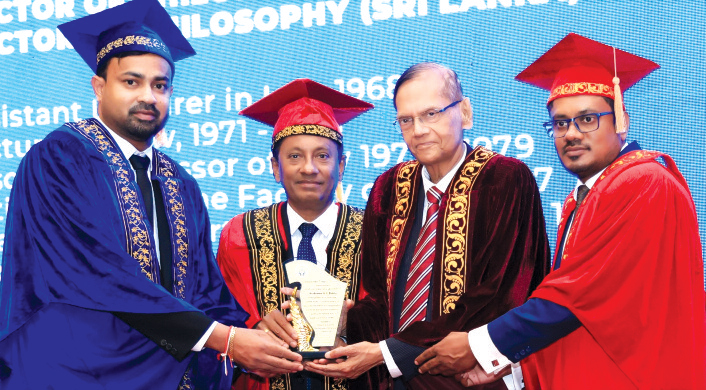
At the award presentation ceremony of the International Rehabilitation Institute last week, Professor G.L. Peiris, as Chief Guest, in his keynote address, dealt with the special relevance of rehabilitation at this time. The traditional criminal law makes provision for punishment after a crime has been committed, and punishment usually takes the form of a prison sentence. It is even more important, however, to explore practical means of prevention and also to have recourse to a custodial sentence as a last resort rather than as the typical response.
The modern approach is that punishment is seen not as retributive but as a means of rehabilitating the offender in society. Prison sentences, bringing a first offender into the prison environment and association with habitual offenders, carries the risk of recidivism, the available statistics indicating the likelihood of return to prison on repeated occasions.
He placed emphasis on the importance of informed social attitudes to ensure that an offender does not carry a permanent stigma, reducing his opportunities for employment and acceptance in society. The importance of religious instruction in early childhood, and the close connection between temple and village, was stressed.
Professor Peiris was honoured with an award of appreciation by academic colleagues.

Trump says he is postponing strikes on Iran power plants after ‘productive’ talks on ending war

Asia stocks slide as US and Iran threaten to escalate war

Heat Index at Caution Level in the Western, Sabaragamuwa, Southern and North-western provinces and in Anuradhapura, Mannar and Vavuniya districts

Showers may occur at several places in the Western and Sabaragamuwa provinces and in Galle, Matara and Nuwara-Eliya districts after 2.00 pm.

Fuel price hikes trigger transport disruptions and calls for fare increases

Prof. Peiris honoured by International Institute of Rehabilitation

‘Dates have the highest sugar content to fight Coronavirus’

Sunday Island 27 December – Headlines

#SundayIsland 17th December – Headlines

Sunday Island – 28th March

Sunday Island Headlines – 21 March

Sunday Island – 21st February – Headlines
-

 News6 days ago
CIABOC questions Ex-President GR on house for CJ’s maid
-

 News7 days ago
Sri Lankan marine scientist Asha de Vos honoured at UNGA opening
-

 News7 days ago
Australian HC debunks misleading travel risk claims for Sri Lanka
-

 News5 days ago
Bailey Bridge inaugurated at Chilaw
-

 Latest News7 days ago
Wednesdays declared a government holiday with effect from 18th March
-

 News5 days ago
Pay hike demand: CEB workers climb down from 40 % to 15–20%
-

 News4 days ago
CIABOC tells court Kapila gave Rs 60 mn to MR and Rs. 20 mn to Priyankara
-

 Editorial6 days ago
Couple QR-based quota with odd-even rationing