News
Wimal calls for probe into US funding and regime change projects
PCCSL assures inquiry into media receiving training to the tune of USD 7.9 mn
By Shamindra Ferdinando
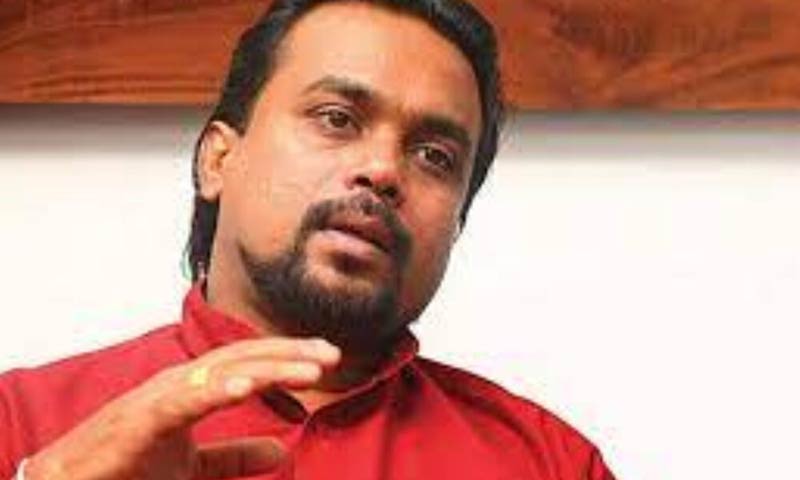
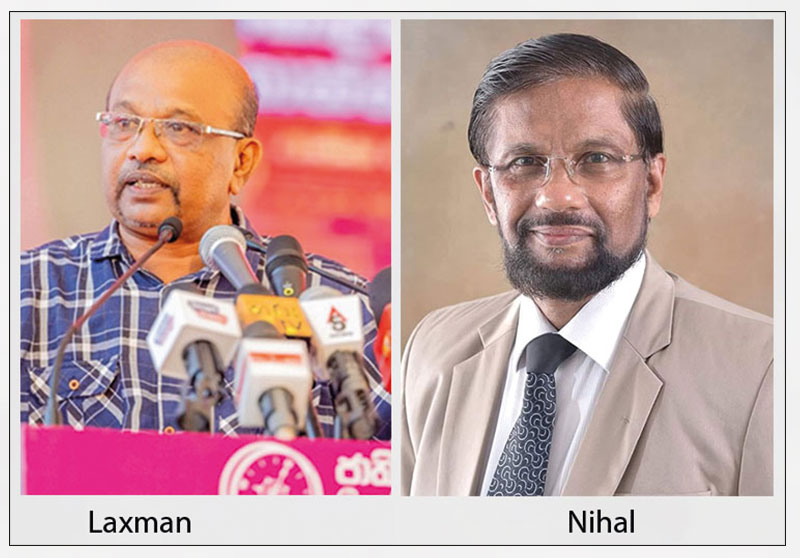
The National Freedom Front (NFF) leader Wimal Weerawansa yesterday (09) renewed his call for a thorough investigation into US intervention in the 2022 so-called Aragalaya project that forced President Gotabaya Rajapaksa out of office.
The former Cabinet Minister said the Janatha Vimukthi Peramuna (JVP)-led Jathika Jana Balawegaya couldn’t side-step the issue against the backdrop of new US administration’s decision to dismantle the US Agency for International Development (USAID) over squandering of US taxpayers’ money on overseas projects.
The crux of the matter was whether the US through USAID and other agencies funded Aragalaya, the former parliamentarian said, pointing out the recent revelation of funding to the tune of USD 7.9 mn made available to teach Sri Lankan journalists how to avoid “binary-gendered language” underscored the urgent need for a comprehensive investigation.
Responding to another query, the former JVPer said that though that funding had been categorized so, the actual purpose could be political as clandestine US interventions here were no secret.
The NFF backed Dilith Jayaweera’s candidature at the last presidential election held in Sept. 2024 but pulled out of that coalition ahead of the general election in Nov. of the same year.
Press Commissioner Niroshan Thambawita said that the Press Council couldn’t inquire into such a matter.
“We could intervene in case of violation of the media code of ethics or some aggravated party making a complaint regarding a news item published in a newspaper or a magazine. The Press Council does not have a mandate to inquire into funding made by a foreign agency to the media here,” Thambawita said. The official said so in response to The Island query.
Asked for the Press Complaints Commission of Sri Lanka (PCCSL) response, its Chief Executive Sukumar Rockwood said that he would initiate an inquiry if it received a complaint. Rockwood said that PCCSL couldn’t initiate an inquiry on its own.
Ex-minister Weerawansa emphasized that successive governments never bothered to take precautionary measures even after the State Department declared that the US funded regime change projects in Myanmar, Nigeria and Sri Lanka during 2014/2015. No less a person than Secretary of State John Kerry is on record as having said that they spent $585 mn in promoting democracy across the globe in 2015, including Sri Lanka, the former minister pointed out. Weerawansa emphasized that USAID was among those outfits that dispensed funds here.
The NFF leader said that perhaps the Editor’s Guild of Sri Lanka should inquire into this matter without delay. All political parties represented in the current Parliament should be seriously concerned as Parliament, too, was a recipient of US funding through USAID and other agencies, the outspoken politician said. Perhaps one of the most important aspects is the need to examine US funding meant for the judiciary, the former Minister said.
Pointing out that in ‘09: The Hidden Story’ he had comprehensively dealt with the US role in the project to oust Gotabaya Rajapaksa, the NFF chief said that those who had been critical of compensation paid to the then lawmakers for destruction of their property were silent on people responsible for the organized attacks.
Sena Thoradeniya, too, intensely examined Aragalaya in ‘Galle Face Protest: System Change or Anarchy? launched soon after Weerawansa’s work.
Weerawansa said that repeated interventions made by the US on behalf of the Aragalaya project weren’t secret. There was a need to examine external interventions as the country couldn’t afford to turn a blind eye to such manipulations, he said.
The Island asked SLPP National List MP and its national organizer Nasal Rajapaksa as to why he was silent on Parliament and Bar Association of Sri Lanka (BASL), too receiving US funding. The former minister said that he would take up it if the newspaper could provide required information.
MP Rajapaksa recently called for US funded projects here. The SLPPer identified the recipients of USAID funding as NGOs, journalists and politicians.
Former UPFA parliamentarian and one-time head of the Peace Secretariat Prof. Rajiva Wijesinha said that examination of USAID funding would be a good idea, for we know that aid over the last quarter of a century has been aimed at fulfilment of political goals. Prof. Wijesinha explained: “But the fault lies in us for not having a proper system of accountability, and mechanisms to assess impact. I tried, when I headed the Peace Secretariat, along with the then Secretary to the Planning Ministry to set up a system, and then again when asked to help monitor activity, but after I failed to vote to impeach Shirani Bandaranayake in January 2013, the late Lakshman Hulugalle, who was in charge, avoided me and work did not proceed. I should add that such monitoring requires staff proficient in English, but they are hard to find at this level given the failure to move on good universal English Language Teaching.”
Prof. Wijesinha said that Sri Lanka in spite of being a major recipient of foreign funding was yet to establish an efficient mechanism to monitor funding. The Parliament should take the initiative in this regard, the academic said.
Former minister Weerawansa said that former Speaker Mahinda Yapa Abeywardena acknowledged external intervention in President Gotabaya Rajapaksa’s ouster but the government didn’t inquire into it. Weerawansa noted that the Human Rights Commission of Sri Lanka (HRCSL) declined to investigate it.
The US Embassy in Colombo directed The Island to contact ‘The Office of Press Operations’ of the State Department when we submitted the following questions: “[1] What is the status of current USAID projects, including Parliament and BASL [2] Is there a likelihood of cancellation of all USAID funded projects here?
The US embassy directed us to get in touch with U.S. Immigration and Customs Enforcement (ICE)- a federal law enforcement agency within the Department of Homeland Security (DHS) regarding our query on deportation of illegal Sri Lankan immigrants against the backdrop of repatriation of illegal Indians.

News
Opposition slams sitting HC judge’s appointment as Justice Ministry Additional Secretary
… alleges Prez trying to control judiciary
Opposition grouping ‘Mahajana Handa’ has accused President Anura Kumara Dissanayake of trying to exercise control over the judiciary by appointing a sitting High Court judge as Additional Secretary to the Justice and National Integration Ministry.
Addressing the media at Dr. N. M. Perera Centre, Punchi Borella, on Tuesday (20) top Opposition spokesman and former External Affairs Minister Prof. G. L. Peiris warned the High Court judge D.M.D.C. Bandara’s appointment was nothing but a direct executive intervention in the judiciary.
Responding to The Island queries, Prof Peiris asked how the government could compel courts to deal with a sitting judge who functioned as Secretary to the Justice and National Integration Ministry.
Prof. Peiris explained that the latest move by the Executive should be examined taking into consideration the attacks on Attorney General Parinda Ranasinghe Jr, PC., the deliberate delaying of the appointment of Auditor General and the controversy over the process of promotions of Judicial Officers, Judges of the High Court and the Court of Appeal in Sri Lanka. Prof. Peiris pointed out that the Bar Association of Sri Lanka (BASL) had raised those controversial promotions with President Anura Kumara Dissanayake.
D.M.D.C. Bandara, Senior Assistant Secretary, Judicial Service Commission, was among altogether 18 High Court judges appointed by President Dissanayake in early Sept this year. The group consisted of 17 Special Class Judicial Officers and a Senior State Counsel serving in the Attorney General’s Department.
Referring to a recent meeting ‘Mahajana Handa’ representatives, including him had with the Mahanayake theras of the Asgiriya and Malwatta Chapters in Kandy, Prof. Peiris said that they had received the blessings of the Mahanayakes to go ahead with what he called a programme of action meant to address major issues.
Prof. Peiris said they would initiate talks with other like-minded political parties and groups in this regard soon. Referring a protest held at the Hulftsdorp on Wednesday (21) demanding the removal of the AG Ranasinghe, Prof. Peiris emphasized that the government’s hand in that demonstration was very clear. President Ranil Wickremesinghe appointed him as the AG in July 2024 with the unanimous backing of the Constitutional Council.
Prof. Peiris said that action was yet to be initiated to appoint new civil society representatives to the Constitutional Council. That issue hadn’t received sufficient public attention, Prof. Peiris said, urging President Dissanayake to come down from his high horse.
Asked whether the President could appoint a sitting judge as an Additional Secretary to a Ministry without consulting the Chief Justice and President of the High Court Judges Association, sources familiar with the issues at hand said that certain appointments could be made on secondment. However, that has to follow the proper procedure, sources said.
The Island sought a response from the Justice and National Integration Ministry to the accusations made by Prof. Peiris on behalf of ‘Mahajana Handa,’ but did not receive one until this edition went to press.
By Shamindra Ferdinando ✍️
News
Largest narcotics haul in SL history seized last year: Police Spokesman
The largest narcotics haul in Sri Lanka’s history was seized last year, according to Police Media Spokesperson and Assistant Superintendent of Police F.U. Wootler.
Addressing a media briefing at the Department of Government Information at Narahenpita on Wednesday (22), ASP Wootler said nationwide operations carried out under Operation Ratama Ekata had helped curb the spread of illicit drugs.
He said police taken into custory 10,871 kilos of heroin, cannabis, ice, hashish and cocaine in 2024, while seizures rose sharply to 23,692 kilograms and 307 grams in 2025.
by Norman Palihawadane ✍️
News
Power policy consultation ‘sham’, say consumers
The Electricity Consumers’ Association has raised serious concerns over the consultation process for the proposed National Electricity Policy, describing it as inadequate and legally questionable.National Secretary of the Association, Sanjeewa Dhammika, said he had been given only 30 minutes to present his views on the policy at a meeting held on Wednesday (21) at the Ministry of Power and Energy.
He said that although six members had been appointed to the National Policy Committee, only three were present at the meeting, casting doubt on the credibility and seriousness of the process.
Dhammika also criticised the absence of Dr. Tilak Siyambalapitiya, who is widely reported to have drafted the policy, from the committee meeting.
“He wrote the policy and then walked away. We didn’t even get a chance to question him,” Dhammika said.
He alleged that the consultation lacked proper notice and planning, noting that he had been informed only by a phone call the previous evening and asked to attend the meeting the following morning.
“This is not how public views should be obtained on a national policy. It should have been done well in advance, in a systematic and transparent manner. It wasn’t even communicated to the media,” he said.
Comparing the process to the public consultation mechanisms used by the Public Utilities Commission of Sri Lanka (PUCSL), Dhammika described the exercise as a “makeshift, token process.”
He also raised concerns over the composition of the committee, stating that the inclusion of a retired senior official of the Ceylon Electricity Board—whom he said bears responsibility for the current state of the power sector and continues to favour coal power while opposing renewable energy—was a serious issue.
According to Dhammika, the proposed National Electricity Policy has been drafted in violation of existing laws.
“Under the current law, the authority to determine electricity tariffs lies with the Public Utilities Commission of Sri Lanka. Through this new policy, there is an attempt to remove those powers from the Commission,” he alleged.
He warned that the policy centralises key decision-making powers—including licensing, power plant acquisitions, power infrastructure development, and renewable energy decisions—into the hands of a few individuals, calling it a high-risk approach.
“This is similar to how the Education Act was distorted under the guise of education reforms. It is shocking to see whether this is what the government calls a progressive new law,” he said.
The Electricity Consumers’ Association strongly opposes the formulation of the policy, with Dhammika describing it as “one of the most failed initiatives seen in recent times.”
He said that if implemented in such a haphazard way, the policy would result in higher electricity bills for low-consumption users, while high-consumption users would benefit from reductions of approximately 38% to 45%.
Dhammika also alleged that the policy discourages the solar power industry and promotes a diesel- and coal-dependent energy model driven by vested interests aligned with oil-based power generation.
By Anuradha Hiripitiyage ✍️
-
Editorial5 days agoIllusory rule of law
-
News6 days agoUNDP’s assessment confirms widespread economic fallout from Cyclone Ditwah
-
Editorial6 days agoCrime and cops
-
Features5 days agoDaydreams on a winter’s day
-
Features5 days agoSurprise move of both the Minister and myself from Agriculture to Education
-
Features4 days agoExtended mind thesis:A Buddhist perspective
-
Features5 days agoThe Story of Furniture in Sri Lanka
-
Opinion3 days agoAmerican rulers’ hatred for Venezuela and its leaders