
Latest News
Trump and Xi conclude ‘very successful’ talks but no deals announced

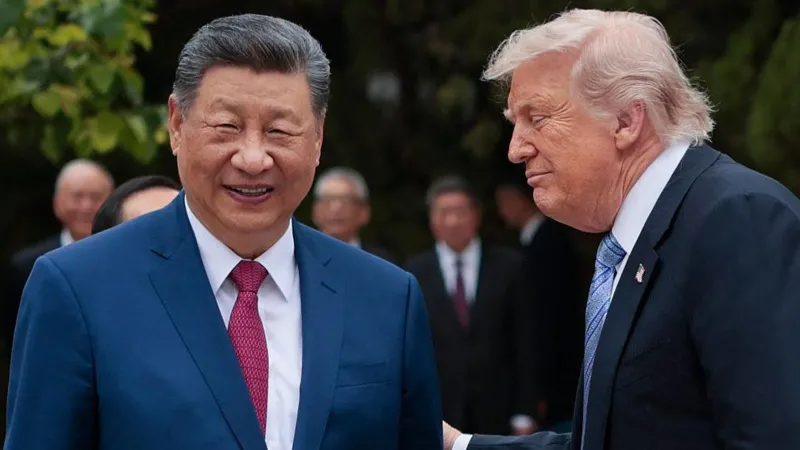
US President Donald Trump left Beijing after a two-day summit saying he had struck “fantastic trade deals, great for both countries”, but few details have emerged on what the two superpowers agreed.
Trump arrived for a high-stakes summit with Chinese leader Xi Jinping on Wednesday, accompanied by several CEOs: a high profile business delegation spanning agriculture, aviation, electric vehicles and artificial intelligence (AI) chips.
Trade was near the top of the agenda despite recent tensions over the Iran war, and businesses hoped for key deals as well as an extension of the tariff truce that is due to expire in November.
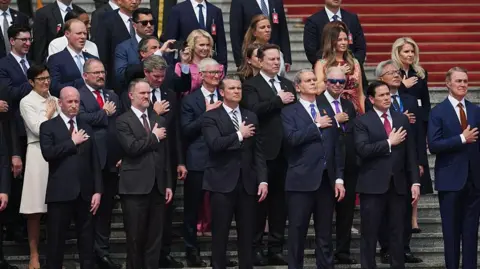
The visit was defined by warm rhetoric and symbolism. Trump was wooed with a packed itinerary that included an honour guard, a state banquet, and an invitation to the exclusive compound where China’s Communist Party leaders live and work.
The US President seemed impressed and invited Xi to the White House in September. He said talks had been “very successful”, while Xi called it a “historic and landmark” visit.
But neither side has announced trade breakthroughs or significant business deals.
President Trump, however, spoke to reporters aboard Air Force One and said that China has agreed to buy 200 Boeing jets, with a potential commitment to buy an additional 750 planes. The BBC has contacted Boeing for comment.
Trump also said American farmers will be happy with his trade deals because China would be buying “billions of dollars” of soybeans.
But there has been no confirmation of any deals or purchases from the Chinese.
If the Boeing orders are finalised, this would be the planemaker’s first major Chinese deal in nearly a decade. It was largely shut out of the world’s second-largest aviation market because of trade tensions between Beijing and Washington.
Asked about Trump’s earlier comments to Fox News in which he said deals had been made, Chinese foreign ministry spokesperson Guo Jiakun only said that the “essence of China-US economic and trade relations is mutual benefit and win-win co-operation”.
He added that both sides should work to implement the “important consensus” reached by the two leaders and bring greater stability to bilateral trade ties and the global economy.
There are still questions over the trade truce agreed in October, when Washington suspended steep tariff increases on Chinese goods while Beijing eased back from restricting rare earth exports critical for manufacturing.
Suprisingly Trump told reporters on Air Force One that he and Xi did not discuss tariffs at all.
The White House however said both leaders agreed to establish a “Board of Trade” to manage the relationship without having to reopen tariff negotiations.
US Treasury Secretary Scott Bessent, who had been leading trade talks for Washington, said in a pre-recorded interview with CNBC that he expected progress on a mechanism to support future investment.
US officials have cautioned, however, that there is a lot of work to be done before these announcements can go into effect.
One of the most closely watched moments came as Air Force One touched down in Beijing on Wednesday night.
Tesla CEO Elon Musk stepped off the plane ahead of senior officials including Pete Hegseth, Marco Rubio and Greer – a sign of the crucial economic agenda that lay ahead.
And Musk and US chipmaker Nvidia’s boss Jensen Huang stayed close to Trump during the welcome ceremony, and were prominent during the banquet.
Huang’s appearance was notable because he was not meant to be part of the delegation originally – but when he joined the trip, it fuelled speculation that AI and access to chips was a bigger part of the talks than previously thought.
With electric vehicles, AI and semiconductors becoming key battlegrounds in the US-China rivalry, both Tesla and Nvidia are very exposed to China.
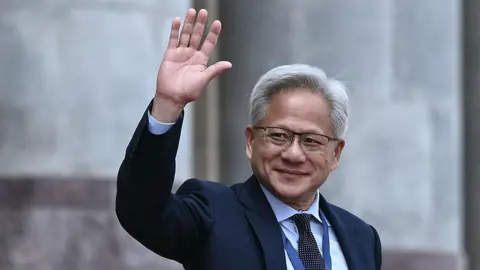
Tesla relies heavily on its Shanghai gigafactory and Chinese consumers, while Nvidia wants to be able to start selling advanced chips to China again, which is currently prohibited by US export controls.
US export controls are aimed at limiting China’s access to frontier AI capabilities, but Greer said they were not a major talking point at the summit.
Beijing, however, continues to push for greater access to advanced tech, while criticising what it sees as efforts to constrain its industrial development.
AI was expected to be a big part of conversations but there was no mention of it in readouts from the summit.
Last year’s tit-for-tat tariff war also hit American farmers, who want to export more soybeans, beef and poultry to China.
According to US trade representative Jamieson Greer, deals on Chinese purchases of US agricultural products have been firmed up. But China’s foreign ministry did not confirm any such new deals, saying only that both sides had agreed to maintain stable trade ties and expand co-operation based on “equality, mutual respect and mutual benefit”.
The White House said the talks also touched on expanding Chinese market access for US companies and increasing Chinese investment in US industries.
While China is a major market for US companies, it is also a difficult operating environment because of regulation, red tape and geopolitical uncertainty.
But Beijing seemed to strike a positive note on this issue. Xi told US business leaders that China’s “doors will open wider” and that American firms would have “broader prospects” in the Chinese market, according to news site Xinhua.
He also called for expanded co-operation in trade, agriculture, healthcare, tourism and law enforcement, describing bilateral ties as “mutually beneficial” and delivering “win-win results”.
Taiwan, the US ally and self-governed island that Beijing claims, has largely been treated as one of several friction points between the US and China during trade talks over the past year.
But this time Beijing linked Taiwan to the broader economic relationship with the United States.
According to Beijing’s readout, Xi said the two sides had agreed to a “new positioning” for relations based on “constructive strategic stability”, but issued the now-familiar warning that Taiwan remained the most sensitive issue.
“The Taiwan question is the most important issue in China-US relations,” Xi warned during the talks, according to Chinese state media.
“If mishandled, the two nations could collide or even come into conflict,” he said.
Taipei would be watching closely but it’s hard to say yet if and how this will affect US collaboration with semiconductor companies in Taiwan, or its long-standing close relationship with the island.
The war against Iran and the resulting blockade of the Hormuz Strait was a key part of the agenda, and Trump entered the talks hoping for Chinese co-operation on the Iran conflict and the oil market.
Trump has said that China could use its influence to encourage Iran to stabilise flows through the Strait of Hormuz, a key global energy artery.
“[Xi would] like to see the Hormuz Strait open, and said ‘if I can be of any help whatsoever, I would like to help,'” Trump told Fox News.
The Chinese foreign ministry was more vague, and released a statement on Friday calling for “a comprehensive and lasting ceasefire”.
“Shipping lanes should be reopened as soon as possible in response to the calls of the international community,” it added.
Chinese readouts indicated that while the Middle East was discussed, details were limited.
The conflict is a challenge for the Chinese economy too. Oil price volatility and repeated disruptions to supply routes have increased China’s import costs and pushed up prices across the world.
Trump has already invited Xi to the White House in September for a second summit.
Discussions between the two sides are expected to continue ahead of that summit, with the hope that the world’s two biggest economies can deliver a major breakthrough on trade that proved elusive this time around.
[BBC]




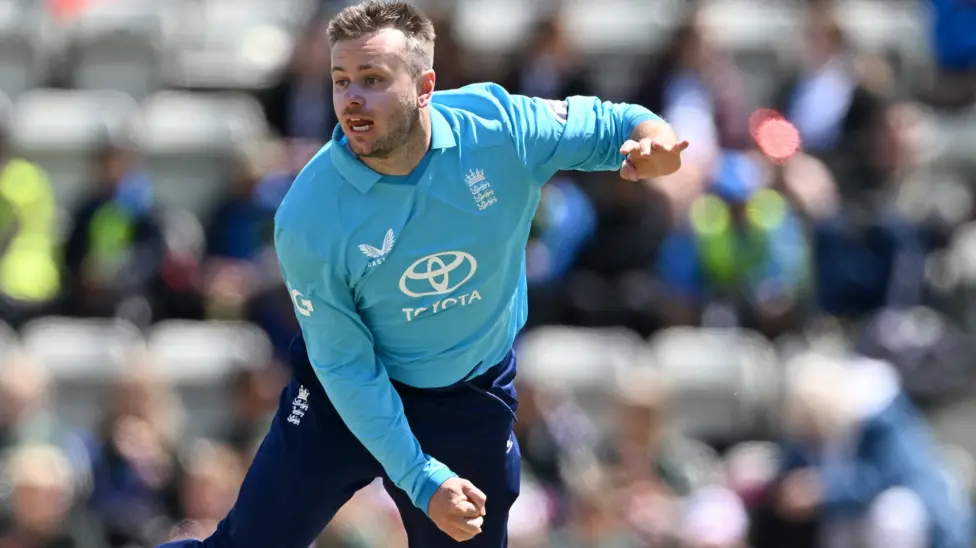
Leg-spinner Mason Crane could play for England for the first time in eight years after being recalled for the one-day international tri-series in Pakistan.
The 29-year-old won his only Test cap against Australia in Sydney in 2018 and is now given an opportunity in the series which also involves Sri Lanka next month.
Crane, who also played two T20 internationals in 2017, could also push his case in the fight to be England’s number one spinner in Test cricket.
Sam Curran and Adil Rashid both return after injuries, and uncapped pair James Coles and Henry Crocombe are included.
Jos Buttler is out with the hamstring injury he sustained last week, while Jacob Bethell is continuing his recovery from knee surgery.
Brydon Carse, who is under an investigation from the Cricket Regulator following an incident outside a nightclub in Derby in August, remains absent.
England are on a diet of white-ball cricket until three Tests in South Africa in December as they build up to the 50-over World Cup in southern Africa next year.
The tri-series in Pakistan involves the three teams taking part playing each other twice, with the top two advancing to the final. Following the trip to Pakistan, England play three one-day internationals and five T20s in Australia in November.
As England continue to shape their backroom staff following the arrival of Stephen Fleming as Test coach, Jeetan Patel, Mike Yardy, David Saker and Carl Hopkinson will assist white-ball head coach Brendon McCullum in Pakistan.
That means Marcus Trescothick, who took temporary charge of the Test team for the series against Pakistan in the home summer, misses the trip.
It is understood the make-up of the coaching staff is part of a plan to rotate the coaches – fielding coach Sarah Taylor and fast-bowling coach Tim Southee are also not going to Pakistan.
All of Trescothick, Taylor and Southee are likely to be part of England’s coaching team for other tours this winter.
England squad for tri-series in Pakistan:
Harry Brook (Yorkshire – captain), Gus Atkinson (Surrey), Sonny Baker (Hampshire), Tom Banton (Somerset), James Coles (Sussex), Jordan Cox (Essex), Mason Crane (Glamorgan), Henry Crocombe (Sussex), Sam Curran (Surrey), Liam Dawson (Hampshire), Ben Duckett (Nottinghamshire), Will Jacks (Surrey), Jamie Overton (Surrey), Adil Rashid (Yorkshire), Joe Root (Yorkshire), Josh Tongue (Nottinghamshire).
(BBC)

Latest News
I extend my heartfelt wishes to all the sons and daughters of our country for a Happy World Children’s Day – President

Children’s Day Message from President Anura Kumara Dissanayake:
“Children are the most valuable asset of a nation. Ensuring their physical and mental well-being and creating an environment conducive to their proper development is a primary responsibility of any government. Children’s imagination, aspirations and creativity will determine the shape and colour of the country tomorrow. The country we build for children must not merely be a country prepared to be handed over to them in the future; it must be a country that gives space to their dreams today, listens to their voices and provides opportunities for them to realise their potential.
For the best interests of children, we are taking the necessary steps to ensure equal access to education, guidance, social protection, opportunities for sport, leisure and recreation, proper nutrition and access to healthcare, while protecting children from all forms of violence and discrimination and safeguarding their rights.
Race, religion, economic status, geographical background or any other circumstance should not be a barrier to any child’s education or proper development. Every child should have equal and fair opportunities to realise their potential, pursue their dreams and create the future they wish for themselves. To this end, we have already begun the process of reforming the education system in Sri Lanka, transforming it towards a skills-based system suited to the new world, one that does not place a burden on parents or cause distress to children.
Our aim is to ensure that no child is left behind in the new Sri Lanka we are building, and to provide every child with opportunities for development in a safe environment. It should be emphasised that the fundamental objective of all the programmes being implemented, from expanding educational scholarships to securing the future of children growing up in child development centres and those in need of care, is to create a dignified and secure tomorrow for every child in the country.
It is the aspiration of every parent to give their children a better life than the one they themselves experienced. We are currently steering the country’s economy towards a correct and stable direction in order to provide children with a safe and happy childhood, free from the shadows of an unstable economy. At the same time, we have launched the national operation “A Nation United” (Ratama Ekata), bringing everyone together to free the younger generation from the menace of illicit drugs.
At a time when we are working towards the goal of building a safe and better country for children, I greatly appreciate the initiative of the Ministry of Women and Child Affairs in organising this year’s World Children’s Day celebrations under the theme “Strong Minds – Enriched Children”, declaring a National Children’s Day Week and conducting a range of meaningful programmes aimed at strengthening children’s rights, well-being, protection, education and freedom.
I extend my heartfelt wishes to all the sons and daughters of our country for a Happy World Children’s Day”.

Showers or thundershowers will occur in most parts of the island after 1.00 p.m.

Unions resist tripartite EPF management plan

Two arrest warrants issued for Gnanasara thera

CA dismisses GR’s writ petition against arrest

ADB-backed virtual net metering project faces policy contradiction

Media action group flays NPP over new anti-terrorism law

‘Dates have the highest sugar content to fight Coronavirus’

Sunday Island 27 December – Headlines

#SundayIsland 17th December – Headlines

Sunday Island – 28th March

Sunday Island Headlines – 21 March

Sunday Island – 21st February – Headlines
-

 Editorial6 days ago
Birth of a bad law
-

 News4 days ago
Police remove Thileepan statue in Jaffna
-
 News6 days ago
TIN mandatory for key transactions from Nov. 1
-

 Features4 days ago
The 22nd Amendment, constitutional recovery and illiberal slippage
-

 Features4 days ago
Of foreigners as CEOs of Lankan ventures
-

 News4 days ago
Sajith rejects Jt. Opp. protest sabotage claim; SJB TU chief demands remedial action
-

 Latest News2 days ago
Gold winner Tharanga gets brand-new Honda Vezel from SLAAJ
-

 Features3 days ago
Thailand’s biggest new global star …