
Business
WIM urges for more board-chair positions for women in Sri Lanka corporate sector

Says that no industry should be labeled on gender bias
by Sanath Nanayakkare
Having more women leaders in corporate management correlates with increased financial and non-financial performance, therefore, the current numbers of women leaders across the country’s corporate landscape should be increased by allowing more of their kind to hold board-chair positions, Women in Management (WIM) Founder & Chairperson Dr. Sulochana Segera told the Island Financial Review.
“It has been proved that when there are women involved in decision-making on corporate boards, those companies reflect favourable outcomes in their performance. Women leaders are able to make this difference because they are very accountable and ethical,” WIM chairperson said.
“Women account for 52.3% of Sri Lanka’s population. They have shown their ability to handle crisis situations with great resilience. So, their influence can have a positive impact at all levels of business, not just in decision-making and leadership roles. If the country doesn’t attract and utilize their talent, it would be wasting a human resource that makes up more than half of its population,” she said.
When asked if the Sri Lankan corporate sector has not yet made an environment conducive to tapping the fullest potential of women leadership and the contribution from women workers at all levels, she replied,” I think that a supporting environment is already in place. You can’t expect to create a perfect environment for absolute gender diversity and parity. It is just that the number of women employed in decision-making roles has to go up. Improving the work environment for women to thrive and deliver their best would be an ongoing process. It is also up to women to step forward and take up these opportunities.”She noted that just by adding a family member to a board may not help ensure the formation of a well-performing board.
Asked whether Sri Lankan women prefer to enter only women-friendly businesses such as apparel, FMCG, she said,” In fact, those sectors used to be our cottage industries and businesses. Now they are operating at a large scale, and we tend to call them ‘women-friendly’. No industry should be labeled on gender bias. It is the passion and the commitment that women bring to any industry that matters. Today there are women in the construction sector, road development sector which are thought to be male-dominant. Their numbers may not still be significant, but the numbers are growing and these women will be role-models for other women who share similar passion. It is not about intruding male-dominated sectors, but entering those sectors with passion and working with male counterparts in collaboration so that these women can advance their career prospects in high-growth sectors while playing a vital role in boosting the national economy.”
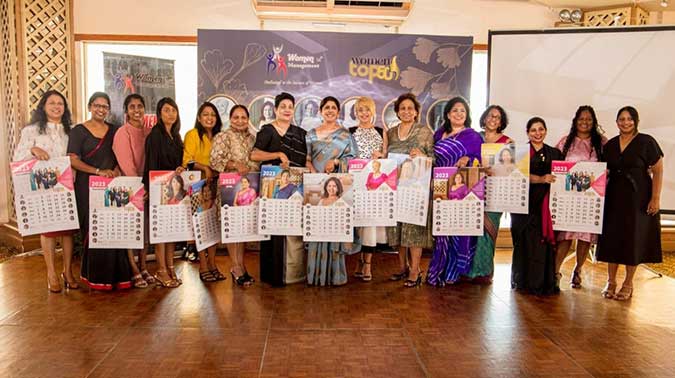
She also said that Sri Lanka needs mentors who can provide help in guiding women through the new and unprecedented challenges they confront.WIM Sri Lanka launched the Second Edition of the Women Top50 Calendar for the year 2023 featuring 12 women Icons on 4th January at the Galadari Hotel. Sara Twigg Programme Manager – Women in Work Sri Lanka International Finance Corporation- was the guest of honour at the event.
This year, WIM has featured women from diverse backgrounds like business, entrepreneurship, corporate boards, state sector, banking, Insurance, corporate careers, legal and etc.
January – Gillian Edwards, Independent Non-Executive Director, Commercial Credit and Finance PLC, February – DevikaEllepola, Head of Passenger Sales, Emirates Airline in Sri Lanka, March – Prof. Dr. Thushari Koralage, Principal/Managing Director, Asian Grammar School (Colombo/Matara), April – Julian Devika Anthony (LLB.), Barrister & Solicitor, President, WIM Canada Chapter, May – NilushiKumaradas, Head of Procurement, Coca Cola Beverages Sri Lanka Ltd, June – Nirosha Jagodaarachchi, Chief Executive Officer, British Cosmetics (Pvt) Ltd, July – Dawn Austin, Managing Director, NIDRO Supply (Pvt) Ltd, August – Shehara de Silva, Non Exec Director, Keells Food Plc, September – Shashi Kandambi Jassim, Professional Banker, October– Keasila Jayawardana, Chairperson, National Savings Bank Plc, November -WIM Sri Lanka Team, Waruni Algama, Vijitha Samarakkodige, Summaiya Macan Markar, Dr. Himalee De Silva, Niroshini Rathnasinghe, Fazeela Dharmarathne & Dr. Nadini Wickarmasinghe, December- Manindri Dias Bandaranayake, Group Chief Brand Marketing Officer, Janashakthi Group.
WIM chairperson said that younger women will have the chance to be inspired by those featured in the calendar and find new ways to make history of their own.


Sri Lanka is one of the world’s richest biodiversity hotspots, with nature deeply intertwined with community life. Reflecting this connection, across the island, small-scale conservation efforts have always thrived in pockets. For MAS Holdings, the urgency of the environmental crisis made it clear that scattered initiatives were not enough- it was time to bring them together into an impactful, long-term approach. Employees have also welcomed the chance to be part of projects that protect nature, finding meaning in contributing to something that benefits both their communities and the environment.
Recognising this, apparel-tech conglomerate MAS Holdings has made biodiversity restoration central to its sustainability roadmap, the MAS Plan for Change 2030. Building on its commitments for 2025, the company has pledged to reforest and restore biodiversity across an area 100 times larger than its global operational footprint.
For an organization that spans 15 countries- across North America, Europe, Asia and Africa, this amounts to more than 31,700 acres of land. According to Nemanthie Kooragamage, Director – Group Sustainable Business at MAS Holdings, achieving reforestation on such an ambitious scale demands bold and innovative approaches.
“Well-planned restoration can do far more than replace lost trees,” she explains. “It can reconnect fragmented landscapes, stabilise soils, improve freshwater quality, rebuild coastal and mangrove nurseries, and create wildlife corridors- benefits that safeguard nature and the long-term resilience of apparel supply chains and communities.”
Building a Scalable Goal
The roots of MAS’ biodiversity goal trace back to 2017, when it pledged to restore 250 acres of land, equivalent to its operational footprint at the time. By the end of the initiative, the company had doubled its target and restored 500 acres of land.
Even then, MAS recognised that planting trees alone was not enough. As it pursued this goal, it became clear that landscapes face different pressures, from invasive species to degraded soils, and therefore require tailored interventions. And so, MAS developed its six-model framework for restoration: Conservation, Reforestation, Invasive Removal, Afforestation, Analog Forests, and Forest Gardens.
This framework later underpinned the biodiversity target set under Plan for Change 2025, which scaled up the 2017 pledge to restore 100 times MAS’ operational footprint at the time, a total of 25,000 acres.
Applying the Six-Model Approach
Over the last five years, the six-model framework has been put into practice, with projects demonstrating how different contexts required different interventions.
Conservation was at the heart of the Panama In-Situ Turtle Conservation Project, launched in partnership with two corporates and the Wildlife and Ocean Resources Conservation Society. Protecting a three to ten-kilometre stretch of coastline, the project has safeguarded 272 nests and released over 17,000 hatchlings since October 2023, directly supporting the survival of endangered sea turtle species.
Reforestation included the restoration of 10 acres of mangroves in Trincomalee, where MAS achieved an 81% sapling survival rate. Meanwhile, the Ittapana Mangrove Forest Reforestation Project, undertaken with the University of Sri Jayawardenepura and local communities, planted 500 saplings with a 94% survival rate. Beyond ecological restoration, it enhanced local fisheries, improved water quality, and engaged students and residents, ensuring long-term community impact.
To restore large, inaccessible degraded terrains, MAS partnered with the Sri Lanka Air Force to disperse seed bombs. This aerial reforestation method restored 275 acres and achieved a 45% survival rate, demonstrating an efficient solution for landscapes that could not be rehabilitated through conventional means.
Invasive Alien Species (IAS) removal was another critical strand, with programmes carried out in national parks in partnership with the Department of Wildlife Conservation. At Horton Plains, MAS removed Ulex europaeus from 82% of the affected areas and restored 244 acres of sensitive ecosystem. At Udawalawe and Lunugamwehera, the manual removal of Lantana camara supported the regeneration of grasslands vital for elephants, leopards, and sloth bears.
“We tested different approaches in Sri Lanka, from coastal conservation to seed bombing and invasive species removal, and they proved effective in their own contexts. With the scale of our biodiversity goals and our global operational footprint, the next step was to take these learnings beyond Sri Lanka and apply them internationally,” said Uvini Athukorala, Manager – Environmental Sustainability.
Expanding Globally
As part of its Plan for Change 2025 biodiversity conservation efforts, MAS extended projects beyond Sri Lanka to countries where it also has manufacturing operations. This ensured that the company’s restoration work addressed the landscapes and communities directly connected to its business footprint.
In Central Java, Indonesia, the Blora Ngawi Biodiversity Restoration Project has restored over 12,601 acres since 2023. The initiative planted more than half a million trees and established a multi-stakeholder forest management model that combines forest protection, land rehabilitation, and habitat enrichment.
In Kenya, MAS launched its largest conservation project to date, protecting 8,275 acres within the Nairobi National Park, in partnership with The Wildlife Foundation. The project secured wildlife corridors critical for elephants, lions, and cheetahs, reduced human-wildlife conflict, and created conservation-linked livelihoods for more than 600 people, with women and youth playing a central role.
These global projects demonstrated that the lessons learned in Sri Lanka, experimenting with diverse approaches and working hand in hand with local partners, could be successfully scaled in other contexts, while directly benefiting the communities where MAS operates.
Lessons for the Future
As the Plan for Change 2025 concludes, MAS has restored 25,058 acres toward its biodiversity conservation goal. The experience highlights two key lessons. First, that restoration must be context-specific. From mangrove reforestation in Trincomalee to invasive species removal in Horton Plains, or aerial reforestation of degraded terrain, each ecosystem required a different model to deliver meaningful results. Second, that collaboration is essential. Partnerships with government agencies, non-profits, universities, and local communities in Sri Lanka, Indonesia, and Kenya ensured both technical expertise and local ownership, making projects sustainable beyond their initial interventions.
Business
People’s Bank’s Commitment to Rebuilding the MSME Sector through Government-Backed Financing

How is People’s Bank ready to support the rebuilding of the MSME sector in Sri Lanka, not only in the post-crisis context but in general?
Micro, Small and Medium Enterprises (MSMEs) are the backbone of the Sri Lankan economy, playing a vital role in employment generation, regional development, and income distribution. At People’s Bank, supporting MSMEs is a long-term strategic priority aligned with our mandate as the country’s premier state-owned commercial bank.
Our approach extends beyond post-crisis recovery to support the full MSME life cycle, from start-ups and micro entrepreneurs to growing and established businesses, through tailored financing, advisory support, and sector-specific solutions. With our island-wide branch network and strong understanding of local economies, People’s Bank is well positioned to serve entrepreneurs across urban, rural, and underserved communities.
What government-funded facilities are currently available through People’s Bank?
People’s Bank actively participates in several government-funded and concessionary loan schemes, offering lower interest rates compared to market rates, medium to long-term tenures, loan amounts based on project viability and eligibility criteria defined by sector, purpose, and enterprise size.

Table 1
Government funded loan products are made available at People’s Bank branches for the sectors in line with government policy directives in MSME sector, as shown in the Table 1.
Can you briefly summarize the MSME loan products offered by People’s Bank?
People’s Bank offers a wide range of bank-funded MSME loan products, including working capital loans to support day-to-day business operations, term loans for machinery, equipment, expansion, and modernization, trade finance facilities including import, export, and local trade support, overdrafts and revolving credit to manage cash flow fluctuations and sector-specific loans tailored for agriculture, manufacturing, tourism, construction, logistics, and services.
Loan amounts, interest rates, and tenures vary depending on the business profile, purpose of the loan, and credit evaluation, with repayment periods extending up to several years for long-term investments whereas the MSME definition introduced by Ministry of Industries for categorization of concerned businesses.
People’s Bank offers a range of bank-funded loan schemes in MSME sector as follows and the interest rates are varies from 7.0% p.a to 12.0% p.a.
The Small and Medium Enterprises Development (SMED) Scheme
The Business Power Loan Scheme
The Solar Power Generation Loan Scheme
The Green Power Loan
The People’s SPARK Loan Scheme
The NCGIL Loan Scheme
People’s Power Loan Scheme
Vanitha Saviya Loan Scheme
Aswenna Loan Scheme
Pledge Loan Scheme (Bank-Funded Variant)
How should customers approach People’s Bank to access these facilities?
Customers are encouraged to visit their nearest People’s Bank branch, which serves as the primary access point for MSME financing. Branch Managers and Credit Officers will assess customer needs, recommend suitable bank-funded or government-funded facilities, and provide guidance on eligibility and documentation, ensuring personalized support throughout the process.
This branch-based approach ensures transparency, sound advisory support, and efficient decision-making. People’s Bank remains committed to empowering Sri Lanka’s MSME sector as a long-term national responsibility, delivering inclusive and sustainable financial solutions through both its own resources and government-backed initiatives.
(This article is based on an interview with People’s Bank Deputy General Manager (SME, Development & Micro Finance), Wickrama Narayana)

In response to the humanitarian needs arising from Cyclone Ditwah, Shangri-La Group has extended financial assistance to support national relief efforts through the Sri Lanka Red Cross Society, under the leadership of Secretary General Dr. Mahesh Gunasekara.
The contribution will be directed towards critical, life-sustaining interventions in some of the most affected communities across the country. According to the Sri Lanka Red Cross, medical services in 25 major hospitals have been severely disrupted by the cyclone. Part of the assistance will therefore support the deployment of mobile medical camps, ensuring timely and accessible healthcare for vulnerable populations.
Recognising the urgent need for safe drinking water in flood-affected areas, the initiative will also focus on restoring natural water sources, including wells and springs, helping communities regain access to clean and reliable water. In addition, a portion of the funds will be allocated to psychosocial support programmes for children residing in temporary camps, offering care, comfort, and emotional reassurance during a deeply unsettling time.
“At Shangri-La, our commitment goes beyond the walls of our hotels. In moments like these, it is about standing alongside communities with empathy, responsibility and care. We hope this support brings not only practical relief, but also comfort and reassurance to families – especially children – who are navigating an incredibly difficult time,” said Shangri-La Sri Lanka Director of Human Resources, Madusha Pihilladeniya. “Our hearts are with every community affected, and we remain united in the belief that compassion, when shared, can help restore hope.”
This initiative reflects Shangri-La’s ethos of Heartfelt Hospitality – a philosophy rooted in empathy, responsibility, and solidarity. It stands as a quiet yet powerful reminder that, beyond hospitality, Shangri-La remains committed to standing with communities when care is needed most and hopes this brings comfort, together with practical assistance to communities affected during this challenging time.

One person dead and 300 buildings destroyed in Australia bushfires

Iran warns it will retaliate if US attacks as protesters defy crackdown

GENERAL WEATHER FORECAST FOR NEXT 36 HOURS

National Communication Programme for Child Health Promotion (SBCC) has been launched. – PM

Level I landslide early warnings issued to the Districts of Badulla, Kandy, Matale and Nuwara-Eliya extended

Rescuers race to find dozens missing in deadly Philippines landfill collapse

‘Dates have the highest sugar content to fight Coronavirus’

Sunday Island 27 December – Headlines

#SundayIsland 17th December – Headlines

Sunday Island – 28th March

Sunday Island Headlines – 21 March

Sunday Island – 21st February – Headlines
-

 News19 hours ago
Sajith: Ashoka Chakra replaces Dharmachakra in Buddhism textbook
-

 News6 days ago
Interception of SL fishing craft by Seychelles: Trawler owners demand international investigation
-

 Features19 hours ago
The Paradox of Trump Power: Contested Authoritarian at Home, Uncontested Bully Abroad
-

 Business20 hours ago
Dialog and UnionPay International Join Forces to Elevate Sri Lanka’s Digital Payment Landscape
-
 News6 days ago
Broad support emerges for Faiszer’s sweeping proposals on long- delayed divorce and personal law reforms
-

 Features19 hours ago
Subject:Whatever happened to (my) three million dollars?
-

 Opinion3 days ago
The minstrel monk and Rafiki, the old mandrill in The Lion King – II
-

 News19 hours ago
65 withdrawn cases re-filed by Govt, PM tells Parliament