
News
Whoever wins presidential poll should adhere to IMF remedies – Japanese Ambassador

… reveals fresh post-war reconciliation effort involving Switzerland and South Africa
Japanese Ambassador in Colombo Hideaki Mizukoshi has said Sri Lanka should remain steadfastly committed to the IMF-led recovery programme regardless of the outcome of the presidential election scheduled to be conducted later this year.
Ambassador Mizukoshi emphasised that the country couldn’t, under any circumstances, deviate from the IMF path as the agreement with the Washington-based lending agency remained the foundation for the entire debt-restructuring process.
The Japanese Ambassador cautioned political parties close on the heels of President Ranil Wickremesinghe depositing the candidate’s fee for the upcoming presidential election. UNP leader Wickremesinghe paid the deposit on Friday (26).
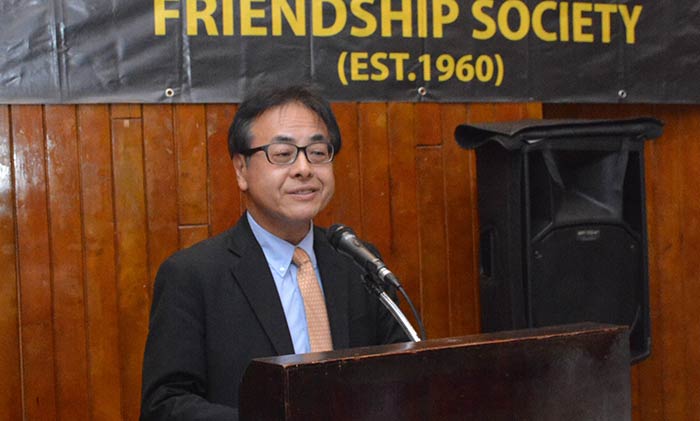
Addressing the members of the Lanka-Japan Friendship Society (LJFS) and invitees at the Sasakawa Memorial Hall Friday evening, Ambassador Mizukoshi said he expected Sri Lanka’s current economic policy and reforms in terms with the IMF agreement would be continued regardless of whoever became President after the next election. “We all should note that the commitment by the Sri Lankan government on the agreement with the IMF is the very basis of the agreement with the creditor countries on debt restructuring and the support of the Japanese government,” the Japanese envoy said.
Ambassador Mizukoshi took over the Japanese mission in Colombo in November 2021 during Gotabaya Rajapaksa’s tenure as the President.
The ambassador dealt with three issues namely post-Aragalaya economic relationship with focus on the debt restructuring process, his commitment to Sri Lanka’s post-war reconciliation efforts and the people-to-people relationship.
The speech delivered at the Sasakawa Memorial Hall was the first since Japan announced the resumption of disbursement of 11 Japanese-funded projects early last week. Japan suspended funding in May 2022 in the wake of Sri Lanka’s declaration of bankruptcy.
Ambassador Mizukoshi declared that the resumption of these projects would energize the Sri Lankan economy. Referring to the unprecedented political-economic-social crisis that compelled President Gotabaya Rajapaksa to resign in July 2022, Ambassador Mizukoshi attributed the speedy improvement of economic indicators largely to freeing of fiscal policy from what he called arbitrary maneuvering and close watch maintained by the international community.
Ambassador Mizukoshi named Central Bank Governor Dr. Nandalal Fernando and Treasury Secretary Mahinda Siriwardena as the architects of Sri Lanka’s recovery under President Ranil Wickremesinghe’s leadership. “I believe that they have implemented bold economic policies in the best interest of the country, gaining trust and respect by the international community.”
The Japanese ambassador discussed the difficulties encountered in the negotiating process especially against the backdrop of both India and China not being members of the Paris club. In the case of Sri Lanka, the number 1 creditor was China, Number 2 was Japan and number 3 was India. Neither China nor India was a member of the Paris Club, the envoy said.
Ambassador Mizukoshi acknowledged the difficulties caused to the people by the current economic policy. The ambassador made reference to the increase in Value Added Tax (VAT) and cut down on subsidies on various commodities in line with the overall post-Aragalaya economic strategy.
Recalling the much needed assistance provided by Japan during this period, Ambassador Mizukoshi disclosed their emergency humanitarian assistance amounted to 100 million US dollars.
The top diplomat warned that there were many challenges ahead as Sri Lanka was at the beginning of a difficult recovery process. Highlighting recovery made by India and South Korea, the Ambassador stressed the importance of Sri Lanka following a market-oriented economy. “So, the debt crisis here can also be a blessing in disguise, and the reform programmes of the IMF will be a silver lining if Sri Lanka navigates its economy in the right direction.”
The Japanese envoy explained the daunting task in attracting Japanese investment unless Sri Lanka achieved what he called transparency of administrative procedures. Ambassador Mizukoshi stressed the responsibility on the part of the government to tackle corruption and administrative delays as well as inefficiency.
“On this point, the IMF has published the IMF Governance Diagnostic Report, a comprehensive assessment of corruption vulnerabilities. We are very much interested in supporting Sri Lanka in correcting these problems because we think they were the root causes of the collapse of the Sri Lankan economy.”
Declaring that Sri Lanka had lost appeal to Japanese investors, Ambassador Mizukoshi said: “The Japanese investors will come to Sri Lanka not when they are asked to come, but when they are convinced that Sri Lanka is a trustworthy country to do business with.”
Commenting on the eradication of the LTTE through military means, Ambassador Mizukoshi expressed concern about the continuing complaints of being discriminated against and left out of economic development in the Northern and Eastern provinces.
Ambassador Mizukoshi disclosed the formation of a troika consisting of him and South African HC and Swiss Ambassador to promote and facilitate national reconciliation. “Each country has different reasons to engage in this exercise. South Africa, with its successful experience of the Truth and Reconciliation Commission to heal the ethnic animosities in the country, can present a good example to Sri Lanka; Switzerland, having a good network among Tamil communities and civil societies; and Japan, having good relationship both with the government and minorities and having the potential to bring in investment as dividend of peace.”
Ambassador Mizukoshi revealed that he advised their Geneva mission appropriately after having visited the Northern and eastern Provinces (SF)



News
Establishment of an Institutional Framework to Inagurate Upper Hydro Catchment Areas Management Authority

Policy approval of the Cabinet of Ministers was granted at their meeting held on 08.06.2026 to establish the Upper Hydro Catchment Areas Management Authority for identification and
execution of a formal and long – lasting remedy to secure the central hills including the upper hydro catchment areas enabling them to sustain amidst extreme weather conditions
due to natural calamities and human activities as well as to be used for the sustainable development of the country.
Accordingly, a concept paper has been prepared including
institutional structure, activities, powers, active subject area as well as administrative and coordination mechanism for the proposed authority by an expert technical committee appointed by the Secretary to the President.
Based on the said concept paper, the Cabinet of Ministers granted approval to the resolution furnished by the President to instruct the Legal Draftsman to prepare a draft bill including legal provisions required for the establishment of Upper Hydro Catchment Areas Management Authority.
News
Introduction of Flora and Fauna (Regulation of actions of the Indigenous Community within the nominated areas) Regulations
With the objective of securing the traditional livelihood and the eco system of the indigenous community, it has been recognized the necessity of introducing a formal regulation methodology to secure their engagement in livelihood activities by being more sensitive to the existing laws.
Thereby, the Fauna and Flora (regularizing) regulations under the Fauna and Flora Protection Ordinance (Authority 469) have been prepared so that nominated activities within the prescribed area to a member of the indigenous community
who has been registered for securing the rights acquired from law or custom or usage or traditional stance to execute an act within a certain state land that is fundamental to the survival of the indigenous community permission can be granted
Accordingly, the Cabinet of Ministers granted approval to the resolution furnished by the Minister of Environment to publish the said regulations in the government gazette notification and thereby submit to the Parliament for its concurrence.
Latest News
M. M. D. J. Senarathne, appointed Director General of the Department of National Botanical Gardens
The Cabinet of Ministers approved the resolution furnished by the Minister of Environment to appoint M. M. D. J. Senarathne, who is the senior most officer in Grade I of Sri Lanka Scientific Service se

Establishment of an Institutional Framework to Inagurate Upper Hydro Catchment Areas Management Authority
Introduction of Flora and Fauna (Regulation of actions of the Indigenous Community within the nominated areas) Regulations
M. M. D. J. Senarathne, appointed Director General of the Department of National Botanical Gardens

Harmanpreet Kaur steps down as India captain

Turkiye, Pakistan agree Saudi Arabia military deployment under Mecca pact

Rumesh Tharanga among nominees announced for World Athlete of the Year 2026

‘Dates have the highest sugar content to fight Coronavirus’

Sunday Island 27 December – Headlines

#SundayIsland 17th December – Headlines

Sunday Island – 28th March

Sunday Island Headlines – 21 March

Sunday Island – 21st February – Headlines
-

 Latest News7 days ago
Gold winner Tharanga gets brand-new Honda Vezel from SLAAJ
-

 News6 days ago
US-assisted ‘Ice’ detection: NPC to examine IGP’s move to transfer drug-busting team
-

 Features7 days ago
Why Sri Lanka needs an Inclusive Civic Nationalism – urgently
-

 Editorial5 days ago
Colombo Port drug bust: The plot thickens
-

 News7 days ago
Civil society activist accuses govt. of favouring Ven. Gnanasara
-
 Midweek Review7 days ago
Dappula’s Easter Sunday ‘grand conspiracy’ claim demolished
-

 Editorial7 days ago
When crime bosses rise above law and shrines
-
Editorial6 days ago
Drug busting, transfers and trust deficit