
Latest News
Modi’s BJP conquers Bengal, one of India’s toughest political frontiers


For years, India’s West Bengal state was the great exception to Narendra Modi’s political advance.
His Bharatiya Janata Party (BJP) had swept through India’s Hindi-speaking heartland, expanded into the west and north-east, and overwhelmed once-formidable regional rivals. Yet Bengal – argumentative and steeped in a self-image of cultural exceptionalism – remained stubbornly resistant.
That made this state election unusually consequential. With more than 100 million people, West Bengal’s electorate is larger than Germany’s, turning its election into something closer to a nation choosing a government than a routine Indian state poll.
Monday’s BJP victory there would rank among the most significant breakthroughs of Modi’s 12-year reign. It is not merely the defeat of a three-term incumbent, but the completion of the party’s long march into eastern India.
“Winning Bengal is a big victory for the BJP – a land of promise that has long eluded its grasp,” says author and journalist Nilanjan Mukhopadhyay.
Monday produced an extrodinary political churn across India’s south as well.
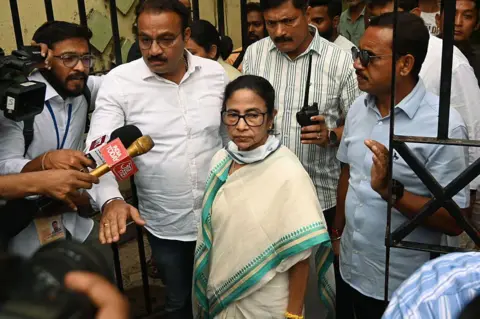
In Tamil Nadu, MK Stalin’s DMK government was swept aside by actor-turned-politician Vijay and his fledgling TVK party, marking the dramatic return of film-star politics to the state.
In Kerala, the Congress-led United Democratic Front (UDF) defeated the Left Democratic Front (LDF) after two consecutive terms, ending the last remaining Communist-led state government in India. Only in Assam did the BJP buck the broader anti-incumbent tide and retain power, while the party and its allies also held on to the federal territory of Puducherry.
Yet nowhere were the results more politically significant than in Bengal.
The state has seen only one change of government in nearly half a century: the Communist Left Front ruled for 34 years before the Trinamool Congress (TMC), led by the firebrand populist Mamata Banerjee, dominated the next 15 years until now. Political scientists have long described Bengal as a system that favours “hegemonic” parties.
Analysts see the outcome not as a sudden upheaval but as the culmination of a decade-long political project. Unlike the BJP’s rapid rise in Tripura or its earlier breakthrough in Assam, Bengal was never a lightning conquest.
“The BJP has been a major force in Bengal for three successive elections, consistently polling around 39% of the popular vote,” says Rahul Verma, who is a fellow at the Centre for Policy Research.
Once it established itself near the 39-40% mark, he argues, “the party really needed only another 5-6% to cross the line”. Voting trends show the BJP mopping up more than 44% of the vote this time.
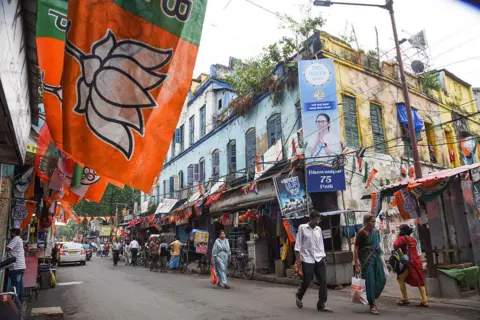
What makes the result particularly striking is that the BJP achieved this despite still lacking the kind of deep organisational machinery that regional parties historically required to win Bengal.
The Trinamool Congress retained a denser grassroots network and the charismatic dominance of Banerjee. Yet the BJP repeatedly sustained a commanding vote share despite allegations of rival political intimidation and the challenge of taking on one of India’s most entrenched regional parties.
“That suggests,” Verma says, “the party’s support now extends beyond the limits of its relatively thin organisational structure.”
So what shifted the election so sharply towards the BJP?
For years, Banerjee’s party forged a formidable social coalition: women, Muslims and large sections of the Hindu vote across both rural and urban Bengal.
Women, in particular, formed the backbone of the party’s welfare-driven politics. The Lokniti-CSDS post-poll survey in 2021 found the TMC’s support among women touching 50% – four percentage points higher than among men – reflecting the impact of years of female-focused welfare schemes and Banerjee’s efforts to expand women’s political representation.
This time, however, the BJP sought to directly challenge that advantage by promising larger cash transfers and expanded welfare benefits of its own.
“Banerjee’s long electoral success rested on a delicate equilibrium between welfare and organisation. But the very organisation that sustained her for 15 years also became her Achilles’ heel,” says political scientist Bhanu Joshi.
“That balance broke down as the party machinery weakened and welfare politics appeared to reach its limits – voters began to see benefits as routine rather than transformative.
“The BJP’s opening was to translate this anti-TMC fatigue into a sharper language of Hindu consolidation. So this is not simply a story of welfare failing; it is a story of welfare and organisation no longer being strong enough to contain polarisation,” says Joshi.
The election also once again highlighted the centrality of Muslim voters to Bengal’s political arithmetic, even if the precise contours of voting patterns remain unclear.
Muslims make up roughly 27% of the population, and nearly a third of the state’s seats have substantial Muslim populations.
In 2021, the TMC swept 84 of 88 Muslim-dominated seats, reflecting a broad consolidation behind Banerjee. While early indications suggest the party retained significant Muslim support this time too, the BJP has increasingly sought to offset that advantage through wider Hindu consolidation and competing welfare promises.
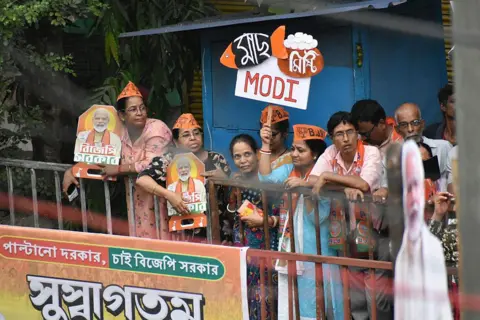
“The BJP combined an aggressive welfare pitch with sharper polarisation. It promised to double cash benefits, while visible communalisation consolidated sections of the Bengali Hindu vote behind the party,” says Maidul Islam, a political scientist at Kolkata’s Centre for Studies in Social Sciences.
BJP leaders, however, framed the result less as ideological consolidation than as a rejection of the Trinamool Congress itself.
The TMC created a “crisis of leadership for itself,” BJP leader Dharmendra Pradhan told one news network. He accused the party of “arrogance” and claimed that “voters, particularly women angered by atrocities and law-and-order failures, had decisively rejected the Trinamool Congress”.
The other elephant in the room was the fiercely contested revision of Bengal’s electoral rolls.
The Election Commission said the exercise, known as the special intensive revision, was intended to clean up voter lists by removing duplicate or ineligible names.
But with nearly three million voters still awaiting tribunal decisions before polling, Banerjee along with activists and civil society groups alleged that Bengal had effectively gone into the election after a “mass disenfranchisement exercise”. This, they said, had disproportionately affecting poor and minority voters, especially Muslims and migrant communities in border districts.
Analysts say the exercise is now likely to come under even sharper scrutiny in closely fought seats where victory margins are much narrower than the number of deleted voters. “The revision of polls will come into play [once the results are in],” politician and activist Yogendra Yadav told NDTV news network.
But the electoral-roll controversy alone cannot explain the scale of the BJP’s surge, many believe.
What also worked in the party’s favour was a tightly focused campaign centred on alleged corruption and governance failures within the Trinamool Congress, hammering scandals such as a trachers’ recruitment scam rather than relying primarily on personal attacks against Banerjee.
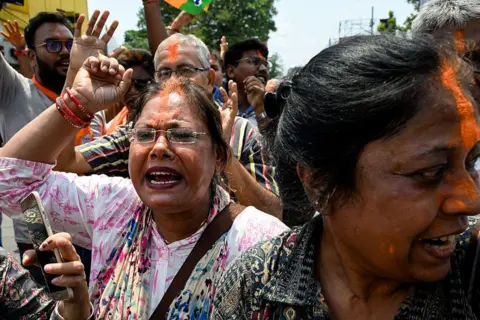
With the BJP firmly on course for victory, the implications will extend far beyond Bengal.
Unlike in neighbouring Bihar, where the party governs through alliances, or even Odisha, where its 2024 breakthrough came against a weakened regional incumbent, a victory in Bengal would represent a standalone conquest of one of India’s most politically formidable states.
“It would strengthen Modi enormously,” says Mukhopadhyay.
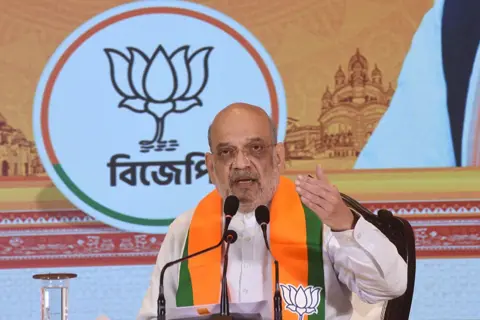
“More than Odisha, this would be seen as a personal political victory not only for Narendra Modi, but also for Home Minister Amit Shah, who effectively ran the campaign.”
Within the BJP, Shah would almost certainly emerge as the informal ‘man of the match’ – echoing the way Modi elevated him after the party’s landmark victory in Uttar Pradesh in 2014.
A Bengal breakthrough could also reshape the BJP’s succession politics, says Mukhopadhyay.
It would reinforce Shah’s standing as Modi’s most likely heir, potentially placing him ahead of rivals such as Yogi Adityanath, Nitin Gadkari and Rajnath Singh in the party’s next-generation power hierarchy.
That would make Bengal’s verdict consequential far beyond the state itself.
For decades, Bengal prided itself on resisting the political currents reshaping the rest of India.
Now that the BJP has finally breached one of India’s most enduring regional strongholds, it may mark not just the end of an era in Bengal, but the beginning of a new phase in the Modi project itself.
[BBC]


Will the Women’s T20 Asia Cup semi-final against Sri Lanka be a full-circle moment for Pakistan ?
Sri Lanka beat Pakistan in the semi final 9f the 2024 edition to qualify for their first Asia Cup final since 2008. Now Pakistan enter this contest having not been at an Asia Cup final since 2016. Moreover, the two teams played a bilateral series only last month. So there is enough familiarity.
Sri Lanka are unbeaten in this tournament, notching up easy wins over UAE and Indonesia before being pushed hard by Bangladesh.Chamari Athapaththu has topped the wickets tally, this time, her seven-for against Indonesia providing a reminder of what she can do in spin-friendly conditions at the Dubai International Cricket Stadium. Her pairing with Imesha Dulani at the top of the batting order has given Sri Lanka a close-to-ideal combination. Nilakshika Silva’s half-century from a tricky spot against Indonesia, and Harshitha Samarawickrama’s composure in a tight chase against Bangladesh have instilled confidence in their batting order.
Pakistan, on the other hand, are slightly short on batting confidence. They posted 119/9 against Thailand and were bowled out for 55 against India. It was only thanks to their bowlers that they could brush Tailand aside. Pakistan also lost the three-match bilateral series against Sri Lanka last month, though they did not have Fatima Sana’s services then.
Shawaal Zulfiqar’s presence at the top allows them to start at a higher gear, and Muneeba Ali’s experience only adds to the heft. Both are yet to fire together in this tournament, and Pakistan would hope it comes in the semi-final in order to end their finals drought.
Being Sri Lanka’s trailblazer, there is so much focus on Athapaththu that it is easy to miss that Harshitha Samarawickrema, still only 28, has already completed a decade in international cricket. She is the vice-captain, and almost the captain-in-waiting when Athapaththu decides to relinquish the role. Samarawickrama has grown in consistently winning games for Sri Lanka. Her unbeaten 48 off 37 against Bangladesh on Sunday is a case in point. Moreover, that knock has also highlighted her versatility. Primarily a top-order bat, she was moved down to No. 5 in order to accommodate Vishmi Gunaratne in the middle-order. She batted in that spot at home against Pakistan last month and finished the chase. Expect Samarawickrama to sit easy under the spotlight against Pakistan in a win-or-go-home contest.
Fatima Sana’s 407 T20I runs in 2026 have come at a strike rate of 150.74, the fourth best this year (minimum 300 runs). There were calls for her to bat higher up than her usual Nos. 7 and 8. Add to it, she has picked up 23 wickets, the most for Pakistan. While she has taken five wickets in the Asia Cup thus far, she is yet to show off her batting might. That is partly down to the surfaces in Dubai. Sri Lanka, though, would be a little wary of her considering she can bash spin, and strikes at 143.24 against them.
Team news
With both teams coming off wins, they are likely to go in with the same teams. Sri Lanka might be tempted to play slinger Mithali Ayodhya since it is a knockout match
Sri Lanka (probable): Imesha Dulani, Chamari Athapaththu (capt), Sanjana Kavindi, Vishmi Gunaratne, Harsthitha Samarawickrama, Kavisha Dilhari, Nilakshika Silva, Kaushini Nuthyangana (wk), Sugandika Kumari, Chethana Vimukthi/Mithali Ayodhya, Chamudi Praboda
Pakistan (probable): Muneeba Ali (wk), Shawaal Zulfiqar, Gull Feroza, Ayesha Zafar, Sadaf Shamas, Fatima Sana (capt), Umm-e-Hani, Eyman Fatima, Tuba Hassan, Nashra Sandhu, Sadia Iqbal
(Cricinfo)
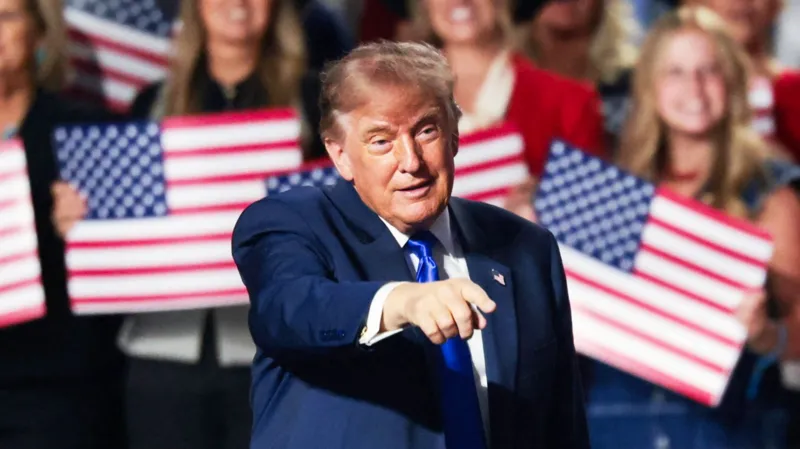
US President Donald Trump says he would offer every adult American a $5,000 (£3,700) payout if Republicans win both chambers of Congress in November’s midterm elections – a plan that would cost more than a trillion dollars.
The offer was made in a speech at the party’s first-ever convention in the middle of a US presidential term.
He gave no details on how it would work or be funded – saying only that the money would have to be spent in the US. Vice-President JD Vance has linked the plan to the revenue that Trump has raised for the US government using tariffs.
Democrats labelled it an “empty promise” and others questioned whether such a pledge was legal or feasible.
It may be the first time a US president offered such a payout to Americans, in the context of an election year plea to get out and vote.
The idea drew raucous applause at the convention and Trump seemed to relish the moment.
There are nearly 270 million American adults, meaning a $5,000 payout would cost the US government some $1.3 trillion.
Questions have begun to be raised about whether his plan is feasible – especially as prices rise in the US, partially as a result of the war that the US and Israel started with Iran in February.
Iran’s retaliation has included attacks against US bases and allies in the Gulf – but crucially it has largely closed the Strait of Hormuz, through which about a fifth of the world’s oil and liquefied natural gas used to transit.
The blockage has caused fluctuations in oil prices worldwide and Trump has faced pressure from his party to end the war.
On Wednesday, the US president warned his supporters that the war would not end until after the midterms and that oil prices would not come down until then.
He made the comments ahead of his speech in Texas, repeating it at the convention where he argued that short-term economic pain was worth it to prevent Tehran from developing nuclear weapons.
Trump’s long speech at the Republican convention in Dallas, Texas, touched on the core of the conflict – the impact on Americans’ standard of living. His pledge to increase their spending power drew raucous applause in the hall.
“If the Republicans win the House of Representatives and the United States Senate, both of them,” Trump said, “I will issue a dividend to every adult citizen in the United States of America for $5,000.”
“We don’t want you going to Canada to spend the money,” he said.
“We don’t want you going to China, to Germany. You got to spend the money in the United States of America.” It is not clear how the spending would be monitored.
The BBC has asked the White House for further clarification on how Trump’s plan would work.
One former Republican strategist and pollster said the promise should be firmly seen in the context of an election that is now less than two months away.
“It is an extraordinary promise, and I’m not sure where that money is going to come from – but it is campaign season,” Robert Moran told the BBC World Service’s Newsday programme.
Moran described it as a “novel solution to an interesting problem”, noting that the historical tendency was for the party of the president to lose seats in Congress during the midterm elections.
It is not the first time that Trump promised such payouts – he has previously proposed $2,000 cheques to be funded by tariff revenues.
Vice-President JD Vance indicated that these post-election payments could similarly be made possible by the money Trump has raised using his wide-ranging tariff programme.
“What the president is talking about is fundamentally a dividend for American workers,” Vance told Fox News.
“We’re taking in an extraordinary amount of revenue because the president of the United States is actually standing up to both foreign companies but also foreign countries who’ve been taking advantage of America’s workers.”
Vance went on to say: “I don’t think it’s a controversial idea.”
Other US politicians in the past have also promised economic rewards in return for electoral success.
For instance, Democrats in Georgia promised $2,000 relief payments if their party took control of the Senate at the height of the Covid-19 pandemic.
In the US, Congress authorises spending. The midterm elections, which will be contested on 3 November, will ultimately decide whether or not Trump’s Republican Party keeps its hold over both the House and Senate.
During his speech in Dallas, the president did not say whether he planned to ask Congress for such approval for the payments – which he dubbed “Trump Dividends”.
However, in addition to the overall cost to the US treasury, the latest proposal from the US president may raise legal questions.
Federal laws prohibit payments that are intended to influence voting.
The issue came to the fore ahead of the 2024 presidential election, during which billionaire Trump supporter Elon Musk offered cash incentives to registered voters in seven swing states who signed a certain petition.
However, some experts say the promise made by Trump during Wednesday’s speech may be seen as a pledge to cut taxes, which is legal.
John Day, a lawyer in New Mexico, said the plan would indeed be legal. It constituted a promise made to all adult citizens of the US during a campaign, rather than a “payment to individuals to try to get them to vote in a particular way”, he told the Associated Press.
Meanwhile, an election law expert who spoke to the New York Times said Trump’s promise would also be covered by the free-speech protection guaranteed under the First Amendment of the US Constitution.
[BBC]
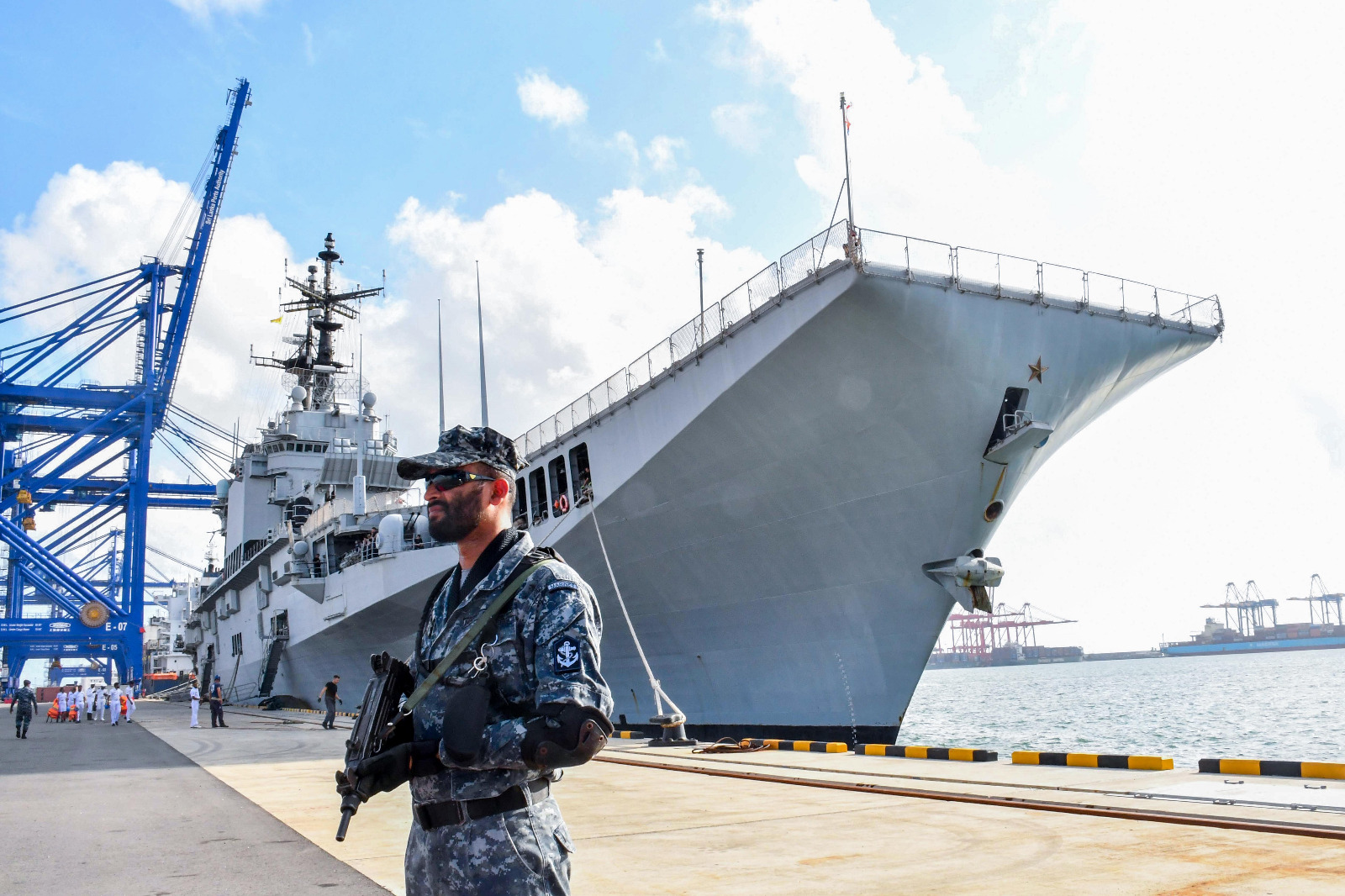
The Italian Naval Vessel ‘ITS Giuseppe Garibaldi’ arrived in Sri Lanka today, 9 September 2026, on a replenishment visit.
The Sri Lanka Navy welcomed the visiting ship in accordance with naval traditions at the port of Colombo.
‘ITS Giuseppe Garibaldi’ is a 180m long Landing Helicopter Aircraft Vessel commanded by Captain Marco GUERRIERO.
During the ship’s stay in Sri Lanka, the Commanding Officer of ‘ITS Giuseppe Garibaldi’ is scheduled to call on the Commander Western Naval Area.

Pakistan seek revenge, Sri Lanka eye another Asia Cup final

Trump says every adult American will get $5,000 if Republicans win midterms

Protesters mistake Pakistan’s U-19 team for asylum seekers in Portsmouth

Steps are being taken to provide accommodation facilities for 16,000 university students – Prime Minister

Showers will occur in the Western and Sabaragamuwa provinces and in Kandy, Nuwara-Eliya, Galle and Matara districts.


‘Dates have the highest sugar content to fight Coronavirus’

Sunday Island 27 December – Headlines

#SundayIsland 17th December – Headlines

Sunday Island – 28th March

Sunday Island Headlines – 21 March

Sunday Island – 21st February – Headlines
-
 News6 days ago
Namal remanded until Sept. 18 over Airbus deal investigation
-

 Latest News5 days ago
Tharanga creates history with Diamond League crown in Brussels
-

 News5 days ago
Dispute which triggered listed company director being detained at BIA resolved
-

 Features4 days ago
After the parade: What a traffic OIC’s walk-out tells us
-
 Opinion7 days ago
In Memory of Dr Upatissa Pethiyagoda
-

 Editorial6 days ago
Power vs Equality
-
Editorial4 days ago
Arrests as theatre
-
 Latest News6 days ago
SLPP MP Namal Rajapaksa arrested by CIABOC