
News
WHO brainstorming meeting among public health experts: Observations and recommendations

Covid-19 surge in Sri Lanka
Public health experts representing diverse specialties held a brainstorming meeting convened by the World Health Organisation (WHO) Sri Lanka to discuss the current spike in cases in Sri Lanka recently, according to a media statement issued by the WHO Colombo Office. The key observations and recommendations to policy and decision-makers indicated below are documented based on proceedings and the consensus achieved at the meeting. The views expressed on the situation are those of the experts and do not necessarily reflect those of WHO.
The following crucial factors were considered:
The COVID-19 situation in Sri Lanka is very likely to get worse over the next few weeks. The decisions we take NOW will affect the lives of millions of Sri Lankans. Therefore, the next 3-4 weeks are critical in controlling transmission and saving lives.
The epidemiological trend of the past weeks shows a rapid exponential increase in the number of cases, this trend is likely to continue for some time if no effective interventions are made.
There is a lag of 1-2 weeks between infection and case detection and a further lag of an additional 2-3 weeks between an increase of reported cases and an increase in reported ICU admissions and deaths. Thus, the deaths and ICU admissions we are seeing now are the consequence of infections that took place at the early stage of this third wave (3-4 weeks ago).
The public sector health system is stretched to the limit, making it difficult to manage COVID-19 cases as well as other essential services. More health professionals and preventive staff (e.g. PHIs) are getting infected and HR policies need to be geared to meet the urgency. There is a “tipping point” beyond which the system can rapidly go out of control.
The more transmissible and severe variants detected in India and other variants have already been detected in the country, these can spread faster and may even circumvent vaccine-induced immunity.
Vaccines will be crucial to controlling the epidemic in the medium-term but will not address the immediate crisis we now face. Some vaccines are only effective after the second dose. Therefore, it will take a minimum of 6-8 weeks to see the effects of vaccination in the number of new cases.
In the context of the above, there are two URGENT actions we can take to save lives – stop new infections as effectively as possible and prepare for the predictable increase in severe cases and deaths.
1.
Globally, evidence shows that strict and immediate measures to restrict mobility are the only measures that quickly and drastically reduce cases. Sri Lanka will also benefit from strict mobility restrictions whilst maintaining major economic activities and essential services. There is a need to stop inter-district travel and introduce severe restrictions on non-essential human mobilities and the congregation of people. Universal adherence to ‘precautions’ such as appropriate masking, physical distancing, hand hygiene, and avoiding the 3Cs – crowds, confined and enclosed spaces, and close-contact settings is a must. High transmission areas must be shut down for 2-3 weeks to stop or limit transmission. There should be a national mobilization effort to accelerate vaccination.
2.
Reconsider the management of asymptomatic cases, revise clinical management protocol to include home management. Increase focus on intermediate care centres to detect cases early, properly monitor patients, and appropriately manage cases, thereby minimizing the need for more intensive care. Prepare for an increase in hospitalization and the need for adequate HDU and ICU care.
Participants
Dr. Palitha Abeykoon, WHO Consultant and WHO Director-General’s Special Envoy For COVID-19 Preparedness and Response for SEAR
Prof. Malik Peiris, Chair/Professor – School of Public Health, The University of Hong Kong, Faculty of Medicine, Hong Kong
Dr. Ananda Wijewickrama, Consultant Physician and Past President of the College of Physicians
Prof. Neelika Malavige, Professor and Head, Department of Immunology and Molecular Medicine, Sri Jayewardenepura University
Dr. Vinya Ariyaratne
Public Health Specialist, President- Sarvodaya (CSO)
Dr. Padma Gunaratne, Consultant Neuro Physician and President, Sri Lanka Medical Association
Prof. Indika Karunathilake, Prof. in Medical Education, Department of Medical Education, Faculty of Medicine and Former President – SLMA
Prof. Asita de Silva, Senior Professor of Pharmacology, University of Kelaniya and President, Sri Lanka Association of Clinical Pharmacology & Therapeutics
Prof. Manuj Weerasinghe , Professor in Community Medicine, Faculty of Medicine, Colombo
Dr. LakKumar Fernando, Consultant Pediatrician and President, Association of Medical Specialists
Dr. Nihal Abeysinghe, Consultant in Community Medicine and Former Chief Epidemiologist in Sri Lanka and President of the College of Community Physicians in Sri Lanka
Prof. Saroj Jayasinghe, Consultant Physician and former Prof. of Medicine, Faculty of Medicine, Colombo
Prof. Kamini Mendis , Professor Emeritus, University of Colombo; Public Health Expert and former WHO Malaria expert
Dr. Olivia Nieveras, Officer In-Charge, WHO Sri Lanka
Dr. Sapumal Dhanapala, WHO Sri Lanka
Dr. Padmal de Silva, WHO Sri Lanka
Prof. Nalika Gunawardena, WHO Sri Lanka
Mr. T Suveendran, WHO Sri Lanka
Dr. Preshila Samaraweera, WHO Sri Lanka
Ms. Sahani Chandraratna, WHO Sri Lanka
Dr. Mizaya Cader, WHO Sri Lanka
Ms. Sadhani Rajapakse, WHO Sri Lanka
Dr. Anjalee De Silva, WHO Sri Lanka
Dr. Roshan Sampath , WHO Sri Lanka
Dr. Shreenika De Silva, WHO Sri Lanka



During an operation conducted in the dark hours of 27 Dec 25, the Sri Lanka Navy seized an Indian fishing boat and apprehended 03 Indian fishermen while they were poaching in Sri Lankan waters, south of the Delft Island in Jaffna.
The seized boat and Indian fishermen (03) were brought to the Kreinagar Jetty and were handed over to the Fisheries Inspector of Jaffna for onward legal proceedings.

Admiral of the Fleet Wasantha Karannagoda said that he is still waiting for the government’s response to the UK sanctions imposed on three ex-military officers, including him, and a former member of the LTTE.
The former Navy Chief said so in response to The Island query whether he was aware of the position taken by a three-member ministerial committee, consisting of Foreign Minister Vijitha Herath, Justice and National Integration Minister Harshana Nanayakkara and Deputy Defence Minister Maj. Gen (retd) Aruna Jayasekera.
The government named the committee in the wake of the UK declaration of travel bans and asset freezes in respect of Karannagoda, General Shavendra Silva, General Jagath Jayasuriya and Vinayagamoorthy Muralitharan, also known as Karuna. Maj. Gen. Jayasekera said that they inquired into the issue at hand.
Karannnagoda said that he would like to know the government’s recommendations if the ministerial committee briefed the Cabinet as per a decision taken by the Cabinet of Ministers. Karannagoda said that the issue should have been taken at the highest level as various interested parties continue to humiliate the war-winning military by targeting selected individuals.
Other sources, familiar with the issues at hand, told The Island that the government was yet to announce its stand.
Sources pointed out that the Opposition has been silent on what they called a matter of utmost national importance.
Cabinet spokesman Dr. Nalinda Jayathissa is on record as having described the UK move as a unilateral move and that committee was formed to examine the developments and recommend appropriate measures to the Cabinet.
Foreign Minister Herath told The Island the government was not successful in getting the British to withdraw sanctions. Describing the UK decision as unilateral, the Miniser said that the government conveyed its concerns but the UK didn’t change its stand.
The Island raised the issue with Minister Herath and Admiral Karannagoda in the wake of British MP of Sri Lankan origin, Uma Kumaran requesting the UK Foreign Secretary Yvette Cooper to expand on the government’s sanctions imposed on the four above-mentioned persons.
During a Foreign Affairs Committee meeting on 16 December, the MP for Stratford and Bow highlighted the lack of accountability and political will from the current Sri Lankan government to address war crimes and mass atrocities committed in Sri Lanka.
Sources said that David Lammy, who served as Secretary of State for Foreign, Commonwealth and Development Affairs at the time of the declaration of sanctions, had no qualms in declaring that the action taken against four Sri Lankans was in line with a commitment he made during the election campaign to ensure those responsible wouldn’t be allowed impunity. The UK government statement quoted Lammy as having said that this decision ensured that those responsible for past human rights violations and abuses were held accountable.
By Shamindra Ferdinando
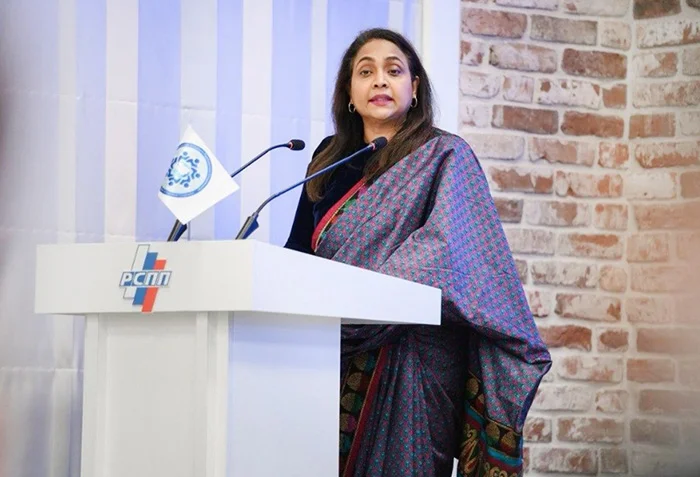
Sri Lankan Ambassador to the Russian Federation, Shobini Gunasekera recently presented a conceptual framework of seven key vectors that defined contemporary international relations and facilitated dialogue among States. She made the presentation at XI Moscow International Financial and Economic Forum held under the theme “Building Bridges: Partnership without Borders”.
In her address, the Ambassador emphasised that these vectors represent the channels through which ideas circulate, trade expands, and peace is strengthened, serving as guiding principles for cooperation amid global uncertainties. The seven key vectors highlighted were economic ties as a foundation for long-term stability; political choice and diplomacy through dialogue and multilateral engagement; security cooperation to address cross-border threats; cultural linkages through education, tourism, and professional exchanges; technological advancement, particularly in digital systems and artificial intelligence; environmental stewardship through collective action on renewable energy and climate change; and humanitarian obligations, including disaster relief and development cooperation.
Drawing on Sri Lanka’s experience, the Ambassador illustrated the practical application of these principles by highlighting the country’s strategic location in the Indian Ocean, its role as a trade and logistics hub, and its active engagement in regional groupings such as BIMSTEC and the Indian Ocean Rim Association, where the Russian Federation serves as a Dialogue Partner.
The potential for enhanced Sri Lanka–Russia bilateral cooperation was underscored, particularly through complementarities between Russia’s technological and energy expertise and Sri Lanka’s logistical capabilities and maritime infrastructure. She noted that such synergies could support joint initiatives in trade, innovation, tourism, and logistics, while cultural and scientific exchanges would further strengthen mutual understanding between the two countries.
Concluding her remarks, the Ambassador stated that sustained progress requires dialogue, mutual respect, and forward-looking partnerships capable of shaping a shared and stable future.

Navy seizes an Indian fishing boat poaching in northern waters

Mandhana, Shafali and Ghosh help India edge run-fest to go 4-0 up

Showers predicted in several provinces today (29th December)

Delay in govt. response to UK sanctions on ex-military chiefs, and others causes concern

Sri Lanka outlines seven key vectors of international cooperation at Moscow forum

Sri Lanka third most preferred destination for Indians

‘Dates have the highest sugar content to fight Coronavirus’

Sunday Island 27 December – Headlines

#SundayIsland 17th December – Headlines

Sunday Island – 28th March

Sunday Island Headlines – 21 March

Sunday Island – 21st February – Headlines
-

 News7 days ago
Members of Lankan Community in Washington D.C. donates to ‘Rebuilding Sri Lanka’ Flood Relief Fund
-

 News5 days ago
British MP calls on Foreign Secretary to expand sanction package against ‘Sri Lankan war criminals’
-

 Features7 days ago
General education reforms: What about language and ethnicity?
-
 News7 days ago
Suspension of Indian drug part of cover-up by NMRA: Academy of Health Professionals
-
 Sports5 days ago
Chief selector’s remarks disappointing says Mickey Arthur
-
 News4 days ago
Street vendors banned from Kandy City
-

 Editorial7 days ago
A very sad day for the rule of law
-

 News7 days ago
US Ambassador to Sri Lanka among 29 career diplomats recalled