
Business
Where were the women?

It’s been 70 years since the Bandung Conference brought leaders of Asian and African countries together in a collective effort to forefront anti-colonial and anti-imperial struggles. Twenty-nine Asian and African countries attended and the 1955 conference symbolised a ‘new spirit of solidarity of the Third World’ . The conference underscored two principles of Third World politics – decolonisation and development – and led to the establishment of the Non-Aligned Movement (NAM) and an alternative conversation on how the world should be ordered including a proposal for a New International Economic Order (NIEO).
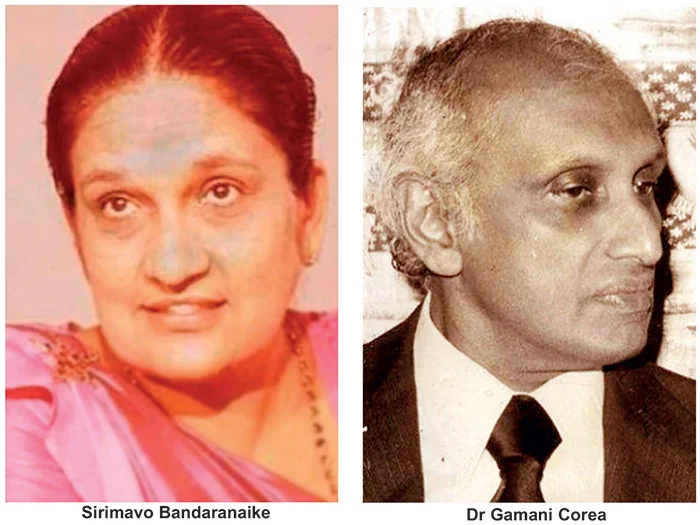
It was a time when Sri Lanka punched significantly above her weight – Mrs Sirimavo Bandaranaike was an acknowledged leader of NAM, Dr Gamani Corea pushed for more favourable trade terms for the global south from his position as the Secretary of UNCTAD, and Ambassador Shirley Amerasinghe pushed against international competition to acquire the resources of the sea bed and was a key player in the International Law of the Sea conferences. It was a time when the themes of the Bandung conference, economic cooperation, respect for fundamental human rights and the principles of the UN Charter, promotion of world peace and recognition of the equality of all races and the equality of all nations large and small, framed the discussions between nations.
Today we live in a world that is experiencing economic, ecological and geo-political crises, and where the above themes of Bandung have been sidelined if not completely obliterated. Many global south countries are deeply entrenched in debt, world peace is wilfully ignored, and genocidal actions and structural violence proliferate from Burma to Palestine. It is also a world in which limiting global warming to 1.5° Celsius is no longer possible and the consequences of climate change presents an existential crisis. It is a time where the revival of the “Bandung spirit” should provide a resonance that can inspire and inform the foreign policies and international relations of small states like Sri Lanka.
A two-day conference in Colombo, organised by IDEAS in collaboration with the BCIS and Yukthi on the 2nd and 3rd of June 2025 at the BCIS in Colombo, will bring together thinkers from Latin America, Africa and Asia to share what the Bandung spirit can portend for the world going forward. BCIS and partners will also organise a series of events leading up to the conference, and following it, to keep the spirit of Bandung at the forefront of our thinking.
In this article I ask the question famously raised by Cynthia Enloe in her writings on international relations –where were the women? It seems like there were NO female delegates at the conference . And even though the 10 points of the Bandung Declaration reiterated the principles of the UN Charter and set a standard for international relations’ and that championed coexistence instead of co-destruction, it did not explicitly refer to women’s rights. Neither this lack of representation nor the omission of women’s rights from the agenda or outcome of the conference meant that women were missing from anti-colonial and anti-imperial struggles that underscored the Bandung spirit – far from it.
In the first half of the 20th century, starting before Bandung, different constellations of national and international women’s organisations planned and implemented three conferences that foreshadowed the rise of women’s international solidarity in Asia and Africa and could have, as some commentators have argued, informed the emerging pan-Asian and Afro-Asian movement for anti-imperialist regional cooperation symbolized by Bandung.
In 1949 the Conference of the Women of Asia was held in Beijing, China, hosted by the Women’s International Democratic Federation (WIDF) together with the All-China Women’s Democratic Federation and Mahila Atma Rakshi Samiti (MARS) or Women’s Self-Defense Committee from West Bengal, India; in 1958 the Asian-African Conference of Women was held in Colombo, Ceylon (Sri Lanka), under the aegis of five national women’s organizations from Indonesia, India, Pakistan, Burma, and Sri Lanka; and in 1961 Afro-Asian Women’s Conference was held in Cairo, Egypt, organized by the Afro-Asian Peoples’ Solidarity Organization (AAPSO) with strong support from the Non-Aligned Movement, including Gamel Abdel Nasser’s government in Egypt.
Not only did the 1949 conference precede Bandung but it took place well before the now familiar United Nations World Conferences on Women, the first of which was held in Mexico City in 1975 ushering in the UN Decade for Women. The early 20th century gatherings of women from Africa and Asia were the outcome of what was a long-standing critique by women from the colonised countries of Western feminism and the development of solidarity along common issues faced by women in the global south
There were several strands to the agenda and demands of global south women at this point in history. A social reform agenda demanded better access for women to education, health care, and social welfare and sought to “modernise” cultural and religious practices. In some ways this agenda mirrored the agitation by nationalist reformers in societies that were demanding decolonisation who saw education and freedom for women, and monogamy, as markers of modernity and development, They strived to create the “enlightened” woman, a partner for the “bourgeois man”, who negated everything that was considered ‘backward’ in the traditions of the colonised societies. The concept of the “new woman” became eagerly adopted, albeit with regional variations, from Egypt to Japan, China to Korea While the ‘new woman’ image at one level reflected characteristics of the emancipated women of Europe and the USA, and the demand for education allowed women from the bourgeois classes to come out of their homes and into various professions and social work, there was also an underlying conservative emphasis on traditional ideals of the woman as wife and mother, reinforcing women’s role as care givers despite the quest for legal equality.
A second strand of feminist agitation In the early 20th century comprised a nationalist and state agenda that sought equal rights for women in independent nations and women’s full participation in public life. As women became more educated their demands also stretched to obtaining voting rights. This agitation was fuelled as the growing feminist literature of the women’s movement (books, journals and magazines) began catering to the educated and literate ‘new’ woman and reported the efforts for women’s emancipation in different parts of the world. So women in Asia and Africa were able to access information about suffragist and feminist struggles in Europe and by the early decades of the 20th century women in China, India, Japan and Sri Lanka were agitating for women’s suffrage in their countries, organising demonstrations and storming the legislature when voting rights were not granted.
What has received the least attention however in the historic accounts has been that strand of feminist organising that sought to restructure the economy as well as social relations and cultural and political practices to enfranchise all women. These feminist movements tended to push their change agenda beyond the nationalist struggles even after formal independence was granted. They recognised that economic pressures from imperial powers and the national propertied classes and business lobbies weakened the political will of governments to institute reforms. Colonial forms of ownership of the means of production continued under the new decolonised systems. They mobilised peasant women and landless migrants in urban areas with the aim of building a movement led by rural, peasant, working class and middle class women. Their activism was based on anti-imperialism, mass-based organising, a membership dominated by rural women and anti-capitalism. It was this strand of feminist analysis and thinking that dominated the first of the international conferences that was held in Beijing in 1949. Some commentators have argued that this ideological stance of the first pan-Asian women’s conference informed the emerging pan-Asian and Afro-Asian movement for anti-imperialist regional cooperation symbolized by Bandung.
(Ms Priyanthi Fernando is the Executive Director of the Bandaranaike Centre for International Studies. The views expressed in this article are her own.)
(To be continued)
by Priyanthi Fernando

By Ifham Nizam
Australian High Commissioner to Sri Lanka Matthew Duckworth described Omega Traders’ latest investment in a modern dhal-processing facility as a strong example of how cross-border supply chains can translate into productive investment, local value addition and new business opportunities in Sri Lanka.
The investment, which adds a 150-metric-tonne-per-eight-hour-day processing capacity to Omega Traders’ operations, marks a significant expansion of the company’s manufacturing footprint as it celebrates 45 years in Sri Lanka’s food commodity industry.
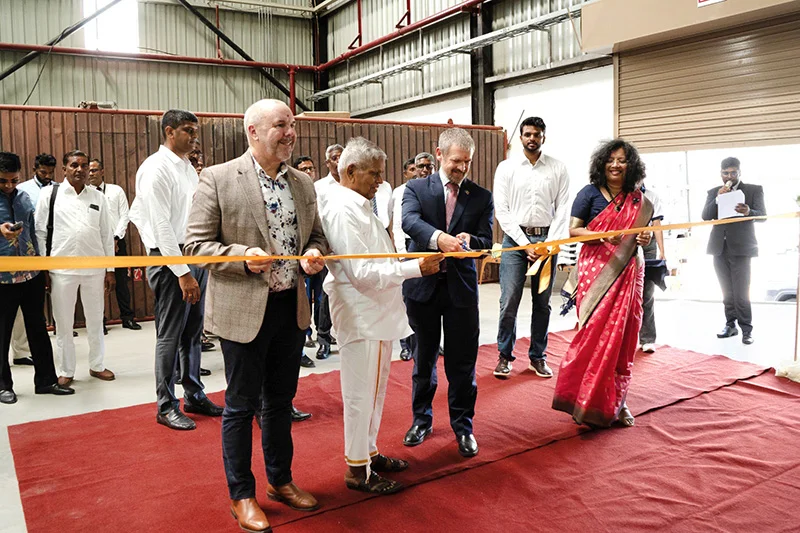
Speaking at the inauguration of the new Lentil and Orid Dhal Processing Factory in Wattala, last Friday, H.C. Duckworth said the facility represented more than an increase in production capacity, pointing to the wider economic value created when Australian agricultural production is connected with Sri Lankan processing and distribution.
‘This facility is not operating on its own. It is part of a long supply chain and a trade partnership between Sri Lanka and Australia, Duckworth said.
His comments placed the Omega Traders’ investment within a broader commercial context: Australia brings agricultural production and established export capabilities, while Sri Lanka provides processing capacity, labour, market access and opportunities for further value addition.
The investment comes as Sri Lanka continues to look towards greater domestic processing and value-added manufacturing rather than relying solely on the import and distribution of finished commodities.
Dr. (Mrs.) Siddhika G. Senaratne, Director General/CEO of the Sri Lanka Standards Institution (SLSI), who attended the inauguration as Guest of Honour, highlighted the importance of quality assurance in food processing and the role of standards in maintaining confidence across the supply chain.
The facility is equipped with new-generation cleaning, processing, sorting and quality-control machinery, including advanced colour-sorting technology, automated systems and an in-house quality-control laboratory.
The additional capacity will support Omega Traders’ three principal Mysoor Dhal brands — Rainbow Jumbo Dhal, Komas Dhal and Rozanna Dhal — which serve different segments of the Sri Lankan market.
But the investment also has a distinctly local agricultural dimension.
Through its Orid Dhal operation, Omega Traders plans to source locally grown black matpe from Sri Lankan farmers and process it at the new facility.
That creates a domestic value chain linking farmers to industrial processing and consumers, while potentially increasing demand for locally produced agricultural commodities.
Duckworth said this type of business partnership could generate benefits for both countries.
‘Australia produces some of the world’s best agricultural products and we are very efficient and very capable at trading them. But that alone is not going to bring success to Australia. Just as building a factory like this is not going to bring success to Sri Lanka, he said.
‘It’s when we bring these entities together that our products produced in Australia can be processed in excellence here in Sri Lanka that enables this to be a success, the H.C. explained.
The investment therefore combines two complementary supply streams: imported agricultural commodities, including Australian-origin products, and locally produced black matpe for the Orid Dhal operation.
For Sri Lanka, the business significance extends beyond Omega Traders itself. Increased processing capacity creates demand for logistics, packaging, distribution, services and agricultural inputs, while supporting employment within the food-processing ecosystem.
HR-led transformation places people, culture and business performance at the heart of the organisation
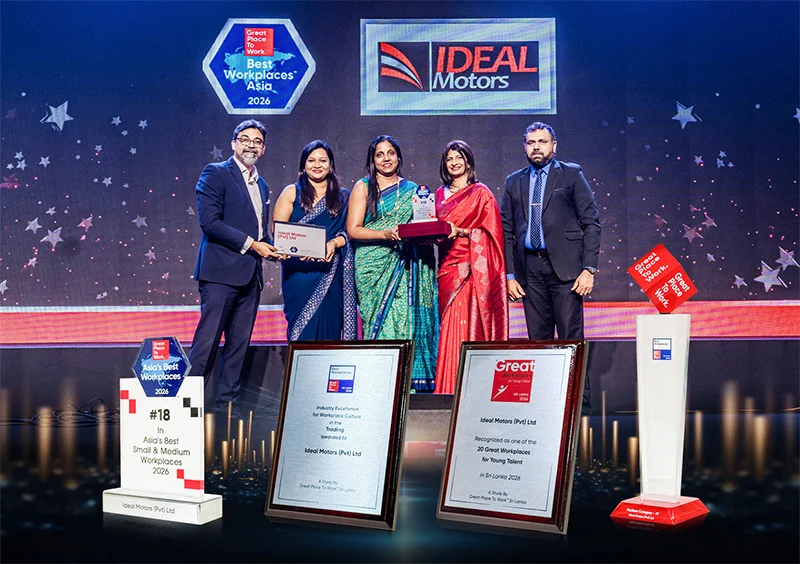
Ideal Motors (Pvt) Ltd,has achieved a significant milestone by securing multiple prestigious workplace and organisational culture accolades in 2026, reinforcing its position as an employer of choice in Sri Lanka’s automotive sector.
Among its latest achievements, Ideal Motors has been recognised as one of the 20 Great Workplaces for Young Talent in Sri Lanka 2026, ranked No. 1 and awarded the Gold Medal in the Small and Medium category of Best Workplaces™ in Sri Lanka 2026, and ranked No. 18 among Best Workplaces™ in Asia in the Medium Scale category—the highest-ranked Sri Lankan organisation in the category. The company also received Industry Excellence for Workplace Culture – Trading Industry.
The Young Talent recognition was presented at the Great Place To Work® CXO Forum 2026 held on 10 September 2026 at Cinnamon Life, Colombo. The recognition followed an evaluation of more than 100 certified organisations and highlights workplaces that create meaningful opportunities for employees under 35 to develop, contribute and grow.
At the Best Workplaces™ in Sri Lanka Awards Gala 2026, held on 11 September 2026 at Cinnamon Life, Colombo, Ideal Motors achieved another historic milestone by entering the Best Workplaces Sri Lanka list for the first time and securing the No. 1 Gold Medal in the Small and Medium category. The company also achieved No. 18 in Best Workplaces™ in Asia, reflecting the strength of its workplace culture beyond Sri Lanka.
These achievements represent more than a collection of awards. They reflect the transformation taking place within Ideal Motors, where people, culture and business performance are increasingly viewed as interconnected drivers of sustainable growth.
Over the past few years, the organisation’s HR function has evolved from a predominantly administrative role into a strategic business partner, with greater emphasis on employee experience, capability development, engagement, performance, communication, wellbeing, diversity and inclusion, and data-driven HR practices.
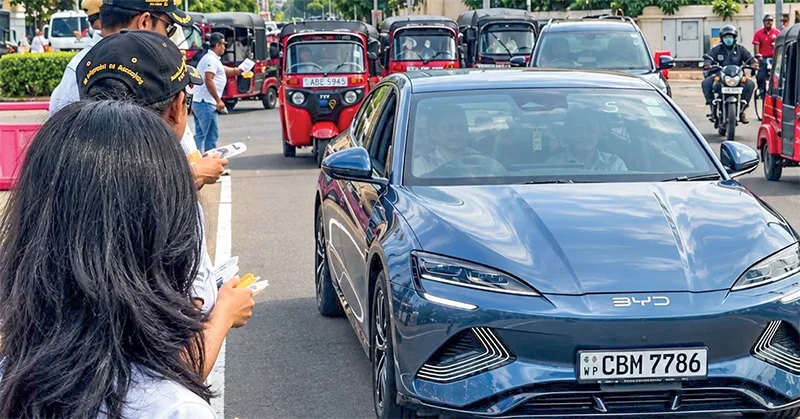
The Automobile Association of Ceylon (AAC) conducted a seat belt safety awareness programme in front of its headquarters and along Galle Face Centre Road, encouraging motorists and passengers to make seat belt use a habit on every journey.
AAC staff, working alongside officers of the Sri Lanka Police Traffic Division, distributed specially designed hanging tags and stickers to drivers. The material carries a clear reminder that seat belts protect drivers as well as passengers in both the front and rear seats.
The public awareness drive was held ahead of the requirement taking effect on 20 September 2026, under which seat belt use becomes mandatory for every occupant of a vehicle travelling on an expressway.
AAC emphasized that the regulation should be understood as a life-saving measure rather than only a legal obligation. Wearing a seat belt can help prevent occupants from being thrown inside or from a vehicle during a collision and can lessen the severity of injuries.
The Association said road safety legislation must be supported by sustained public education, visible enforcement and responsible behaviour by all road users. The participation of the Traffic Police helped the campaign reach motorists directly in a busy part of central Colombo.

High Court convicts 14 over deadly Easter bombings

Mandhana, Shafali and Ghosh lead dominant India to Asian Games gold

Fatima Sana and Umm-e-Hani secure bronze for Pakistan in Asian Games

India bat first in Asian games womens cricket final

Showers about 100mm will occur in the Western, Sabaragamuwa, Central and North-western provinces and in Galle and Matara Districts

Govt. confident of 2/3 majority despite NPP split speculation

‘Dates have the highest sugar content to fight Coronavirus’

Sunday Island 27 December – Headlines

#SundayIsland 17th December – Headlines

Sunday Island – 28th March

Sunday Island Headlines – 21 March

Sunday Island – 21st February – Headlines
-

 News6 days ago
US embassy won’t comment on IGP’s probe into joint drug raid
-

 News4 days ago
Shanakiyan urges urgent action over reported death sentence for Lankan in Saudi Arabia
-

 News5 days ago
Bid for Basil’s extradition nears final stage: Police
-

 Business6 days ago
All-new Bolero MaXX unveiled in Sri Lanka
-

 News3 days ago
Namal Rajapaksa Buddhist gambit fails, bail denied
-
 Opinion6 days ago
A journalist who wrote across the divide
-

 Editorial7 days ago
More fuel price shocks shrouded in secrecy
-
 Sports7 days ago
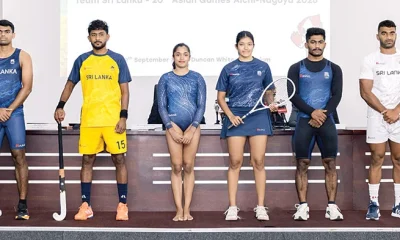
MAS Holdings, official clothing sponsor of Sri Lanka team at Aichi–Nagoya 2026 Asian Games