
Opinion
What is Jathika Chinthanaya?

A response to the ‘Anatomy of a movement: Jathika Chinthanaya’
by Dr. Sumedha S. Amarasekara
This article is a response to the question- ‘If the failure of the left was what portended Jathika Chinthanaya, what would the sterility and decay of Jathika Chinthanaya portend?’ asked by Uditha Devapriya (UD) at the end of his article: ‘Anatomy of a movement: Jathika Chinthanaya’ (The Island 15.03.2024).
In his article, UD analyses the reasons for the failure of the Left and the fallout from it. Though he is unable to specifically tie in the ‘demise of the Left’ with the ‘relevance of Jathika Chinthanaya (JC), he maintains this to be the case, more or less on the lines that nature abhors a vacuum. Despite the title, UD does not seem to discuss the anatomy of JC, and in the absence of this, it is difficult to ascertain what UD means by ‘the JC of today is no longer the JC of yesterday’. UD instinctively sees a connection between the introduction of an open economy and the aftermath that followed, and the relevance of JC. However, UD does not seem to have been able to corelate these separate concepts meaningfully, especially in the absence of a meaningful ‘definition’ of JC.
In order to answer UD’s question, one must understand the concept of JC and then look at the Left movement in this country from that perspective, it is only then that a sensible answer can be arrived at.
JC can be best described as an ideology based on a ‘civilisational consciousness’ that we have acquired over the last two and a half thousand years. According to Anagarika Dharmapala people of this country guided by this civilisational consciousness lived ‘a contended life’. Each family had a plot of land and the forest and the grasslands were open to the public for their use. The people followed the Sangha who lived a collective life. Collectivism, and not individualism, was the aim of their existence.
Our kings who ruled our country were not tyrants or despots (in a general sense, though a few of them may have been). They were guided by an ethical code – Dasa Raja Dharma, the political /economic system that had evolved over centuries guided by a civilisational consciousness; the Buddhist ‘way of living’ that we had right up until the time we came under the dominion of the British in 1815. What is critical to grasp is that even throughout the rule of the British this ‘civilisational consciousness’ remained intact throughout the villages of this country. It is this civilisational consciousness that was flourishing in the village life that is depicted in the novels by Martin Wickremasinghe (MW) and Gunadasa Amarasekera (GA). In fact, one could argue that MW is the one who started the dialogue of JC, albeit at a subconscious level.
What happened between 1815 and our Independence in 1948, changing the destiny of our country (any many other countries) was the Industrial Revolution. To appreciate the recent (during the last 200 years) economic/political changes in the world, it is pertinent to understand that despite a myriad of scientific advances and break throughs, right up until the industrial revolution there were no real changes in the day to day living.
For example, Julius Cesare arrived in Alexandria, Egypt in 48 BC riding in a ‘horse driven vehicle’ and 2000 years later Abraham Lincoln came to the White house in 1860 still in a ‘horse driven vehicle’. The industrial revolution changed all of this in an unprecedented manner and speed. The industrial revolution-starting in the 19th century- leading to a capitalistic society swept across the world and its propagation happened in this country according to the wishes of our colonial masters, the British- their ideology, expectations and beliefs.
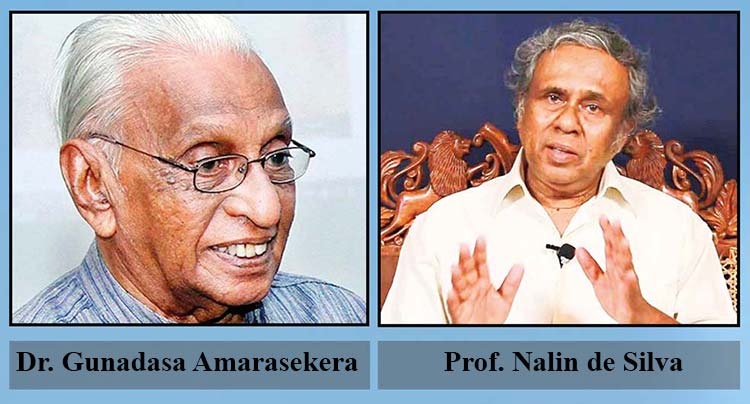
The traditional Left movement in Sri Lanka coincided with the development of the Left movements in the rest of the world- which were an alternative response to the ‘capitalistic society’ which followed the industrial revolution and the increasing ownership of private wealth. Central to these movements was the ideology expounded by Karl Marx (1818- 1883) who saw a socialist state as the next stage in the economic development where workers would own the production process (and benefits) which would lead to the eventual abolition of private property. It was this anti-capitalistic sentiment in the Left movement which resonated in both Gunadasa Amarasekera (GA) and Prof. Nalin de Silva (NdS), which is the explanation as to why both of them were sympathetic towards a Left cause.
In 1948 when we were granted independence; the United National Party (UNP) which came into power, was the de-facto ‘British party’ carrying out the economic policies for a capitalistic society with the Left political parties lined up against this. It was SWRD Bandaranaike who made the first conscious step away from this capitalistic model forming the Sri Lanka Freedom Party (SLFP) in search of our own model. If Anagarika Dharmapala’s movement is considered as a national awaking of the JC, the SLFP could be considered as the beginning of a political party representing the JC.
The 1970 ‘s government under Mrs. Srimavo Bandaranaike (United Front coalition with the Left movement) was a further step away from the capitalistic direction. Despite the criticisms levelled at her government, it was the first and last time that we, as a nation achieved true economic independence under the guidance of Dr. N.M. Perera as the Minister of Finance and probably had the best foreign policy we ever had-the non-aligned policy.
In 1977, under the auspices of JR Jayewardene, our country embraced an open economic policy in a diametrically opposite path, to what had been taken up to that time. The economic path was Right centred to such an extent that the traditional Left movements became obsolete. As UD states in his article it was the open economic policies of the UNP government that paved the way for the terrorist movements in the South by the JVP and the North by the LTTE. It was a country plunging into disarray that triggered the buried ‘civilizational consciousness ‘of GA in search of our JC.
This search preceded the events in 1977. The splintering of the coalition in 1975, changed the then existing political climate and it looked as if we were leaning again towards a capitalistic path- if not lost our way. It was this feeling of impending gloom and doom that pushed GA to write ‘Abuddassa yugayak’ in 1976. This was the start of his journey towards JC.
‘Anagarika Dharmapala Marxwadida’?
which came out in 1980 embraces the ideological dialogue that GA has with the Left movement/Marxism and JC. This book is probably the most significant political analysis /review that has been done with regard to the role played by Anagarika Dharmapala and provides the deeper understanding to the political movement initiated by SWRD Bandaranaike. ‘Ganaduru mediyama dakinemi arunalu’ published 10 years after the ‘1977 – dharmishta society’ signifies the completion of GA’s study of JC. It was during this time that NdS also seemed to have moved away from his Left leanings.
At that time GA saw the Janatha Vimukthi Peramuna (JVP) as an umbrella group that consisted of the educated youth of this country who were unhappy with the current politics of this country. In Ganaduru mediyama dakinemi arunalu GA discusses the ideological clashes between JC and the traditional Left/ Marxist movement in great detail and as to why they failed in this country. Ganaduru mediyama dakinemi arunalu was in fact, an invitation for this group to embrace their heritage of JC and start a new path. It is probably the concept of JC that influenced politicians such as Wimal Weerawansa who were originally with the JVP to lean away from the Left /Marxist views towards nationalism.
The mid to late 1980’s can be described as a time where there was a huge debate raging throughout the country on civilisation and civilisational consciousness. This was partly due to the opposition by the Tamil separatists (militant and otherwise) and foreign powers who were out to divide this country and the NGOs that funded them. They opposed JC on two fronts, working towards this common goal of a divided Sri Lanka. One front argued that we were all part of humanity and that in reality there was no such thing as an ethnic/national identity!
The other front took the pendulum to the other end and portrayed JC as based on the ethnic consciousness of the Sinhala people and that it is a ‘Sinhala Jathika Chinthanaya’ – an ethnic nationalism based on an ethnic consciousness. GA pointed out the inherent contradiction in the term ethnic nationalism and maintained that ethnic consciousness based on culture cannot take the place of civilisational consciousness based on the harmonious co-existence of different ‘ethnic consciousnesses’ and cultures. This is what we had prior to the advent of the foreigner. There were no clashes among the ethnic groups – no fighting among them. The fights were with the invaders.
GA and NdS had to fight hard against this misconception promoted by the NGOs. It was during this period, as a medical student, that I had the privilege of being exposed to the brilliant oratory of Prof. NdS, who was then at the Department of Mathematics of the University of Colombo. Being born in 1993, UD as well as almost all of our younger generation, unfortunately would have missed these brilliant arguments given in the style of Nagasena Wasthuwa.
The issue of a national identity had an enormous impact on the country and especially the army that was fighting the war. True the army was fighting against the LTTE, but what were they fighting for? One fights for one’s family or one’s country: and here was a situation where the people as well as the world outside were made to believe that we fighting the Tamils and this was an ethnic war.
GA, NdS as well as many other national movements worked tirelessly during this period to counteract this vicious propaganda and create a sense of nationalism. It was especially in this context that the Left movements proved to be impotent. The Left movements identified only with class. They had no inherent national identity. How does a movement that does not identify with the concept of a nation support a national cause? JC was the ideology that provided the answer to this question.
The JVP movement despite being a ‘homegrown movement’ did not appreciate this fact either.
The founders of JC were able to get their message across to the people with the backing of such movements like the Patriotic National Movement and the Manel Mal movement. It was this JC movement that gave the impetus for Mahinda Rajapakse to finally win the war against the LTTE in 2009. It is the same sentiment that gave such an enormous victory to Gotabaya Rajapaksa in 2019. The focus of the manifesto ‘saubagyaye dekma’ was ‘santhosayen inna pawulak’ – a happy family. The concept comes from Buddhism where happiness is seen as the ultimate wealth – ‘Santhutti Paramang Dhanang’. It is a concept of wealth that excludes money /ownership.
So, in response to UD’s article it can be seen that there is no JC of yesterday that is different to the JC of today. It is the same civilizational consciousness that comes through. Certainly, it can evolve over time. But time in this case needs to be measured relative to the civilization, in centuries, if not in millennia. As a civilizational consciousness, JC is not a movement- political or otherwise. It exists in us whether we like it or not. GA showed it and defined it for us, so that we could now consciously recognize it, acknowledge it and embrace it. The failure of the Left was its inability to recognize/comprehend JC -not that the failure of the Left portended JC.
And to finally answer the question raised by UD at the end of his article – what would the sterility and decay of Jathika Chinthanaya portend? In other words what would the sterility and decay of a civilizational consciousness portend? It will portend the end of a civilization. This is how civilizations get fossilized and disappear. And how nations get swept of the earth. In this case it portends the end of our nation. As GA would say, when he is in a pessimistic mood – ‘Maka ma dakinne may Jathiye, Rate awasanya widhiyatai’
Will it happen to us, to Sri Lanka? Have we reached the end?

After jog for the camera, wearing shorts in Jaffna, thanks to the freedom gained by the country being liberated from the clutches of the Tigers by the valiant efforts led by Mahinda Rajapaksa, President Anura Kumara Dissanayaka, said: “Some come past Sri Maha Bodhi and other Buddhist temples all the way to Jaffna to observe Sil, not to spread compassion but hatred.” When the need of the hour is reconciliation what an outrageous statement that was, to be made by the head of state! Will he say that the people of the North and the East bypass many Kovils straddling the area and come to Kataragama to spread hate? Probably not! His claim has become a hot topic of conversation.
Having lost a majority of the votes garnered from the North at the presidential and parliamentary elections, to the Tamil nationalist parties at the local government elections, President Dissanayake’s claim may well have been a pitiful attempt to recover lost ground in the North. But at what cost?
It all started with AKD’s refusal to refer to those brave service personnel who saved the unity and the integrity of the country as Rana Viruwo. Interestingly, the most devastating rebuke for this came from a Tamil MP, who is an avowed admirer of Prabhakaran, stating in Parliament that a Sinhala Rana Viruwa saved his life when he was about to be washed off in the flood waters resulting from Cyclone Ditwah. He teased the government by asking in ‘raw’ Sinhala Ei umbalata lejjada unta Rana Viruwo kiyanna? (Are you shy to call them war heroes?)
In addition to slinging mud at MR and harassing service personnel, there is no doubt whatsoever that AKD’s government is trying to harass any Tamil politicians who helped eradicate the Tigers. This fact is borne out by the treatment meted out to Douglas Devananda. Shamindra Ferdinando has explained this in his article, “EPDP’s Devananda and missing weapons supplied by Army” (The Island, 7 January).
NPP ministers publicly insult Buddhist monks, but whenever they are in trouble, they rush to Kandy to meet the Maha Nayakas, the latest being Harini’s visit. Instead of admitting the mistake and trying to make amends, the government went on, until it realised the futility in trying to justify the ‘Buddy’ episode. Excuses given by Harini to the Maha Nayakas, to say the least, were laughable. She had the audacity to say that though the questionable web link was printed in the textbook there were no instructions to click on it! She may continue as Prime Minister but can anyone who does not know what to do with a link or who is trying to encourage ten-year-olds to have e-buddies when the rest of the world is heading towards banning 16-year-olds from social media, continue to be the Minister of Education?
Number of MOUs/pacts signed with India, including defence, have not yet been disclosed even to Parliament. The Cabinet Spokesman once stated that the contents of those MOUs/pacts could not be divulged without the consent of India. Interestingly, we have had very frequent visits from VVIP politicians and top government officials from India, some at very short notice. One of them referred to these as ‘usual’ ones! However, what is unusual is that a party that shed a lot of blood of Sri Lankans for even selling ‘Bombay’ onions, is now in government and seems under Indian command. Perhaps, its transformation occurred when India sponsored a visit by AKD in early 2024, which helped him secure the presidency. Among the NPP’s election pledges, the most touted one was to reveal the mastermind behind the Easter Sunday attacks. It has been alleged in some quarters that India was behind the attacks. The NPP government’s silence about this speaks volumes!
It has transpired recently that it was Indian High Commissioner Gopal Baglay who pressured Speaker Mahinda Yapa Abeywardena in July 2022 to take over the presidency after the elected President was toppled by protesters, but many believe that it was a joint effort by the Indian HC and the ‘Viceroy’ who just left, after an overstay! It is an illegal act as pointed out in the editorial “Conspiracy to subvert constitutional order” (The Island, 22 January) and may be investigated by a future government, if elections are not postponed forever!
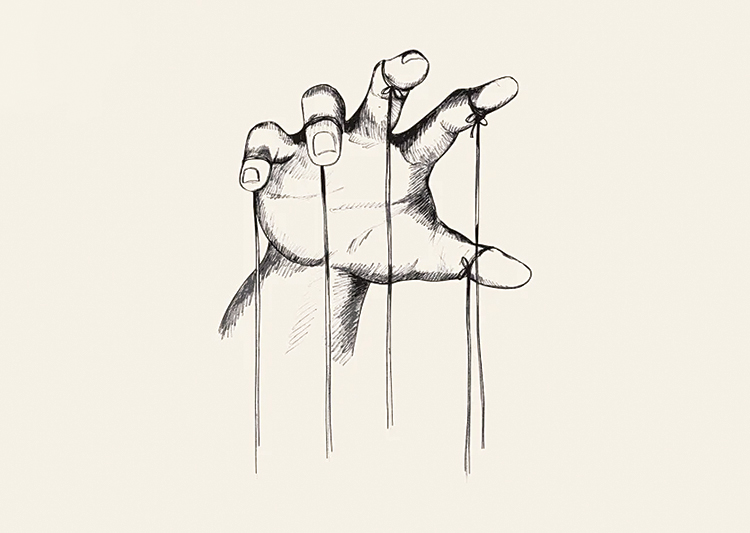
We seem to be watching a puppet show where many puppeteers outside are pulling the strings! Are we paying the price for electing a bunch of inexperienced politicians?
By Dr Upul Wijayawardhana ✍️

Salute to a brave father-son
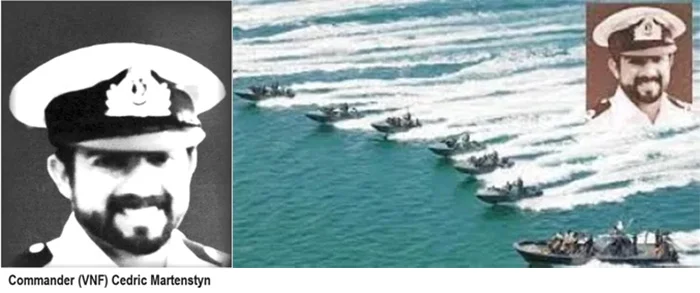
Cedric Martenstyn was a very affluent man. He owned a house in Colombo 7, valuable properties throughout the country, vehicles / speed boats and ran the lucrative business of importing Johnson and Evinrude Outboard Motors (OBM) and sold them to local fishermen and businessmen.
Cedric was the local agent for the OBMs, which were known for reliability and after-sales service, and among his customers were humble fishermen. He was fondly known as Sudu Mahattaya “(white Gentleman) by humble fishermen and he would often travel in his double cab across the country to meet his customers and solve their problems.
He had a loving wife and children. He was an excellent scuba diver, member of Sri Lanka Navy Practical Pistol Firing team and his knowledge of wildlife and reptiles was amazing.
A member of the Dutch Burgher community of Sri Lanka, he was a true patriot, who volunteered to protect country and people from terrorists. An old boy of S. Thomas’ College, Mount Lavinia, he was an excellent sportsman.
The founding father of Sri Lanka Army Commando Unit, Colonel Sunil Peris, was his classmate at S.Thomas’.
I first met Cedric when I was a very junior officer at Pistol Firing Range at Naval Base, Welisara. I helped him catch a poisonous snake in the Range. I think he carried that snake home in a bottle! That was the type of person Cedric was!
We became very close friends as we both loved “guns and fishing rods”. His experience and tactics in angling helped me catch much bigger Paraw (Trevallies) in the Elephant Rock area at the Trincomalee harbour. He was a dangerous man to live with at Trincomalee Naval Base wardroom (officers’ mess), because he had various live snakes kept in bottles and fed them with little frogs!
Even though he was a keen angler, he was keen to conserve endangered species both on land and in water. He spent days in Horton Plains and the Knuckles Mountain Range streams to identify freshwater species in Sri Lanka. Did you know there is an endangered freshwater fish species he found in Horton Plains and Knuckles Mountain Range has been named after him?
Feeding of snakes was an amusement to all our stewards at the wardroom at that time! They all gathered and watched carefully what Cedric was doing, keeping a safe distance to run away if the snake escaped. Our Navy stewards dare to enter Cedric’s cabin (room) at Trincomalee wardroom (officers’ mess), even keeping his tea on a stool outside his cabin door. One day pandemonium broke in the officers’ mess when Cedric announced that one snake escaped! We never found that snake, and that was the end of his hobby as the Commander Eastern Naval Area, at that time, ordered him to ” get rid of all snakes! Sadly, Cedric released all snakes to Sober Island that afternoon.
Cedric was a volunteer Navy officer, but still joined me (he was 47 years old then) to help SBS trainees (first and second batch) on boat handling and OBM maintenance in 1993, when I raised SBS. It was exactly 31 years ago!
The Arrow Boat
Being an excellent speed boat race driver and boat designer, he prepared the blueprint of the first “18-foot Arrow Boat” and supervised building it at a private Boat Yard in 1993. This 18- foot Arrow Boat was especially designed to be used in the shallow waters of the Jaffna lagoon, fitted 115 HP OBMs, and with two weapons he recommended; 40mm Automatic Grenade Launcher (AGL) and 7.62×51 mm General Purpose Machine Guns (GPMGs). In no time, we had highly trained and highly motivated four SBS men on board each Arrow Boat at Jaffna lagoon, and they were very effective.
Same hull (deep V hull) developed during the tenure of Admiral of the Fleet Wasantha Karannagoda, as Commander of the Navy, by Naval architects, with knowledge-gained through captured LTTE Sea Tiger boats, designed 23- foot Arrow Boats and implemented the “Lanchester Theory” (theory of battle of attrition at sea in littoral sea battles) to completely nullify LTTE’s superiority which it had gained with small craft and deadly suicide boats.
Thank you, the Admiral of the Fleet for understanding the importance of Arrow Boat design and mass production at our own boatyard at Welisara. Karannagoda, under whom I was fortunate to serve as Director Naval Operations, Director Maritime Surveillance and Director Naval Special Forces during the last stages (2006/7) of the Humanitarian Operations, always used to tell us “You cannot buy a Navy- you have to build one”! Thank you, Sir!
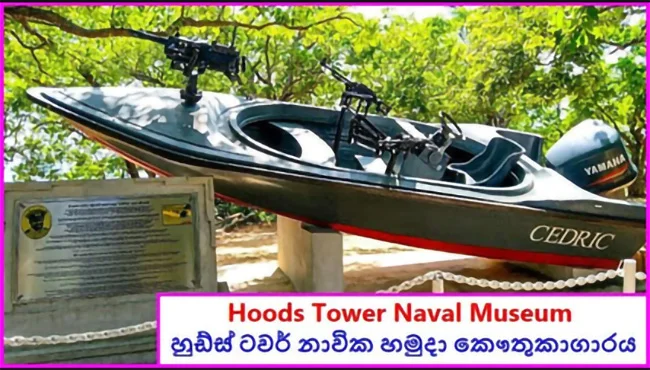
Cedric craft display at Naval Museum, Trincomalee
The Hero he was
When I was selected for my Naval War Course (Staff Course) conducted by the Pakistan Navy Staff College at Karachi, Pakistan, (now known as Pakistan Navy War College relocated at Lahore), Cedric took over the command (even though he was a VNF officer) as Commanding Officer of SBS.
Being one of the co-founders of this elite unit, he was the most suitable person to take over as CO SBS. He was loved by SBS officers and sailors. They were extremely happy to see him at Kilali or Elephant Pass, where SBS was deployed during a very difficult time of our recent history – fighting against terrorists during the 1996-97 period.
Motivated by father’s patriotism, his younger son, Jayson, who was a pilot working in the UK at that time, came back to Sri Lanka and joined the SLAF as an volunteer pilot to fly transport aircraft to keep an uninterrupted air link between Palaly (Jaffna) and Ratmalana (Colombo). Sometimes Jayson flew his beloved father on board from Palaly to Ratmalana. Cedric was extremely happy and proud of his son.
Tragically, young Jayson was killed in action in a suspected LTTE Surface-to-Air missile attack on his aircraft. Cedric was sad, but more determined to continue the fight against LTTE terrorists. He would also lead the rescue and salvage operation to identify the aircraft wreckage his son flew in. The then Navy Commander advised him to demobilise from VNF and look after his grieving family or join Naval Operations Directorate and work from Colombo which he vehemently refused. When I called him from Pakistan to convey my deepest condolences, he said, he would look after the “SBS boys”, he had no intention of leaving them alone at that difficult hour of our nation. That was Cedric. He was such a hero—a hero very few knew about!
The young officers, and sailors in SBS were of his sons’ age, and Cedric would not leave them even when he was facing a personal tragedy. He was a dedicated and courageous person.
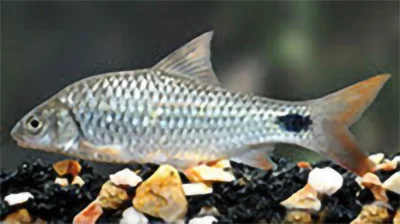
Scientific name: Systomus Martenstyni
English name : Martenstyn’s Barb
Local name: Dumbara Pethiya
Sadly, like many who served our nation and stood against terrorists, Cedric would go on to be considered Missing In Action (MIA) following a helicopter crash off the seas of Vettalikani with Lt. Palihena (another brave SBS officer- KDU intake). He was returning to Point Pedro after visiting the SBS boys at Elephant Pass, Jaffna.
Cedric and his son, Jayson, will go down in history as a brave father-son duo who paid the supreme sacrifice for the motherland. MAY THEY REST IN PEACE ! Salute!
Commander Martenstyn was considered missing in action (MIA) on 22 January 1996 in the sea off Vettalaikerni, while returning to Palaly Air Force Base in an SLAF helicopter when it was lost to enemy fire. He was returning from visiting an SBS detachment in Elephant Pass near the Jaffna Lagoon. Considering his contribution to the war effort, his gallentry and valour in fighting the enemy, and his steadfast service to the Sri Lanka Navy in manufacturing Arrow Boats, and training the SBS, all SLN Arrow Boats were renamed ‘Cedric’ on his 70th Birthday.
(The writer is former Chief of Defence Staff and Commander of The Navy, and former Chairman of the Trincomalee Petroleum Terminals Ltd.)
By Admiral Ravindra
C Wijegunaratne
(Retired from Sri Lanka Navy)
Former Chief of Defence Staff and Commander of the Sri Lanka Navy,
Former Sri Lanka High Commissioner to Pakistan
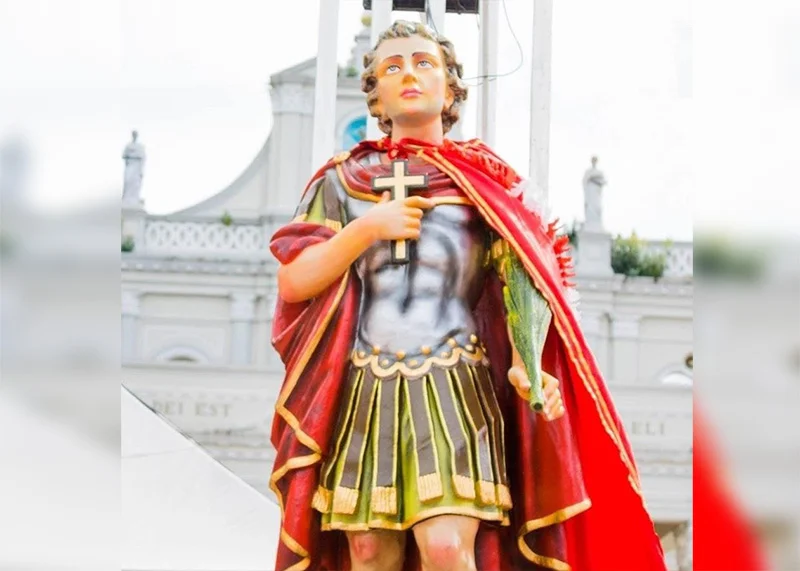
According to legend, St. Sebastian was born at Narbonne in Gaul. He became a soldier in Rome and encouraged Marcellian and Marcus, who were sentenced to death, to remain firm in their faith. St. Sebastian made several converts; among them were master of the rolls Nicostratus, who was in charge of prisoners, and his wife Zoe, a deaf mute whom he cured.
Sebastian was named captain in the Roman army by Emperor Diocletian, as by Emperor Maximian when Diocletian went to the east. Neither knew that Sebastian was a Christian. When it was discovered that Sebastian was indeed a Christian, he was ordered to be executed. He was shot with arrows and left to die but when the widow of St. Castulas went to recover his body, she found out that he was still alive and nursed him back to health. Soon after his recovery, St. Sebastian intercepted the Emperor; denounced him for his cruelty to Christians and was beaten to death on the Emperor’s order.
St. Sebastian was venerated in Milan as early as the time of St. Ambrose. St. Sebastian is the patron of archers, athletes, soldiers, the Saint of the youths and is appealed to protection against the plagues. St. Ambrose reveals that the parents that young Sebastian were living in Milan as a noble family. St. Ambrose further says that Sebastian, along with his three friends, Pankasi, Pulvius and Thorvinus, completed his education successfully with the blessing of his mother, Luciana. Rev. Fr. Dishnef guided him through his spiritual life. From his childhood Sebastian wanted to join the Roman army. With the help of King Karnus, young Sebastian became a soldier and within a short span of time he was appointed as the Commander of the army of King Karnus. The Emperor Diocletian declared Christians the enemy of the Roman Empire and instructed judges to punish Christians who have embraced the Catholic Church. Young Sebastian, as one of the servants of Christ, converted thousands of other believers into Christians. When Emperor Diocletian revealed that Sebastian had become a Catholic, the angry Emperor ordered for Sebastian to be shot to death with arrows. After being shot by arrows, one of Sebastian supporters, Irane, treated him and cured him. When Sebastian was cured he went to Emperor Diocletian and professed his faith for the second time disclosing that he is a servant of Christ. Astounded by the fact that Sebastian is a Christian, Emperor Diocletian ordered the Roman army to kill Sebastian with club blows.
In the liturgical calendar of the Church, the feast of the St. Sebastian is celebrated on the 20th of January. This day is indeed a mini Christmas to the people of Kandana, irrespective of their religion. The feast commenced with the hoisting of the flag staff on the 11th of January at 4 p.m. at the Kandana junction, along the Colombo-Negombo road. There is a long history attached to the flag staff. The first flag staff, which was an areca nut tree, 25 feet tall, was hoisted by the Aththidiya family of Kandana, and today their descendants continue hoisting of the flag staff as a tradition. This year’s flag staff, too, was hoisted by the Raymond Aththidiya family. Several processions, originating from different directions, carrying flags, meet at this flag staff junction. The pouring of milk on the flag staff has been a tradition in existence for a long time. The Nagasalan band was introduced by a well-known Jaffna businessman that had engaged in business in Kandana in the 1950s. The famous Kandaiyan Pille’s Nagasalan group takes the lead, even today, in the procession. Kiribath Dane in the Kandana town had been a tradition from time immemorial.
According to available history from the Catholic archives and volume III of the Catholic Church in Sri Lanka, the British period of vicariates of Colombo, written by Rev. Ft. Vito Perniola SJ, in 1806, states that the British government granted the freedom of conscious and religion to the Catholics in Ceylon and abolished all the anti-Catholic legislation enacted by the Dutch.
The proclamation was declared and issued on the 3rd of August 1796 by Colonel James Stuart, the officer commanding the British forces of Ceylon stated “freedom granted to Catholics” (Sri Lanka national archives 20/5).
Before the Europeans, the missioners were all Goans from South India. In the year 1834, on the 3rd of December, XVI Gregory the Pope, issued a document Ex Muwere pastoralis ministeric, after which the Ceylon Catholic Church was made under the South Indian Cochin diocese. Very Rev. Fr. Vincent Rosario, the Apostolic Vicar General, was appointed along with 18 Goan priests (The Oratorion Mission in Sri Lanka being a history of the Catholic Chruch 1796-1874 by Arthur C Dep Chapter 11 pg 12). Rev Fr. Joachim Alberto arrived in Sri Lanka as missionary on the 6th of March 1830 when he was 31 years old and he was appointed to look after the Catholics in Aluthkuru Korale, consisting Kandana, Mabole, Nagodaa and Ragama. There have been one Church built in 1810 in Wewala about three miles away from Kandana. The Wewala Chruch was situated bordering Muthurajawela which rose to fame for its granary. History reveals that the entire area was under paddy cultivation and most of them were either farmers or toddy tappers. History further reveals that there has been an old canal built by King Weera Parakrama Bahu. Later it was built to flow through the Kelani River, and Muthurajawela, up to Negombo, which was named as the Dutch Canal (RL Brohier historian). During the British time this canal was named as Hamilton Canal and was used to transport toddy, spices, paddy and tree planks of which tree planks were stored in Kandana. Therefore, the name Kandana derives from “Kandan Aana”.
Rev. Fr. Joachim Alberto purchased a small piece of land, called Haamuduruwange watte, at Nadurupititya, in Kandana, and put up a small cadjan chapel and placed a picture of St. Sebastian for the benefit of his small congregation. In 1837, with the help of the devotees, he dug a small well where the water was used for drinking and bathing and today this well is still operative. He bought several acres of land, including the present cemetery premises. Moreover, he had put up the Church at Kalaeliya in honour of his patron St. Joachim where his body has been laid to rest according to his wish of the Last Will attested by Weerasinghe Arachchige Brasianu Thilakaratne. Notary Public, dated 19th July 1855. The present Church was built on the property bought on the 13th of August 1875 on deed no. 146 attested by Graciano Fernando. Notary Public of the land Gorakagahawatta Aluthkuru Korale Ragam Pattu in Kandana within the extend ¼ acre from and out of the 16 acres. According to the old plan number 374 made by P.A. H. Philipia, Licensed surveyor on the 31st of January 195, 9 acres and 25 perches belonged to St. Sebastian Church. However, today only 3 acres, 3 roods and 16.5 perches are left according to plan number 397 surveyed by the same surveyor, while the rest had been sold to the villagers. According to the survey conducted by Orithorian priest on the 12th of February 1844 there were only 18 school-going Catholic students in AluthKuru Korale and only one Antonio was the teacher for all classes. In 1844 there was no school at Kandana (APF SCG India Volume 9829).
According to Sri Lanka National Archives (The Ceylon Almanac page 185) in the year 1852 there were 982 Catholics Male 265, female 290, children 365, with a total of 922. According to the census reports in 2014, prepared by Rev. Ft. Sumeda Dissanayake TOR, the Director Franciscan Preaching group, Kadirana Negombo a survey revealed that there are 13,498 Catholics in Kandana.
According to the appointment of the Missionaries in the year 1866-1867 by Bishop Hillarien Sillani, Rev. Fr. Clement Pagnani OSB was sent to look after the missions in Negoda, Ragama, Batagama, Thudella, Kandana, Kala Eliya and Mabole. On the 18th of April 1866, the building of the new Church commenced with a written agreement by and between Rec. Fr. Clement Pagnani and the then leaders of Kandana Catholic Village Committee. This committee consisted of Kanugalawattage Savial Perera Samarasinghe Welwidane, Amarathunga Arachchige Issak Perera Appuhamy, Jayasuriya Arachchige Don Isthewan Appuhamy, Jayasuriya Appuhamylage Elaris Perera Muhuppu, Padukkage Andiris Perera Opisara, Kanugalawattage Peduru Perera Annavi and Mallawa Arachchige Don Peduru Appujamy. The said agreement stated that they will give written undertaking that their labour and money will be utilised to build the new Church of St. Sebastian and if they failed to do so they were ready to bear any punishment which will be imposed by the Catholic Church.
Rev. Fr. Bede Bercatta’s book “A History of the Vicariate of Colombo page 359” says that Rev. Fr. Stanislaus Tabarani had problems of finding rock stones to lay the foundation. He was greatly worried over this and placed his due trust in divine providence. He prayed for days to St. Sebastian for his intercession. One morning after mass, he was informed by some people that they had seen a small patch of granite at a place in Rilaulla, close to the Church premises, although such stones were never seen there earlier, and requested him to inspect the place. The parish priest visited the location and was greatly delighted as his prayers has been answered. This small granite rock amount provided enough granite
blocks for the full foundation of the present church. This place still known as “Rilaulla galwala”. The work on the building proceeded under successive parish priests but Rev. Fr. Stouter was responsible for much of it. The façade of the Church was built so high that it crashed on the 2nd of April of 1893. The present façade was then built and completed in the year 1905. The statue of St. Sebastian, which is behind the altar, had been carved off a “Madan tree”. It was done by a Paravara man, named Costa Mama, who was staying with a resident named Miguel Baas a Ridualle, Kandana. This statue was made at the request of Pavistina Perera Amaratunge, mother of former Member of Parliament gatemuadliyer D. Panthi Jayasuirya. The Church was completed during the time of Rev. Fr. Keegar and was blessed by then Archbishop of Colombo Dr. Anthony Courdert OMI on the 20th of January 1912. In 1926, Rev. Fr. Romauld Fernando was appointed as the parish priest to the Kandana Church. He was an educationalist and a social worker. Without any hesitation he can be called as the father of education to Kandana. He was the pioneer to build three schools in Kandana: Kandana St. Sebastian Boys School, Kandana St. Sebastian English Girls School and, the Mazenod College Kandana. Later he was appointed as the Principal of the St. Sebastian Boys English School. He bought a property at Kandana, close to Ganemulla Road, and started De Mazenod College. Later, it was given officially to the Christian Brothers of Sri Lanka, by then Archbishop of Colombo, Peter Mark. In 1931, there were 300 students (history of De Lasalle brothers by Rev. Fr. Bro Michael Robert). Today, there are over 3,500 students and is one of the leading Catholic schools in Sri Lanka. In 1924, one Karolis Jayasuriya Widanage donated two acres to build De Mazenod College for its extension.
The frist priest from Kandana to be ordained was Rev. Fr. William Perera in 1904. With the help of Rev. Fr. Marcelline Jayakody, he composed the famous hymn “the Vikshopa Geethaya”, the hymn of our Lady of Sorrow.
The Life story of St. Sebastian was portrayed through a stage play called “Wasappauwa” and the world famous German passion play Obar Amargavewchi whichwas a sensation was initiated by Rev. Fr. Nicholas Perera. Legend reveals that in the year 1845 a South Indian Catholic, on his way to meet his relatives in Colombo, had brought down a wooden statue of St. Sebastian, one and half feet tail, to be sold in Sri Lanka. When he reached Kalpitiya he had unexpectedly contracted malaria. He had made a vow at St. Anne’s Church, Thalawila, expecting a full recovery. En route to Colombo, he had come to know about the Church in Kandana and dedicated to St. Sebastian. In the absence of the then parish Priest Rev. Fr. Joachim Alberto, the Muhuppu of the Church, with the help of the others, had agreed to by the statue for 75 pathagas (one pahtaga was 75 cent). Even though the seller had left the money in the hands of the “Muhuppu” to be collected later, he never returned.
On the 19th of January 2006, Archbishop Oswald Gomis declared St. Sebastian Church as “St. Sebastian Shrine” by way of a special notification and handed over the declaration to Rev. Fr. Susith Perera, the Parish Priest of Kandana.
On the 12th of January 2014, Catholics in Sri Lanka celebrated the reception of a reliquary containing a fragment of the arm of St. Sebastian. The reliquary was gifted from the administrator of the Basilica of St. Anthony of Padua and was brought to Sri Lanka by Monsignor Neville Perera. His Eminence Malcolm Cardinal Ranjit, Archbishop of Colombo, accompanied by priests and a large gathering, received the relic at the Katunayake International Airport, and brought it to Kandana, led by a procession, and was enthroned at the St. Sebastian Shrine.
Rev. Fr. Srinath Manoj Perera, the present administrator of the shrine, and assistant Priest Rev. Fr. Asela Mario, have finalised all arrangements to conduct the feast of St. Sebastian in a grand scale.
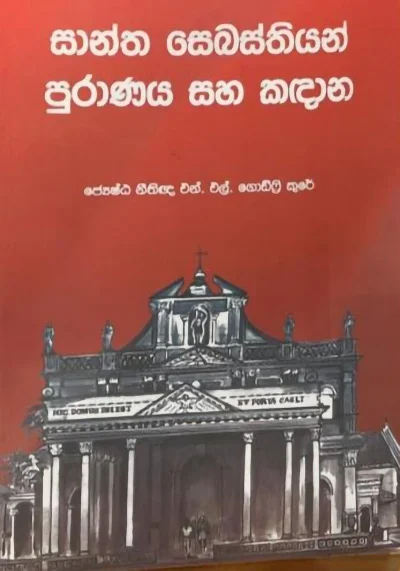
The latest book, written by Senior Lawyer Godfrey Cooray, named “Santha Sebastian Puranaya Saha Kandana” (The history of St. Sebastian and Kandana), was launched at De La Salle Auditorium, De Mazenod College, Kandana.
The Archbishop of Colombo His Eminence Most rev. Dr. Malcolm Cardinal Ranjith was the Chief Guests at the event.
The book discusses about the buried history of Muthurajawela and Aluth Kuru Korale civilisation, the history of Kandana and St. Sebastian. The author discusses the historical and archaeological values and culture.
158th Annual Feast of St. Sebastian’s National Shrine, Kandana, will be held on 20th of January 2026. On the 19th of January, Monday, Solemn Vespers were presided by His Lordship most Rev. Dr. Maxwell Silva Auxiliary Bishop of Colombo.
Festive High Mass will be presided by His Lordship Most Rev. Dr. J. D. Anthony, The Auxiliary Bishop of Colombo, on the 20th of January at 8pm.
By Godfrey Cooray
Senior Attorney -at -Law,
Former Ambassador to Norway and Finland
President, National Catholic Writers’ Association

PM returns to the island

Navy divers restore sluice gate of Bomburuella Reservoir

Gujarat Giants comfortably overcome sloppy UP Warriorz

After fall from grace, Asalanka aims to bat on for Sri Lanka

PM holds High-Level meetings with EU, UNDP, and corporate leadership at World Economic Forum

Trump withdraws Canada’s invite to join Board of Peace

‘Dates have the highest sugar content to fight Coronavirus’

Sunday Island 27 December – Headlines

#SundayIsland 17th December – Headlines

Sunday Island – 28th March

Sunday Island Headlines – 21 March

Sunday Island – 21st February – Headlines
-

 Editorial6 days ago
Illusory rule of law
-
 News7 days ago
UNDP’s assessment confirms widespread economic fallout from Cyclone Ditwah
-
 Editorial7 days ago
Crime and cops
-
 Features6 days ago
Daydreams on a winter’s day
-
 Features6 days ago
Surprise move of both the Minister and myself from Agriculture to Education
-
 Features5 days ago
Extended mind thesis:A Buddhist perspective
-
 Features6 days ago
The Story of Furniture in Sri Lanka
-
 Opinion4 days ago
American rulers’ hatred for Venezuela and its leaders