
News
WB pledges support for disaster victims in SL


The World Bank Group has expressed deep sorrow over the devastation caused by Cyclone Ditwah in Sri Lanka, extending condolences to families who have lost loved ones, homes, and livelihoods. The institution also acknowledged the resilience shown by affected communities and commended the Government of Sri Lanka for its swift response to save lives and initiate recovery efforts, the World Bank said in a statement.
Full text of the statement: The World Bank Group is deeply saddened by the devastation caused by Cyclone Ditwah in Sri Lanka. Our thoughts are with the people who have lost loved ones, homes, and livelihoods, and with the communities now facing immense hardship. We commend the remarkable resilience shown by Sri Lankans in the face of this disaster and the Government’s swift action to save lives and launch recovery efforts.
In response to the Government’s request, the World Bank is making up to US$120 million in emergency support available by repurposing funds from ongoing projects. This will support recovery and help restore essential services and infrastructure—including health care, water, education, agriculture, and connectivity—in the areas hit hardest by the cyclone. The International Finance Corporation (IFC), the private sector arm of the World Bank Group will continue to strengthen the private sector by providing advisory support and strategic investments in key sectors—such as agriculture, manufacturing and logistics, including support to MSMEs—to create jobs and drive economic recovery.
To guide recovery efforts, a Global Rapid Post-Disaster Damage Estimation (GRADE) assessment is already underway in partnership with the Global Facility for Disaster Risk Reduction (GFDRR). This rapid assessment will provide credible estimates of disaster impacts to inform early decisions and help target response and recovery efforts. We are also working closely with the Government as it plans the broader recovery, including the creation of the new “Rebuilding Sri Lanka” Fund and the next phase of post-disaster needs assessments.
“Our hearts go out to every Sri Lankan affected by Cyclone Ditwah. We are inspired by how communities across the country have come together to support each other during this difficult time,” said Gevorg Sargsyan, World Bank Group Country Manager for Sri Lanka and the Maldives. “The World Bank Group is committed to helping Sri Lanka restore livelihoods, accelerate economic recovery, and rebuild stronger, safer, and more resilient communities.”
Looking ahead, the World Bank Group stands ready to work with the Government to mobilise additional resources, based on the findings of the GRADE assessment and the financing needs for recovery and resilient reconstruction. We will also make necessary adjustments in our future programmes to accommodate the impacts of this crisis.
The World Bank Group is committed to making sure support reaches those who need it most—quickly, transparently, and effectively. We are putting robust oversight mechanisms in place with implementing agencies and local authorities. At the same time, we continue to coordinate closely with development partners to ensure that our collective efforts have the greatest possible impact and help Sri Lanka recover and rebuild for the long term.


Parliament yesterday (30) said the use of inferior quality coal at Norochcholai Lak Vijaya coal-fired power plant caused environmental pollution.
The Opposition has accused the Energy Ministry of importing low quality coal and the CEB has directly blamed the developing crisis in coal imported from South Africa.
The Parliament is scheduled to debate a no-confidence motion moved by SJB-led Opposition against Energy Minister Kumara Jayakody on 10 April.
The Sectoral Oversight Committee on Environment, Agriculture and Resource Sustainability has instructed officials to immediately prepare a plan for the environmentally friendly disposal of ash emitted from the Norochcholai Lak Vijaya Power Plant.
These instructions were given at a recent meeting of the Committee held in Parliament, under the Chairmanship of Member of Parliament Hector Appuhamy.
It was revealed during the meeting that due to issues related to the quality of coal imported to Sri Lanka for power generation, the volume of ash emitted during electricity generation had increased significantly. Officials were directed to formulate a plan under the leadership of the District Secretary of the Puttalam District, to take the necessary measures.
It was also proposed that the possibility of reusing the coal ash for production purposes be studied, and that any revenue generated from such products be utilised for welfare projects benefiting the communities affected by the power plant.
In addition, the Committee instructed the Central Environmental Authority to submit a comprehensive report on whether water and air pollution have occurred as a result of the Norochcholai Power Plant. Furthermore, the North Western Provincial Environmental Authority was also instructed to provide responses within two weeks regarding the questionnaire and related matters submitted by the Committee in connection with the Norochcholai Power Plant.
Officials of the North Western Provincial Environmental Authority stated that although the volume of ash emitted from the plant had increased, the filtration system in use at the plant was sufficient to absorb it. Several matters, including the issuance of environmental protection licenses for the power plant, were discussed at the committee meeting.
By Ifham Nizam
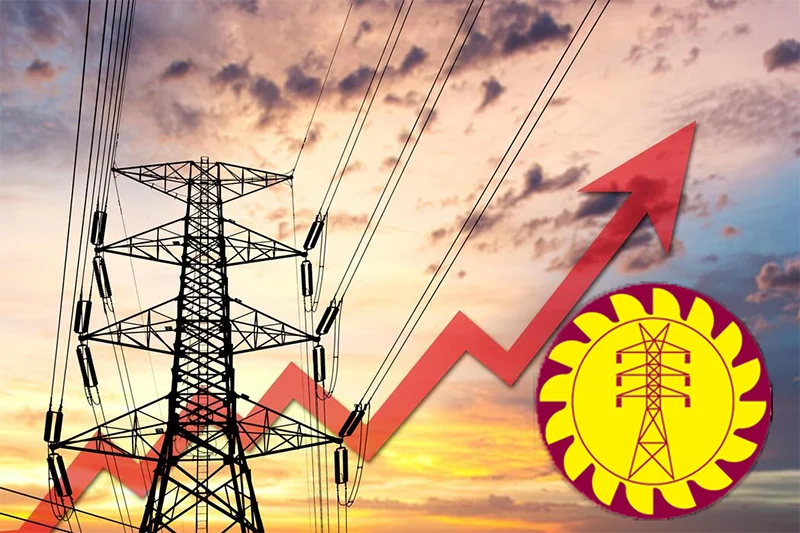
Electricity consumers will face a fresh financial jolt from 01 April, with the Public Utilities Commission of Sri Lanka (PUCSL) approving a countrywide tariff increase that will push up monthly bills across all consumption categories, with the heaviest burden falling on high-end users.
The decision follows a proposal by the Ceylon Electricity Board (CEB), which sought a 13.56 percent upward revision for the second quarter of the year, citing mounting operational costs and financial pressures within the power sector.
Under the new tariff structure, even the lowest-income households will not be spared, though the increases at the bottom tiers remain relatively modest. Consumers using between 0–30 units will see a 4.3 percent rise, adding approximately Rs. 15 to their monthly bill. Those in the 31–60 unit bracket will experience a 6.9 percent increase, translating to an additional Rs. 45.
For middle-tier users, the impact becomes more pronounced. Households consuming 61–90 units will pay around Rs. 120 more per month, following a 6.9 percent hike, while those in the 91–120 unit range will face a sharper increase of 7.1 percent, pushing their monthly costs up by about Rs. 420.
However, the steepest escalation is reserved for heavy electricity users. Consumers exceeding 180 units will be hit with a staggering 25 percent increase — the highest adjustment under the latest revision — raising serious concerns over affordability, particularly for urban households and small businesses already grappling with rising living costs.
Energy sector analysts warn that the latest revision signals deeper structural issues within the power sector, including reliance on costly thermal generation, currency pressures, and inefficiencies in energy procurement.
“The burden is gradually shifting toward consumers as the sector struggles to maintain financial stability,” a senior power sector analyst said, noting that repeated tariff adjustments could further strain public tolerance.
The PUCSL maintained that the revision was necessary to ensure the sustainability of electricity supply and to prevent a recurrence of crises that previously led to widespread outages and load shedding. The regulator has also indicated that cost-reflective pricing remains a key policy direction, particularly as global energy markets remain volatile.
The move comes at a time when many households are still adjusting to broader economic pressures, including high food prices and transport costs, raising fears that the tariff hike could have a cascading effect on the cost of living.
Small and medium enterprises, already operating on thin margins, are also expected to feel the pinch, with higher electricity costs likely to feed into production expenses and retail prices.
Despite the increases, questions remain over whether the tariff revision alone will be sufficient to stabilise the financially strained power sector, or if further adjustments — or reforms — may be inevitable in the months ahead.
With electricity demand steadily rising and generation costs remaining unpredictable, consumers now brace for yet another phase of higher utility bills, underscoring the fragile balance between energy security and economic resilience.
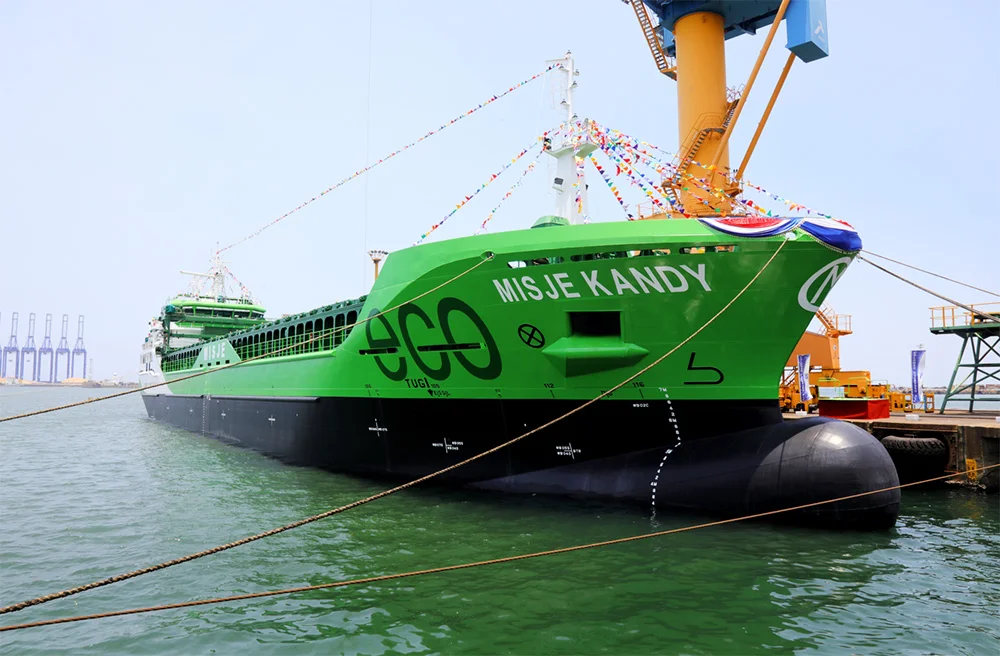
The Colombo Dockyard (CDL) under its new management has completed a major contract undertaken in March 2020 to build ten ships for Norwegian Misje Eco Bulk AS.
The company said that in spite of unprecedented global disruptions, a pandemic, an economic bankruptcy, regional wars, supply chain disruptions, logistical uncertainties, and untold hardships, they had been able somehow to meet contractual obligations.
The tenth ship was delivered to Misje Eco Bulk AS at the Colombo harbour recently.
Indian shipbuilding giant Mazagon Dock Shipbuilders Ltd. (MDL), affiliated to India’s Ministry of Defence (MOD), acquired controlling stake in CDL from Japanese shipbuilder Onomichi in mid last year MDL paid USD 52.96 mn for the stake.
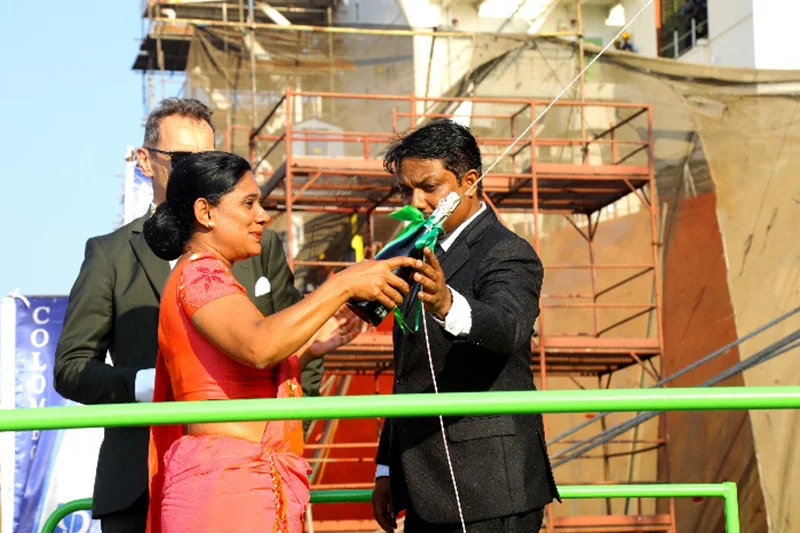
Dileesh Rosemary De Silva breaking a bottle of champagne in celebration. She is flanked by Roald Misje CEO Misje EcoBulk AS and Thusitha Herath Site Team Manager of Misje EcoBulk AS
The owners named the vessel ‘Misje Kandy’ as a tribute to CDL. Ceremonial breaking of the milk pot in accordance with the Sri Lankan traditions was done by the Colombo Dockyard’s Project Manager of the series of 10 vessels S.M.S.B. Serasinghe. In accordance with the western traditions the ceremonial breaking of the Champagne bottle was done by the God Mother of the vessel Mrs. Dileesh Rosemary de Silva.
The 89.95m DNV-classed Eco Bulker was conceptualised by Wartsila Ship Design Norway, with detailed design work carried out by CDPLC’s skilled in-house design team. In line with the latest trends in sustainable shipping. The vessel is equipped with an advanced Energy Storage Battery System (ESS) for Electric Hybrid Propulsion, complementing the conventional diesel propulsion system to enhance operational performance and reduce environmental impact.
Indian High Commissioner in Colombo Santosh Jha attended the ship launch with the government represented by deputy ministers Nishantha Jayaweera and Janitha Kodithuwakku.

Showers may occur at a few places in the Western and Sabaragamuwa provinces and in Galle and Matara districts after 2.00 pm

Burning of low-grade coal at N’cholai plant increases pollution: Parliament

Tariff shock from 01 April as power costs climb across the board

CDL under new management completes major Norwegian ship order

Govt. making arrangements for 3,500 SL Hajj pilgrims

NGO activists warn of ‘democratic dangers’ as PSTA draft bill looms over Parliament

‘Dates have the highest sugar content to fight Coronavirus’

Sunday Island 27 December – Headlines

#SundayIsland 17th December – Headlines

Sunday Island – 28th March

Sunday Island Headlines – 21 March

Sunday Island – 21st February – Headlines
-

 News6 days ago
Senior citizens above 70 years to receive March allowances on Thursday (26)
-

 Features3 days ago
A World Order in Crisis: War, Power, and Resistance
-

 News4 days ago
Energy Minister indicted on corruption charges ahead of no-faith motion against him
-

 News5 days ago
US dodges question on AKD’s claim SL denied permission for military aircraft to land
-

 Business5 days ago
Dialog Unveils Dialog Play Mini with Netflix and Apple TV
-

 News6 days ago
CEB Engineers warn public to be prepared for power cuts after New Year
-

 Sports4 days ago
SLC to hold EGM in April
-
 Latest News5 days ago
A strong Technical and Vocational Education and Training (TVET) system equips individuals with practical, relevant, and future-oriented skills helping to innovate responsibly towards a greener and sustainable future – PM