
Features
“Ways of Looking” – A lecture on Martin Wickramasinghe at Sapumal Foundation

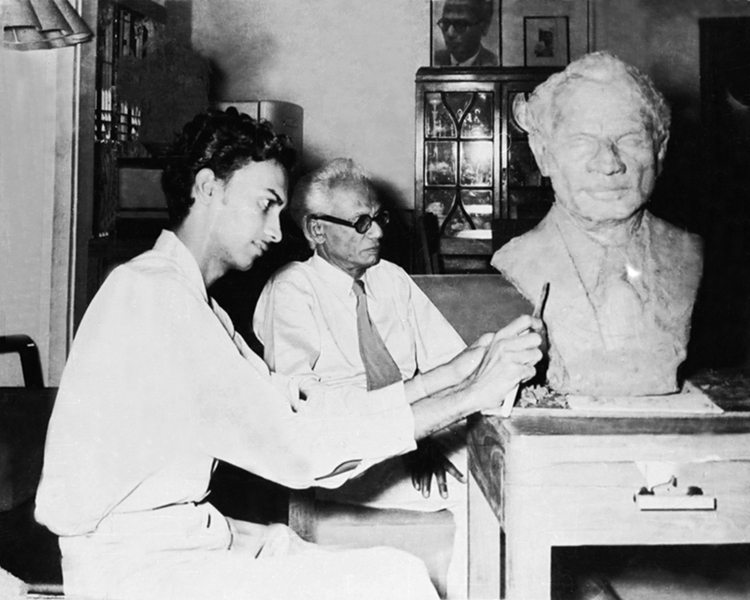
“Ways of Looking: Martin Wickramasinghe and the Currents of Sri Lankan Art”, a lecture on Martin Wickramasinghe’s writings on art and culture, will unveil at The Garden Gallery at the Sapumal Foundation on Tuesday, 31 March 2026 from 04.45 pm.
Organized by the Martin Wickramasinghe Trust, the lecture focuses on Wickramasinghe’s evolving views on art history in the context of early 20th century Sri Lanka and South Asia. It will be presented by Uditha Devapriya. Opening remarks will be given by Avishka Mario Senewiratne, while closing remarks will be given by Hasini Haputhanthri. The session will be moderated by Samindi Warnasooriya of the Open University.
Though not himself an artist, Wickramasinghe commented on art, including on painting. During his most formative years, a number of scholars explored these aspects of Sri Lankan and South Asian society. Ananda Coomaraswamy’s Mediaeval Sinhalese Art was published just two years after Wickramasinghe came to Colombo. In Colombo, he came across the work of scholars like E. B. Havell and Alfred Foucher. He reflected on their writings and formed his views on the subjects they explored. By the end of his life, his reputation as a cultural critic had grown so much that no fewer than six modern artists – including Harry Pieris, Richard Gabriel, and David Paynter – had drawn him.
The lecture at the Sapumal Foundation traces his interest in art to his early life in Koggala and his immersion in art history. It assesses his critiques of scholars of Sri Lankan and South Asian art. Finally, it appraises his reputation as a leading literary figure against the backdrop of cultural modernism in Sri Lanka and in South Asia.
“Ways of Looking” marks the final lecture in a series that were planned and organized by the Wickramasinghe Trust last year. Beginning with a webinar at the School of Oriental and African Studies (SOAS) in the UK and a presentation at the India International Centre in New Delhi in November 2025, the lectures involved sessions at Lakmahal Community Library, the Social Scientists’ Association, and the International Centre for Ethnic Studies.
These explored diverse aspects to Wickramasinghe’s life, work, and thought, focusing on views on subjects like culture, society, politics, and anthropology. Devapriya is also involved in a major study of Martin Wickramasinghe, slated for review and publication this year. Incorporating primary archive material and interviews with scholars and acquaintances of Wickramasinghe, the book marks a culmination to nearly two years of research into one of Sri Lanka’s most iconic literary and cultural figures.
For more information on the lecture, contact Uditha via email at or WhatsApp and phone at (+94)716419646.

A quiet yet profound shift is underway in American healthcare, and its implications extend far beyond the United States’ borders. A recent Associated Press report describes a scene that would have seemed improbable, even five years ago: a woman in Texas, experiencing side effects from a weightloss injection, does not call her doctor, visit a clinic, or even search Google. Instead, she opens her phone and consults ChatGPT. She tells the system how she feels, describes her symptoms, and receives an instant explanation. This behaviour, once the domain of early adopters and technology enthusiasts, has now entered the mainstream. A West Health–Gallup poll confirms that nearly onequarter of American adults used an AI tool for health information or advice in the previous month. For a country with one of the world’s most expensive and fragmented healthcare systems, this shift is not merely a technological curiosity. It is a sign of the public searching for speed, clarity, and affordability in a system that often fails to provide any of these.
Sri Lanka, though vastly different in scale, culture, and resources, is not insulated from this global transformation. If anything, the pressures that drive Americans toward AI—long wait times, high costs, difficulty accessing specialists—are even more acute in our own health system. The difference is that Sri Lanka is only beginning to experience the cultural and institutional adjustments that accompany widespread AI use. Yet the trajectory is unmistakable. What is happening in the United States today is almost certainly a preview of what will happen here tomorrow in Sri Lanka, though in a form shaped by our own social realities, linguistic diversity, and healthcare traditions.
The American experience shows that AI is becoming the new gateway to health information. As Dr. Karandeep Singh of UC San Diego observes, AI tools now function as an improved version of the old Google search. Instead of sifting through dozens of links, users receive a concise, conversational summary tailored to their question. This is precisely the kind of convenience that Sri Lankans, too, will find irresistible. In a country where a single specialist appointment can require hours of travel, waiting, and uncertainty, the appeal of an instant, alwaysavailable digital assistant is obvious. The idea that one could ask a question about a rash, a fever, a medication side effect, or a lab report and receive an immediate explanation—without navigating hospital queues or private consultation fees—will inevitably attract public interest. For example, one of my friends, who was with me in school, called me and said he is prescribed Linavic, a drug for type 2 diabetes. I told him that, as it is not widely known in the USA, to give me the generic name. He searched ChatGPT and told me it is called Tradjenta, which is widely available in the USA as a prescription drug for type 2 diabetes.
But Sri Lanka’s path will not be identical to America’s. Our adoption of AI in healthcare is emerging through institutions rather than individuals. Nawaloka Hospitals has already introduced AI-powered chatbots, including NASHA, an OPD assistant capable of guiding patients through symptom assessment and basic triage. This is a significant development because it signals that Sri Lankan hospitals are preparing for a future in which AI is not an optional addon but a core part of patient interaction. The government’s draft National AI Strategy reinforces this direction by identifying healthcare as a priority sector and emphasising responsible, transparent, and safe deployment. Academic bodies, such as the Sri Lanka Medical Association, have also begun training clinicians to understand and work alongside AI systems. These are early but important steps, suggesting that Sri Lanka is building the professional ecosystem needed for safe AI integration.
Yet, the public’s relationship with AI remains limited. Unlike in the United States, where consumers independently experiment with tools like ChatGPT, Sri Lankans tend to rely on doctors as the primary source of authority. Digital literacy varies widely, especially outside urban centres. Sinhala and Tamilcapable AI tools are still developing. And our society has a long history of health misinformation spreading rapidly through social media, from miracle cures to conspiracy theories. Without careful regulation and public education, AI could amplify these risks rather than reduce them. The danger is not that AI will replace doctors, but that poorly informed users may treat AI outputs as definitive diagnoses, bypassing professional care when it is urgently needed.
At the same time, Sri Lankans’ lived experiences reveal why AI will inevitably become part of the healthseeking landscape. Anyone who has visited the outpatient department of a major government hospital knows the reality: queues forming before dawn, patients clutching files and prescriptions, and overworked medical officers trying to see hundreds of cases in a single shift. In rural areas, the situation is even more challenging. A villager in Monaragala or Mullaitivu may have to travel hours to see a specialist, often relying on neighbours or family for transport. Many postpone care simply because they are unsure whether a symptom is serious enough to justify the journey. For such individuals, an AI-based triage tool—available on a basic smartphone, in Sinhala or Tamil—could be transformative. It could help them decide whether to seek immediate care, wait for the next clinic day, or manage the issue at home.
Sri Lanka’s private healthcare sector, too, is ripe for AI integration. Private hospitals are increasingly turning to digital systems for appointment scheduling, lab report delivery, and patient communication. Anyone who has waited for hours at a private OPD, despite having an appointment, knows the frustration. AI-driven systems could help streamline patient flow, predict peak times, and reduce bottlenecks. They could also assist doctors by summarising patient histories, flagging potential drug interactions, and providing evidencebased guidelines. For patients, AI could offer explanations of lab results in simple language, reducing anxiety and improving understanding.
There are already glimpses of this future. Some Sri Lankan patients, especially younger urban professionals, quietly admit that they use AI tools to interpret their blood tests before seeing a doctor.
Others use AI to understand the side effects of medications prescribed to them. Parents use AI to check whether a child’s fever pattern is typical or concerning. Migrant workers, returning home for short visits, use AI to prepare questions for their doctors, ensuring they make the most of limited consultation time. These behaviours mirror the early stages of the American trend, though on a smaller scale.
Sri Lanka’s cultural context will shape how AI is used. Our society places great trust in doctors, often viewing them as authoritative figures whose word should not be questioned. This trust is a strength, but it can also discourage patients from seeking information independently. AI has the potential to shift this dynamic—not by undermining doctors, but by empowering patients to participate more actively in their own care. A patient who understands their condition is better able to follow treatment plans, ask relevant questions, and recognise warning signs. AI can support this empowerment, provided it is used responsibly.
The deeper question is not whether Sri Lanka will adopt AI in healthcare, but how. The American example shows both the promise and the peril. AI can democratise access to information, reduce anxiety, and empower patients. But it can also mislead, oversimplify, or create false confidence. The challenge for Sri Lanka is to build a culture of responsible use—one that recognises AI as a tool, not a substitute for clinical judgment. Hospitals must ensure accuracy and transparency. Regulators must set standards. And the public must learn to treat AI as a guide, not a guru.
Sri Lanka has an opportunity to leapfrog. By studying the American experience, we can avoid its pitfalls and adopt its strengths. We can design AI systems that respect our linguistic diversity, our cultural habits, and our healthcare realities. We can integrate AI into hospitals in ways that enhance, rather than erode, the doctor-patient relationship. And we can prepare our citizens to use these tools wisely, with curiosity but also with caution.
The transformation is already underway. It will accelerate whether we prepare for it or not. The question for Sri Lanka is whether we will shape this future deliberately or allow it to shape us by default. The American shift toward AImediated healthcare is a reminder that technology does not wait for societies to catch up. It moves forward, and nations must decide whether to follow passively or lead thoughtfully. Sri Lanka, with its strong public health tradition and growing technological ambition, has every reason to choose the latter.
by Prof Amarasiri de Silva
I began running on the beach after a fall on a broken pavement left me with a head injury and a surgically repaired eyebrow. Mount Lavinia beach, world‑famous and crowded, especially on Sundays, is only a seven‑minute walk from home, so it became the obvious place for my rehabilitation jogs.
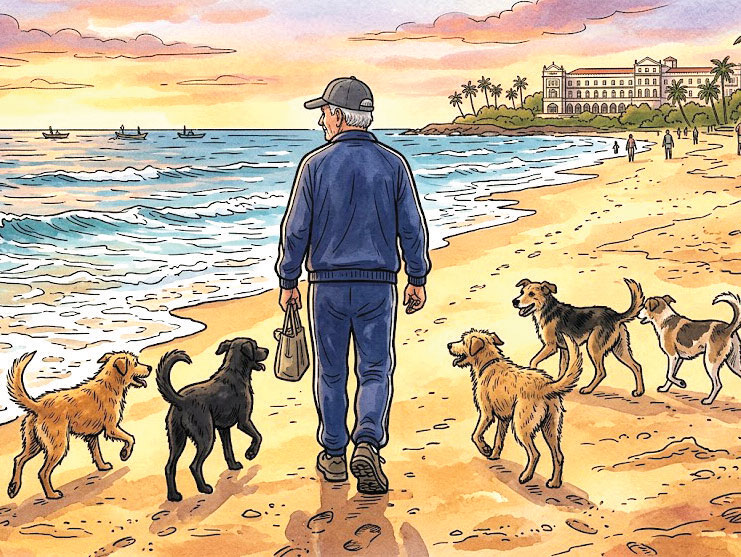
On my first day, my wife, a true Mount Lavinia girl, accompanied me. Though we’ve been married for over 40 years, this was the first time I had ever jogged on the beach. She practically shepherded me there and watched from a safe distance as I made my way towards the Wellawatte breakwater. Dogs were everywhere: some strays, some with collars. I’m not usually afraid of dogs, so I ran past them confidently. Then one fellow barked sharply, making me stop. He advanced even after I stood still. I bent down, picked up some sand, and only then did he retreat, still protesting loudly. On my return run, he repeated the performance.
The next time, I carried a stick. The beach was quiet, perhaps my friend had taken the day off. But on the third day he was back, barking as usual. I showed him the stick and continued. Further along, more dogs barked, and I repeated the ritual. Soon I found myself growing jittery, even numb, whenever I approached a dog. Jogging was no longer comfortable.
My elder daughter, an ardent animal lover who keeps two dogs and wanting to have more, suggested bribery, specifically, biscuits. So, on my next run, I filled my pocket with them. When the usual culprit appeared, I tossed him a biscuit before he could bark. He sniffed suspiciously, then ate it. I jogged on. The rest of the “orchestra” received similar treatment and promptly forgot to bark. Not a dog barked the entire run, or on my way back.
Some groups had five or six dogs, but bribing the noisiest one was enough to quieten the rest. Soon they grew used to me running close to them, and the biscuits made me a trusted friend. These round little sugary crackers turned out to be the perfect currency for seemingly aggressive but essentially harmless dogs, a fact well known to my daughter, Dr. Honda Hitha, but a revelation to me.
One day, a friendly dog decided to escort me home. After receiving his biscuit, he lingered near our gate before returning to the beach. Over time, the number of escorts grew until I found myself flanked by about 10 canine disciples. They became my strength instead of a source of fear. They were darlings. Unlike humans, their affection, even if won initially with biscuits, soon became unconditional.
They still accompany me home, whether or not they receive a treat. Bless them! May they be born human in their next lives, perhaps the only way our wicked world can become a better place.
by Dr. M. M. Janapriya
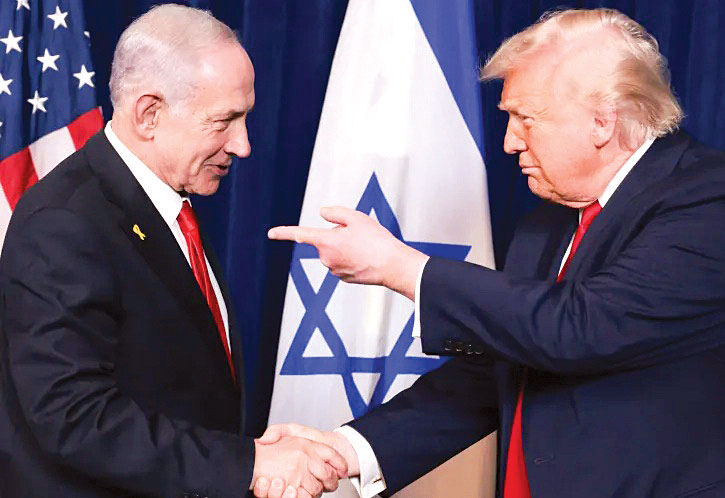
If there is one country that urgently needs a regime change it is Israel. The whole world is suffering and thousands of people, including children and women, are dying due to Israel’s Prime Minister Benjamin Netanyahu’s political survival strategy. He needs the war to avoid going to jail and also certain defeat at the next elections. The corruption and other charges against him, if proved, would send him to jail. He had asked the Israel President for a pardon and his friend Trump also has written to the President, on his behalf.
Netanyahu is able to commit genocide in Gaza with impunity because the US backs him to the hilt, economically, politically, militarily and also in the United Nations. Without all this, Israel will not be able to fight its many wars and pursue its “Greater Israel” project in Gaza, Lebanon, Syria, and also weaken the countries that oppose its grand plan, such as Iran, Yemen and Turkey. The US gives military aid to Israel, worth USD 3.8 bn, annually, which is used in these genocidal wars and expansionist projects. The US is, therefore, complicit in all these war crimes.
US presidents, beginning from Eisenhower (1950) to Joe Biden (2022), expressed displeasure at Israeli aggression. Ronald Reagan halted the shipment of cluster artillery shells, in 1982, over concerns about their use against civilians in Lebanon, and delayed the delivery of F-16 warplanes until Israel withdrew from Lebanon. George H.W. Bush (1990s) postponed $10 billion in loan guarantees in 1991 to pressure Israel to stop building settlements in the West Bank and to attend the Madrid peace conference. Barack Obama frequently criticised Israeli settlement expansion and, in the final days of his term, withheld a US UN Security Council veto on a resolution regarding settlements. Joe Biden (2020s) threatened to withhold military aid if Israel launched a major offensive in Rafah during the 2024 conflict in Gaza, pausing a shipment of heavy bombs. Most of these presidents had been in favour of the two state solution for the Palestine problem as well.
Trump abandoned these longstanding US policies on Israel that were upheld by Obama and later restored by Biden. Significant and far-reaching changes, included recognising Jerusalem as Israel’s capital, moving the embassy, declaring settlements not inherently illegal, and recognising Golan Heights, which belonged to Syria, as part of Israel sovereignty. These evil deeds of Trump seem to have boomeranged on him as he battles to extricate himself from a war forced on him by Israel, which has resulted in enormous economic and political, not to mention military, losses for the US and Trump. Consequently Israel, in the eyes of many leading political commentators, is now a liability for the US.
How this war was started reveals the dastardly and barbaric mentality of Netanyahu and Trump. The US and Iran were engaged in negotiations, with the mediation of Oman, to resolve their differences, and on 26 February, 2026, the Foreign Minister of Iran stated that a historical agreement with the US was about to be entered into and, the following day, Oman corroborated this announcement. Iran apparently had agreed that its nuclear programme could be brought under the surveillance of the International Atomic Energy Agency. Surprisingly on 28 February, 2026, Israel and the US attacked Iran, Trump saying that it posed a nuclear threat to the US! Oman said it was “dismayed” and the Iranian Foreign Minister said it was a “betrayal”. Obviously, Trump, who is under obligation to the Jewish lobby, which had funded his election campaign, had been drawn into the war. The Epstein files issue may have pushed Trump across the threshold. Iran’s response was calculated and appropriate. Trump says he will obliterate the Iranian civilisation in one night but soon agrees to have negotiations with Iran, in Islamabad.
However, Netanyahu cannot afford an end to the war he started to save his own skin. He goes ahead and drops 100 bombs in 10 minutes on Lebanon, killing 254 civilians, including children. The massacre in Lebanon continues with Israel pushing towards the Litani river in an attempt to annex southern Lebanon. Israel disqualifies itself not only as a reliable ally but also as an honourable member of the world community by having leaders of the calibre of Netanyahu. Israel is fast becoming internationally isolated, according to experts like Professors Robert Pape, John Measheimier, Richard Wolff, Jeffrey Sachs and Yanis Varonfakis. And these experts are of the view that if Israel continues its aggressive approach and expansionist policy, disregarding the historical facts of its origin and the Palestine problem, it will implode and destroy itself.
Israel must face the reality that Iran has emerged stronger after the war and may have control over the Strait of Hormuz and may even force the US out of the region. Israel, under Netanyahu, may not be willing to acknowledge these facts, but the people in the US must realise that it is not in their national interests to have Israel as an indispensable ally. This war is very unpopular in the US not entirely due to the economic impact but the extremely atrocious way it has been prosecuted by Israel and also the equally horrendous threats made by the US against Iran. It is also very unpopular among the US allies who bluntly refused to join or even approve it. Australia, Japan and South Korea, though far removed from the theatre of war, seem to be pretty angry about the whole thing, as they are badly affected by the economic impact of the war. They may be concerned about the brutality of Israel, and the degree of support and approval it gets from the US.
Those who have significantly gained from the war may be Russia who could have a windfall on their oil sales, and China who could quietly weave its diplomatic network throughout the Middle East and watch the decline of US influence in the region. Saudi Arabia and UAE, two countries bombed by Iran, have already started a dialogue with Iran. These developments may hasten the emergence of the new world order, spearheaded by China.
The war, that was started by Netanyahu, with a willing Trump, seems to have backfired on them, with both facing a hostile world and a fast changing geopolitical global situation. Trump’s MAGA project was aimed at quelling the growth of the new world order that had China and Russia at the head. He attempted to hit Russia with sanctions but failed. He tried to curb China with tariffs but failed. Denying oil supplies to China was attempted by kidnapping the Venezuelan President. China’s monopoly on rare earth minerals was a headache to Trump and he proposes to annex Canada and Greenland which have rich deposits of these elements. War on Iran was another opportunity to do a regime change and get control over that country and its oil. He threatened to wipe out Iran saying that “the civilization would die tomorrow night”, only a psychopathic megalomaniac could make such utterances , not a president of the US. Fortunately, the changing world order would not allow Trump to achieve any of his crazy goals.
Netanyahu inadvertently may have hastened his own downfall by starting a war without realising that the global geopolitics have changed and he cannot have his way even with the full backing of Trump. Both Israel and the US need a regime change if the world is to have peace.
by N. A. de S. Amaratunga

US intercepts and seizes Iranian-flagged cargo ship, Trump says

Heat Index at ‘Caution level’ in the Northern, North-central, North-western, Western, Sabaragamuwa, Eastern and Southern provinces and in Monaragala district

Showers or thundershowers will occur at most places of the island after 1.00 pm.

Church calls for Deputy Defence Minister’s removal, establishment of Independent Prosecutor’s Office

Road accidents, drowning, claim 70 lives in 8 days

Lanka sees surge in higher education attainment

‘Dates have the highest sugar content to fight Coronavirus’

Sunday Island 27 December – Headlines

#SundayIsland 17th December – Headlines

Sunday Island – 28th March

Sunday Island Headlines – 21 March

Sunday Island – 21st February – Headlines
-

 Latest News7 days ago
Prasidh, Buttler set up comfortable win for Gujarat Titans
-

 News5 days ago
PNS TAIMUR & ASLAT set sail from Colombo
-

 Latest News6 days ago
“I extend my heartfelt wishes to all Sri Lankans for a peaceful and joyous Sinhala and Tamil New Year!” – President
-

 Business2 days ago
Harnessing nature’s wisdom: Experts highlight “Resist–Align” path to resilience
-

 News2 days ago
Gratiaen Trust announces longlist for the 33rd Annual Gratiaen Prize
-
 News2 days ago
Heroin haul transported on 50-million-rupee contract
-
 Latest News7 days ago
Salt and Patidar power RCB past Mumbai Indians
-
 Latest News6 days ago
US blockade of Iran would worsen global energy crisis, analysts say