
Sports
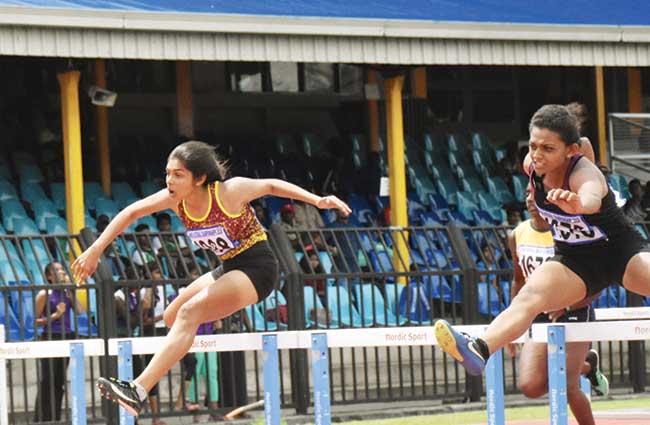
Waiting for the next Olympic hurdler

Tokyo Olympics – 7 days to go
By Reemus Fernando
Continued from yesterday
Hurdles as obstacles
A maximum of four athletes advance from each Zonal to the Provincial Competition where they experience their first proper 400 metres hurdles race. An athlete qualifying from the Provincial level will next compete in the All Island Schools Games Athletics Championship. The Sir John Tarbet Athletics Championship, the Sri Lanka Athletics’ Junior National Championship and District meets are the other meets where a schools hurdler could compete on proper hurdles. However, a vast majority of schoolchildren do not witness hurdles races at school level due to the unavailability of hurdles.
What about sports schools? Sadly many Sports Schools which have 400 metres tracks do not have enough hurdles to conduct proper 400 metres hurdles races. Ibbagamuwa Central, one of the Sports Schools from where the country’s most decorated female hurdler in the 100 metres hurdles hailed from, does not conduct 400 metres hurdles races. Even for 100 metres hurdles, they opt for just two lanes.
“Hurdles are a real headache for education officials who conduct athletics events at Divisional and Zonal level. If you are really interested in conducting a hurdles race you can certainly do that. It is not a big deal to collect 80 hurdles from where they are available. It is a matter of managing logistics. Maybe it is the lack of funds and manpower to complete the meet in two or three days that discourage officials from conducting it properly,” says a coach.
“There used to be a time when you could see hurdles set up at St. John Bosco ground, Hanwella all day around. That was the time when Rev. Fathers trained athletes. During that time Hanwella had the best hurdlers in the country. Children who pass by the hurdles would make attempts to clear the hurdlers. Those sights are rare nowadays,” says Saman Kumara, Sri Lanka Athletics statistician.
Setting up hurdles and removing them after training is a time consuming endeavour. Sports Instructors at schools that promote more than one sport find it difficult to leave hurdles at the ground for the next training session when the ground is also used for other sports.
However, dedicated coaches and their athletes have often overcome the unavailability of facilities. When St. Joseph’s Balika, Kegalle was producing the fastest female sprinters at school level nearly a decade ago A.D. Nandawathie’s trainees would carry hurdles from the school to the ground in Kegalle on foot. After the training session in the morning, they would return to school on foot carrying the hurdles. One of Nanda’s trainees, Amali Harshani went on to win at the national level. That was in the 100 metres hurdles. She had a wind-aided personal best of 14.08 seconds in 2012.
To be continued……..


Sri Lanka won the toss and chose to bat first in the first T20I against Pakistan being played in Rawalpindi.
Sri Lanka XI: Kusal Mendis (capt & wk), Lahiru Udara (wk), Kamil Mishara, Kamindu Mendis, Sahan Arachchige, Dasun Shanaka, Dunith Wellalage, Maheesh Theekshana, Dushmantha Chameera, Eshan Malinga, Nuwan Thushara
Pakistan XI: Sahibzada Farhan (capt), Saim Ayub, Maaz Sadaqat, Fakhar Zaman, Hasan Nawaz, Khawaja Nafay (wk), Shadab Khan, Muhammed Imran, Razaullah, Naseem Shah, Abrar Ahmed
Latest News
Sutherland and Litchfield lead Australia to quick and convincing win in ODI series opener

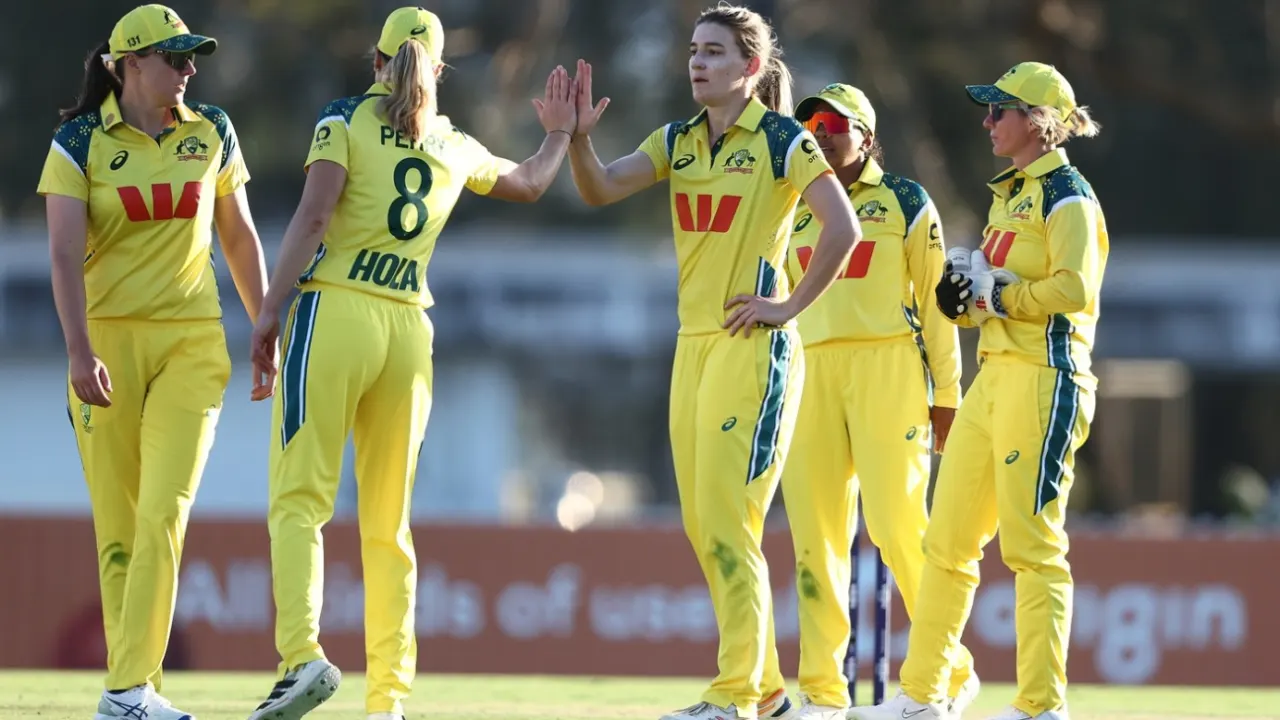
Bangladesh’s second visit to Australia and their first women’s ODI in the country began on a disappointing note as Australia ran out quick and convincing victors.
Annabel Sutherland showed why she is regarded as one of the most versatile fast-bowling allrounders in the world by taking 4 for 30. She kept the batters on their toes by varying the lengths and speeds as Bangladesh were bowled out for 166. Phoebe Litchfield’s swift 77 helped Australia canter home with 24.2 overs and seven wickets to spare to take a 1-0 lead in the three-match series.
The win meant Australia extended their unbeaten record in ODIs at the Allan Border Field in Brisbane to 22 games.
Bangladesh might have put up an even lower total if not for an intent-filled innings from Ritu Moni. Batting at No. 7, she hit two fours in her first four balls following a phase where Bangladesh scored only 35 in about 15 overs.
Asked to bat first, Bangladesh were stung first ball when Megan Schutt got one off a length to hoop in big to have Fargana Hoque caught at slip. In her next over, Schutt trapped the other opener Sarmin Sultana lbw to become only the third Australia woman to 150 ODI wickets.
When Sutherland’s bouncer cramped Sharmin Akhter for room, leaving her unable to get any control on the pull, Bangladesh were truly under the cosh, having lost three wickets inside the first powerplay.
That soon became 48 for 4, which prompted captain Nigar Sultana, perhaps Bangladesh’s best batter, to go into a shell. She hardly looked to score from that point and was happy to defend and merely prevent further wickets from falling.
The ploy was evident from the fact that Nigar didn’t put Sutherland under pressure when she bowled three successive no-balls in the 12th over. What’s more, unaware of the free hit on offer, she ducked under a short ball as well. Shorna Akter, too, curtailed her aggressive instincts to support her captain.
Bangladesh crawled at three runs per over through the middle phase before Tahlia McGrath had Nigar caught behind for 29 off 83 balls. Nigar perhaps half-referred to her own innings when, after the game, she said that Bangladesh “need to be cautious against the new ball and get the intent right”.
As soon as she fell, Moni and Shorna started to put back the pressure on Australia’s spinners. Moni fetched a couple of sweeps from outside off to hit them through midwicket. Shorna also used her feet more frequently.
Moni looked good to score her second half-century in ODIs but was hampered by cramps. That hindered her running, and eventually she was run-out for 45 off 63 balls. Sutherland was generous with her use of the back-of-the-hand slower ones from then on to keep the rest of the batters on a leash.
Australia were never going to be challenged in a paltry chase of 167, and Georgia Voll and Litchfield hit five fours in the first five overs of the chase to get them going.
That is when Bangladesh found another performer of note. Seventeen-year-old Habiba Islam, on ODI debut, bowled a sharp bouncer which got rid of Voll. Habiba, who made her T20I debut against India in 2024 as a 15-year-old, got the ball to nibble around at high pace. While her first spell was expensive, she returned in the middle overs to get Beth Mooney caught brilliantly at midwicket. She bowled the length ball outside leg and got it to move in late, and Mooney could only spoon it to Fargana, who ran in from the circle and completed a diving catch.
But between these two bits of celebration for Habiba and Bangladesh, Litchfield had almost killed the chase. She moved around the crease to hit Marufa Aklter for three successive fours in the seventh over of the chase, and then muscled Habiba over mid-on for the only six in the match.
She played her trademark reverse sweep off Nahida Akter and soon got to fifty off just 35 balls. Her second-wicket stand with Ellyse Perry was worth 89 off 67 balls with Perry contributing only 15 off 23. Until the time Litchfield stepped out and drove Rabeya Khan straight to cover, it looked as if she would complete a century even with so few runs to get.
Scores:
Australia Women 168 for 3 in 25.4 overs (Phoebe Litchfield 77, Ellyse Perry 26*, Annabel Sutherland 25*; Habiba Islam 2-36) beat Bangladesh Women 166 in 49.4 overs (Sharmin Akhter 24, Nigar Sultana 29, Shorna Akter 21, Ritu Moni 45; Megan Schutt 2-19, Ammabel Sutherland 4-30) by seven wickets
[Cricinfo]

by Rex Clementine
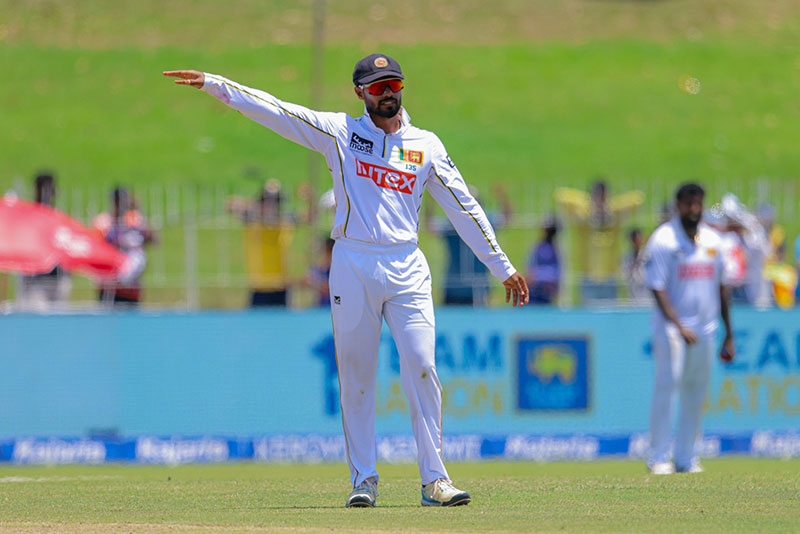
Sri Lanka’s Test captain Dhananjaya de Silva has done an Ian Botham. No, not by pulling off a miraculous victory against Australia at Headingley, but by resigning a minute before he was sacked.
The writing had been on the wall for DDS after he got his sums horribly wrong during the recent home Test series against India. His defensive approach from day one left Sri Lanka chasing the game rather than dictating terms and the hosts eventually surrendered the series.
There had also been growing criticism of DDS’s inability to lift the side when the chips were down. His laid back attitude, particularly the sight of him cracking jokes with team mates in the SSC dressing room balcony while Sri Lanka were following on, did not go down well with the cricket establishment.
Not that DDS was doing anything out of character. By nature, he is a relaxed, easy going individual who loves his video games and rarely seems to have a worry in the world. The mistake was made by those who handed such a character the Test captaincy and then expected him to turn into a fire breathing leader overnight.
DDS was so chilled out that even SLC’s photographers had reason to complain during the India Test series when the official team photograph was being taken.
Sri Lanka have been guilty of failing to groom leaders and in recent years the captaincy has too often fallen into someone’s lap by default rather than through careful planning. The result has been a revolving door of captains, with little thought given to succession.
DDS’s successor, Kusal Mendis, is no Mike Brearley or Ian Chappell when it comes to tactical nous, but to his credit, he has worked hard in recent years to shed his bad boy image and become a more responsible cricketer.
More than anything, Mendis has discovered consistency with the bat. Equally impressive in the eyes of the authorities has been his willingness to shoulder responsibility. He has never been one to duck a challenge, even when the workload has threatened to become overwhelming.
Currently, Mendis keeps wicket in both white ball formats while batting at the top of the order. With the additional burden of becoming Sri Lanka’s all format captain, he is set to be relieved of wicketkeeping duties in Test cricket.
The selectors are now on the lookout for a replacement ahead of the Pakistan assignment, although they are unlikely to turn to Niroshan Dickwella again. That particular chapter, it seems, has been closed.
Meanwhile, Chairman of Selectors Kapila Wijegunawardene has broken his silence over Wanindu Hasaranga’s omission, confirming that the star leg-spinner had indeed been dropped rather than sidelined through injury.
Wijegunawardene made little attempt to sugar coat the selectors’ disappointment with a player whose immense talent has not always translated into performances befitting his reputation.
“Hasaranga has not lived up to expectations, to be frank,” Wijegunawardene said.
“The player understands that too. We had expected a lot of him. His knowledge of the game is immense and he has much more to offer, and we are confident he will stage a comeback,” Wijegunawardene added.

Sri Lanka chose to bat first in Rawalpindi

Sutherland and Litchfield lead Australia to quick and convincing win in ODI series opener

USS Tulsa departs Colombo

Appointments for 1,540 Grama Niladhari Officers

Trump says US will not strike Iran before midterm elections

2026 Nobel Peace Prize awarded to Navi Pillay

‘Dates have the highest sugar content to fight Coronavirus’

Sunday Island 27 December – Headlines

#SundayIsland 17th December – Headlines

Sunday Island – 28th March

Sunday Island Headlines – 21 March

Sunday Island – 21st February – Headlines
-

 Features6 days ago
The first woman in the foreign service or Ceylon Overseas Service it was then called
-

 News5 days ago
Geneva takes up Sallay’s case and govt. ignores opportunity to answer accusations
-

 Editorial7 days ago
Fuelling discontent and protest
-

 Foreign News6 days ago
Ten injured after car crashes into rugby supporters in Australia
-

 News6 days ago
Nearly 20 Iranian tankers stranded off Lanka amid US sanctions
-

 Latest News6 days ago
Tharindu Rathnayake, bowlers secure Asian Games Bronze for Sri Lanka
-

 Features5 days ago
Sri Lanka Cricket Bill: Governance reform is not yet a cricket strategy
-

 Features4 days ago
Preventing grievances from becoming communal