
Features
Viktor Orban, Benjamin Netanyahu and Donald Trump: The Terrible Threes of the 21st Century


In the autumn of 1956, Hungary staged the first uprising against the 20th century Soviet behemoth. Seventy years later, in the spring of 2026 Hungary has delivered the first electoral thrashing against 21st century right wing populism in Europe. The 1956 uprising was crushed after seven days. But the opposition scored a landslide victory in Hungary’s parliamentary election held on Sunday, April 12 and. Viktor Orban, Prime Minister since 2010 and the architect of what he proudly called “the illiberal state”, was resoundingly defeated. Orban who has been a pain in the neck for the European Union was a close ally of US President Donald Trump and Israeli Prime Minister Benjamin Netanyahu.
Trump even dispatched his Vice President JD Vance to Budapest to campaign for Orban. After Orban’s defeat, Trump and his MAGA followers may be having nightmares about the US midterm elections in November. Similarly, Orban’s defeat has reportedly caused “great concern in the halls of power in Jerusalem.” Netanyahu has lost his only ally in the European Union and the opposition victory in Hungary does not augur well for his own electoral prospects in the Israeli elections due in October.
Ceasefire Hopes
Trump and Netanyahu have bigger things to worry about in the Middle East and among their own political bases. Trump is going bonkers, blasphemously imitating Christ and badmouthing the Pope, launching a blockade in the Strait of Hormuz and strong arming more talks in Islamabad. Netanyahu has been forced to sit on his hands, pausing his fight against Iran while pursuing peace talks with Lebanon. The leaders and diplomats from Pakistan, Egypt and Turkey are shuttling around drumming up support for another round of talks in Islamabad and a prolonged extension of the ceasefire.
Further talks in Islamabad and potential extension of the ceasefire received a new boost by Trump’s announcement of a new 10-day ceasefire between Israel and Lebanon. The background to this development appears to be Iran’s insistence on having this secondary ceasefire, and Trump insisting on ceasefire abidance by Hezbollah in return for his ordering Netanyahu to stop his brutal ‘lawn mowing’ in Lebanon. All of this might seem to augur well for a potential extension of the primary ceasefire between the US and Iran. There are also reports of the narrowing of gap between the two parties – involving a potential moratorium on Iran’s uranium enrichment, the opening of the Strait of Hormuz, and Iran’s access to its frozen assets estimated to be $100 billion.
Meanwhile the IMF has released its latest World Economic Outlook with a grim forecast. “Once again, says the report, “the global economy is threatened with being thrown off the course – this time by the outbreak of war in the Middle East.” Before the war, the IMF was expected to upgrade its growth forecasts for the global economy. Now it is going to be weaker growth and higher inflation with oil price optimistically stabilizing around $100 a barrel in 2026 and $75 a barrel in 2027. In a worst case scenario, if the oil prices were to hit $110 in 2026 and $125 in 2027, growth everywhere will further weaken and inflation will go further up in countries big and small.
In a joint statement on the Middle East, the Finance Ministers of the United Kingdom, Australia, Japan, Sweden, Netherlands, Finland, Spain, Norway, Republic of Ireland, Poland and New Zealand have called on the IMF and World Bank “to provide a coordinated emergency support offer for countries in need, tailored to country circumstances and drawing on the full range and flexibility of their tool kits.” They have also welcomed “advice on domestic responses that are temporary, targeted, and effective, and encourage work to identify steps needed to protect long-term growth.”
Subversion from the Right
The two men, Trump and Netanyahu, who started the war and precipitated the current crisis are not being held accountable by anyone and they are still free to do what they want and as they please. The third man, Victor Orban, who did not have anything to do with the war but extended wholehearted ideological and political support as a faithful apprentice to the two older sorcerers, has been democratically defeated. Together, they formed the terrible threes of the 21st century, spearheading a subversion from the right of the emerging liberal status quo of the post Cold War world. Orban’s defeat is a significant setback to the illiberal right, but it is not the end of it.
The three emerged in the specific historical contexts of their own polities that are both vastly different and yet share powerful ingredients that have proved to be politically potent. The broader context has been the end of the Cold War and the removal of the perceived external threat which opened up the domestic political space in the US, for locking horns over primarily cultural standpoints and climate politics. This era began with the Clinton presidency in 1992 and the election of Barack Obama 16 years later, in 2008, created the illusion of a post-racial America.
In reality, the right was able to push back – first with the younger Bush presidency (2000-2008) pursuing compassionate conservatism, and later with the foray of Trump (2016-2020) threatening to end what he called the “American Carnage.” Of the 32 years since the election of Bill Clinton, Democrats have controlled the White House for 20 years over five presidential terms (Clinton – two, Obama – two, and Biden -one), while the Republicans won three terms (Bush – two, Trump – one) spanning 12 years.
Trump has since won a second term for another four years, but already in his five+ years in office he has issued executive orders to roll back almost all of the liberal advancements in the realms of civil rights, equality, diversity and inclusion. All that the celebrated acronym DEI (Diversity, Equality and Inclusion) stands for has been executively ordered to be banished from the state, its agencies and its programs.
In Europe, the European Union became the champion and bulwark of liberalism and subsidiarity, which in turn provoked the rise of right wing populism in every member country. Brexit was the loudest manifestation against what was considered to be EU’s overreach, but after Britain’s bitter Brexit experience the populists in the European countries gave up on demanding their own exit and limited themselves to fighting the EU from their national bases.
Viktor Orban became the face and voice of anti-EU nationalists. But he and his political party, the Christian Nationalist Fidesz – Hungarian Civic Alliance, are not the only one. Nigel Farage’s Reform UK in Britain and Marine Le Pen’s National Rally Party in France are becoming real electoral contenders, while right wing presidents have been elected in Argentina and Chile.
The rise and fall of Viktor Orban
Of the three terribles, Orban is the youngest but with the longest involvement in politics. Born in 1963, Viktor Orban became a political activist as a 15-year old high schooler, becoming secretary of a Young Communist League local. He continued his activism while studying law in Budapest, visiting Poland and writing his thesis on the Polish Solidarity movement, giving lectures in West Germany and the US as a potential future Hungarian leader, and undertaking research on European civil society at Pembroke College, Oxford.
At the age of 26, Orban gained national prominence with a speech he delivered on June 16, 1989 in Budapest’s Heroes’ Square to mark the reburial of Imre Nagy and other Hungarians killed in the 1956 uprising. Imre Nagy was the leader of the 1956 Hungarian uprising against the puppet Soviet Union outpost in Budapest.
To digress and make a local connection – the pages of Sri Lanka’s parliamentary Hansard of 1956, contain an impressive record of the political debate in Sri Lanka over the events in Hungary. The LSSP’s Colvin R de Silva eloquently led the Trotskyite prosecution of the Soviet invasion of Hungary and the suppression of its freedoms. Pieter Keuneman of the Communist Party used his wit and debating skills to defend the indefensible. GG Ponnambalam, the unrepentant anti-communist, used the opportunity to take swipes on both sides. Finally, for the government, Prime Minister SWRD Bandaranaike deployed his own oratorical skills to empathize with the uprising without condemning the USSR. The four men were Sri Lanka’s foremost verbal gladiators and they used the occasion to put on quite a display of their talents.
Back to Hungary, where Orban began his political vocation identifying himself with Imre Nagy and demanding the withdrawal of the Soviet army from Hungary and calling for free elections in that country to elect a new government. That same year in 1989, Fidesz was recognized as a political party; Orban became its leader four years later in 1993 and led the party and its allies to their first victory and formed a new government in 1998. At age 35 Orban became the second youngest Prime Minister in Hungary’s history.
During his first term, Orban started well on the economy, reducing inflation and the budget deficit, was welcomed to the White House by President George W. Bush, and led Hungary to join NATO overruling Russian objections. But the slide into authoritarianism and corruption was just as quick, including the attempt to replace the two-thirds parliamentary majority requirement by a simple majority. By the end of the term the ruling coalition disintegrated and Orban lost the 2002 election and became the leader of the opposition over the next two terms till 2010.
Orban returned to power with a two-thirds majority in 2010 and immediately introduced a new constitution that set the stage for ushering in the illiberal state. What had been previously a communist state now became a Christian state where ‘traditional values’ of gender rights, sexuality, and exclusive nationalism were constitutionally enshrined. The electoral system was changed reducing the number parliamentarians from 386 to 199 – with 103 of them directly elected and 93 assigned proportionately. Orban went on to win three more elections over 16 years – in 2014, 2018 and 2022 – each with a two-thirds majority, and used the time and power to transform Hungary into a conservative fortress in Europe.
The new constitution and its frequent amendments were used to centralize legislative and executive power, curb civil liberties, restrict freedom of speech and the media, and to weaken the constitutional court and judiciary. It was his opposition to non-white immigration that made him “the talisman of Europe’s mainstream right”. He described immigration as the West’s answer to its declining population and flatly rejected it as a solution for Hungary. Instead, he told his compatriots, “we need Hungarian children.” His ‘Orbanomics’ policies restricted abortion and encouraged family formation – forgiving student debt for female students having or adopting children, life-long tax holiday for women with four or more children, and sponsoring fixed-rate mortgages for married couples.
Orban wanted to make Hungary an “ideological center for … an international conservative movement”. Orban heaped praise on Jair Bolsonaro for making Brazil the best example of a “modern Christian democracy.” He endorsed Trump in every one of Trump’s three presidential elections, the only European leader to do so. In return, Orban has been described by US MAGA ideologue Steve Bannon as “Trump before Trump.” Orban’s attack on universities for being the citadels of liberalism have found their echoes in Trump’s America and Modi’s India.
For all his efforts in making Hungary a conservative ideological centre, Viktor Orban’s undoing came about because of Hungary’s growing economic crises and the depth of corruption and systemic nepotism that engulfed the government. The economy has tanked over the last three years with rising prices and the national debt reaching 75% of the GDP – the highest among East European countries. Orban’s critics have exposed and the people have experienced systemic corruption that enabled the siphoning of public wealth into private accounts, the creation of a ‘neo-feudal capitalist class’, and the enrichment of family and friends. Orban’s corruption became the central plank of the opposition platform that Peter Magyar and his Tisza Party presented to the voters and caused his ouster after 16 years.
The Prime Minister elect is not a dyed in the wool liberal, but a member of a conservative Budapest family, and a politician cut from the old Orban cloth. Magyar (literally meaning “Hungarian”) was once a “powerful insider” in the Fidesz government – notably active in foreign affairs, while his ex-wife was once the Minister of Justice in Orban’s cabinet. Mr. Magyar may not fully roll back all of Orban’s illiberalism, but he has committed himself to eliminating corruption, increasing social welfare spending, limiting the prime ministerial tenure to two terms, and being more pro-European, EU and NATO.
EU and European leaders have openly welcomed the change in Hungary, and may be looking for the new government to change Orban’s vetoing of a number of EU initiatives, especially those involving assistance to Ukraine. In return, the new government in Hungary will be expecting the unfreezing of as much as $33 billion funds that the EU extraordinarily chose to freeze as punishment for Orban’s illiberal initiatives in Hungary. For Trump and Netanyahu, the defeat of Viktor Orban removes their only ally and supporter in all of Europe.
by Rajan Philips



 Should Sri Lanka consider an 18th IMF programme? Some academicians exploring Sri Lanka’s development prospects in depth are raising this issue. It is yet to emerge as a hot topic among policy and decision-making circles in this country but common sense would sooner rather than later dictate that it be taken up for discussion by the wider public and a decision arrived at.
The issue of an 18th IMF programme was raised with some urgency locally by none other than Dr. Ganeshan Wignaraja,Visiting Senior Fellow, ODI Global London, one of whose presentations, made at the Regional Centre for Strategic Studies (RCSS), Colombo, was highlighted in this column last week, May 7th. An IMF programme is far from the ideal way out for a bankrupt country such as Sri Lanka but a policy of economic pragmatism would indicate that there is no other way out for Sri Lanka. Such a programme is the proverbial ‘Bird in the hand’ for Sri Lanka and it may be compelled to avail of it to get itself out of the morass of economic failures it is bogged down in currently.
While local economic growth possibilities are far from encouraging at present, such prospects globally are far from bright as well. Some of the more thought-provoking data in the latter regard were disclosed by Dr. Wignaraja. For example, ‘The IMF’s April 2026 World Economic Outlook projects global growth slowing to 3.1 percent in 2026; with downside risks dominating: prolonged conflict, geopolitical fragmentation, renewed trade tensions, bearing down hardest on emergent and developing economies.’
However, as is known, an ‘IMF bailout’ is fraught with huge risks for the people of a developing country. ‘The Silver Bullet’ brings hardships for the people usually and they would be required by their governments to increasingly ‘tighten their belts’ and brace for perhaps indefinite material hardships and discontent. For Sri Lanka, the cost of living is unsettlingly high and 20 percent of the population is languishing below the poverty line of $ 3.65 per day.
These statistics should help put the spotlight on the people of a country, who are theoretically the subjects and beneficiaries of development, and one of the main reasons, in so far as democracies are concerned, for the existence of governments. Placing people at the centre of the development process is urgently needed in the global South and shifting the focus to other considerations would be tantamount to governments dabbling in misplaced priorities.
Technocrats are needed for the propelling of economic growth but a Southern country’s main approach to development cannot be entirely technocratic in nature. The well being of the people and how it is affected by such growth strategies need to be prime focuses in discussions on development. Accordingly, discourses on how poverty alleviation could be facilitated need urgent initiation and perpetuation. There is no getting away from people’s empowerment.
In the South over the decades, the above themes have been, more or less, allowed to lapse in discussions on development. With economic liberalization and ‘market economics’ being allowed to eclipse development, correctly understood, people’s well being could be said to have been downplayed by Southern governments.
The development issues of Southern publics could be also said to have been compounded over the years as a result of the hemisphere lacking a single and effective ‘voice’ that could consistently and forcefully take up its questions with the global powers and institutions that matter. That is, the South lacks an all-embracing, umbrella organization that could bring together and muster the collective will of the South and work towards the realization of its best interests.
This columnist has time and again brought up the need for concerned Southern sections to explore the potential within the now virtually moribund Non-Aligned Movement to reactivate itself and fill the above lacuna in the South’s organizational and mobilization capability. In its heyday NAM not only possessed this institutional capability but had ample ‘voice power’ in the form of its founding fathers, with Jawaharlal Nehru of India, for example, proving a power to reckon with in this regard. The lack of such leaders at present needs to be factored in as well as accounting for the South’s lack of power and presence in the deliberative forums of the world that have a bearing on the hemisphere’s well being.
The Executive Director of the RCSS, Ambassador (Retd) Ravinatha Aryasinha, articulated some interesting thoughts on the above and related questions at a forum a couple of months back. Speaking at the launching of the book authored by Prof. Gamini Keerewella titled, ‘Reimagining International Relations from a Global South Perspective’, at the Bandaranaike Centre for International Studies, Colombo, Amb. Aryasinha said, among other things: ‘Historically, there is a precedent that has been realized by the Non-Aligned group of countries – unfortunately, rather than being reformed and modified at the end of the Cold War, it has been tossed away.’
The inability of the nominally existent NAM to come out of its state of veritable paralysis and voice and act in the name of the South in the current international crises lends credence to the view that the organization has allowed itself to be ‘tossed away.’ The challenge before NAM is to prove that it is by no means a spent force.
As indicted, NAM needs vibrant voices that could advocate value-based advancement for the global South. Moral principles need to triumph over Realpolitik. Such transformative changes could come to pass if there is a fresh meeting of enlightened minds within the South. Pakistan by offering to mediate in the ongoing conflict between the US and Iran, for instance, proved that there are still states within the South that could look beyond narrow self-interest and work towards some collective goals. Hopefully, Pakistan’s example will be emulated.
Along with Pakistan some Gulf states have shown willingness to work towards a de-escalation of the present hostilities in West Asia. This could be a beginning for the undertaking of more ambitious, collective projects by the South that have as their goals political solutions to current international crises. These developments prove that the South is not bereft of visionary thinking that could lay the basis for a measure of world peace. That is, there are grounds to be hopeful.
NAM needs to see it as its responsibility to make good use of these hopeful signs to bring the South together once again and work towards the realization of its founding principles, such as initiating value-based international politics and laying the basis for the collective economic betterment of Southern people.
 (The author is on X as @sasmester)
I have often been told by university colleagues how soulless and dangerous ‘artificial intelligence’ (AI) is to academia and humanity. They lament that students no longer read anything as they can now get various AI programmes to summarise what is recommended which is mostly in the English language to Sinhala or Tamil or get easier versions in English itself. They get their assignments and even dissertations fully or partially written by AI. And I am led to believe that universities do not have reliable detection software to assess plagiarism and academic fraud that have been committed using AI beyond the software freely available on the internet with their own limitations. This is due to financial restrictions in these institutions. Even these common malpractices have been done mostly with the aid of free AI programmes which are readily available, which means cheating in this sense is free and mostly safe. For teachers, this is a ‘menace’ in the same way ‘copying’ once was. But its implications are far worse.
But given the global investments made over AI, it cannot be wished away despite the enormous negative impact its use has on the environment, particularly due to its massive demand for energy. So, AI is with us to stay, and it has a considerable role to play in human civilisation even though like most innovations and inventions, this too carries its own burden of negativity. In this context, instead of demonising AI and lamenting its replacement of human agency and ingenuity, one needs to think seriously about how to deal with and engage with it reflectively and pragmatically as there is much it can offer if people are intelligent enough to make rational and sensible choices.
When I am making these observations, I am restricting myself to a handful of practices involving only writing both in university-based examination processes and in the fields of creative writing.
My initial introduction to AI was through the Research Methods class I used to teach in New Delhi. In 2022, this class was supposed to go to Dharmshala in Uttar Pradesh for fieldwork training, and we needed to write a funding proposal quickly. One of the students in the class, already familiar with ChatGPT introduced by OpenAI as a free programme in 2022, did the proposal with its help before the two-hour class was over. I edited it soon after and sent it off to the university administration for funding which we received. That stint of field work was completed in five days and was the most detailed work undertaken as a training programme up to that time in the university which had considerable output ranging from a documentary film to a detailed ethnography based on the findings.
While the technical details, the format of the proposal and its basic writing were done by AI due to the time constraints the class faced, its fine-tuning was done by me and a few students. AI could not then and even now cannot undertake that level of specificity without close human intervention. But the film, the ethnography and the actual process of research had nothing to do with AI. It was the result of human labour, thinking, planning and at times creativity and ingenuity. This was an early example of how AI could coexist in an academic environment if its technical usefulness was clearly understood and potential for excesses was also understood. But this was a time, easily accessible AI was just emerging, and we did not know much about it. But I was fortunate enough to have intelligent students in my class who gave me a crash course into this kind of AI use, which I followed up with my own reading and experimentation later on. As a result, I am keener now to see how it can be used for the betterment of academic practice rather than taking an uncritically demonising position, which I know will not lead anywhere.
But how is this possible? The lamentations of my colleagues about the abuse of AI in academic practice is not unfounded. It is a serious threat that remains mostly unaddressed not only in our country but almost everywhere else in the world too. This is mostly because the advancements of AI even in day-to-day free usage have far exceeded any thoughts for actionable codes of ethics to ensure its practice is sensible and ethical. At the same time, I cannot see why a student should not use AI to correct his spelling and grammar in assignments. I also cannot see why a student cannot seek AI’s help to secure research material from secondary sources available online which I have been doing for years. For instance, the originals of specific books and rare manuscripts might not be available in any repositories in our part of the world. In such situations, what AI might find us is all we have access to in a world where we are restricted in our mobility due to semi-racist visa regimes of failed empires and former superpowers as well as our own lack of ability to travel due to our own unenviable economic conditions. But unfortunately, the materials we need are often only available in research centers and libraries in those nations.
Similarly, when it comes to academic prose, it makes no sense now to take years to translate works from multiple languages to Sinhala and Tamil. This has always been a time-consuming, cumbersome and expensive process. Non-availability of Sinhala and English translations of core originals in languages such as English, French, German and so on has been a long-term problem for our country. But this can now be done well – at least from English to our languages – quite quickly and with a very low margin for error by using specific AI programmes which are meant to do precisely this. What this means is a quick expansion of knowledge in local languages which would have ordinarily taken years to achieve or might not have been possible at all. But still, this needs significant human intervention and time towards perfection. However, I do not think AI-based translations work as well for fiction and poetry or creative works more generally. But the ability for AI to emulate nuance and feeling in language is fast emerging. These are two clear examples of improving technical abilities in research and writing in which AI can be of help.
But looking for sources of information with help the help of AI or using it as a tool to undertake essential translations from one language to another is quite different from simply using it without ascertaining the accuracy of collected information, getting AI to do all your work without any reflection or without any hard work at all, including engaging AI to do the final product in a writing assignment — be that a term paper or a work of fiction. If one proceeds in this direction, as many unfortunately do nowadays, then, our ability to think and be creative as a species will become diminished over time and our sense of humanity itself will take a toll. This is what my colleagues worry about when they say AI is making younger generations soulless.
It is here that ethical practices on how to use AI responsibly without compromising our sense of humanity must play a central role. But these ethical practices must be formally written and taught, followed by viable programmes for detection and publication if unethical practices are followed. This needs to be the case particularly in teaching institutions as well as the broader domain of creative writing. After all, what is the fun in reading a novel or a collection of poetry written by AI?
It is time people began to think about what AI can do in their own fields without falling prey to its power and their own laziness. This brings to my mind Geoffrey Hinton’s words: “There is no chance of stopping AI’s development. But we need to ensure alignment; to ensure it is beneficial to us …” Similarly, as Yann LeCun observed, “AI is not just about replicating human intelligence; it’s about creating intelligent systems that can surpass human limitations.” In this sense, it is up to us to find our edge in creativity and common sense to find the most sensible way forward in using AI.

 The legendary Engelbert Humperdinck, who is known for his hit songs such as ‘A Man Without Love’, ‘Release Me’, ‘Spanish Eyes’, ‘The Last Waltz’, ‘Am I That Easy To Forget’, ‘Ten Guitars’ and ‘I Can’t Stop Loving You’, turned 90 on 02 May, 2026, and there were some lovely Hollywood-related celebrations.
Before his birthday, Engelbert’s new single ‘I’ve Got You’ was released – on 23 April – and Engelbert had this to say: “‘I’ve Got You’ is especially close to my heart. It speaks to love, loyalty, and the quiet strength we find in one another”.
The main birthday event was held at The Starlight Cabaret, in Los Angeles, California, and Sri Lankan Raju Rasiah, now based in the States, and his wife Renuka, who are personal friends of Engelbert, were invited to participate in the celebrations, along with Ingrid Melicon – also a Sri Lankan, now domiciled in America.
The invitation said “An evening of music, memories and celebration. Let’s make it a night to remember!” And it certainly turned out to be a night never ever to be forgotten!
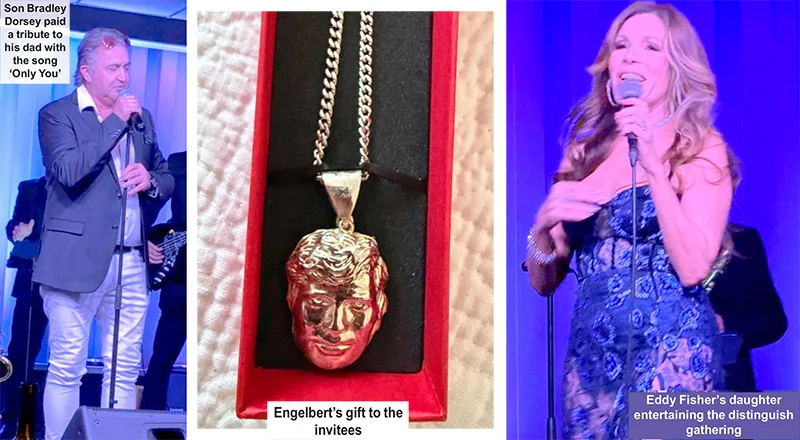
Invitees experienced a “magical entrance” with Engelbert’s name lighting up the screen and showing him performing his hit songs.
The invitees were also presented with a unique gift – a necklace with Engelbert’s face, engraved with the words “Remember, I Love You.”
Engelbert’s son, Bradley Dorsey, sang a tribute song ‘Only You’ for his dad, while Eddy Fisher’s daughters, Tricia and Joely, also got on stage to entertaining the distinguish gathering.
Engelbert didn’t perform but got on stage for the cutting of the birthday cake.
There was also a video compilation of birthday wishes from fellow celebrities, and the lineup included Gloria Gaynor, Micky Dolenz, Wayne Newton, Pat Boone, Lulu, Judy Collins, Deana Martin, Angélica María, Rupert Everett, Matt Goss, and more.

Birthday boy Engelbert Humperdinck
At 90, Engelbert is still performing. He’s on THE CELEBRATION TOUR for his 90th year, with over 50 international dates in 2026, including Australia, Germany, the US, and Canada. He’ll be at Massey Hall in, Toronto, on 06 October, 2026. He said: “The stage is my home… Canada has always been a highlight”.
He performed 60+ concerts, worldwide, in 2025, and says karaoke keeps his songs fresh: “Most of my songs are on karaoke because people love to sing them”.

Vaibhav Sooryavanshi picked in India ‘A’ squad for one-day tri-series in Sri Lanka

Saudi Arabia set to host Dunes League T20 from October

The guidance of Religious Leaders is essential to strengthen coexistence among communities. — Prime Minister

‘Watermelon deaths’ in Mumbai puzzle investigators

Mass sex abuse allegations force closure of boarding school in Indonesia

Gunshots fired in Philippine Senate where lawmaker wanted by ICC is holed up

‘Dates have the highest sugar content to fight Coronavirus’

Sunday Island 27 December – Headlines

#SundayIsland 17th December – Headlines

Sunday Island – 28th March

Sunday Island Headlines – 21 March

Sunday Island – 21st February – Headlines
-

 News5 days ago
Lanka Port City officials to meet investors in Dubai
-
 News2 days ago
Ex-SriLankan CEO’s death: Controversy surrounds execution of bail bond
-
 News6 days ago
SLPP expresses concern over death of former SriLankan CEO
-

 Editorial7 days ago
The Vijay factor
-
 News6 days ago
Police inform Fort Magistrate’s Court of finding ex-CEO of SriLankan dead under suspicious circumstances
-
 Features3 days ago
When University systems fail:Supreme Court’s landmark intervention in sexual harassment case
-
Features3 days ago
High Stakes in Pursuing corruption cases
-

 Features7 days ago
Palm leaf manuscripts of Sri Lanka – 1