
Latest News
US sends world’s largest warship towards Caribbean as it ramps up military presence

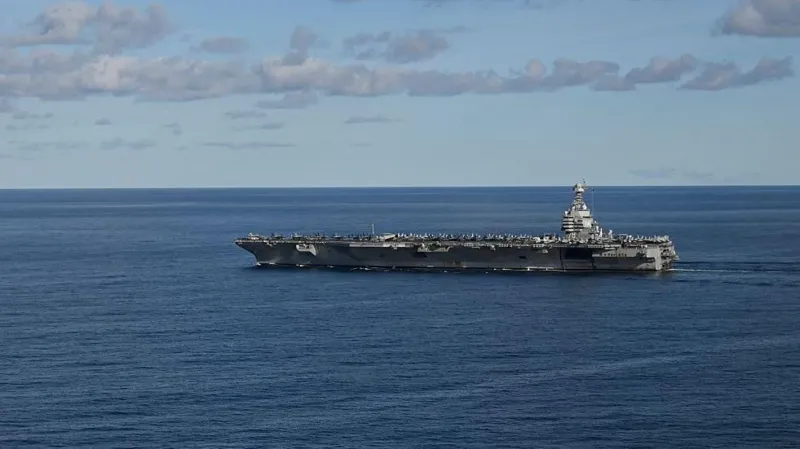
The US is deploying the world’s largest warship towards the Caribbean, marking a major escalation in what it says is a campaign to target drug traffickers.
Defence Secretary Pete Hegseth ordered the USS Gerald R Ford aircraft carrier, which can carry up to 90 aircraft, to move from the Mediterranean on Friday.
The US has been increasing its military presence in the Caribbean in recent weeks, and it now includes eight other warships, a nuclear submarine as well as F-35 aircraft.
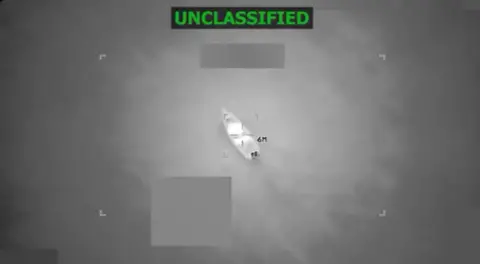
It has carried out airstrikes on boats it says belong to drug traffickers, including on Friday when Hegseth said “six male narco-terrorists” had been killed.
That operation took place in the Caribbean Sea, against a ship Hegseth said belonged to the Tren de Aragua criminal organisation.
The strikes have drawn condemnation in the region and experts have questioned their legality. The Trump administration says it is conducting a war on drug trafficking, but it has also been accused by experts and members of Congress of launching an intimidation campaign that seeks to destabilise the government of Venezuela’s President Nicolás Maduro.
Maduro is a longtime foe of Trump, and the US president has accused him of being the leader of a drug-trafficking organisation, which he denies.
“This is about regime change. They’re probably not going to invade, the hope is this is about signalling,” Dr Christopher Sabatini, a senior fellow for Latin America at the Chatham House think tank, told the BBC.
He argued the military build-up is intended to “strike fear” in the hearts of the Venezuelan military and Maduro’s inner circle so that they move against him.
In its Friday announcement, the Pentagon said the USS Gerald R Ford carrier would deploy to the US Southern Command area of responsibility, which includes Central America and South America as well as the Caribbean.
The additional forces “will enhance and augment existing capabilities to disrupt narcotics trafficking and degrade and dismantle TCOs”, or transnational criminal organisations, spokesman Sean Parnell said.
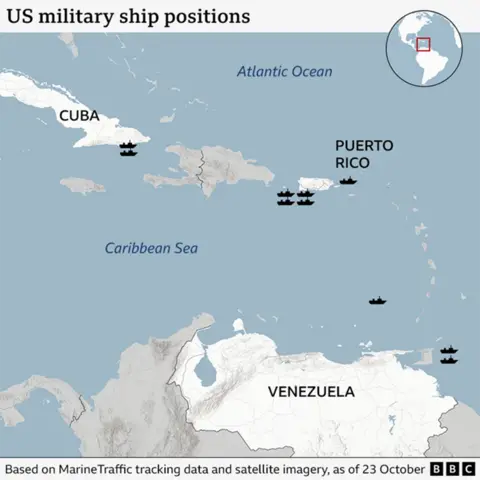
The carrier’s deployment would provide the resources to start conducting strikes against targets on the ground. Trump has repeatedly raised the possibility of what he called “land action” in Venezuela.
“We are certainly looking at land now, because we’ve got the sea very well under control,” he said earlier this week.
It comes as CNN reports Trump is considering targeting cocaine facilities and drug trafficking routes inside Venezuela, but is yet to make a final decision.
The aircraft carrier last publicly transmitted its location three days ago off the coast of Croatia, in the Adriatic Sea.
Its deployment marks a significant escalation in the US military buildup in the region. It is also likely to increase tensions with Venezuela, whose government Washington has long accused of harbouring drug traffickers.
The carrier’s large aircraft load can include jets and planes for transport and reconnaissance. Its first long-term deployment was in 2023.
It is unclear which vessels will accompany it when it moves to the region, but it can operate as part of a strike group that includes destroyers carrying missiles and other equipment.
The US has carried out a series of strikes on boats in recent weeks, in what President Donald Trump has described as an effort to curtail drug trafficking.
Members of US Congress, both Democrats and Republicans, have raised concerns about the legality of the strikes and the president’s authority to order them.
On 10 September, 25 Democratic US senators wrote to the White House and alleged the administration had struck a vessel days earlier “without evidence that the individuals on the vessel and the vessel’s cargo posed a threat to the United States”.
Senator Rand Paul of Kentucky, a Republican, has argued that such strikes require congressional approval.
Trump said he has the legal authority to order the strikes, and has designated Tren de Aragua a terrorist organisation.
“We’re allowed to do that, and if we do it by land, we may go back to Congress,” Trump told White House reporters on Wednesday.
US Secretary of State Marco Rubio added that “if people want to stop seeing drug boats blow up, stop sending drugs to the United States”.
The six deaths in the operation Hegseth announced on Friday brings the total people killed in the US strikes to at least 43.
(BBC)

Latest News
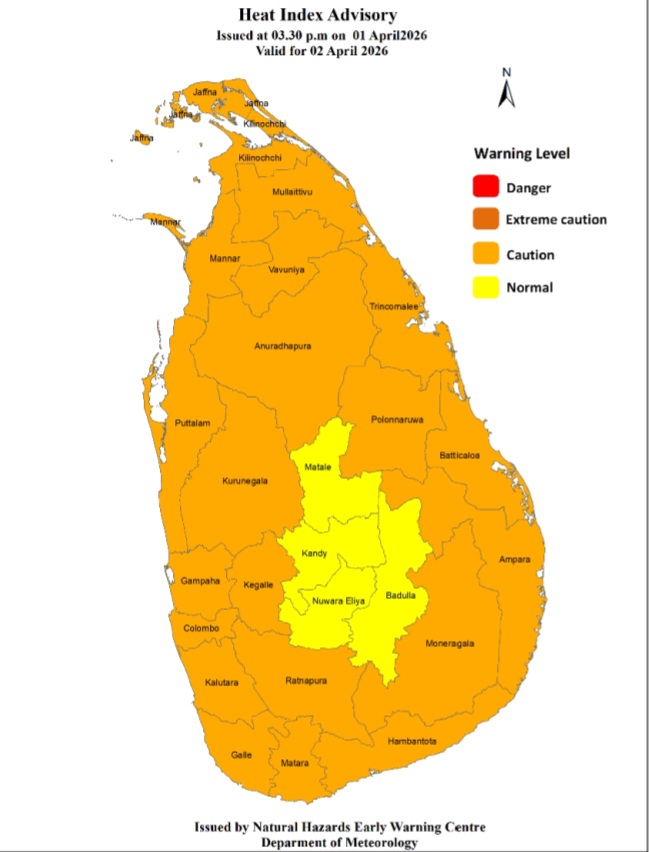
Heat Index at Caution Level in the Western, Sabaragamuwa, Southern, Eastern, North-western, Northern and North-central provinces and in Monaragala district.
Warm Weather Advisory
Issued by the Natural Hazards Early Warning Centre
Issued at 3.30 p.m. on 02 April 2026, valid for 03 April 2026.
The Heat index, the temperature felt on human body is likely to increase up to ‘Caution level’ at some places in the Western, Sabaragamuwa, Southern, Eastern, North-western, Northern and North-central provinces and in Monaragala district.
The Heat Index Forecast is calculated by using relative humidity and maximum temperature and this is the condition that is felt on your body. This is not the forecast of maximum temperature. It is generated by the Department of Meteorology for the next day period and prepared by using global numerical weather prediction model data.

Effect of the heat index on the human body is mentioned in the above table and it is prepared on the advice of the Ministry of Health and Indigenous Medical Services.
ACTION REQUIRED
Job sites: Stay hydrated and takes breaks in the shade as often as possible.
Indoors: Check up on the elderly and the sick.
Vehicles: Never leave children unattended.
Outdoors: Limit strenuous outdoor activities, find shade and stay hydrated.
Dress: Wear lightweight and white or light-colored clothing.
Note:
In addition, please refer to advisories issued by the Disaster Preparedness & Response Division, Ministry of Health in this regard as well. For further clarifications please contact 011-7446491.
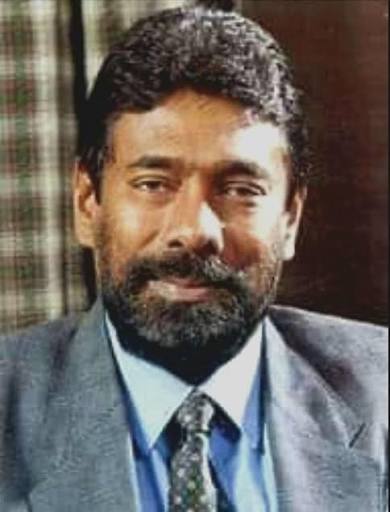
Former Matara District Member of Parliament and Cabinet Minister Mahinda Wijesekara has passed away this morning (02) at the age of 83 family sources have announced.
Mahinda Wijesekara served as a Member of Parliament for the Matara district for over two decades (1989 to 2010), representing the People’s Alliance, the United National Party and the United People’s Freedom Alliance.
He held several ministerial portfolios, including Minister of Postal and Telecommunication Services in 2008, Minister of Forestry and Envioronment 1999-2001, Minister of Fisheries and Ocean Resources from 2001 to 2004 and Minister of Special Projects 2007-2008
He was in poor health following injuries sustained in the 2009 bomb attack by the LTTE terrorists in Godapitiya, Matara.
He was the father of former Minister Kanchana Wijesekara.
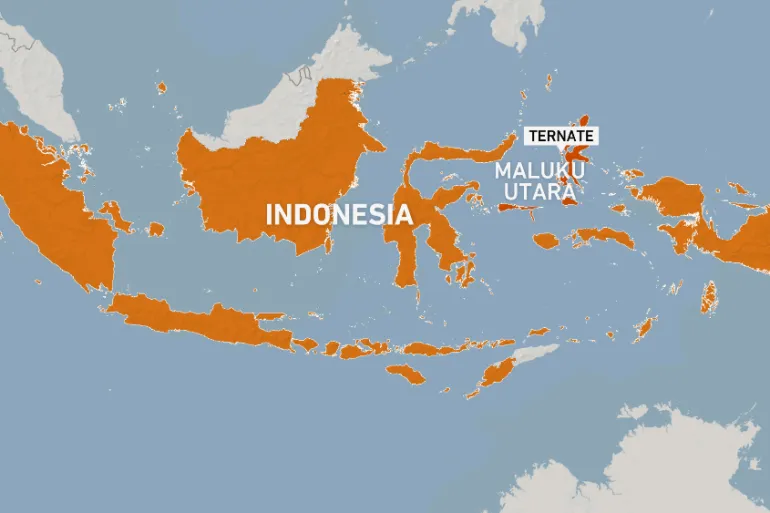
A magnitude 7.4 earthquake has hit the Northern Molucca Sea off the coast of the city of Ternate, in Indonesia, killing at least one person and triggering a tsunami warning that was subsequently lifted.
The United States Geological Survey (USGS) said Thursday’s quake, which was initially recorded at a magnitude of 7.8, struck at a depth of 35km (22 miles), greater than the early figure of 10km (six miles). There were no immediate reports of injuries.
The epicentre of the earthquake was about 120km (75 miles) from Ternate, in Indonesia’s North Maluku province.
Local authorities in some cities, such as Ternate and Tidore, were urged to prepare citizens for evacuation, while news channel Metro TV broadcast images of damaged buildings.
One person was killed when a building collapsed in the city of Manado in North Sulawesi province, a local search and rescue official told AFP news agency.
“The quake was felt strongly and around Manado … one person died and one person had a leg injury,” George Leo Mercy Randang told AFP by telephone. The victim was “buried under the rubble” of a collapsed building, he said.
The Hawaii-based Pacific Tsunami Warning Center (PTWC) initially said hazardous tsunami waves were possible within 1,000 kilometres (621 miles) of the epicentre along the coasts of Indonesia, the Philippines and Malaysia.
Within half an hour of the quake, waves up to 75 centimetres were recorded in North Minahasa and 20 centimetres in Bitung, both in the north of Sulawesi island, according to Indonesia’s BMKG geological agency.
Thirty-centimetre waves were also logged in North Maluku province.
The PTWC lifted its warning just over two hours after the tremor, saying the tsunami threat “has now passed”.
Indonesia straddles the so-called Pacific Ring of Fire, an area of high seismic activity where tectonic plates meet and earthquakes are frequent.
[Aljazeera]

Atmospheric conditions will be favorable for afternoon thundershowers in most parts of the island.

Nuwan Thushara files lawsuit against SLC for IPL NOC

Mercury fears over coal imports: CEJ urges urgent standards, health probe

Heat Index at Caution Level in the Western, Sabaragamuwa, Southern, Eastern, North-western, Northern and North-central provinces and in Monaragala district.

Govt. toys with the idea of moving public sector work online

Namal blames President for coal scam

‘Dates have the highest sugar content to fight Coronavirus’

Sunday Island 27 December – Headlines

#SundayIsland 17th December – Headlines

Sunday Island – 28th March

Sunday Island Headlines – 21 March

Sunday Island – 21st February – Headlines
-

 Features6 days ago
A World Order in Crisis: War, Power, and Resistance
-

 News3 days ago
Tariff shock from 01 April as power costs climb across the board
-
 News6 days ago
Minister Jayakody indicted in Colombo High Court over alleged corruption
-
 News4 days ago
Inquiry into female employee’s complaint: Retired HC Judge’s recommendations ignored
-

 News6 days ago
Police look for male partner of Chinese woman found stabbed to death at an apartment in Kohuwala
-
 Features4 days ago
New arithmetic of conflict: How the drone revolution is inverting economics of war
-
 Features5 days ago
When seabed goes dark: The Persian Gulf, cable sabotage, and race for space-based monopoly
-

 Business2 days ago
Hour of reckoning comes for SL’s power sector