
News
US must understand, a rising India is not a threat to Washington. It is an asset

The belief that the US can pressure India into unconditional alignment is short-sighted and self-defeating
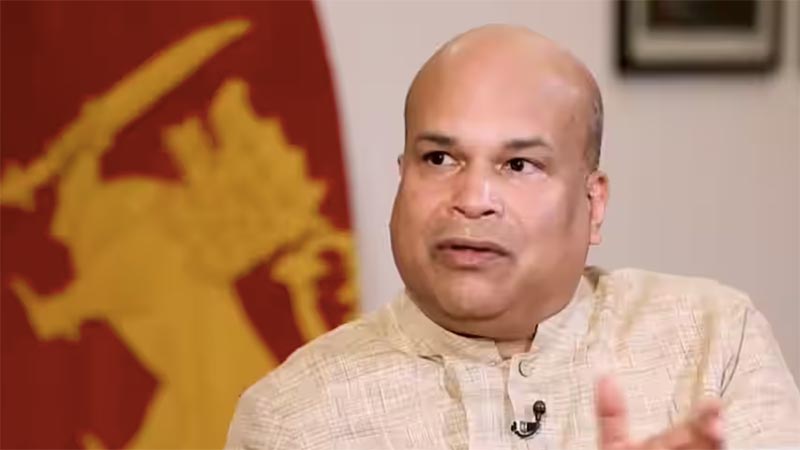
Former cabinet minister, High Commissioner to India, and founder of the Pathfinder Foundation Milinda Moragoda has questioned the US actions vis a vis India, in an article carried in The Indian Express, in its August 19th edition.
With US–India relations entering a more fragile phase, Washington’s pressure-first approach risks alienating a partner whose rise could be one of America’s greatest strategic assets in the 21st century. George Washington, in his farewell address of 1796, urged Americans to “observe good faith and justice toward all nations” and to “cultivate peace and harmony with all.” More than two centuries later, those words resonate in a very different but equally critical context.
For years, the US-India relationship has been described as a “defining partnership of the 21st century” — a rare convergence of two large democracies, diverse in their societies but united in their commitment to pluralism, innovation, and open markets. Yet in recent years, there has been a troubling shift in tone. Trust, once the hallmark of this partnership, is being replaced by suspicion.
At the heart of this erosion is a dangerous miscalculation by some in Washington: The belief that the US can pressure or “manage” India into unconditional alignment. This approach is short-sighted and self-defeating. It risks undermining one of America’s most natural, complementary partnerships at a time when the global order is becoming more multipolar and less predictable.
India is not just any large emerging economy. It is the world’s most populous democracy, a USD 4 trillion economy in the making, a leader in space exploration and digital public infrastructure, and a trusted voice in the Global South. Few countries offer such a unique blend of economic potential, democratic resilience, and geopolitical reach. From defence cooperation and technology partnerships to counterterrorism and climate action, the areas of overlap between India and the US are vast and expanding.
Despite this, US foreign policy has now taken a transactional turn. The escalation of trade disputes, the threat of secondary sanctions over energy purchases, and restrictive technology-transfer regimes all signal a willingness to apply pressure rather than build consensus. While disagreements between partners are natural, the manner in which they are pursued matters. Coercive tactics not only erode goodwill — they invite pushback.
India’s commitment to strategic autonomy is not a bargaining chip; it is a national consensus rooted in history. This is not about rejecting partnerships — it is about ensuring that they are built on equality and mutual respect. Attempts to “bully” India into alignment are destined to fail. Equally troubling is the view — still held in some quarters — that India’s rise must be tempered because it could one day compete with US interests. That mindset belongs to an era of zero-sum geopolitics and ignores the strategic reality of the 21st century.
A rising India is not a threat to the US. It is an asset. In the Indo-Pacific, where both countries share concerns about maritime security, supply-chain resilience, and the rules-based order, India’s role is indispensable. In global governance, India’s voice strengthens calls for reform of multilateral institutions — an agenda the US itself claims to support. In technology and innovation, Indian and American companies are increasingly intertwined, from Silicon Valley to Bengaluru.
If the US continues down its current, pressure-driven path, it risks alienating a partner with the best possible long-term strategic synergy. In a multipolar world, where trust is the most valuable currency, such alienation will have lasting consequences. India has options deepening engagement with Europe, expanding ties with ASEAN strengthening South–South cooperation and will use them if it feels constrained or disrespected.
This is not to say the relationship is beyond repair. Far from it. But Washington must change course before it is too late: Recognising India as an indispensable ally, one with shared democratic values, overlapping strategic objectives, and the capacity to work alongside the US in shaping a stable global order. It means replacing the mindset of managing India with one of empowering the partnership. For America, the choice is stark: Continue with mistrust and coercion, and risk losing one of its most consequential allies in Asia; or embrace India’s rise and, in doing so, strengthen its own strategic position.
George Washington also warned that “the nation which indulges toward another an habitual hatred or an habitual fondness is in some degree a slave.” In today’s world, that means rejecting fear and domination as the foundation of foreign policy and replacing them with balance, respect, and mutual purpose.






Latest News
Heat Index at Caution Level in the Western, Sabaragamuwa, Southern, Eastern, North-western, Northern and North-central provinces and in Monaragala district


Warm Weather Advisory
Issued by the Natural Hazards Early Warning Centre
Issued at 3.30 p.m. on 31 March 2026, valid for 01 April 2026.
The Heat index, the temperature felt on human body is likely to increase up to ‘Caution level’ at some places in the Western, Sabaragamuwa, Southern, Eastern, North-western, Northern and North-central provinces and in Monaragala district.
The Heat Index Forecast is calculated by using relative humidity and maximum temperature and this is the condition that is felt on your body. This is not the forecast of maximum temperature. It is generated by the Department of Meteorology for the next day period and prepared by using global numerical weather prediction model data.

Effect of the heat index on human body is mentioned in the above table and it is prepared on the advice of the Ministry of Health and Indigenous Medical Services.
ACTION REQUIRED
Job sites: Stay hydrated and takes breaks in the shade as often as possible.
Indoors: Check up on the elderly and the sick.
Vehicles: Never leave children unattended.
Outdoors: Limit strenuous outdoor activities, find shade and stay hydrated.
Dress: Wear lightweight and white or light-colored clothing.
Note:
In addition, please refer to advisories issued by the Disaster Preparedness & Response Division, Ministry of Health in this regard as well. For further clarifications please contact 011-7446491.

Govt. rations stocks as imports falter
By Ifham Nizam
The government faces a looming fertiliser crisis ahead of the 2026 Yala season, with a sharp shortfall in urea threatening paddy yields and food security.
Experts have warned that the fertiliser shortage will take its toll on the yala harvest.
With just over 100,000 tonnes of fertiliser in stock by early March—barely enough for paddy cultivation alone—and more than half of expected imports either cancelled or delayed, the government has moved to ration supplies through Agrarian Service Centres, based on last year’s consumption.
Leading crop scientist Professor Buddhi Marambe has warned that while rationing is unavoidable, it will reduce productivity. “Even last season we applied below recommended levels. This year, the gap will be worse,” he said.
Authorities are prioritising paddy, followed by maize and tea, as limited stocks are stretched across crops.
However, experts estimate yields could fall by 15–20% if nutrient shortages persist—raising the risk of higher food prices in the months ahead.
The crisis has been worsened by global disruptions, including Gulf conflict affecting fertiliser shipments and precautionary export restrictions by key suppliers, such as China.
Although the Government is pursuing deals with countries like Russia, supplies remain uncertain.
With global urea prices surging and production costs rising, smallholder farmers are expected to be the hardest hit.
“This is a wake-up call,” Prof. Marambe said, urging urgent steps to build buffer stocks and strengthen Sri Lanka’s long-term food security strategy.

By Shamindra Ferdinando
Frontline Socialist Party (FSP) spokesman Pubudu Jayagoda says the Gampaha Magistrate’s Court order that the ruling JVP hand back the FSP’s Kirindiwela office, grabbed by a group of JVP politicians on 02 September, 2025, has shown that the government cannot undermine the law.
Jayagoda said that the FSP had been compelled to move the court against the JVP as the Gampaha police refused to intervene due to political pressure. “They probably thought we were going to give up that office. Perhaps, the ruling party felt they could forcibly occupy other FSP offices,” Jayagoda said.
FSP’s Administrative Secretary Chamira Koswatta and trade unions, which operated from the Salmal Garden office, sought the court intervention to confirm the ownership of that building in the FSP. The court initially transferred the building to the police and issued a directive to law enforcement authorities to remove the JVP/NPP from that building.
Among the 20 respondents was Tilvin Silva, General Secretary of the JVP. Those now identified themselves as FSP quit the JVP in 2011 and later formed their own party.
Gampaha Additional Magistrate Shilani Perera on Monday ruled that the legitimate owner was the FSP. The Magistrate ruled that the FSPers had been forced out of that office, illegally.
Jayagoda said that the FSP considered the court ruling a victory for democracy and a devastating blow to the increasingly authoritarian JVP/NPP rule.

Amelia Kerr hits 139-ball 179* as New Zealand pull off record chase to level series

Punjab Kings fined for slow over-rate

Ice-cool Connolly leads nervy Punjab Kings home on IPL debut

Showers expected in the Western, Sabaragamuwa and Southern provinces in the evening or night

Heat Index at Caution Level in the Western, Sabaragamuwa, Southern, Eastern, North-western, Northern and North-central provinces and in Monaragala district

Urea shortage threatens Yala harvest: Experts

‘Dates have the highest sugar content to fight Coronavirus’

Sunday Island 27 December – Headlines

#SundayIsland 17th December – Headlines

Sunday Island – 28th March

Sunday Island Headlines – 21 March

Sunday Island – 21st February – Headlines
-

 Features5 days ago
A World Order in Crisis: War, Power, and Resistance
-

 News6 days ago
Energy Minister indicted on corruption charges ahead of no-faith motion against him
-

 News7 days ago
US dodges question on AKD’s claim SL denied permission for military aircraft to land
-

 Business7 days ago
Dialog Unveils Dialog Play Mini with Netflix and Apple TV
-

 Sports6 days ago
SLC to hold EGM in April
-

 Opinion6 days ago
When elephants fight, it is the grass that suffers
-

 Latest News6 days ago
A strong Technical and Vocational Education and Training (TVET) system equips individuals with practical, relevant, and future-oriented skills helping to innovate responsibly towards a greener and sustainable future – PM
-

 Features6 days ago
Lest we forget