
News
“UNDO Doesn’t Work in Real Life”: New campaign launched to tackle harmful speech and promote social cohesion

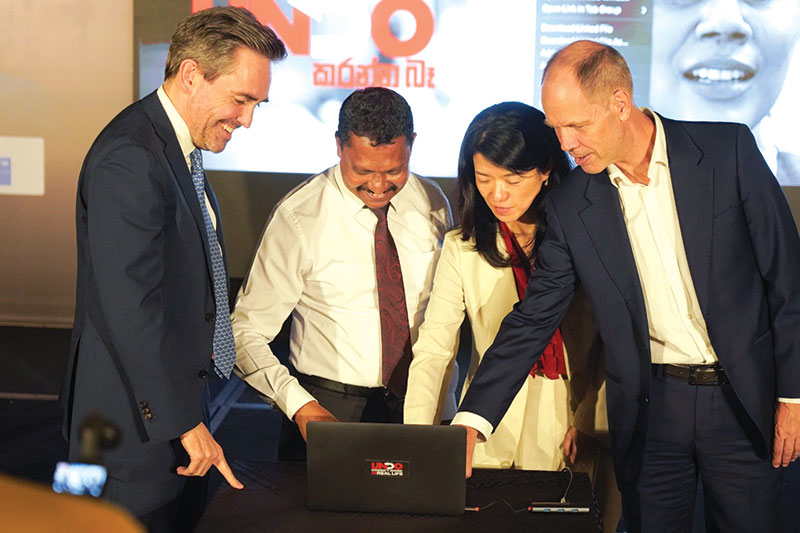
A public awareness campaign, titled “UNDO Doesn’t Work in Real Life,” was launched yesterday to address the growing threat of harmful speech and misinformation, while fostering empathy, accountability, and responsible storytelling in Sri Lanka.
This joint campaign is a collaborative initiative by the United Nations in Sri Lanka together with the Ministry of Health and Mass Media, and is implemented by the United Nations Development Programme (UNDP) and UNICEF in Sri Lanka, with support from the UN Sri Lanka SDG Fund.
Held in Colombo, the launch event saw the participation of Dr. Hansaka Wijemuni, Deputy Minister of Health and Mass Media; Marc-André Franche, Resident Coordinator, United Nations in Sri Lanka; Azusa Kubota, Resident Representative, UNDP Sri Lanka; and Christian Skoog, Representative, UNICEF Sri Lanka, alongside senior ministry officials, journalists, civil society actors, and media professionals.
Commenting on the effects of dangerous speech, Dr. Hansaka Wijemuni, Deputy Minister of Health and Mass Media, noted, “The power to combat hate speech misinformation and disinformation does not lie only with the government, tech companies and journalists, it lies also with the people. Let us work together to strengthen the policies to combat online hate speech and misinformation.”
The centrepiece of the campaign is a series of short videos, developed using real-time data from Sri Lanka’s online and offline spaces. These stories reflect the very real consequences of dangerous speech on individuals and communities, particularly women, youth, and marginalized groups.
Marc-André Franche, the United Nations Resident Coordinator highlighted the UN Secretary General’s Strategy and Plan of Action on Hate Speech which provides a clear framework to counter hate while upholding freedom of expression—a balance that is critical in a rapidly polarizing global and national media landscape in which greater responsibility is placed on governments, civil society, media and individual users to navigate online harm: “The rise in online harmful speech, particularly during politically sensitive periods, is a disturbing trend we must confront together”, stated Franche.
According to the UN Early Warning Brief (February 2025), 46% of online harmful speech still targets women, despite a 22% month-on-month drop in total harmful content. These trends reinforce the urgent need for public awareness, especially around the gendered impacts of disinformation and hate speech. “In the digital world, you can press ‘undo’ — but in real life, the damage caused by harmful speech is ingrained in someone’s hearts and minds, and often irreversible,” said Azusa Kubota, Resident Representative, UNDP in Sri Lanka.
“We hope the media will carry this message forward to enhance awareness amongst the public on the unintended and intended consequences of harmful speech, and promote responsible dialogue towards social cohesion.” “As UNICEF we have taken several actions to empower communities and future generations. We are equipping young minds with skills to engage in safe internet use and nurture critical thinking skills to recognize, challenge, and reject false and harmful language before it takes root”, said Christian Skoog, UNICEF Representative in Sri Lanka.
“In addition, UNICEF is working with grassroots organisations and religious leaders to actively prevent and counter hate speech and misinformation in their communities”, he added. The campaign which will run on mainstream media and digital outlets aims to spark national conversation, build digital literacy, and encourage responsible storytelling with media professionals playing a central role in carrying the message to the public.

News
The book “Intimidated?” presents a significant and timely contribution to understanding challenges, resilience, and innovation in the modern world, offering valuable insights for education, research, and social transformation – PM


Prime Minister Dr. Harini Amarasuriya made these remarks while participating in the book launch of “Intimidated?” authored by Professor Suranga Nanayakkara, Head of Department at the National University of Singapore, held on Saturday 28 March 2026 at the Lotus Hall of BMICH.
Authored by Professor Suranga Nanayakkara, the book “Intimidated?” reflects on contemporary global and personal challenges, innovation, and the importance of resilience, offering readers a thoughtful and inspiring perspective grounded in academic experience and global exposure. The publication, along with its English translation, was ceremonially presented to the Prime Minister during the event.
Congratulating the author on this important publication, the Prime Minister stated that such scholarly work plays a vital role in inspiring future generations, particularly students and young researchers, to think critically, embrace challenges, and contribute meaningfully to society. She further emphasized the importance of knowledge-sharing and innovation in shaping a progressive and inclusive educational environment in Sri Lanka.
The Prime Minister also ceremonially launched the programme to distribute 5,000 copies of the book free of charge to students and educational institutions, highlighting the importance of making knowledge accessible to a wider audience.
The event was attended by Deputy Minister of Digital Economy Eranga Weeraratne, Secretary to the Ministry of Education Nalaka Kaluwewa, family members of Professor Suranga Nanayakkara, university Vice Chancellors, professors and lecturers, senior officials of the Ministry of Education, school principals, students, and invited guests.

(Prime Minister’s Media Division)
News
It is the government’s objective to create an education system that provides every child with access to modern technological opportunities — Prime Minister

Prime Minister, Dr. Harini Amarasuriya, stated that it is the government’s objective to establish an education system that ensures every child has access to modern technological opportunities.
The Prime Minister made these remarks while attending the opening ceremony of the National Competition of the World Robot Olympiad (WRO), that aims to elevate the technological skills of Sri Lanka’s younger generation to international standards, held on Saturday (28) at Burhani Serendib College in Colombo.
A total of 66 teams from schools across the island participated in this year’s competition, marking a threefold increase compared to last year. The event was held under the theme “Robots Meet Culture,” and over 500 students, presented creations blending local culture with modern engineering concepts.
Expressing her views, the Prime Minister stated:
“In today’s rapidly evolving world, giving priority to the fields of Science, Technology, Engineering, and Mathematics (STEM) should be a national priority.
Platforms such as the World Robot Olympiad provide opportunities for our younger generation to develop essential skills such as logical thinking, innovation, and teamwork”,
Sri Lanka participated in the International Robot Olympiad held in Singapore in 2025, with two teams representing the country, which marked a highly significant and enriching experience for our children.
The Prime Minister further emphasized that the government remains committed to building an education system that enables every child to benefit from such technological opportunities.
The event was attended by the Secretary to the Prime Minister, Pradeep Saputhanthri, officials from the Indian High Commission, government officials, and school students.

(Prime Minister’s Media Division)
Latest News
Heat Index likely to increase up to ‘Caution level’ at some places in the Western, Sabaragamuwa, Southern, Eastern, North-western, Northern and North-central provinces and in Monaragala district

Warm Weather Advisory
Issued by the Natural Hazards Early Warning Centre
Issued at 3.30 p.m. on 29 March 2026, valid for 30 March 2026.
The Heat index, the temperature felt on human body is likely to increase up to ‘Caution level’ at some places in the Western, Sabaragamuwa, Southern, Eastern, North-western, Northern and North-central provinces and in Monaragala district.
The Heat Index Forecast is calculated by using relative humidity and maximum temperature and this is the condition that is felt on your body. This is not the forecast of maximum temperature. It is generated by the Department of Meteorology for the next day period and prepared by using global numerical weather prediction model data.

Effect of the heat index on human body is mentioned in the above table and it is prepared on the advice of the Ministry of Health and Indigenous Medical Services.
ACTION REQUIRED
Job sites: Stay hydrated and takes breaks in the shade as often as possible.
Indoors: Check up on the elderly and the sick.
Vehicles: Never leave children unattended.
Outdoors: Limit strenuous outdoor activities, find shade and stay hydrated.
Dress: Wear lightweight and white or light-colored clothing.
Note:
In addition, please refer to advisories issued by the Disaster Preparedness & Response Division, Ministry of Health in this regard as well. For further clarifications please contact 011-7446491.

The book “Intimidated?” presents a significant and timely contribution to understanding challenges, resilience, and innovation in the modern world, offering valuable insights for education, research, and social transformation – PM

It is the government’s objective to create an education system that provides every child with access to modern technological opportunities — Prime Minister

Caf general secretary resigns amid Afcon final fallout

Heat Index likely to increase up to ‘Caution level’ at some places in the Western, Sabaragamuwa, Southern, Eastern, North-western, Northern and North-central provinces and in Monaragala district

National Namal Uyana Declared a ‘National Heritage of Sri Lanka’

Philippine transport strikers say Marcos Jr failing to control oil prices

‘Dates have the highest sugar content to fight Coronavirus’

Sunday Island 27 December – Headlines

#SundayIsland 17th December – Headlines

Sunday Island – 28th March

Sunday Island Headlines – 21 March

Sunday Island – 21st February – Headlines
-

 News5 days ago
Senior citizens above 70 years to receive March allowances on Thursday (26)
-

 Features2 days ago
A World Order in Crisis: War, Power, and Resistance
-

 Features7 days ago
Trincomalee oil tank farm: An engineering marvel
-

 News3 days ago
Energy Minister indicted on corruption charges ahead of no-faith motion against him
-

 News4 days ago
US dodges question on AKD’s claim SL denied permission for military aircraft to land
-

 Features7 days ago
The scientist who was finally heard
-

 Business4 days ago
Dialog Unveils Dialog Play Mini with Netflix and Apple TV
-

 Sports3 days ago
SLC to hold EGM in April