
News
UN Women’s project boosts community role of females here

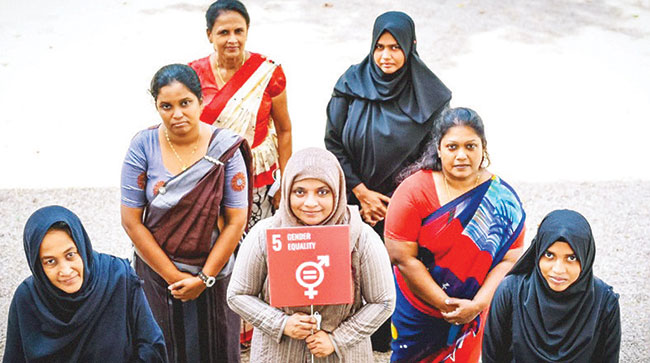
Lankan women carry the main burden of household work, and therefore they have knowledge and influence that could be channeled to improve community waste management, which is not only harming health and the environment but also causing disputes between different communities, says Asia and the Pacific branch of the UN Women.
The government’s Time-Use Survey of 2017 found that women spend 27.6 per cent more time than men doing housework each day. Yet while women are the ones handling all the household waste, they barely have a voice when it comes to deciding how to manage waste in the larger community.
In Sri Lanka, the local government councils have the primary responsibility for collecting and disposing of waste within their areas. But historically, very few women have held seats on these bodies because of institutional and structural barriers, and gender stereotypes such as that politics is unsuitable for women or that women should just stay at home.
Before the last local elections, in 2018, women held only 1.9 per cent of these seats. A new 25 percent quota for female representation boosted that number, though today, women still hold only 23.7 per cent of seats.
To address the problem of women’s representation and environmental management, UN Women, United Nations Office for Project Services, and Chrysalis, a local non-governmental organisation, are jointly implementing a project called Promoting Women’s Engagement in Effective Solid Waste Management. The 2020-2021 project, funded by the United Nations Peacebuilding Fund, is expected to directly benefit about 4,000 people in Puttalam and Mannar districts along the country’s western coast. Most people in these districts work in fisheries and in agriculture.
“Through this project, we are working with women to ensure their voices are heard and that they are fully involved in making decisions that impact them, their households and communities,” said Ramaaya Salgado, Country Focal Point at UN Women Sri Lanka. “Solid waste management was identified as the main community issue that this project addresses, but we are building their capacities so that this whole-of-community approach can be replicated in addressing other conflicts and community issues as well.”
Because improper waste disposal harms health, the environment and inter-communal relations, the project brings communities together to develop sustainable solutions for their shared environment — with women at the forefront of that process.
In April 2020, the project organized a series of local-level dialogues in which about 350 elected officials, public officials, women community leaders, members of civil society groups, religious leaders, young people and others in Puttalam and Mannar discussed common issues and solutions to waste management.
UN Women and Chrysalis then gave the dialogue participants training on collective leadership, peace-building and non-violent conflict resolution.
Earlier this month, UN Women organized two town hall meetings that connected local authorities and women community leaders with experts in solid waste management, including environmental and civil engineers, local government officials and environmental activists. The broader aim was to get more women into leadership positions and adopt best practices on solid waste management.
The women participating in the UN Women project include Kaweeda Manohari, 48, a member of the Chilaw Municipal Council in Puttalam, and Dilushani Fernando, a social worker and community leader in Puttalam.
“Recently, I had to be a mediator to a conflict between two parties,” Manohari said. “Since it was fresh in my mind, I was able to use some of the techniques I learned at our training to help the two parties arrive at a compromise and push for a legal solution to their issue.”
Fernando said: “I learned a lot about waste segregation and the economic benefits of upcycling while reducing waste. Now I always think twice before throwing away something. I use it to create something new instead. This is what I hope to teach young children in my community.”



Bosnian Serb General Ratko Mladic, who was serving a life sentence for genocide, war crimes, and crimes against humanity during the bloody 1992-1995 war in Bosnia and Herzegovina, has died.
Mladic, the so-called “butcher of Bosnia” died at the age of 84, the Serbian state RTS television and the official Bosnian Serb television reported. His death was also confirmed by a UN official speaking to the Reuters news agency.
The reports said that Mladic died in a UN prison hospital in The Hague, Netherlands.
A family member of Mladic confirmed the reports and told the Associated Press that Mladic’s son, Darko Mladic, was on his way to The Hague.
Mladic was convicted of genocide for orchestrating the 1995 massacre of at least 8,000 Bosniak men and boys in a UN-designated “safe area” of Bosnia, in Europe’s worst atrocity since World War II.
He spent his last years in jail after he was convicted in 2017 for crimes the tribunal said at the time were “amongst the most heinous known to humankind”.
Former UN rights chief Zeid Ra’ad al Hussein described him as “the epitome of evil” after his conviction.
The former communist officer-turned nationalist warlord, was one of the most notorious figures of the conflict in which more than 100,000 people were killed and more than one million were driven from their homes.
He commanded his troops to “scorch the brains” of the Bosniaks and boasted of being a “Serbian god”.
When the Bosnian war started in 1992, Mladic became the commander of the Bosnian Serb troops and took control of large swaths of the country in an attempt to form a Serb mini-state.
Serbs under Mladic’s control laid siege to the capital, Sarajevo, and other cities and villages, established camps for detained Bosniaks and enemy soldiers, and systematically killed prisoners.
The killings, recognised as a genocide, were the culmination of a war that had lasted over three years, in which the Mladic pounded the besieged capital Sarajevo daily with the artillery, tanks, mortars and heavy machine guns of his nationalist Serb army, killing 10,000 people.
The dead from Srebrenica were bulldozed into mass graves over four days in July 1995, some of them dug up and relocated to remote mountains so as to hide evidence of the killings.
The goal, as determined by the UN International Criminal Tribunal for the former Yugoslavia (ICTY), was “ethnic cleansing” — the forcible expulsion of Bosniaks, Croats and other non-Serbs to clear Bosnian lands for a Greater Serbia.
The tribunal found that Mladic, together with late Serbian President Slobodan Milosevic and Bosnian Serb political leader Radovan Karadzic, were part of a criminal conspiracy to implement the plan.
Defiant to the end, Mladic said “I do not recognise this court,” at an ICTY hearing of his case in 2014.
When he was sentenced to life in prison in 2017 he shouted: “This is all lies, you are all liars!”
[Aljazeera]
* Govt. lacks plan to meet IMF targets
By Shamindra Ferdinando
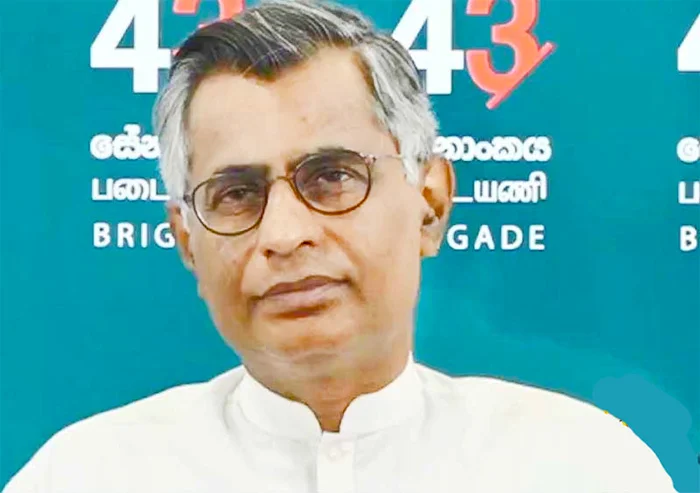
United Republican Front (URF) leader Patali Champika Ranawaka has alleged that the 22nd Amendment is aimed at enabling the National People’s Power (NPP) to perpetuate its rule without conducting elections.
The former Minister was addressing the media at the Flower Road Office of UNP leader Ranil Wickremesinghe on Tuesday (25). Alleging that the Pelawatte-based ‘red junta’ spearheaded the operation to enact the controversial 22nd Amendment, the ex-parliamentarian pointed out that neither President Anura Kumara Dissanayake nor Health and Media Minister Dr. Nalinda Jayathissa, who is also the Cabinet spokesman, never denied declarations made by various members of the NPP parliamentary group that elections wouldn’t be conducted for 10, 20 years.
The President and the Cabinet spokesman never clarified that such declarations were not the position of the government, Ranawaka said. The URF leader pointed out that some NPP/JVP members told those receiving appointments that they would also retire under the same administration.
Addressing the media after former External Affairs Minister Prof. G. L. Peiris, convenor of the Joint Opposition, said that the government recognised them as the real opposition. Referring to Dr. Jayathissa’s recent claim that they conspired at the residence of Prof. Peiris and challenged them to come on to the streets, ex-lawmaker Ranawaka thanked the Minister for the recognition at the expense of the Samagi Jana Balawegaya (SJB). The government accepted the challenge posed by them in spite of the main Opposition party, in Parliament, having 40 MPs, the URF Chief said, urging the government to reveal the identities of those who clandestinely led the ruling party.
The former MP said that the country was now aware of their conspiracies during the past six decades. Blaming the government for its inordinate delay in conducting the Provincial Council polls, and the failure to take tangible measures to do away with the executive presidency, as repeatedly promised in the run-up to the national elections in 2024, Ranawaka alleged that the government was busy conspiring to roll back the electoral map. He also alleged that President Dissanayake was leading the operation.
According to Ranawaka the government was keen to postpone elections indefinitely as its members feared to face the law under a different government.
Commenting on the economic situation, Ranawaka explained how under President Wickremesinghe tough measures were taken during the 2022 to 2024 period to stabilise the country with the backing of the International Monetary Fund (IMF). “However, the country cannot go on beyond 2027 under the current setup. In terms of the agreement with the IMF, the debt repayment was stopped. However, the country will have to start repayment in 2028,” the ex-MP said, pointing out the country’s reserves were down to USD 6.4 bn.
The ex-MP said the IMF expected Sri Lanka to maintain foreign reserves at USD 6.8 bn and to increase the reserves to USD 12 bn next year. In terms of the IMF’s recommendations, the foreign reserves have to be increased to USD 15 bn by 2028, Ranawaka said, recollecting how former President Ranil Wickremesinghe, at a recent book launch, explained the daunting challenges faced by the country on the economic front.
Ranawaka was referring to Wickremesinghe’s speech at the launch of former Minister Ranjith Siyambalapitiya’s book launch at the BMICH, where the former President warned of dire consequences if the government failed to adhere to the IMF formula.
The former Minister disputed the government’s much touted claim that corruption was dealt with. The person who caused an unprecedented gas crisis, in 2021, by promising to supply gas at a much lower price than what was paid by the then government at that time and ended up causing countrywide panic due to “accidental” blasts of domestic gas cylinders, received protection from this government.
The government conveniently refrained from initiating action against that person, Ranawaka said. Referring to the developments leading to President Gotabaya Rajapaksa’s government declaration of bankruptcy in April 2022, the ex-Minister claimed that the IMF, in a letter dated 7 March, 2022, alerted the Secretary to the President, the Finance Ministry and the Central Bank, of the impending economic collapse. The NPP government failed to take action against those responsible for creating the 2022 crisis, Ranawaka said.

Navy headquarters yesterday said it was continuing the search for Lt. Thilina Udayapriya, second-in-command of the Super Dvora Mark III Fast Attack Craft (FAC), which sank in the seas off Angulana, on 15 August, 2026. Of the 12-member crew, 11 were rescued but so far SLN efforts to locate the missing officer’s body had failed, sources said.
They said that the salvage operation of the sunken craft, taken delivery from Israel after the end of the war, is continuing amidst gruelling weather and rough sea conditions, and the sunken vessel is now off Bambalapitiya.
Sources said that the vessel collided with a sunken ship MV Thermopylae Sierra that sank in August 2012, during a monsoon storm. The ill-fated Super Dvora Mk III has gone over the ship wreck in spite of it being clearly demarcated in the nautical chart, aka hydrographic chart available to the ill-fated vessel’s crew. But authorities had failed to mark the site with a buoy to warn maritime traffic, in spite of public appeals. (SF)

More than 360 dead, 1,400 missing in Nepal and Tibet after Himalayan floods

Bosnian Serb convicted war criminal Ratko Mladic dies

Prince of Wales to celebrate 150th anniversary with six-a-side cricket

Unyielding Dinusha, spirited tail hold off India to save Colombo Test

US golfer Gogel gets six-month ban for betting

UAE’s Asif Khan handed 15-month ban for using a banned substance

‘Dates have the highest sugar content to fight Coronavirus’

Sunday Island 27 December – Headlines

#SundayIsland 17th December – Headlines

Sunday Island – 28th March

Sunday Island Headlines – 21 March

Sunday Island – 21st February – Headlines
-
 News7 days ago
Country’s first woman Surveyor General appointed
-

 Business6 days ago
SriLankan Airlines makes ShakthiSAT Mission possible for talented Sri Lankan student
-

 Features7 days ago
Medical education in Sri Lanka: Then and now
-
 Latest News7 days ago
Imran Khan moved to private hospital amid deteriorating health
-

 Latest News7 days ago
Government has declared 21, 22 and 23 August 2026 as national days of mourning
-
 Features5 days ago
My secondary schooling after Royal Primary
-
 Features5 days ago
From the First to the 22nd: A short history of Amendment Politics and Reform Frustrations
-
 News7 days ago
22A: Opp. demands all available SC judges hear petitions