
Editorial
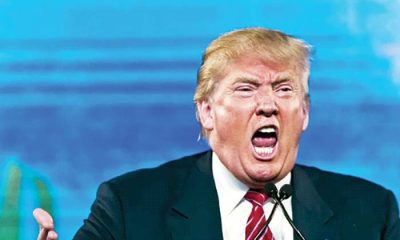
Trump again? God forbid


Thanks to regular columnist Vijaya Chandrasoma’s incisive contributions on political developments in the USA, readers of this newspaper have been able to get a good understanding of what is happening in one of the world’s greatest democracies, in the run-up to its presidential election next year.
Donald Trump is the current front-line candidate for the Republican ticket at the forthcoming election in November 2024, leading his four rivals by more than 40 points in the latest polls. Trump did not even bother to participate in the fourth debate held in Tuscaloosa, Alabama last Wednesday, the final debate before the first of the Republican primaries scheduled in Iowa for January, 2024.
His performance during his first presidential term, his personal vulgarity, his refusal to accept a clear defeat and the havoc he unleashed after the last presidential election results were declared are good enough reasons, most would think, for Trump to be convicted for sedition and obstruction of justice and imprisoned for a considerable period of time. Not so in America, though, for two main reasons.
One, the delays in the US justice system, which takes months, if not years, to conclude the legal processes to be negotiated even to initiate a trial. Even, or rather, especially, trials of an accused criminal like former President Trump, whose main legal objective is to delay those he faces on four indictments and 91 felonies until after the 2024 election. Which he expects to win, and as President, he will then pardon himself for federal crimes and claim executive immunity for state offenses.
Two, white supremacy and privilege are so deeply entrenched in the so-called “greatest democracy in the world”, that there is one law for the white and privileged, another for the indigent and colored. It would be impossible to imagine the fate which would have befallen African-American President Barack Obama, had he behaved just once the way Trump behaved every day in his four years at the White House. Obama was reviled by Fox News, the Republican Party propaganda arm, for wearing a tan suit at a press conference, the only “scandal” during his two-term presidency!
Many political commentators believed that the election to the presidency of Obama in 2008 and his re-election four years later signaled the beginning of the end of racial prejudice in America. At last, the enactments of the Civil Rights Act of 1964 and the Voting Rights Act of 1965, were showing promise of the erosion of the evils of segregation and employment discrimination from the Jim Crow era. Perhaps the day of the dream of the Rev. Martin Luther King, “that my four little children will one day live in a nation where they will not be judged by the color of their skin but by the content of their character” had finally dawned.
In fact, one of the most popular and astute political satirists of the time, Jon Stewart, made the memorable statement the night Obama was elected to the Presidency in November 2008: “At last we have become what we said we were”!
Nothing could have been further from the truth. Obama’s election to the highest position in the land unleashed deep-seated feelings of white supremacy, which had been seething at such depths under the surface that they were almost invisible. Chandrasoma says that during the two decades he lived in the USA at the turn of the century, seven years in the then deep-red state of Arizona, the only racial hatred he felt was after 9/11, when he was mistaken for an Arab. In fact, where education was concerned, he says minorities were at an advantage, during the Clinton years, especially if they were poor. He recalls his daughter thanking him for being the greatest father in the world, if only because his poverty enabled her to secure student loans to attend the best universities in the world with ease!
Trump, who had no previous experience in governing or public service, won the 2016 election, defeating Hillary Clinton, one of the most qualified and experienced presidential candidates in history. There were many subterfuges and Russian trickery involved in his victory, not the least of which was his exploitation of the racism of white Americans, incensed at the election of a black president. Especially one who graced the presidency with two terms of competency and compassion, without a trace of scandal, personal or political.
When Trump lost the presidency in 2020 in what was, according to election and judicial authorities, one of the fairest elections in US history, he called Foul and refused to concede defeat. Much has been written about his subsequent criminal behavior, his Big Lie about a stolen election, his incitement of a violent insurrection in an attempt to prevent the constitutional and peaceful transfer of power, and his persistent claim that he has been the victim of the greatest witch-hunt in history. This is a claim that has been embraced, in the face of the most conclusive evidence, by the Republican base, in their desperation to maintain their fantasy of a Christian white supremacist state.
Trump has already made it abundantly clear that, if he wins a second term, he will terminate the constitution, and place the entire executive branch under his complete control, which will enable him to employ only those loyal to him in the federal government. In a recent interview, when asked if he would abuse the power of the presidency if re-elected, Trump confirmed that he would, only on the first day, when he would close the southern border, fire all federal employees, judges and prosecutors who had been disloyal to him, and “drill, baby, drill” with no thoughts of pollution and climate change.
The most powerful nation, the leader of the free world, may well be reduced to just another Banana Republic, though, frighteningly, one with the greatest nuclear arsenal in the world; and with a madman in control.












Tuesday 13th January, 2026
What began as a debate on the government’s education reforms has descended into a dirty political war, with the propaganda brigades of both the JVP/NPP and the Opposition carrying out vilification campaigns against the key figures in the rival camps. Prime Minister Dr. Harini Amarasuriya, who is also the Minister of Education, has become a victim of a savage character assassination campaign, which no reasonable person will hesitate to condemn unreservedly. Shame on those who have stooped so low as to carry out personal attacks on her!
What has led to the current dispute in the education sector is basically the government’s intransigence. While claiming to be willing to consider dissenting views, it is all out to shove its reform package down the throats of other key stakeholders who unfortunately want the baby also thrown out with the bathwater, so to speak. A prerequisite for resolving the current conflict, which has the potential to cripple the education sector, is for both warring parties to soften their stands and negotiate.
President Anura Kumara Dissanayake is scheduled to meet the representatives of the trade unions representing teachers and principals shortly, we are told. One can only hope that two sides will move towards a rapprochement, which is the need of the hour.
The government ought to stop cherishing the delusion that its mandate is carte blanche for it to do as it pleases with no heed for dissent. It is only wishful thinking that the government will be able to ensure the implementation of its education reforms without the fullest cooperation of the frontline stakeholders—school teachers and principals.
Even the staunchest opponents of the education reforms at issue agree that the education system has to be reformed. What they are opposing tooth and nail is the manner in which the government has set about the task of introducing education reforms and its attempts to impose a fait accompli on other key stakeholders. The Opposition is not without a political agenda where its campaign against the education reforms is concerned; it will go to any extent to gain political mileage.
The government has erred by compressing the process of formulating education reforms into a year or so and proceeding at a pell-mell pace to implement them. Teachers’ and principals’ trade unions are of the view that some modules were prepared in just three months.
By rushing to reform the education sector, the government has provided the Opposition with a fresh rallying point and the latter is making the most of it. Various associations have sprung up overnight purportedly to ‘save free education’, and some Opposition politicians are planning to launch fasts against the education reforms.
A collective of Opposition parties held a protest in Matugama, the other day, claiming to safeguard free education. A group of NPP supporters staged a demonstration in the same township against the malicious propaganda attacks on Prime Minister Amarasuriya. They vehemently condemned the Opposition for insulting women. Their message must have struck a responsive chord with the public regardless what the Opposition politicians and their propaganda hitmen may say about them. Worryingly, the female JVP/NPP supporters have remained silent on scurrilous attacks the pro-government propagandists carry out on women in the Opposition; they have launched a vilification campaign against a young woman who spoke at a joint Opposition rally at Nugegoda recently. Politicians and propagandists in both the government and the Opposition must do unto others as they would have others do unto them.
Since all stakeholders agree that the education system needs reform, the government should put its controversial reform package on hold immediately and invite teachers, principals, the Opposition and others to a serious discussion.
The government would do well to refrain from crossing the Rubicon and be flexible enough to listen to the other stakeholders and make a course correction. It is hoped that the focus of the talks to be held between the government and the opponents of the education reforms will be on how to retain the baby while throwing away the bathwater.

Monday 12th January, 2026
Corruption has eaten into the vitals of Sri Lanka’s power and energy sectors to such an extent that one wonders whether ‘C’ in the initialisms of the Ceylon Electricity Board (CEB) and the Ceylon Petroleum Corporation (CPC) stands for ‘Corrupt’. Pressure is mounting on the government to cancel a questionable coal tender which is causing staggering losses to the state.
We reported on the coal scam at issue about three months ago, turning the spotlight on the fraudulent procurement of substandard coal. Following our report, the Opposition and the anti-corruption outfits did their own investigations and unearthed more information about the questionable deal. It has been revealed that the government extended the closing date for bidding and changed the eligibility criteria for the bidders in favour of a company of its choice. The company that won the tender has a history of supplying low-quality goods to Sathosa, and its owner and local agent are reportedly under a cloud. A complaint has been lodged with the Commission to Investigate Allegations of Bribery or Corruption (CIABOC) against Minister of Energy Kumara Jayakody over alleged misappropriation of state funds when he was in the Fertiliser Corporation. It is against this backdrop that the coal scam in question should be viewed.
The Opposition took up the issue of substandard coal imports, in Parliament, last week, accusing the NPP government of trying to cover up the scam. SLPP MP D.V. Chanaka told the House that only 107 metric tonnes of coal were usually required per hour to generate 300 megawatts of electricity but now 120 metric tonnes of newly imported coal had to be burnt to produce the same amount of power. About 13 extra tonnes of coal are required per hour due to the scam, according to Chanaka, who also said tests conducted at the Lakvijaya Coal Power Plant had revealed that the calorific value of the first two newly imported coal shipments ranged from 5,600 and 5,800 kilocalories per kilogram (kcal/kg). But under the coal tender guidelines, the minimum required calorific value was 5,900 kcal/kg. Energy Minister Kumar Jayakody is reported to have said the Lakvijaya laboratory is not an accredited facility, and therefore its test results are not acceptable; action will be taken when the test report from an accredited laboratory is received.
Curiously, the government has questioned the integrity of tests conducted by a Sri Lankan laboratory that has tested coal shipments all these years to ascertain their quality. How come the NPP government has suddenly refused to accept the accuracy of the tests conducted by this lab? Is it trying to go on testing the substandard coal until it gets the result it wants so that it can continue to import low-quality coal and help its members line their pockets? In fact, there is no need for any laboratory testing to prove that there is something terribly wrong with the coal procured under the current dispensation; that is clearly borne out by the fact that it takes 120 tonnes of newly imported coal to produce a particular amount of electricity previously generated with only 107 tonnes of standard of coal.
The NPP government seems to have taken a leaf out of the book of the previous administration, which became a metaphor for corruption. It too resorts to dilatory tactics and obfuscation to cover up scams. It has succeeded in diverting the public’s attention from the Ondansetron scam by claiming that more tests need to be conducted; the Opposition, the media, and civil society organisations have forgotten that pharmaceutical racket for all intents and purposes. It is using the same modus operandi in the case of the coal scam. Anti-corruption campaigners must remain intensely focused on all questionable deals and monitor the progress in investigations into them. It was their vigilance and relentless campaigning that led to the arrest and prosecution of Minister Keheliya Rambukwella and some panjandrums over the procurement of a fake cancer drug.
Given the sheer number of corrupt deals and shameful attempts to cover them up, under the incumbent government, which came to power, vowing to eliminate corruption and usher in good governance, one may say, with apologies to Immanuel Kant, out of such crooked wood as that which politicians and officials are made of, nothing straight can be fashioned.

Trade unions and professional associations have been cranking up pressure on the NPP government to put its education reforms on hold and invite all key stakeholders to a serious discussion. Prime Minister Dr. Harini Amarasuriya struck a conciliatory note in Parliament the other day, indicating that the government was willing to take dissenting views on board. But President Anura Kumara Dissanayake has said in no uncertain terms that the government will go ahead with its education reform programme. Speaking at the launch of the Rebuilding Sri Lanka project yesterday, he made his government’s position on education reforms clear. The university teachers who naively sought President Dissanayake’s intervention to have the education reforms halted must be disillusioned.
Arguments against the education reforms, particularly the recently created modules, are tenable. Teachers and principals have highlighted serious flaws in them, and the government is trying piecemeal remedies such as removing pages containing errors. Some modules have already found their way into the hands of private tutors, according to teachers’ unions.
Prime Minister Amarasuriya met the Mahnayake Theras in Kandy on Thursday and briefed them on the government’s education reforms and related issues. The prelates expressed their concerns, and requested the government to resolve the issues other stakeholders had flagged. Addressing the media subsequently in Kandy, the PM put a bold face on the situation and sought to make light of the no-confidence motion the Opposition is planning to move against her. Claiming that her political rivals’ efforts had no chance of succeeding, she said a debate on the no-confidence motion against her would provide the government with an opportunity to elaborate on its education reforms. However, it is the Opposition parties that usually gain propaganda mileage in debates on no-confidence motions. The beleaguered SLPP government also defeated no-confidence motions against its members in the last Parliament, but could not prevent public opinion from turning against it.
There is no gainsaying that religious leaders should be kept informed of reforms in vital sectors such as education, but what matters most in implementing education reforms is not their support or blessings however important and valuable they may be. The government should make a serious effort to enlist the support of teachers and principals if it is to achieve its goal of reforming the education system properly. They are the frontline stakeholders who interact with students and perform core operational tasks.
Teachers and principals are on the warpath, insisting that the education reforms are ill-conceived and flawed and therefore they cannot implement them. The government must heed their voice and make a course correction. Most of all, it must ensure that all schools are provided with necessary facilities, such as smart boards. Parents must not be made to pay for them. General Secretary of the Ceylon Teachers’ Union Joseph Stalin has said some schools are already collecting money to buy smart boards, etc. The government is testing the public’s patience.
Doomed is a government that succumbs to hubris. Workers’ Struggle Centre Secretary Duminda Nagamuwa has likened the NPP government’s education reform package to the organic fertiliser drive of the Gotabaya Rajapaksa administration, which tried to bulldoze its way through and drove the public to stage an uprising. Gotabaya secured 52.24% of the total number of valid votes in the 2019 presidential election, and the SLPP mustered a two-thirds majority the following year. He and his party did not heed public opinion and views of independent experts, whom they considered enemies, and committed political hara-kiri.
Overwhelmingly dominant governments become complacent and unresponsive to dissenting views, and this is known as the supermajority syndrome, which has affected five governments led by the SLFP, the UNP, the SLPP and the JVP since 1970. It will be a mistake for the NPP administration to cross the Rubicon in its efforts to railroad key stakeholders into accepting its education reforms.

Lanka Premier League draft set to take place on March 22

Trump to meet Venezuelan opposition leader Machado at the White House

Festival advance for government officers to be increased
Providing underutilized lands/properties to suitable investors for optimal utilization.
Implementation of the National Fisheries and Aquaculture Policy

Expressions of Interest called to develop selected locations within the Pelawatte Sugar Factory premises

‘Dates have the highest sugar content to fight Coronavirus’

Sunday Island 27 December – Headlines

#SundayIsland 17th December – Headlines

Sunday Island – 28th March

Sunday Island Headlines – 21 March

Sunday Island – 21st February – Headlines
-
 News3 days ago
Sajith: Ashoka Chakra replaces Dharmachakra in Buddhism textbook
-

 Business3 days ago
Dialog and UnionPay International Join Forces to Elevate Sri Lanka’s Digital Payment Landscape
-

 Features3 days ago
The Paradox of Trump Power: Contested Authoritarian at Home, Uncontested Bully Abroad
-

 Features3 days ago
Subject:Whatever happened to (my) three million dollars?
-

 News2 days ago
Level I landslide early warnings issued to the Districts of Badulla, Kandy, Matale and Nuwara-Eliya extended
-

 News2 days ago
National Communication Programme for Child Health Promotion (SBCC) has been launched. – PM
-

 News3 days ago
65 withdrawn cases re-filed by Govt, PM tells Parliament
-

 Opinion5 days ago
The minstrel monk and Rafiki, the old mandrill in The Lion King – II