
News
Thico scam draws Monetary Board’s attention, abuse of banking system under scrutiny


One of the alleged masterminds had been on prez’s delegation to Libya in 2009
By Shamindra Ferdinando
Secretary to the Finance Ministry Mahinda Siriwardena yesterday (07) said that the ongoing investigation into the alleged Thico scam haD received the attention of the Central Bank and Monetary Board.
Siriwardena, one of the five members of the Monetary Board said that the issues at hand would be appropriately dealt with. The Monetary Board consists of Central Bank Governor Dr. Nandalal Weerasinghe (Chairman of the Board), Dr. Ranee Jayamaha, Sanjiva Jayawardena, PC, and Nihal Fonseka.
The Finance Secretary said so when The Island raised the alleged abuse of the banking system by the Thico Group of Companies based at the World Trade Centre (WTC) over a period of time.
The official said that although periodic warnings were issued, some people continued to be deceived by high interest rates and other benefits.
Former Governor of the Western Province (January-June 2019) Azath Salley told The Island that he invested Rs 80 mn and one of his close associates Rs 226 mn in Thico Group of Companies run by Thilini Priyamali only on the assurance given by Janaki Siriwardena, Chief Executive Officer and Director of The One Transworks Square project meant to build 92 storeyed commercial and residential tower.
The One Transworks Square in late February 2019 announced the launch of phase II of the project (JW Marriott Hotel & Residences). The top management declared that the second phase would be completed in two and a half years.
Salley emphasised that he had absolutely no reason to have any doubts as regards the investments as the influential businesswoman was known to him since 2002. According to Sally, the leader of the National Unity Alliance (NUA) formerly led by Mrs. Ferial Ashraff, at the time they first met he served as the Deputy Mayor of the UNP-run Colombo Municipal Council (CMC).
Responding to another query, Salley said that when the Criminal Investigation Department (CID) had recorded his statement as regards the investment that had gone awry, he brought to the notice of the investigators the complicity of bank officials in the abuse of the banking system.
Specific reference was made to the female manager of a branch of a private bank located at the WTC as regards issuance of instructions by Thilini Priyamali to stop payments after having issued cheques to be cashed at that particular bank, Sally said. How that particular bank could allow her to irresponsibly issue cheques continuously in spite of not having sufficient funds in her account, Salley asked.
Salley emphasised that he wouldn’t have invested money nor encouraged his associate to commit as much as Rs 226 mn with Thilini Priyamali without Janaki Siriwardena’s guarantee.
So far, the Fort Magistrate has remanded five persons arrested in connection with the Thico scam till Nov 16 pending further investigations. The CID arrested Waduwaarage Thilini Priyamali on Oct 05. On Oct 17, the police arrested one of her associates, Dissanayake Mudiyanselage Isuru Shammika Bandara. Several days later, the police apprehended Wijesuriya Arachchige Kasun Harshana Perera, a director of Thico Construction Company, Ven. Borelle Sirisumana, who has reportedly declared as having attained arahathood and Janaki Siriwardena were taken in on Nov 01 and Nov 04, respectively.
A female officer, Chief Inspector Niroshani Hewapathirana, the officer in charge of the Financial Crimes Investigation Division of the CID, leads the investigation.
Appearing on ‘Truth with Chamuditha,’ Salley recently said that Janaki Siriwardena was so influential the slain Libyan leader Col Muammar Gaddafi had provided a special aircraft to fly her home. The Libyan leader intervened after she sought to return home claiming an emergency, the former Western Province Governor told the interviewer. According to Salley, Janaki Siriwardena had been part of the government delegation led by President Mahinda Rajapaksa.
President Rajapaksa visited Libya in April and August 2009. Rajapaksa is on record as having said that Sri Lanka’s economy could have collapsed before the war was brought to a successful conclusion in May 2009 if not for Muammar Gaddafi agreeing to lend 500 million USD to Sri Lanka in response to a single phone call from him.
Salley said that he had first met Thilini Priyamali at Janaki Siriwardena’s office situated at the One Transworks Square project building on May 03, this year. Declaring that he hadn’t even heard of Thilini Priyamali prior to that, Salley said that the meeting took place on Ramazan Day. The NUA leader said that within a week he gave Rs 45 mn to Janaki Siriwardena and Thilini Priyamali. “Of that amount, Janaki Siriwardena collected Rs 5 mn from me at my home and subsequently Thilini Priyamali received Rs 19 mn and 21 mn on two days. On both days, she came with Isuru Banadara who drove a 7 series Benz.”
Later, Janaki Siriwardena accepted Rs 20 mn and 15 mn on two days at her office, Sally said, altogether he invested Rs 80 mn. “I haven’t received my money back,” Salley said, acknowledging his associate, too, was in a dilemma. Although Salley declined to name the associate or what business he was involved in, he didn’t deny when Chamuditha Samarawickrema repeatedly asked whether the unnamed investor was Abdul Shattar. Attorney-at-Law Maithri Gunaratne yesterday told The Island that he represented Abdul Shattar, who was one of the few persons to lodge complaints in this regard.
Salley questioned the reportage of the Thico scam by two social media commentators in a way he alleged was meant to influence the ongoing investigations. Claiming the duo did so at the behest of Janaki Siriwardena, Salley said that some of those who were duped by the duo didn’t lodge complaints fearing repercussions. Salley said that one of the commentators referring to his military background warned the public of his shooting prowess, both in side arms and assault weapons. That was meant to scare those struggling to recover their money, Salley said, adding that The One Transworks project was now in serious trouble.
Disclosing that he got in touch with Janaki Siriwardena’s boss based in India, Salley said that the project was unlikely to be completed against the backdrop of growing controversy over this matter.
Commenting on the involvement of Ven. Borelle Sirisumana thera in the Thico ‘operation,’ Salley said that after a dispute over the failure on the part of the two women to settle money taken from him and his associate, the monk on at least six occasions assured the quick return of their money. But, so far not a single cent had been returned, Salley said, revealing that part of the money taken from them seemed to have been given to a Galle based Kattandiya, a former member of the Southern Provincial Council who is the custodian of a devalaya in Bataduwa.
Salley recalled a ceremony conducted by this particular kattandiya at One Transworks complex at the request of Janaki Siriwardena.
Salley dismissed accusations that he had an affair with Thilini Priyamali. Various Tamil social media platforms exploited unsubstantiated allegations and claims made by a particular social media activist with a military background. Those platforms would be dealt with appropriately through legal means, Salley said, warning he wouldn’t give up until he recovered the money stolen from him. Sally estimated the total amount misappropriated by Thilini Priyamali and Janaki Siriwardena at over Rs 4 bn. However, others speculated the total amount could be as much as Rs 10 bn.
An Attorney-at-Law familiar with the case told The Island that former minister who had served Chandrika Bandaranaike Kumaratunga’s cabinet is believed to have made quite a substantial investment with Thico. However, he hadn’t lodged a complaint with the police so far. Salley also claimed that he knew three other persons who lost money but they were scared to disclose their plight fearing retaliation by Janaki Siriwardena.



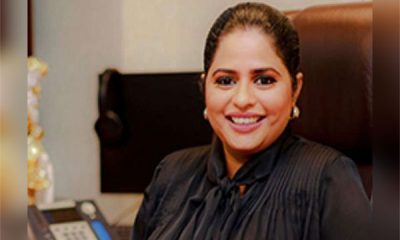








Former first lady Shiranthi Rajapaksa, wife of former President Mahinda Rajapaksa was produced before the Hulftsdorp court, after being arrested by officers of the Commission to Investigate Allegations of Bribery or Corruption (CIABOC) and produce
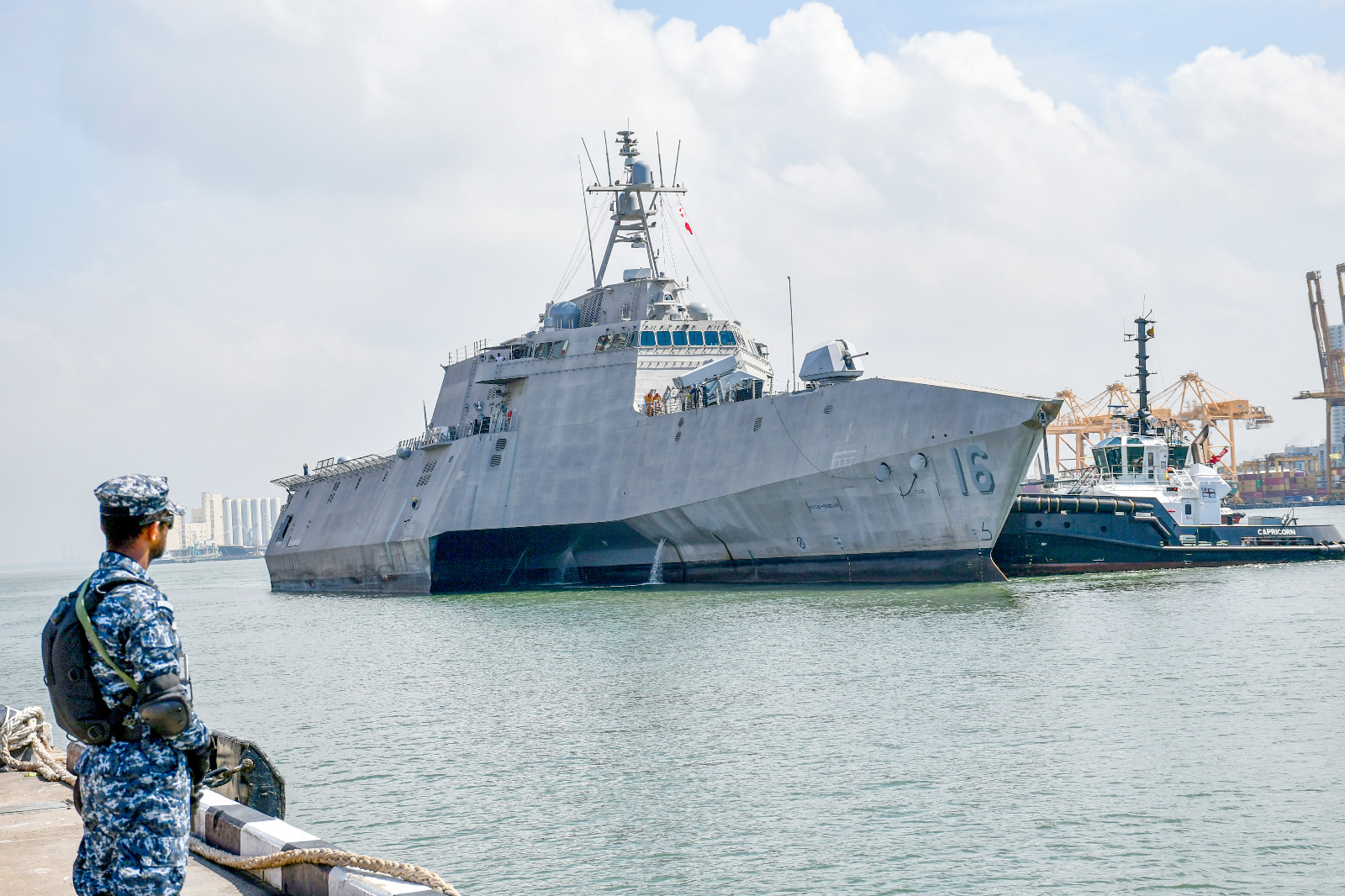
The U.S. Navy ship USS Tulsa (LCS 16) arrived at the Port of Colombo this morning, 7 October 2026 for replenishment purposes.
The visiting ship was welcomed by the Sri Lanka Navy in accordance with naval traditions.
The 127.7-metre-long platform is a Littoral Combat Ship commanded by Commander BM Wanier. Commissioned on 16 February 2019, USS Tulsa has since been in service with the US Navy.
The ship previously made a port call in Sri Lanka on 27 August 2025.
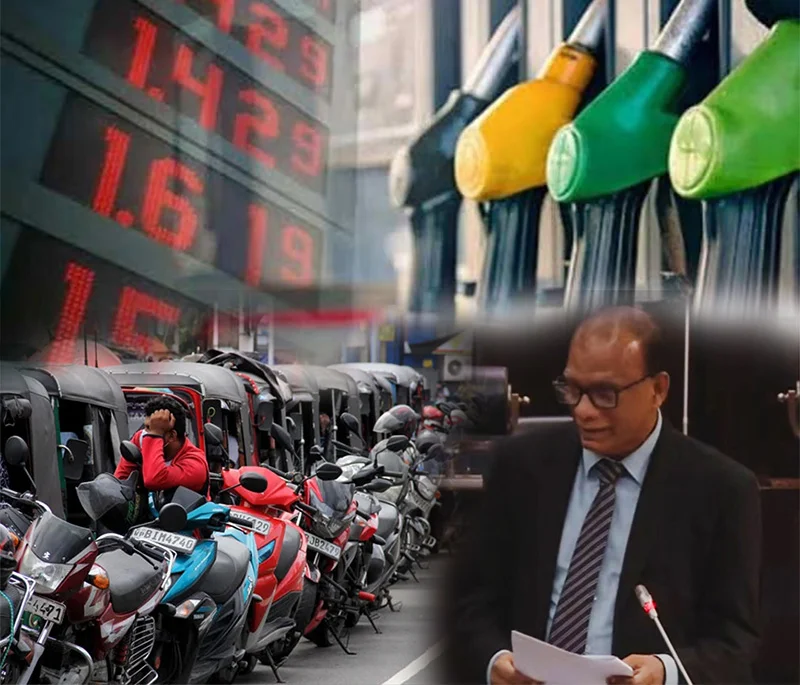
Govt. tells fuel distributors to maintain stocks to ensure uninterrupted supplies
by Saman Indrajith and Norman Palihawadane
The government had instructed private fuel distributors to maintain minimum stocks and ensure uninterrupted supplies to the market, Energy Minister Anura Karunathilaka told Parliament yesterday (06).
Karunathilaka said the Ministry of Energy Secretary had notified the relevant companies of the requirement, following a reduction in supplies by some private distributors, amid higher international fuel prices.
The Minister said private companies had informed the government that they were facing losses because international prices had risen while fuel was being sold, locally, at prevailing prices. As a result, some companies had reduced the volumes released to the market.
The reduced supplies had increased the burden on the Ceylon Petroleum Corporation (CPC), whose share of the diesel market had risen from about 54% to 82%, the Minister said.
“The CPC currently holds an 82% share of the market,” he said, adding that it had increased its supplies, compared with February, to compensate for the reduction by private distributors.
Karunathilaka said the government could not, under the existing agreements with private companies, specify the quantities they should supply to individual filling stations. However, it could require them to maintain minimum stocks in the country.
The Minister said the Energy Ministry had already instructed companies that had failed to maintain the required stocks to take steps to prevent supply disruptions.
The Minister attributed the queues reported at some filling stations to reduced supplies from private distributors, as well as normal variations in fuel distribution. He also said demand for CPC fuel had increased because private companies generally did not provide fuel to dealers on credit, while the CPC offered a three-day credit facility.
“We expect that, as the Ceylon Petroleum Corporation takes on this additional burden, the problem will ease to some extent by Wednesday or Thursday,” Karunathilaka said.
He said instructions had also been issued to increase supplies to CPC filling stations. A special discussion on the issue is scheduled for today (07), with officials of the Energy Ministry and CPC expected to participate,
along with President Anura Kumara Dissanayake.
Meanwhile, Petroleum Dealers’ Association officials have called for an early solution to the supply issue. Association Chairman D.V. Shantha Silva said queues had been reported at many filling stations, mainly those operated by private distributors.
He said the situation was not due to an overall shortage of fuel, but was linked to reduced orders by Lanka IOC, Sinopec and R.M. Parks amid concerns over losses incurred on fuel sales.
The Ceylon Petroleum Private Tanker Owners Association has urged motorists to refrain from panic buying, saying there was no nationwide disruption to fuel supplies.
The government earlier increased fuel prices and introduced a per-litre diesel subsidy following concerns raised by distributors over rising international prices.

Former first lady Shiranthi Rajapaksa arrested by CIABOC

U.S. Navy ship USS Tulsa arrives in Colombo for replenishment visit

Smriti Mandhana appointed India captain across formats

Ronaldo apologizes for Portugal walkout; says Jesus broke promise

Showers in the Western, Sabaragamuwa, Central, Uva, North-western and Southern provinces and in Anuradhapura and Mannar districts

Fuel crunch looms

‘Dates have the highest sugar content to fight Coronavirus’

Sunday Island 27 December – Headlines

#SundayIsland 17th December – Headlines

Sunday Island – 28th March

Sunday Island Headlines – 21 March

Sunday Island – 21st February – Headlines
-

 News7 days ago
US-assisted ‘Ice’ detection: NPC to examine IGP’s move to transfer drug-busting team
-

 Editorial6 days ago
Colombo Port drug bust: The plot thickens
-

 Editorial7 days ago
Drug busting, transfers and trust deficit
-

 Features4 days ago
The first woman in the foreign service or Ceylon Overseas Service it was then called
-
 News7 days ago
Sri Lankan facing death penalty in Saudi Arabia: Mano G appeals to Crown Prince
-

 Editorial5 days ago
Fuelling discontent and protest
-

 News3 days ago
Geneva takes up Sallay’s case and govt. ignores opportunity to answer accusations
-

 Latest News4 days ago
Tharindu Rathnayake, bowlers secure Asian Games Bronze for Sri Lanka