
Business
The US occupation of the Indian Ocean ‘Zone of Peace’

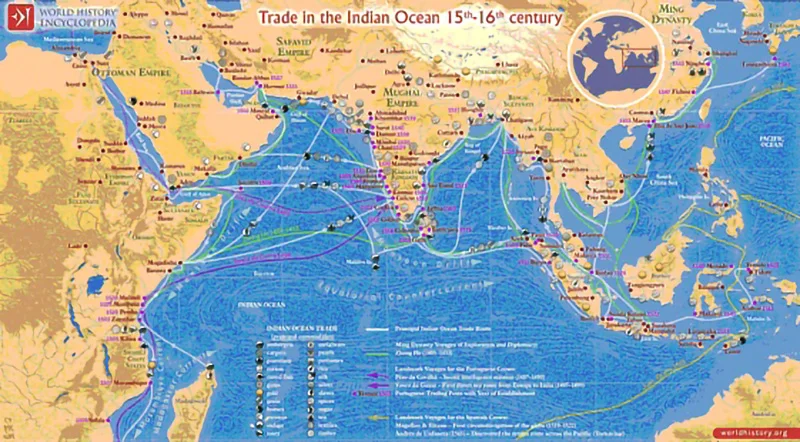
America’s war of choice on Iran has spread across the Indian Ocean World and maritime Silk Route. Starved of oil and gas South and Southeast Asia’s emerging economies have seen local currencies fall against the ‘exorbitantly privileged’ Petrodollar as public and private debt increased with soaring energy costs.
The US fifth fleet’s occupation and blockade of Indian Ocean trade routes targeting the Strait of Hormuz has shown the importance of the 1971 United Nations (UN) declaration of the ‘Indian Ocean as a Zone of Peace’ — for global security and prosperity.
55 years ago the United Nations General Assembly (UNGA) led by the world’s first woman head of state, Prime Minister Sirimavo Bandaranaike of Ceylon, declared the Indian Ocean a ‘Zone of Peace’. Resolution 2832 (XXV1) affirmed the vast Indian Ocean together with the airspace above and the subjacent ocean floor for all time a “Zone of Peace”.
The bold resolution by the world’s first woman head of state 55 years ago has never been more relevant: De-militarizing and de-colonizing the Indian Ocean in line with UNGA Resolution 2832 is vital to sustain and deepen the fraying 60-day peace pause between Iran and the United States brokered by Pakistan and Qatar.
The Indian Ocean World’s maritime Silk Route, where Iran, formally Persia sits, was the home of the world’s oldest and wealthiest sea-based trade system. For millennia the Silk Route of the Seas wherein the Straits of Hormuz is an integral part, connected the coastal regions and hinterlands of the Supercontinent of Asia with Africa and Europe– long before the US came into existence across the Atlantic Ocean in the “new world’.
European invaders of the Indian Ocean World fought bloody battles to access, control and colonize Indian Ocean sea lanes from the 17th century onward, much like the US today, which seeks to toll Indian Ocean shipping, wage hybrid economic warfare, and stymie the Asian 21st Century at this time.
Strategic islands and waterways like the Malacca Straits and Hormuz were vital to control of Indian Ocean supply chains and trade routes, in order to access and loot the great wealth of Asian civilizations, particularly, Persia/Iran, India and China.
Indeed, to this day the Indian Ocean remains to be fully de-colonized. Distant water fishing states or non-Indian Ocean countries, France, Spain, Japan, Taiwan PRC etc. are some of the biggest looters of Indian Ocean fishery with industrial trawler fleets according to data from the Indian Ocean Tuna Commission. Meanwhile littoral states fishery remains underdeveloped and “artisanal’; dependent on Foreign Aid for de-industrialization.
It was hence too that UNGA Resolution 2832 (XXV1) establishing the Indian Ocean Zone of Peace was spearheaded by the world’s first woman head of state, the Socialist Prime Minister Sirimavo Bandaranaike of Ceylon back in 1971 during the Cold War amid great power rivalry between the Soviet Union/Russia and the US.
Ceylon, now Sri Lanka is geo-strategically located at the center of the Indian Ocean World’s trade routes and supply chains. Hence, the county was perpetually in the cross-hairs of big power rivalry, and subject to neocolonial projects; most recently by the International Monetary Fund (IMF) which has upended economic sovereignty and Energy policy autonomy in the Eurobond debt-trapped country.
United Nations Mandate and IOZP
The Declaration of the Indian Ocean as a ‘Zone of Peace’ (IOZP), 55 years ago has never been more relevant to global security, growth and decolonization, which are Core Mandates, albeit seemingly forgotten at the UN.
The UNGA IOZP Resolution sought to ensure that the world’s busiest trade routes would be free of foreign bases, militarization, and nuclear weapons during the long Cold War between the US and Soviet Union/Russia. Big power rivalry had undermined development and de-colonization while driving proxy wars in Asia, Africa and South America.
Ceylon’s Sirimavo Bandaranaike was aided by stalwarts of the Non-Aligned Movement (NAM) and Global South: President Julius Kambarage Neyerere of the Republic of Tanzania in the western reach of the Indian Ocean later joined to co-sponsor UN Resolution 2832 (XXVI). It was a time of Afro-Asian, South-South cooperation.
India’s Prime Minister Indira Gandhi of the Congress Party was a close friend of Ceylon’s Bandaranaike and a supporter of Palestine, unlike the current pro-Israeli Modi regime in New Delhi.
UNGA Resolution 2832 called upon big powers to enter into consultations with the littoral States of the Indian Ocean with a view to halting escalation of their military presence, and to eliminate all bases, military installations and logistical supply facilities, nuclear weapons, and other weapons of mass destruction.
In the context, should not UN Secretary General Antonio Guterres invoke the IOZP at this time to aid and deepen the tenuous peace agreement between Iran and the US? However, Guterres has preferred to focus on twin global ‘polycrisis’ narratives- pandemic health and Anthropocene climate disinformation.
The IOZP Declaration was made when Burma’s U Thant was the highly respected UN Secretary General and Asian Buddhist Principles of Panchaseel (5 principle virtues in Sanskrit), underpinned NAM diplomacy. Indeed, the current UNSG would do well to call on US President Trump to remove the marine environment despoiling US fifth fleet “Armada” led by aircraft carrier Abraham Lincoln from the Indian Ocean in order to shore up the fraying peace agreement between Iran and the US at this time.
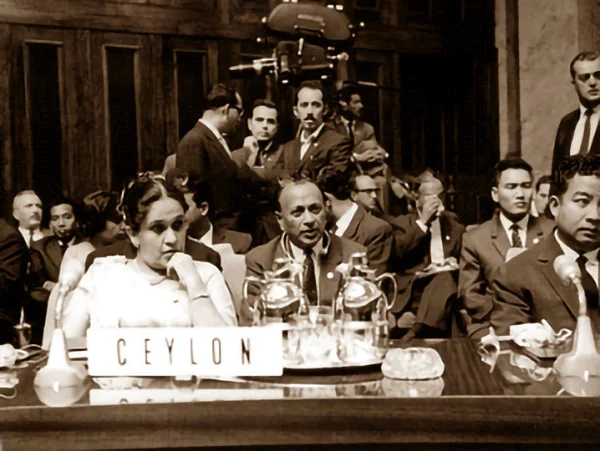
Prime Minister of Ceylon Sirimavo Bandaranaike speaks at the Belgrade Conference Non-Aligned Movement Archives (Yugoslavia)
TANJUG (Telegraphic Agency of the New Yugoslavia)
Priorities of the next UNSC: Return to Core Mandate amid New Cold War
The current US invasion and occupation of the Indian Ocean, far from America’s shores in the Atlantic and Pacific Ocean in order to blockade the Strait of Hormuz and starve Asian countries of energy violates UNGA Resolution 2832.
The US has used the rhetoric of a ‘free and open Indo-Pacific” and ‘freedom of navigation’ ironically to militarize and blockade Indian Ocean trade routes and reroute energy supply chains to control markets, benefit corporate interests and prop up the Petrodollar as the BRICS de-dollarize.
President Trump’s alternating sanctions on Russian and Iran oil seem designed to destabilize energy markets and sales. South and Southeast Asian countries meanwhile have been forced to buy expensive US oil and gas buttressing the Petrodollar, rather than source cheaper oil from Asian neighbours and pay in local currency.
It is vital that the US cease and desist from aggression and occupation of Indian Ocean trade routes and plans to levy tolls from ships in the Indian Ocean. Rather, the US Armada would best return to the Atlantic Ocean and where it came from, to restore the Indian Ocean as a’ Zone of Peace’ as envisaged by the world’s first woman head of state.
However, it appears that the legacy of Prime Minister Sirimavo Bandaranaike declaring the IOZP has been forgotten at the UN, ironically, even as its corridors buzz with debate on the gender/s of the next UN Secretary General as the current UNSG’s term thankfully draws to an end.
It is increasingly clear that the gender of the next UNSG is irrelevant to making the UN relevant again. What is clear at this time is that the next UNSG should be from the Global South and a strong voice for Economic Justice for the Global South. Likewise, the priority of the next UN Secretary general would be to Streamline the organization and its agencies, literally cull the fat, in order to focus on Core Mandates of de-colonization, peace and security.
Anxieties of the American Empire: Undoing Indo-Pac Com
The UN has evolved as a behemoth in recent times with proliferating development and humanitarian agencies funded and controlled by corporate interests wedded to Disaster Capitalism and the Deepstate. The current UN Secretary General Antonio Guterres meanwhile prefered to talk up ‘global polycrisis’ narratives of climate disaster that mask geoengineering and weather warfare, and health emergency while side stepping their real causes including awkward subjects like, Gain-of-Function research, Covid-19 origins in biowarfare labs, directed energy weapons and geoengineering for weather warfare in the fake Anthropocene.
A firm voice for peace, decolonization and Economic Justice for the Global South is needed from the august body and is solely missed the world over at this time. The UN seems to have abandoned its primary mandate of peace, security and de-colonization at this time.
By Darini Rajasingham-Senanayake

By Ifham Nizam
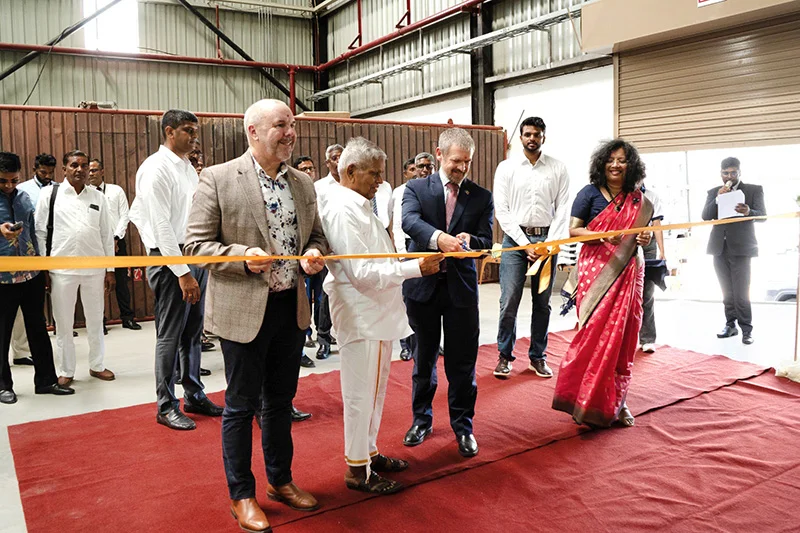
Australian High Commissioner to Sri Lanka Matthew Duckworth described Omega Traders’ latest investment in a modern dhal-processing facility as a strong example of how cross-border supply chains can translate into productive investment, local value addition and new business opportunities in Sri Lanka.
The investment, which adds a 150-metric-tonne-per-eight-hour-day processing capacity to Omega Traders’ operations, marks a significant expansion of the company’s manufacturing footprint as it celebrates 45 years in Sri Lanka’s food commodity industry.
Speaking at the inauguration of the new Lentil and Orid Dhal Processing Factory in Wattala, last Friday, H.C. Duckworth said the facility represented more than an increase in production capacity, pointing to the wider economic value created when Australian agricultural production is connected with Sri Lankan processing and distribution.
‘This facility is not operating on its own. It is part of a long supply chain and a trade partnership between Sri Lanka and Australia, Duckworth said.
His comments placed the Omega Traders’ investment within a broader commercial context: Australia brings agricultural production and established export capabilities, while Sri Lanka provides processing capacity, labour, market access and opportunities for further value addition.
The investment comes as Sri Lanka continues to look towards greater domestic processing and value-added manufacturing rather than relying solely on the import and distribution of finished commodities.
Dr. (Mrs.) Siddhika G. Senaratne, Director General/CEO of the Sri Lanka Standards Institution (SLSI), who attended the inauguration as Guest of Honour, highlighted the importance of quality assurance in food processing and the role of standards in maintaining confidence across the supply chain.
The facility is equipped with new-generation cleaning, processing, sorting and quality-control machinery, including advanced colour-sorting technology, automated systems and an in-house quality-control laboratory.
The additional capacity will support Omega Traders’ three principal Mysoor Dhal brands — Rainbow Jumbo Dhal, Komas Dhal and Rozanna Dhal — which serve different segments of the Sri Lankan market.
But the investment also has a distinctly local agricultural dimension.
Through its Orid Dhal operation, Omega Traders plans to source locally grown black matpe from Sri Lankan farmers and process it at the new facility.
That creates a domestic value chain linking farmers to industrial processing and consumers, while potentially increasing demand for locally produced agricultural commodities.
Duckworth said this type of business partnership could generate benefits for both countries.
‘Australia produces some of the world’s best agricultural products and we are very efficient and very capable at trading them. But that alone is not going to bring success to Australia. Just as building a factory like this is not going to bring success to Sri Lanka, he said.
‘It’s when we bring these entities together that our products produced in Australia can be processed in excellence here in Sri Lanka that enables this to be a success, the H.C. explained.
The investment therefore combines two complementary supply streams: imported agricultural commodities, including Australian-origin products, and locally produced black matpe for the Orid Dhal operation.
For Sri Lanka, the business significance extends beyond Omega Traders itself. Increased processing capacity creates demand for logistics, packaging, distribution, services and agricultural inputs, while supporting employment within the food-processing ecosystem.
HR-led transformation places people, culture and business performance at the heart of the organisation
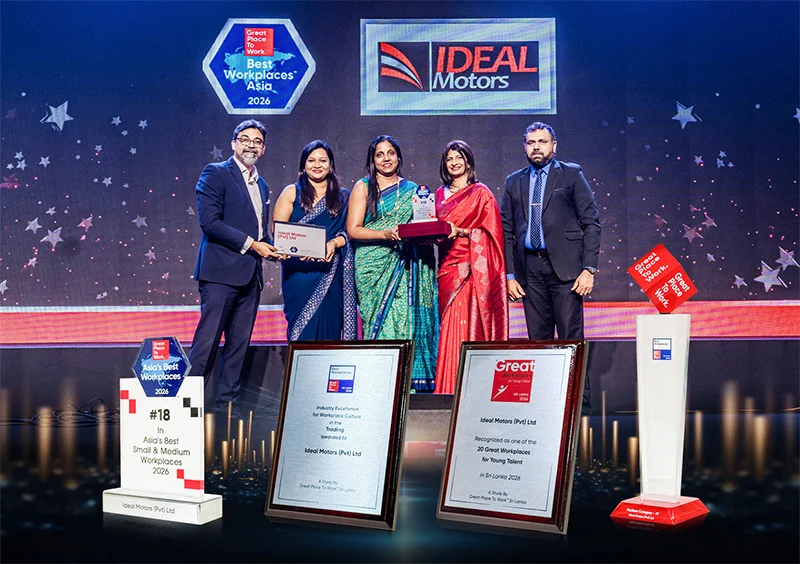
Ideal Motors (Pvt) Ltd,has achieved a significant milestone by securing multiple prestigious workplace and organisational culture accolades in 2026, reinforcing its position as an employer of choice in Sri Lanka’s automotive sector.
Among its latest achievements, Ideal Motors has been recognised as one of the 20 Great Workplaces for Young Talent in Sri Lanka 2026, ranked No. 1 and awarded the Gold Medal in the Small and Medium category of Best Workplaces™ in Sri Lanka 2026, and ranked No. 18 among Best Workplaces™ in Asia in the Medium Scale category—the highest-ranked Sri Lankan organisation in the category. The company also received Industry Excellence for Workplace Culture – Trading Industry.
The Young Talent recognition was presented at the Great Place To Work® CXO Forum 2026 held on 10 September 2026 at Cinnamon Life, Colombo. The recognition followed an evaluation of more than 100 certified organisations and highlights workplaces that create meaningful opportunities for employees under 35 to develop, contribute and grow.
At the Best Workplaces™ in Sri Lanka Awards Gala 2026, held on 11 September 2026 at Cinnamon Life, Colombo, Ideal Motors achieved another historic milestone by entering the Best Workplaces Sri Lanka list for the first time and securing the No. 1 Gold Medal in the Small and Medium category. The company also achieved No. 18 in Best Workplaces™ in Asia, reflecting the strength of its workplace culture beyond Sri Lanka.
These achievements represent more than a collection of awards. They reflect the transformation taking place within Ideal Motors, where people, culture and business performance are increasingly viewed as interconnected drivers of sustainable growth.
Over the past few years, the organisation’s HR function has evolved from a predominantly administrative role into a strategic business partner, with greater emphasis on employee experience, capability development, engagement, performance, communication, wellbeing, diversity and inclusion, and data-driven HR practices.

The Automobile Association of Ceylon (AAC) conducted a seat belt safety awareness programme in front of its headquarters and along Galle Face Centre Road, encouraging motorists and passengers to make seat belt use a habit on every journey.
AAC staff, working alongside officers of the Sri Lanka Police Traffic Division, distributed specially designed hanging tags and stickers to drivers. The material carries a clear reminder that seat belts protect drivers as well as passengers in both the front and rear seats.
The public awareness drive was held ahead of the requirement taking effect on 20 September 2026, under which seat belt use becomes mandatory for every occupant of a vehicle travelling on an expressway.
AAC emphasized that the regulation should be understood as a life-saving measure rather than only a legal obligation. Wearing a seat belt can help prevent occupants from being thrown inside or from a vehicle during a collision and can lessen the severity of injuries.
The Association said road safety legislation must be supported by sustained public education, visible enforcement and responsible behaviour by all road users. The participation of the Traffic Police helped the campaign reach motorists directly in a busy part of central Colombo.

Mandhana, Shafali and Ghosh lead dominant India to Asian Games gold

Fatima Sana and Umm-e-Hani secure bronze for Pakistan in Asian Games

India bat first in Asian games womens cricket final

Showers about 100mm will occur in the Western, Sabaragamuwa, Central and North-western provinces and in Galle and Matara Districts

Govt. confident of 2/3 majority despite NPP split speculation

Justice Corea appointed Acting President of the Court of Appeal

‘Dates have the highest sugar content to fight Coronavirus’

Sunday Island 27 December – Headlines

#SundayIsland 17th December – Headlines

Sunday Island – 28th March

Sunday Island Headlines – 21 March

Sunday Island – 21st February – Headlines
-

 News6 days ago
US embassy won’t comment on IGP’s probe into joint drug raid
-

 News5 days ago
Bid for Basil’s extradition nears final stage: Police
-

 News4 days ago
Shanakiyan urges urgent action over reported death sentence for Lankan in Saudi Arabia
-

 Business6 days ago
All-new Bolero MaXX unveiled in Sri Lanka
-

 News3 days ago
Namal Rajapaksa Buddhist gambit fails, bail denied
-
 Opinion6 days ago
A journalist who wrote across the divide
-

 Editorial7 days ago
More fuel price shocks shrouded in secrecy
-

 Sports7 days ago
MAS Holdings, official clothing sponsor of Sri Lanka team at Aichi–Nagoya 2026 Asian Games