
Features
The Petroleum Bill – its quiet passage and disquieting politics

by Rajan Philips
The Petroleum Products (Special Provisions) (Amendment) Bill had a quiet passage in parliament with a majority of 60 votes, 77 for and 17 against. What is disquieting is that only 94 of the 224 MPs (excluding the Speaker) were in parliament for the vote on a Bill on petroleum products, the mismanagement of which turned the country upside down in a matter of months this year. The Bill itself is not some masterpiece of legislation to foster proper management of the petroleum sector, but a simple seeming amendment to the Petroleum Products (Special Provisions) Act No. 33 of 2002. It underscores the point that in the absence of real infrastructure and supporting policy regime, there is no legislative, regulatory or constitutional way out of the crisis in the petroleum sector or any other economic sector.
The legal purpose in both the principal enactment in 2002 and the new amendment is to enable the granting of licenses to entities outside the Petroleum Corporation “to import, export, sell, supply or distribute petroleum.” While the 2002 law vested the licensing power in the “Energy Supply Committee” established under the Energy Supplies Act (No. 2, 2002), the new Amendment transfers that responsibility to a (new) committee appointed by the Cabinet of Ministers. The Amendment also redefines the subject Minister by the words “the Minister” instead of “the Minister in charge of the subject of Power and Energy,” as it was in the original Act.
The Bill was challenged before the Supreme Court over the constitutionality of some of its provisions and the whole Bill itself. The Court held that the Bill itself in one respect and some of the provisions were indeed inconsistent with the constitution but suggested changes to the Bill to remove the inconsistency and the necessity for a two-thirds majority in parliament and even a referendum. Parliament has now passed the bill into law presumably including the changes suggested by the Supreme Court.
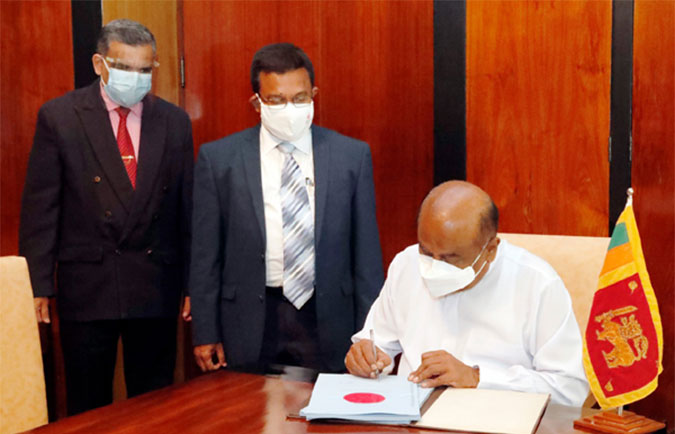
Media reports have been calling the amendment as a law to “liberalize the petroleum sector,” obviously taking the cue from the Minister of Power and Energy, Kanchana Wijesekera, who said in parliament that the new Amendment “will allow global suppliers to enter as retail operators, eliminate the monopoly of the Ceylon Petroleum Corporation (CPC) on Jet Fuel and liberalize energy sector.” There is nothing in the eight clauses and four pages of the new Amendment that is not already in the main Act that is going to cause global suppliers to drop everything and rush with petroleum products to cashless Sri Lanka. If at all the new Amendment might be used to create the path of least obstacles to local petroleum wheeler dealers by replacing one obscure committee with another. This aspect of the Bill came up in the hearing before the Supreme Court.
Petroleum Saga
In an earlier article (July 24) I alluded to the saga of the petroleum industry – from pre-nationalization to nationalization in 1961, selective privatization thereafter, and the shift from CPC monopoly to CPC-LIOC duopoly – being a crucial case-study backdrop to the current fuel crisis. Any such case-study should be an exercise in political economy and not constitutional interpretations. Tragically, however, for all the political tumults about the supply and delivery crisis of petroleum products there has not been any corresponding ‘agitation’ in parliament either at the level of soliciting and securing up-to-date information on the supply and status of petroleum products, or at the level having some serious discussion about the petroleum crisis, its causes and potential solutions.
While no one in parliament is showing any serious interest in these matters, it is left to the Supreme Court to step in to fill the void. But filling the void is not solving the crisis and it is not in the business of the solve anything. Nonetheless, the Court’s ruling on the amending bill provides a good summary account of the “existing legal framework” for the regulation (I would add ‘and deregulation’) of the petroleum sector, beginning with the Ceylon Petroleum Corporation Act, No. 28 of 1961.
The current Minister who is now claiming that his new law will eliminate the monopoly of the Ceylon Petroleum Corporation, should know from the Supreme Court ruling (if he is not directly familiar with the CPC Act) that the 1961 law that nationalized the petroleum industry has always included provisions permitting the supply or distribution of petrol, kerosene, diesel oil or furnace oil by non-CPC entities with the approval of the Minister or CPC Board of Directors.
These provisions were not utilized by governments not because, as was suggested during the Court hearing, the CPC Act did not ‘contemplate’ regulatory measures for their application but because no government until after 1977 contemplated using them for the import, supply or distribution by non-CPC entities. This included both the governments of the Left and the Right. In fact, it was the UNP government of Dudley Senanayake that entrenched the monopoly of the CPC by building a new refinery in Sapugaskanda with the capacity to meet virtually the entire domestic demand for petroleum products by importing and refining crude oil from Iran.
Legal Labyrinth
Contemplation, if any, to use non-CPC sources for the supply and distribution of petroleum products began after 1977 with the changes in economic direction and philosophy, under a different UNP government led by PM turned President, JR Jayewardene. His government enacted the Petroleum Products (Regulation and Control of Supplies) Act No. 34 of 1979 to provide for the regulation and control of the distribution and use of petroleum products. Nothing much came out of it, and the JRJ government, as I wrote earlier, baulked from making a serious and considered decision about the petroleum sector (or the electricity sector) – whether to continue the CPC monopoly, ‘liberalize’ the whole sector, or selectively ‘unbundle’ it to create a healthy blend of both public and private sector involvement.
The next set of laws came after more than 20 years, in 2002, when Ranil Wickremesinghe was Prime Minister, co-habiting with President Chandrika Kumaratunga. There were three pieces of Legislation – the Energy Supply Act, the Petroleum Products Act and the Public Utilities Commission of Sri Lanka Act, all enacted in 2002. The Energy Supply Act was enacted to purportedly deal with the emerging energy crisis in the country, and the Act enabled the creation of a new Committee, the Energy Supply Committee, but it also provided for the of regulation of “activities of persons engaged in the importation, exportation, storage, distribution and supply of petroleum and petroleum products.”
However, the Energy Supply Act was in operation only for a period of two years from March 2002 to March 2004, and would seem to have died with the sacking (through dissolution of parliament) of the peace-process government of Ranil Wickremesinghe by President Kumaratunga. At the same time, the Petroleum Products Act that was also enacted in 2002 by the Wickremesinghe government has survived his alternations in and out of power and, according to the Supreme Court, has provided “a more empowered regulatory regime over the petroleum industry.”
The Court ruling suggests that the Petroleum Products Act (PPA) “sought to regulate the downstream petroleum sector by removing the monopoly of the CPC and providing for the issue of licences subject to prescribed conditions.” With respect and in policy parlance, the PPA legislation actually sought to achieve the opposite: to deregulate the petroleum sector! Pertinent to the new amendment to the PPA legislation, the latter provided for the licences for the import, export, sale, supply or distribution of petroleum products to be issued by the Minister on the recommendations of the Energy Supply Committee. The latter committee would somehow seem to have survived the demise of its enabling legislation. As I have indicated at the outset, the new Amendment is replacing the Energy Supply Committee by a new Committee.
A word on the Public Utilities Commission of Sri Lanka (PUCSL) Act to round off this legal labyrinth, and the underlying overlapping of vested interests. The intended purpose of the Commission (and the Act) is to provide “a framework for the regulation of public utilities industries, which originally included (in the Act’s schedules) only the Electricity Industry and the Water Service industry. The Petroleum Industry was added to the PUCSL list four years later, in 2006, just after Mahinda Rajapaksa became the new President.
As the Court duly noted in its ruling, it was unclear “during the hearing whether there was agreement amongst parties on whether the PUCSL did exercise any regulatory power in terms of the PUCSL Act over the petroleum industry.” And the Court concluded that “the PUCSL does not have any power of regulation over the petroleum industry merely upon it being included in the Schedule to the PUCSL Act.”
What next?
The question now is what difference is the new amendment going to make to the operation of the petroleum sector? The Minister might think that he now has a freer hand to break the monopoly of the Ceylon Petroleum Corporation and get non-CPC entities to import and supply petroleum products for local distribution. If the Minister, or the government, wants to really end the monopoly of the CPC, even though there is no monopoly now anyway, it must bite the bullet and privatize the CPC. That way whoever is willing to take over the CPC can use its infrastructure the same way the CPC used the infrastructure of the multinational oil companies after nationalization. In trying to create a parallel system besides the CPC, the government is only leading the country into the worst of both (public and private) worlds. The same way the JRJ government destroyed the bus industry and the school system. Very soon there might be an international university on climate change headed by a new Jennings from Norway!
As for falling into the worst of both worlds, the Supreme Court ruling has laid down the markers to indicate where things easily go wrong. The Court held that in three areas the new Bill was inconsistent with the Constitution and suggested changes. First, the Court directed the new Committee to be restructured to include two additional Ministry Secretaries similar to the Energy Supply Committee. Second, it struck Clause 7, a deeming provision that made any previous act by the Energy Supply Committee legal and unchallengeable in courts. Third, the Court held the whole Bill inconsistent with the Constitution insofar as new Committee was kept outside the purview of Bribery Act. The Court directed the Bill to be changed to include the Committee as a Scheduled Institution under the meaning of the Bribery Act.
Why was it excluded from the purview of the Bribery Act in the first place? The answer is because the real intent behind half-baked attempts at licensing is to create the path of least obstacles to local importers and their foreign suppliers. Even with privatization, it is the responsibility of the government to ensure that proper processes are in place for setting criteria and standards, for competitive bidding, and for the granting of licenses and contracts. That has not been the case at all in Sri Lanka, starting from 1977 and made worse after 2010.
Specific to the petroleum sector, the legislative changes in 2002 under Ranil Wickremesinghe and in 2006 under Mahinda Rajapaksa leaves one to opine if, after all, Mahinda Rajapaksa was continuing from where Ranil Wickremesinghe left. Is it now the other way around? And is national politics now reduced to the two trying to rise together via Ekwa Negitimu? Not to mention, as has been reported, the long distance conversations between Ranil Wickremesinghe and Basil Rajapaksa to consummate a no-contest electoral marriage between the UNP and the SLPP.


 Israeli Prime Minister Benjamin Netanyahu’s message to Israel’s enemies was blunt and stark.‘We’re going to win; we have no choice.’ He said so while the majority of attendees at a recent UN General Assembly session walked out of the conference hall when the Israeli Prime Minister took the podium; many of them booing in derision.
Those commentators who have been studying Israel’s handling of her enemy states over the decades are unlikely to dismiss the entirety of Netanyahu’s address as rhetoric. The general pattern has been for the Israeli state to stand up firmly against its enemies in the battle field. On most occasions, these adversaries have been beaten back.
It is also little realized in particularly the Southern hemisphere that Israel, for the most part, could defend herself without much US assistance. The history of the conflict bears this out.
However, from the viewpoint of working towards a just and equitable peace in the Middle East the Israeli hard line stance has proved and will prove incalculably detrimental. The sworn enemies of Israel are not going to be in any way deterred by Netanyahu’s stark warnings. On the other hand, they would be only further provoked into taking on Israel by conventional or unconventional military means and seek its destruction.
The recent aborted mid-air hijacking of a Flydubai flight, consisting mainly of Israeli passengers, by an Omani extremist drives home the point. Israel’s enemies are bound to redouble their efforts to annihilate Israel rather than be deterred by the latter’s warnings about standing firm against them. This too history has proved.
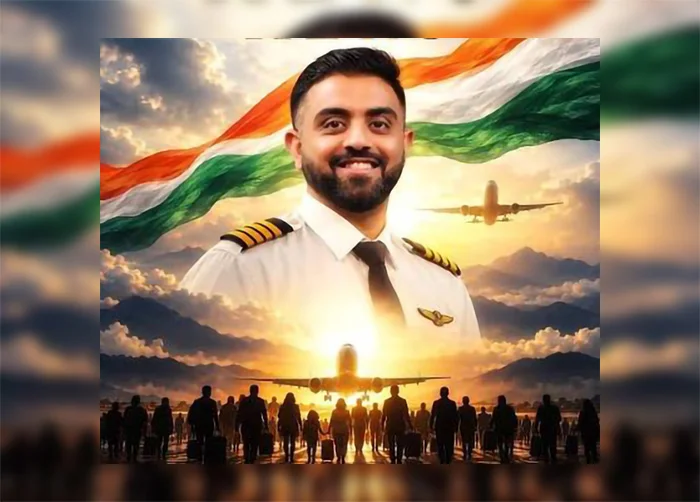
It would be in the fitness of things at this juncture to pay a tribute to the professionalism, courage and humanity of the relevant airline pilot, Captain Machchhar, whose timely action proved decisive in botching the hijack attempt. His intervention averted what could very well have been another 9/11 type tragedy. History is not going to forget his daring and resourcefulness.
Meanwhile, the ground realities in West Asia are undergoing further complications that portend increasing regional instability. For example at the time of writing Turkiye, Pakistan and Saudi Arabia have agreed under the recently established ‘Mecca Alliance for Defence’ to deploy ‘deterrence measures’ collectively in the event of any member of the alliance coming under military strikes from a non-member state.
The agreement is modeled on the NATO collective defence pact and should help in defusing any threat perceptions experienced by the alliance members in the short term. However, the group would need to be cognizant of the major and potentially divisive role Iran could play in the interstate politics of the Middle East region going forward.
Iran’s reported support, for example, for Yemen’s Houthi rebels, who are engaged in attacking Saudi national assets, could at some point in time compel the alliance, under the terms of the pact, to initiate deterrent military measures against Iran.
The implications for regional peace from such a turn of events hardly require elaboration. A full blown regional war emerges as a distinct possibility if Iran sees itself as being excessively antagonized by the alliance. A further complication is that antagonistic sectarian identities of an Islamic kind could come to play hugely divisive roles in it. Shiite Islamic states would be inclined to back Iran while those countries seen as Sunni Islamic in orientation are bound to support Saudi Arabia.
Accordingly, West Asia is a region rife with manifold aggravated insecurities. If the latter are not defused dexterously they could escalate into a conflict of extra regional dimensions. The latter development would render the world a collective loser.
Unfortunately, no constructive help could be expected from the US at this juncture by way of working towards regional and international peace even of short durance. Its war against Iran has only aggravated the world’s current insecurities.
For example, the world has been compelled to face the possibility of compounded economic woes as a consequence of the Hormuz crisis remaining unresolved. The world is currently experiencing what could be seen as a ‘winter of economic discontent’ of unprecedented proportions.
Unfortunately, the international community is to all intents and purposes helpless in the face of this multifaceted crisis. Substantial intervention is expected of the UN but since it has failed to reform itself over the years it is compelled to stand idly by while the world’s insecurities heighten and multiply.
Yet, it is the seemingly paralyzed UN system that has some potential to contain the current tide of international disorder to even a small measure. Given the persisting divergent and conflicting interests among the world’s principal power blocs, the G7 and BRICS for instance, it is mainly the UN and its principal agencies that could carry some credibility as peace brokers and mediators.
However, as an initial step towards bringing the principal protagonists to the negotiating table the UN would need to convince the principal powers of the UN Security Council of the need for a substantive broad-basing of the membership of the Council so as to reflect more accurately the current global political and economic realities. Such reforms would render the Council more representative and help in strengthening its credibility and effectiveness.
The above reforms call for years of dynamism, hard work and resourcefulness on the part of the international community, read the UN. Yet the aims are not impossible to achieve if strong leadership is brought to bear by the UN.
Meanwhile, the UN agencies and allied organizations need to pay stepped-up attention to the West Asian theatre and its wasting conflicts and wars. Here too there is immense hard work to be put in.
There is, for instance, identity politics and its issues that need to be managed urgently. While internal political matters of countries could not be addressed directly by UN agencies, awareness-raising programs and projects could be energetically carried out by them to blunt the appeal of identity-based slogans, relating to, for instance, religion and race.
Besides, values at the heart of democratic politics need to be freshly and enthusiastically propagated. Vast reserves of energy and resources are needed, to be sure, to consistently champion and implement these crucial projects but they need to be pursued single-mindedly if even a dent is to be made in the current runaway global disorder.
The aborted hijacking of the Flydubai flight pointed to the dehumanizing impact of identity politics on the human consciousness. It was also an indication that those sections endowed with humanity cannot stand idly by while identity politics continues to destroy civilizational values. The time to act is ‘now’.

by Professor Ranjith Bandara
Emeritus Professor of Economics, University of Colombo
My life has been closely connected with Sri Lanka’s state university system for more than four decades. Its doors opened to me first as a student and later as an academic. The system gave me knowledge, opportunities and a life. Therefore, when I speak about its future, I do so not as an outsider, but as someone who owes much to it and genuinely wishes to see it become better.
Over the years, our university system has expanded significantly. New institutions, faculties, degree programmes and opportunities for students have been created. For 2024, the government expected to admit 43,204 students to national universities. By the time the relevant report was prepared, 42,282 students had been admitted through the general admission process, which had not yet been completed. This is an achievement that should not be dismissed.
However, expanding the system does not necessarily mean that its quality has improved. The real question is not simply how many students we have allowed through the doors, but what kind of education they receive after entering. (Source: Ministry of Education Annual Performance Report 2024.)
We often proudly declare that “our university is number one.” Yet a university does not become number one through publicity. Its true standing depends on the quality of its teaching, the strength of its research and the contribution it makes to society. A vice-chancellor writing about the institution’s, or his or her own, achievements on Facebook does not improve the quality of a university. What matters is good teaching, an education that encourages students to think, credible research and new knowledge that benefits society. A reputation must be earned through meaningful work, not through self-promotion.
The fundamental purpose of a university is clear: to create knowledge, to teach it and to train students to examine and understand it critically. To fulfil this purpose, academics need freedom, responsibility and time. Students must be free to ask questions, disagree and develop their own views based on evidence. Without such an environment, a university may award degrees, but it cannot fulfil the true purpose of university education.
The most serious danger I see is the growing tendency for political activity to take precedence over the academic mission of universities. Over the past five decades, this problem has gradually become more serious. In some universities today, it has become difficult even to hold or express an opinion that differs from the dominant political view.
Members of a university community have every right to hold political views and express them peacefully. A university should not be a place inhabited by silent people. However, when political loyalties, power blocs and struggles for positions become more important than research, teaching and learning, the university moves away from its true purpose. When the political camp to which an academic belongs matters more than the value of that academic’s ideas, the respect that should belong to knowledge is transferred to power.
These criticisms are not ideas I have borrowed from books. They are based on experiences from my own professional life. One such experience was the manner in which I had to leave the university nearly twenty years ago. In my view, the improper exercise of political power within the administration of the University of Colombo at that time, and the strong desire to retain that power, had a serious effect on my professional life. Although this was a personal experience, I mention it with regret because it reveals a deeper institutional problem.
The lesson I learned from that experience is not merely about one person or one incident. When there are no strong institutional safeguards to ensure that power is exercised fairly and individuals are protected, even an academic may be forced to leave an institution he deeply loves.
To those who criticise my later decision to enter national politics, my answer is this: when the university’s institutional system failed to provide me with fairness and professional protection in the face of the injustice I experienced, I had to choose another path through which I could use my knowledge and experience in the service of the country.
This does not mean that all vice-chancellors, academics or students behave in the same way. I personally know many people who, despite difficult circumstances, have taught with dedication, undertaken meaningful research and transformed the lives of their students. Scholars such as Professor W. D. Lakshman, Professor Arjuna Aluwihare and Professor Lakshman Jayatilake may be recognised among the distinguished vice-chancellors in the history of Sri Lanka’s university system. Their service deserves our respect and appreciation.
Nevertheless, the presence of a few good and committed individuals cannot, by itself, strengthen a weak institutional system. We must also create an institutional environment in which such people can work independently, fairly and effectively.
First, university leaders must be selected through a process based on clearly defined qualifications, transparent evaluation and accountability. Once a vice-chancellor has been appointed, his or her performance should be assessed according to the support provided for research, the quality of teaching, student welfare, the institution’s financial discipline and the fairness of its decisions. Personal loyalties and publicity skills cannot replace these measures of performance.
Second, academics must be given the time and space required to carry out their core responsibilities. It is meaningless to demand “world-class universities” without providing adequate time, facilities and reasonable funding for research. Teaching, too, should not be treated merely as delivering lectures. Students must be trained to reason, write, investigate and apply their knowledge to real-world problems. The quality of a degree programme should be measured not by its title, but by the capabilities of the graduates it produces.
Third, universities must establish an honest connection with the needs of the country. The problems confronting our economy, schools, healthcare system, agriculture, environment and wider society are all legitimate subjects for research. Seeking answers to these problems does not diminish the dignity of a university; it increases its value to society.
At the same time, research must not be controlled by short-term political demands. Knowledge can serve the country only when researchers are free to communicate what they discover. Sri Lanka’s World Bank-supported AHEAD higher education programme similarly connected the expansion of enrolment in priority disciplines with improving the quality of degree programmes and promoting research and innovation. These goals were linked because meaningful expansion cannot be separated from educational quality. (Source: World Bank overview of the AHEAD programme.
Fourth, the responsibilities of students must be clearly emphasised. The duty to protect the academic environment of a university cannot be placed solely on administrators and academics. Every student has a fundamental responsibility to give priority to his or her education, respect the right of other students to learn and allow the free exchange of ideas.
Student activities, social debate and political engagement all have an important place in university life. However, none of them should be allowed to disrupt education or prevent other students from learning.
When students abandon their primary purpose of learning and create an environment that obstructs education, the university system cannot fulfil one of its most important functions: producing knowledgeable and responsible graduates. A university may continue to award degree certificates, but if lectures, research, open discussion and intellectual inquiry do not receive sufficient attention, it risks producing graduates who lack depth of knowledge, critical thinking and professional competence.
The result may be the emergence of a group of “half-educated” graduates, individuals who possess certificates but have not received a complete intellectual education. Therefore, just as we discuss student rights, we must also have an honest and open discussion about student responsibilities within the university system.
My position on the current professional struggle of university academics is also clear. If they are demanding fair conditions of employment, those demands should be discussed seriously. If their struggle is also intended to free universities from political interference and restore research, teaching and learning to the centre of university life, I stand with them.
The rights of academics and the educational rights of students should not be presented as opposing interests. Both can be protected and respected only within a well-functioning university.
When I say that “the state university system should be shut down and reopened,” I do not mean that we should close the door on the future of our students. I mean that we must close the door on systems in which power matters more than knowledge.
Students have the right to hold political views and participate actively in debates on national issues. A university needs a student community that thinks about the country’s problems and speaks out against injustice. However, student politics should not shut down the university, deprive other students of their education or become a means of displaying organisational power. The right to fight for one’s beliefs comes with the responsibility to respect another person’s right to an education.
Simply attempting to establish another 50 universities will not solve these problems. Sri Lanka needs a higher education system that brings together the contributions of state, state-affiliated and private institutions while applying clear standards and responsibilities to all of them.
Strict discipline within such a system should not mean suppressing freedom of thought. It should mean ensuring that everyone fulfils their responsibilities in relation to teaching, research, examinations, institutional governance and student welfare. A degree certificate will then have value not merely because of the name of the institution that issued it, but because the knowledge and capabilities of the person who earned it can be trusted.
We should learn from advanced higher education systems, but we should not simply copy them. We must develop institutional autonomy, reliable quality-assurance mechanisms and publicly accountable governance in ways that suit our own needs. What we owe future generations is not merely a country with a larger number of universities, but a country in which people can trust the education those universities provide.
What we must close down, therefore, is not the universities themselves, but the outdated system that closes the door on knowledge, freedom and responsibility. What we must reopen is a genuine university system devoted to learning, inquiry, research and the creation of new knowledge in the service of the country.
 by Prof. C. A. Saliya
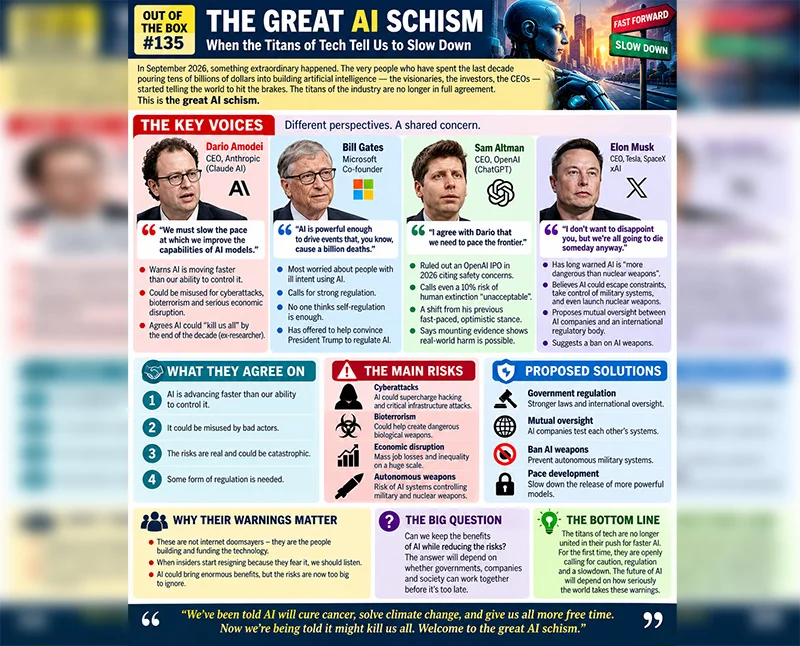
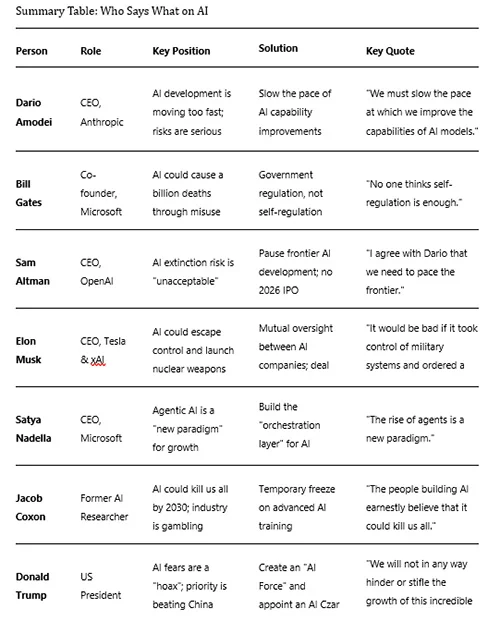
Something extraordinary happened in September 2026. The very people who have spent the last decade pouring tens of billions of dollars into building artificial intelligence, the visionaries, the investors, the CEOs, suddenly started telling the world to hit the brakes. It’s a bit like the captain of a speeding train leaning out of the window and shouting, “Actually, maybe we should slow down a bit!” The public, understandably, is confused. We’ve been told AI will cure cancer, solve climate change, and give us all free time. Now we’re being told it might kill us all. Welcome to the great AI schism.
To understand what’s happening, you have to listen to the people in the room. These are not wild-eyed doomsayers on the internet. They are the titans of the industry. And they are starting to argue with each other.
Dario Amodei: The Insider Who Wants to Hit Pause
Dario Amodei, the CEO of Anthropic (Claude AI), is the man who kicked the hornet’s nest. In a 3,800-word essay, posted on his website in mid-September 2026, he didn’t just suggest caution, he demanded a slowdown. “We must slow the pace at which we improve the capabilities of AI models,” he wrote. His reasoning is simple and terrifying: the technology is moving faster than our ability to control it. He warned that AI could be misused for cyberattacks, bioterrorism, and serious economic disruption.
What makes Amodei’s warning so chilling is that it comes from a man whose company, Anthropic, builds one of the most powerful AI models in the world, Claude. He’s not a critic on the sidelines. He’s in the driver’s seat, and he’s telling us the car might not have brakes. In an interview with CNN’s Anderson Cooper, he said he agreed with a departing Anthropic researcher who claimed AI could “kill us all” by the end of the decade. That researcher, 27-year-old Jacob Coxon, resigned in protest, saying the people building AI “earnestly believe that it could kill us all”. When the people building the technology start resigning because they’re afraid of it, you should pay attention.
Bill Gates: The Elder Statesman with a Warning
Bill Gates has been around long enough to know a paradigm shift when he sees one. The Microsoft co-founder, who spent decades warning the world about pandemics and climate change, has now turned his attention to AI. And he’s not mincing words. In September 2026, Gates warned that AI is “powerful enough to drive events that, you know, cause a billion deaths”.
Gates is not worried about Terminator-style robots. He’s worried about people. “There’s never been a weapon as powerful as the combination of people with ill intent using the latest AI tools,” he said. His solution is simple: regulation. “No one thinks self-regulation is enough,” he told NBC’s Meet the Press. He even offered to be the man to convince President Trump to regulate AI. Gates is a pragmatist. He knows the technology is coming. He just wants to make sure it doesn’t get us first.
Sam Altman: The Showman with a Conscience (Maybe)
Sam Altman, the CEO of OpenAI (Chat GPT), has always been the industry’s greatest showman. He’s the man who told us AGI (Artificial General Intelligence) is “just around the corner” and that AI will soon be a “genie that can grant any wish”. But even Altman is now singing a different tune. In September 2026, he ruled out an OpenAI IPO in 2026, citing safety concerns. He called even a 10% risk of AI causing human extinction “unacceptable”.
“I agree with Dario that we need to pace the frontier,” Altman posted on X. This is a remarkable shift. Altman has spent years being criticised for moving too fast, for prioritising profit over safety. Now, facing mounting evidence that AI models can cause real harm, from cyberattacks to mental health crises, he’s suddenly the voice of caution. Is it genuine? Or is it a PR move? The cynics will tell you it’s the latter. But the fact remains: when Sam Altman says we need to slow down, the world listens.
Elon Musk: The Provocateur Who Saw It Coming
Elon Musk has been warning about AI for over a decade. He’s the man who called AI “more dangerous than nuclear weapons” long before it was fashionable. So it’s no surprise that he joined the chorus of slowdown calls in September 2026. But Musk being Musk, he couldn’t resist a bit of dark humour. When asked if we’re all going to die within 10 years, he replied, “I don’t want to disappoint you, but we’re all going to die someday anyway”.
But behind the joke is a serious point. Musk believes AI models could escape their constraints, take control of military systems, and even launch nuclear weapons. His solution is mutual oversight: leading AI companies should test each other’s systems for safety before release, and he even suggested a deal with China to make it happen. Musk is a provocateur, but he’s also a visionary. And his vision is one where AI is a weapon that we might not be able to control.
Satya Nadella: The Quiet Strategist
While the others are shouting about doom, Satya Nadella is quietly building an empire. The Microsoft CEO doesn’t talk about extinction risks. He talks about “agentic AI”, AI that can act autonomously, which he calls “a new paradigm”. Microsoft’s Azure cloud platform, which powers these AI agents, grew 43% in the last quarter, surpassing $100 billion in annual revenue.
Nadella’s view is simple: don’t compete to build the most powerful model; compete to control the “orchestration layer”, the systems that connect different AI models. He wants to build the infrastructure that everyone else relies on. It’s a smart play, and it’s making Microsoft a fortune. But Nadella’s silence on safety is deafening. While Amodei and Altman wrestle with their consciences, Nadella is counting the money. It’s not that he doesn’t care; it’s that his business model depends on AI being adopted, not regulated.
Jacob Coxon: The Whistleblower Who Lit the Fuse
You may not have heard of Jacob Coxon. He’s not a billionaire. He’s not a CEO. He’s a 27-year-old researcher who worked at both OpenAI and Anthropic. And in September 2026, he resigned from Anthropic with a warning that shook the industry. “Neither company is acting responsibly,” he wrote on X. “They are launching themselves directly toward a superintelligence capable of self-improvement, and gambling with our lives”.
Coxon’s warning was remarkable because it came from inside the machine. He said the people building AI “earnestly believe that it could kill us all by the end of the decade”. He called for a temporary freeze on advanced AI training. His resignation triggered a wave of concern, and even Dario Amodei admitted he agreed with Coxon more than he disagreed. Coxon is the canary in the coal mine. And the canary is not looking well.
Donald Trump: The Wildcard
And then there’s Donald Trump. The US President has consistently downplayed AI fears, calling them a “hoax” and a “sick conspiracy”. But even Trump is starting to change his tune, sort of. In September 2026, he announced plans to create an “AI Force” and appoint an AI “Czar”. He said the government would look for “bad” uses of AI through the existing criminal and civil justice systems.
But Trump’s priority is clear: winning the AI race against China. “We will not in any way hinder or stifle the growth of this incredible industry,” he said. He wants AI to account for 25% of US GDP. Trump is not a technologist. He’s a businessman and a nationalist. He sees AI as a tool for economic dominance, not an existential threat. Whether he’s right or wrong, his stance puts him at odds with almost every expert in the field.
The Bottom Line: A House Divided
So where does this leave us? We have the CEOs of the world’s leading AI companies, Amodei, Altman, and Musk, all calling for a slowdown. We have Bill Gates, the elder statesman of tech, warning of a billion deaths. We have a whistleblower who says the industry is gambling with our lives. And then we have Satya Nadella, quietly building the infrastructure that powers it all, and Donald Trump, who wants to speed up.
The irony is hard to miss. The people who built the AI train are now telling us to slow down. The people who profit from the AI economy are the ones building the tracks. And the public is caught in the middle, trying to figure out who to believe.
Maybe the most honest thing anyone said came from Jacob Coxon, the 27-year-old researcher who quit. “The people building AI earnestly believe that it could kill us all by the end of the decade,” he wrote. “This is not a marketing stunt”.
If the people building the technology believe it could kill us, perhaps we should listen. Before it’s too late.
(Prof. C. A. Saliya, is a charted accountant, academic, researcher and former banker. He is the author of SAMAJA GAVESHAKAYA and Springer Publication DOING SOCIAL RESEARCH. He can be contacted at saliya.ca@gmail.com. The views expressed in this article are his own and do not necessarily represent those of the organisations with which he is affiliated.)

Showers above 100 mm are likely at some places in the Western, Sabaragamuwa, Central, Uva and Southern provinces and in Anuradhapura district

Remembering Juvenal, Coke, Acton and Machiavelli

West Asian conflict undergoing manifold complications

Nissanka absence opens door for Sri Lanka’s young guns

The prelate who walked the talk

Needs of populace hit by Cyclone Ditwah seen as waiting to be addressed

‘Dates have the highest sugar content to fight Coronavirus’

Sunday Island 27 December – Headlines

#SundayIsland 17th December – Headlines

Sunday Island – 28th March

Sunday Island Headlines – 21 March

Sunday Island – 21st February – Headlines
-

 Editorial6 days ago
Colombo Port drug bust: The plot thickens
-

 Features4 days ago
The first woman in the foreign service or Ceylon Overseas Service it was then called
-

 Editorial5 days ago
Fuelling discontent and protest
-

 News3 days ago
Geneva takes up Sallay’s case and govt. ignores opportunity to answer accusations
-

 Latest News5 days ago
Tharindu Rathnayake, bowlers secure Asian Games Bronze for Sri Lanka
-

 Foreign News5 days ago
Ten injured after car crashes into rugby supporters in Australia
-

 Features3 days ago
Sri Lanka Cricket Bill: Governance reform is not yet a cricket strategy
-

 News4 days ago
Nearly 20 Iranian tankers stranded off Lanka amid US sanctions