
Sports
The need to treat legends with dignity


by Rex Clementine
The scathing remarks of Professor Charitha Herath during a COPE hearing pertaining to Sri Lanka Cricket exposed severe deficiencies in our cricket administration and the public could get a firsthand experience of how poorly the sport has been run as SLC took on former great Chaminda Vaas earlier this week.
Rather than sorting matters out behind closed doors, like it happens in professional environments, SLC opted to wash dirty linen in public and did not adhere to the best of corporate practices.
When the national cricket team’s Fast Bowling Coach David Saker left Colombo in January without informing his employers, SLC treated the Aussie with kid’s gloves. The board even didn’t mind going for an amicable settlement. Saker is a proven coach and SLC needs to be commended for the way they handled matters.
However, two weeks later, they were on the war path with another fast bowler – Chaminda Vaas. Was Vaas treated in that way because he is a local?
SLC paid Saker US$ 15,000 a month. They pay Vaas only US$ 3500. That is not correct. Vaas only asked for US$ 5000 more. But SLC made to look as if he was asking for the pound of flesh.
Interestingly, the decision that Vaas will replace Saker for the tour of West Indies was taken in the second week of February. But SLC had little communication with Vaas. Instead, they issued a media release announcing his appointment. But, the terms and conditions had not been discussed as it would happen in a professional environment.
Vaas was officially informed only on Friday, 72 hours before the team left for the Caribbean.
In previous instances when other coaches had to come in as replacements, SLC had compensated them handsomely. Nic Pothas is an example. When he replaced his former mentor Graeme Ford as Head Coach in 2017, the board paid him well. So why not Vaas? Again it’s back to square one. Is it because he was a local? Black lives do matter.
What Vaas wanted was a raise of his daily allowance from US$ 75 to US$ 200. What it meant was a raise of US$ 5000 for the entire tour of the Caribbean. But SLC chief Shammi Silva was not willing to negotiate. He would not budge an inch from his stance, which was go on the tour and come back and then we shall negotiate. Rather than taking the nation’s most successful fast bowler head on, Silva could have been better off had he handled matters diplomatically. But he did not. It has been claimed that he refused to meet Vaas. SLC has denied.
SLC officials claimed that they were willing to pay Vaas a sum of Rs. 750,000 on his return from the trip. Although it is slightly less than what Vaas had asked for, the former fast bowler would have been foolish to turn down that offer. Here’s the next interesting question. There have been several e-mail exchanges between Vaas and SLC. Did in any of those exchanges SLC mention that he will be paid the said Rs. 750,000?
There have been similar crises in cricket before. There are individuals within SLC who have handled matters completely differently.
Jayantha Dharmadasa was President of SLC when suddenly the selectors decided to fly in Sanath Jayasuriya as an additional player to England in 2006. The team and in particular Head Coach Tom Moody resisted. Dharmadasa intervened and drove home the point that having Jayasuriya in England early could turn out to be productive as he could acclimatize and be ready by the time the limited over games come. True to form Jayasuriya was in red hot form and slammed two hundreds in the ODIs and was named Player of the Series as Sri Lanka completed a 5-0 drubbing.
Mohan de Silva, another former President of SLC had to face a similar predicament after the tsunami in 2004 when players were adamant to return home but New Zealand Cricket wanted the series to go ahead. De Silva did not antagonize the players and in the meantime dealt diplomatically with hosts New Zealand and promised that the team will return the following year to complete the series. Accordingly in 2005, Sri Lanka made two trips to Kiwi land – in March to play Tests and in December to play ODIs. It was a win-win situation for all.
Such diplomacy was missing in the case of Vaas. The media release that SLC put out should have only said the board and Vaas had parted ways. Instead, it went to minute details. It should not have happened.
SLC seem to be having not many supporters these days. Their biggest supporter seems to be Sports Minister Namal Rajapaksa, who took the side of the board addressing the Parliament. Namal needs to watch his steps here. As his Parliamentary colleague Professor Herath pointed out at the COPE hearing, the public does not have a good image of SLC.



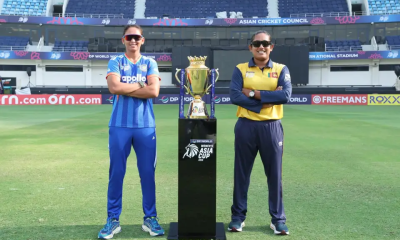



If spin is to decide the Women’s T20 Asia Cup final, both India and Sri Lanka have plenty to call upon. India’s spin attack, led by Deepti Sharma, has taken 26 wickets in the tournament, the most by a side. Sri Lanka are next with 25. That makes it seem like a spin vs spin and more spin kind of title contest.
On the plus side for India is that they have appeared well-rounded on the whole. Smriti Sharma and Shafali Verma have scored the bulk of the runs.
Sri Lanka, by contrast, have had to fight for momentum with the bat on the slow Dubai pitches. They were 33 for 4 in the semi final against Pakistan before Hrshitha Samarawickrema and Kavisha Dilhari revived and then completed the chase. Prior to that, they were 44 for 5 against Bangladesh and had to depend on Samarawickrama’s composed knock to seal their semi-final spot. They were also 45 for 5 against Indonesia in the league stage, before Nilakshi Silva lifted them.
That batting order has looked shaky. Chamari Athapaththu allying just 63 runs from four innings and Imesha Dulani 64 from four innings is a concern. And India’s bowling – quick bowler Nandani Sharma has been in good form too – might be tougher to handle than what Sri Lanka have faced so far.
India’s recent record against Sri Lanka also makes them favourites. They swept the five-match T20I series in December 2025 at home, and have won nine of their last ten T20Is against them.
But Sri Lanka’s one victory in that stretch came in the biggest game of all: the 2024 Asia Cup final in Dambulla, when they chased down 166 with eight wickets to spare to win the title.
That means Sri Lanka have both a challenge and a cause for optimism. They will need their batters to withstand Nandani and India’s spin trio – Deepti, N Shree Charani and Prema Rawat – and find a way to build partnerships, rather than leave too much for the middle and lower-middle order to do.
India have the balance and form while Sri Lanka, the defending champions, know better than most that a final can reset the equation. Not to forget, despite their struggles with the bat, Sri Lanka have an all-win record in the Asia Cup so far, the same as India.
Shafali Verma has made fast starts a recurring theme, scoring 168 runs in four matches at an impressive strike rate of 169.69. Two of her knocks have been 64s, and she has shown little sign of taking her foot off the accelerator. In the final, how she sets up the innings could be crucial.
Sri Lanka have found ways to recover from early collapses, with different players stepping up at different stages. But they need their talisman, Chamari Athapaththu, to come to the fore in the final. Athapaththu has made an impact with the ball – she is the tournament’s joint-highest wicket-taker – but her batting is yet to click. She has crossed 30 only once in four matches, in the opener against UAE. A noteworthy contribution with the bat, to go with her threat with the ball, could give Sri Lanka the spark they need against India.
India have fielded an unchanged XI in the tournament so far and, barring injuries, should do the same.
India Women (probable): Smriti Mandhana, Shafali Verma, Pratika Rawal, Harmanpreet Kaur (capt), Richa Ghosh (wk), Bharti Fulmali, Deepti Sharma, Prema Rawat, Kranti Gaud, N Shree Charani, Nandani Sharma
Sri Lanka have used 14 of their 17 players. In the semi-final against Pakistan, they left out Vishmi Gunaratne and Chethana Vimukthi for Hasini Perera and Mithali Ayodhya, which might be their ideal XI.
Sri Lanka Women (probable): Imesha Dulani, Chamari Athapaththu (capt), Sanjana Kavindi, Harsthitha Samarawickrama, Hasini Perera, Kavisha Dilhari, Nilakshika Silva, Kaushini Nuthyangana (wk), Sugandika Kumari, Chamudi Praboda, Mithali Ayodhya


by Rex Clementine
Red flags have been raised over the culture within the Sri Lankan dressing room, with administrators concerned by low energy levels, poor attitudes and even drinking issues among some fast bowlers during the recent series against India.
Test captain Dhananjaya de Silva is expected to get the axe ahead of the next tour of Pakistan, but changing the man at the helm will hardly cure what appears to be a much deeper malaise. More worryingly, there is no obvious successor being groomed for the job.
These problems have not sprung up overnight. They have been simmering for years. Previous administrations either chose to ignore the warning signs or lacked the vision to determine what sort of cricketers Sri Lanka should be producing, not merely in terms of runs and wickets, but character and professionalism.
For men such as Sidath Wettimuny and Roshan Mahanama, who came through an era shaped by administrators of the calibre of Gamini Dissanayake and Killi Rajamahendran, some of what they see today must make uncomfortable viewing.
Sri Lankan cricket has had numerous opportunities to address these issues. Too often, it chose to look the other way.
Take the infamous Covid bubble breach in England. Three players broke protocols, jeopardising not only the tour but the safety of everyone around them. The retired judge who conducted the inquiry noted a lack of remorse and recommended hefty fines and lengthy suspensions.
Sri Lanka Cricket ignored the learned judge’s warning. The board imposed fines but significantly reduced the bans. Once those punishments came into effect, they were watered down further. In the end, the three players effectively walked away with slaps on the wrist.
And what happened a little over a year later? Danushka Gunathilaka was arrested in Australia. A problem that could have been nipped in the bud was instead allowed to grow into a national embarrassment.
Then there is Niroshan Dickwella, one of Gunathilaka’s companions during the Covid bubble breach. Here was a young man blessed with enormous talent, capable of playing some of the most audacious strokes on the fastest pitches in the world. His knowledge of the Laws of Cricket is so sharp that he could put some international umpires to shame. After the Calcutta Test in 2017, none other than Virat Kohli praised his street smart cricket.
Yet Dickwella never fulfilled his potential.
Recently, selectors made a hue and cry about him being the best wicketkeeper in the country. That is hardly news. We know how good a wicketkeeper he is. We don’t need a Gary Kirsten to come and tell us about that. We have seen it all before. The question is what influence he has on younger players in the dressing room.
His suspension following a positive test for cocaine was initially three years before being reduced to three months on appeal. A three year suspension becoming two years would at least be understandable. Three years becoming three months is quite another matter. That is Sri Lanka Cricket for you. Sometimes you wonder whether administrators themselves sit down with Dickwella for a line of cocaine.
There was a time when cricket in Sri Lanka was largely the preserve of society’s elite, with a handful of leading Colombo schools supplying much of the national team. That landscape has changed dramatically and for the better. Today, players emerge from every corner of the island, many from simple middle class families and modest backgrounds.
But that brings its own responsibilities for administrators.
A youngster who has never handled serious money can suddenly find himself with a contract worth US$100,000, endorsement deals and celebrity status. Without proper guidance, it is easy to lose perspective.
Former SLC chief Hemaka Amarasuriya, with his strong corporate background, understood this. He championed the idea of a Cricket Academy at the R. Premadasa Stadium that would teach players on the threshold of international cricket not only the finer points of the game but also how to conduct themselves on and off the field.
Sadly, Amarasuriya’s tenure ended before the plan could be put into practice.
Several years later, Sidath Wettimuny produced a blueprint for a high performance centre equipped with everything modern cricket demanded, a state of the art gymnasium, swimming pools, the latest coaching technology and more importantly life lessons. Once Wettimuny left the board, however, those who followed found other priorities rather than building the infrastructure to bring out a good cricketer and a person.
The often repeated story in cricket circles is that Bangladesh somehow obtained that blueprint and went on to develop similar facilities around the country. Sri Lanka had ideas but repeatedly failed to follow them through. To put it simply, the last decade has been a disaster and we have made little progress.
Much is said about the importance of the democratic process and why elected officials should administer cricket. In theory, that argument is difficult to dispute. In practice, however, the democratic process in Sri Lankan cricket has produced its fair share of the bad and the ugly since the 1996 World Cup triumph.
Government appointed Interim Committees, meanwhile, have on several occasions been called upon to clean up the mess.
Admittedly, politicians subsequently abused that mechanism too, using Interim Committees to accommodate political supporters or individuals unable to win cricket elections. But look at the first three Interim Committees appointed during Chandrika Kumaratunga’s presidency, or indeed the current set up. There is purpose and direction at the moment. Above all, cricket rather than politics or personal agendas come first.
Which brings us back to the dressing room.
Changing captains and coaches will achieve only so much. Sri Lanka must start teaching young cricketers values long before they reach the national side. Discipline, humility, respect for the game, responsibility towards the team and an understanding that wearing the national cap is a privilege cannot suddenly be drilled into someone at the age of 25.
There is far too much selfishness in the modern dressing room. Image and celebrity sometimes appear to matter as much as cricket itself. Too many players seem preoccupied with cultivating a brand rather than building a career. That culture needs to change.
Sanath Jayasuriya attempted to address some of these issues during his stint as Head Coach. What Sri Lankan cricket requires now is a strong figure with unquestioned standing, someone in the mould of Arjuna Ranatunga, who is prepared to establish standards and insist that they are maintained.
At present, there is too much soft pedalling.
Perhaps Sri Lanka should take a leaf out of Rahul Dravid’s book. Start with the Under-19 team. Spend two years shaping young cricketers before they acquire the trappings of international fame. Then move with them to the ‘A’ team for another couple of years before eventually taking charge of the senior side.
By then, many of the boys who started with you at Under-19 level will have graduated to international cricket. They will understand your methods, know your standards and appreciate what you are trying to build.
It is not a quick fix. It may take five years.
Changing the captain may be the easiest decision of all. Changing the culture is the real challenge.

Shonali Dharmasena has been appointed captain of the Sri Lanka basketball team for the Asian Games, which will be held in Japan later this month.
A product of Holy Family Convent, Bambalapitiya, Shonali has excelled for her school across all age groups and has also represented Sri Lanka at Under-19 level in international competitions.
Sport, it seems, runs deep in the Dharmasena family. Shonali’s grandmother, Sofia Dharmasena, was a double international, having represented Sri Lanka in both netball and volleyball.
Her father, Kisan Dharmasena, represented Sri Lanka at Under-19 level in cricket before going on to play first-class cricket for NCC and Tamil Union.
Shonali will now carry that rich family sporting tradition onto a bigger stage as she leads Sri Lanka’s basketball challenge in Japan.

Death toll from Philippines ferry fire rises to 76, with more still missing

Anthropic boss Dario Amodei calls for AI development to slow down

It’s spin vs spin as India and Sri Lanka battle for Asia Cup title

Atmospheric conditions are favorable for afternoon thundershowers in most parts of the Island today [13]

Gnanasara Thero absconding after SC ruling

House to debate 22A, Judicature Bill next week

‘Dates have the highest sugar content to fight Coronavirus’

Sunday Island 27 December – Headlines

#SundayIsland 17th December – Headlines

Sunday Island – 28th March

Sunday Island Headlines – 21 March

Sunday Island – 21st February – Headlines
-

 Sports2 days ago
DDS set to lose Test captaincy
-

 Features6 days ago
After the parade: What a traffic OIC’s walk-out tells us
-

 Editorial6 days ago
Arrests as theatre
-
 News5 days ago
Thailand shuts door on undesirables from Sri Lanka
-

 Latest News6 days ago
Harshitha’s composed knock seals Sri Lanka’s semi-final berth
-
 Business5 days ago
CEB successor company breaks into top three in competitive BESS tender
-

 News2 days ago
Sri Lanka faces new grid challenge as rooftop solar surges: former CEB GM
-

 News6 days ago
‘Choka Malli’ slips out of country before travel ban