
Business
The National Action Plan on UNSCR1325 and the impact of armed conflicts on children


The Universities Network for Children in Armed Conflict and the Institute of Political Studies “S. Pio V”, supported by the Italian Ministry of Foreign Affairs and International Cooperation have organised a conference within the framework of the project ‘The National Action Plans (NAP) on UNSCR1325 and the impact of armed conflicts on children: a study and analysis of the International Universities Network”. The project aims to carry out qualitative and quantitative research and produce an insightful report, by geographical area, of the serious violations against children by armed conflict situations. The research also makes a valuable analysis of post-conflict reform, rehabilitation and reintegration of children affected by armed conflict and this is the critical path where UNSCR1325 can and should play a pivotal role.
Speaking about the objectives of this conference Laura Guercio, Professor of Sociology of Human Rights & International Cooperation to Development at the University of Perugia and a Professor of International Relations at the University Cusano Rome. A member of the Council of the European Law Institute in Vienna said, ” The NAP is to create a narrative and collate ideas on how Resolution 1325 can impact and support the global movement to reduce the direct and indirect impacts of armed conflict on children. To achieve this, we must expand the understanding and impact of Resolution 1325 from its gender perspective to reach children affected by armed conflict as well as create a wider umbrella of sustainable peacebuilding via the four pillars of Resolution 1325 – Participation, Protection, Prevention, and Relief and Recovery. The impact of armed conflict on children needs to deep dive into the areas.”
Participation – how can we create a dialogue from a gender perspective to mutually include the protection of children under Resolution 1325 and how should the National Action Plans reflect this?
Protection – how does the jurisdiction of the national and international communities work together to create a system of sustainable protection of children from armed conflict under the umbrella of Resolution 1325? (Considering that internal civil wars create a jurisdictional question for international community intervention)
Prevention – what specific areas of direct and indirect impacts of armed conflict on children can Resolution 1325 address?
Relief and Recovery – can Resolution 1325 play a larger role in the relief and recovery of children affected by armed conflict (as this is a critical impact point that tends to see a lot of children fall through the cracks)?
Accountability – how do we improve accountability measures to support children and women affected by armed conflict?
Armed conflict causes severe direct and indirect consequences for children and most often the indirect consequences are not addressed due to the grave nature of the direct consequences, which are broadly defined as death, injury, recruited as child soldiers and violence against children. The dire consequences of the indirect harm caused to children during the armed conflict have a lasting impact on these children due to the double-barrelled trauma such as gross violations of being abducted, forced removal from their families, illegal detention and recruitment as child soldiers. In addition, these children are also deprived of their fundamental rights to education, shelter, and the right to build a fruitful and holistic life.

Laura Guercio
The project will also include videos and a photo exhibition by two Italian photo reporters, Marzia Ferrone and Vittorio Alonzo, on the condition of children living in armed conflict and post-conflict.
This conference provides the opportunity to build a comparative analysis of NAP’s of selected Asian countries vis a vis the IV Italian Action Plan in accordance with Resolution 1325.
Background to Conference and Research Topic
The charter of the United Nations Security Council (UNSC) is the maintenance of international peace and security. Security must be present, and its presence must be realised – this is a critical indicator of peace. As the popular saying goes, “The absence of war doesn’t necessarily mean the presence of peace”.
In 2000, The UNSC Resolution 1325 recalled 1261 (1999), 1265 (1999), 1296 (2000) and 1314 (2000) and;
expressed concern about the fact that the majority of people affected by armed conflict are women and children,
reaffirmed the role of women as “agents of lasting peace”: their equal participation in peacebuilding, maintaining and promoting peace and security and the increase in decision-making for conflict prevention are crucial for peace and security,
reaffirmed the need for humanitarian and human rights laws that protect the rights of women and children during and after conflicts.
The Beijing Declaration (1995) states the hard reality of women and children being most vulnerable during conflict and further states that women and girl-children are even more at risk due to their social status and sex.
In the presence of conflict, it is observed time and time again that women assume the key role of ensuring family livelihood amid armed conflict and destruction. Women are also seen as being active in cultivating peace and collaboration in their communities at a grass root level. A strong example of this is; during the armed conflict and post-conflict in Sri Lanka, we saw the transformation of battle-hardened women into successful entrepreneurs. What started as a desperate shift for survival has now mainstreamed and evolved into a community of businesswomen that challenged the patriarchal gender norms and changed the socio-cultural landscape. Therefore, the narrative must begin to reflect the strong agency women are competent, capable and willing to carry forward with the global community looking beyond the umbrella of protection of women per se. This is the narrative that will make UNSCR 1325 stronger and able to reach further to the protection of children.

Business
Sri Lanka’s apparel sector records 5.42% growth for January-November 2025: November slight dip


Sri Lanka’s apparel industry delivered a robust performance during the first eleven months of 2025, with cumulative exports reaching US$4,571.99 million marking a 5.42% increase over the same period last year, according to data released today by the Joint Apparel Association Forum (JAAF).
Sri Lanka’s total apparel exports for November 2025 reached US$367.60 million, representing a slight decrease of 1.96% compared to US$374.94 million in November 2024.
The monthly performance showed mixed results across key markets: United States: US$152.32 million (up 5.79% from US$143.98 million), European Union (excluding UK): US$119.61 million (up 3.35% from US$115.73 million), United Kingdom: US$43.63 million (down 13.83% from US$50.63 million), Other Markets: US$52.04 million (down 19.44% from US$64.60 million)
Strong cumulative performance: January-November 2025
Despite the November softness, cumulative apparel exports for the eleven-month period from January to November 2025 demonstrate solid growth, reaching US$4,571.99 million—a 5.42% increase over the corresponding period in 2024 (US$4,336.84 million).
Year-to-Date Performance by Market:
European Union (excluding UK): US$1,435.39 million (up 13.07%)
Other Markets: US$742.98 million (up 5.75%)
United States: US$1,769.08 million (up 1.73%)
United Kingdom: US$624.54 million (down 0.22%)
Commenting on the export data, JAAF stated “The 5.42% growth in our cumulative exports for the first eleven months of 2025 reflects the resilience and adaptability of Sri Lanka’s apparel sector in navigating a challenging global environment. While we experienced a modest 1.96% decline in November, this should be viewed within the broader context of our strong year-to-date performance.
“Particularly encouraging is our 13.07% growth in the European Union market, which demonstrates the success of our strategic focus on strengthening relationships with EU buyers and meeting their increasingly stringent sustainability and compliance requirements. Similarly, our continued growth in the US market, despite tighter margins, shows that Sri Lankan manufacturers remain competitive on quality, delivery, and ethical manufacturing standards”.
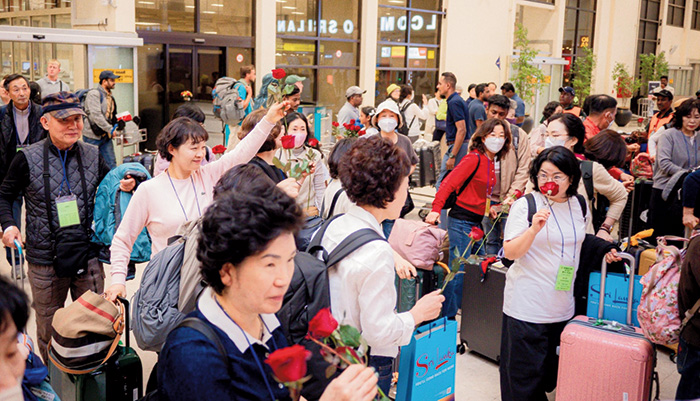
Sri Lanka Tourism, in collaboration with the Embassy of Sri Lanka to the Republic of Korea, is providing support for the two VVIP South Korean Buddhist delegations visiting the country, demonstrating solidarity and strengthening cultural and religious ties with Sri Lanka.
The first delegation included Anunayake thero of Jogye order , South Korean chief Buddhist monks and devotees arrived in Sri Lanka consisting of 120 , on 01st December 2025, with the intention of undertaking a pilgrimage tour and highlighting Sri Lanka’s importance as a major Buddhist attraction for Buddhists around the world.
As same as the first delegation, the second VVIP Buddhist delegation which arrived on the 10th of December, 2025, was also given warm and a colorful welcome at the Bandaranaike International Airport, complete with a Cultural Dance troupe and a group of Sri Lankan children to greet them upon their arrival, making them feel at home and happy to see such a sensational sight. Ms . Thanuja Muniweera , Deputy Director and also the officer in charge of the Korean Market , was there to welcome the much revered guests . The delegation consisted of 150 visitors including both priests and devotees.
Led by Ven . Hyeil, , Chief priest of Haeinsa Temple , the main purpose of this visit is to show Sri Lanka as a welcoming and culturally vibrant destination. This will be a great opportunity to show the importance of the Korean Market as an emerging market and also promote Buddhist and Pilgrimage Tourism. South Koreans are known to be travelling in large numbers, including December 2025. The South Korean Buddhist delegation is one such example.

Diversified conglomerate Sunshine Holdings PLC (CSE: SUN) has been included in the S&P Sri Lanka 20 Index, following the 2025 year-end index rebalance announced by the Colombo Stock Exchange (CSE) and S&P Dow Jones Indices. The inclusion takes effect from 22 December 2025, after market closing on 19 December 2025.
The S&P Sri Lanka 20 Index represents the 20 largest and most liquid companies listed on the CSE, selected based on stringent criteria including market capitalisation, liquidity, financial viability and sustained profitability. Constituents are weighted by float-adjusted market capitalisation, with a single-stock caps to ensure balanced representation.
Commenting on the milestone, Sunshine Holdings Group Chief Executive Officer, Shyam Sathasivam, said, “Our inclusion in the S&P Sri Lanka 20 is the result of more than five decades of collective effort and perseverance by our people, past and present, who have built Sunshine Holdings into the institution it is today. This recognition reflects the strength of our foundations, the discipline with which we have grown, and the consistency of our performance across business cycles. As we move forward, we remain focused on building resilient businesses, upholding strong governance standards and delivering sustainable long-term value to all stakeholders.”
The S&P Sri Lanka 20 Index is constructed in line with global index methodologies and international best practices, with all constituents classified under the Global Industry Classification Standard (GICS®). Eligibility requires a minimum float-adjusted market capitalisation of Rs. 500 million, a six-month median daily value traded of Rs. 250,000, and positive net income over the twelve months preceding the rebalancing reference date.
Sunshine Holdings’ inclusion in the S&P Sri Lanka 20 reflects the Group’s long-term capital markets journey, evolving from a closely held family enterprise into a widely held blue-chip listed company. Over the years, the Group has focused on building institutional credibility, strengthening governance standards and expanding its shareholder base, resulting in a current market capitalisation of approximately LKR 70 billion, underscoring its scale and relevance within the Colombo Stock Exchange.

Two people killed in magnitude 6.5 earthquake in Mexico

President Trump says the US has ‘captured’ Venezuelan President Nicolas Maduro and his wife and flown them out of the country

Navy seize an Indian fishing boat poaching in northern waters

US Coast Guard suspends search for survivors of Pacific boat strike

Venezuela’s capital hit by explosions, Caracas blames the US

Tri-Forces donate LKR. 372 million, a day’s pay of all ranks to ‘Rebuilding Sri Lanka’ Fund

‘Dates have the highest sugar content to fight Coronavirus’

Sunday Island 27 December – Headlines

#SundayIsland 17th December – Headlines

Sunday Island – 28th March

Sunday Island Headlines – 21 March

Sunday Island – 21st February – Headlines
-

 Sports6 days ago
Gurusinha’s Boxing Day hundred celebrated in Melbourne
-
 News4 days ago
Leading the Nation’s Connectivity Recovery Amid Unprecedented Challenges
-

 Features5 days ago
It’s all over for Maxi Rozairo
-

 Sports7 days ago
Time to close the Dickwella chapter
-

 News7 days ago
Environmentalists warn Sri Lanka’s ecological safeguards are failing
-

 News5 days ago
Dr. Bellana: “I was removed as NHSL Deputy Director for exposing Rs. 900 mn fraud”
-

 Opinion3 days ago
Remembering Douglas Devananda on New Year’s Day 2026
-
 News4 days ago
Dons on warpath over alleged undue interference in university governance