
Business
The Fragrance of Cinnamon at Dilmah Tea

Dilhan C. Fernando
Chairman, Dilmah Ceylon Tea Company PLC
There’s always a lingering fragrance around the Dilmah complex in Colombo. It is generally woody, sometimes tinged with citrus, occasionally fruity, and always pleasant. That’s the aroma of tea, varying only as the seasons influence the teas. We taste over 10,000 teas each week in selecting only the finest teas for Ceylon’s Finest so that lively aroma has always surrounded us, spurring us on in our mission to make the world a better tea since the time my father first started his journey in tea in the 1950s.
There’s been a difference recently, the woody fragrance complemented by subtle sweetness, an added warmth and majestic piquancy. That change marks the first time Dilmah has ventured beyond tea, with the Cinnamon produced on its Kahawatte Plantations now offered in elegant cinnamon coloured packages, emblazoned with a golden logo declaring the contents, ‘Dilmah Finest Ceylon Cinnamon.’
There are natural parallels in the two iconic Sri Lankan products. Ceylon Tea and Ceylon Cinnamon are universally acclaimed the finest tea and cinnamon in the world, accolades that are linked to the richness of the island’s biodiversity, its monsoonal climate, the diverse ecosystems, soils and the sophistication of the island’s tradition of sustainable agriculture. Since 3 BC, Sri Lanka was ruled by Kings who understood and embraced the natural synergy that should define interaction between people and nature. Colonialism interrupted that relationship although respect for nature and sustainability persists amongst many tea and cinnamon growers, adding to the allure of both.
Dilmah Tea was born in September 1985 with the assurance that, ‘In Ceylon a country famous for its tea, there is a tea famous for its taste,’ evolving to my father’s invitation in 1994 to tea drinkers to ‘do try it!’. My father, Merrill J. Fernando, passed away in July last year yet the values he espoused through his lifetime of devotion to tea & kindness form the foundation of the legacy he leaves behind. A part of that legacy is a discussion we had on Ceylon Cinnamon and its potential to parallel the story of taste, goodness and ethical purpose in tea that my father devoted his life to. That discussion ended in a momentous decision to offer our Cinnamon, branded ‘Dilmah, Finest Ceylon Cinnamon.’
Next year, Dilmah Tea celebrates 40 years since its debut in 1985. My father devoted his life to tea, and since the early days of Dilmah when he and 18 others laboured to make his dream of the first producer owned tea brand, a reality, our vision and mission have focused on making the world a better tea. Our decision to offer Dilmah Ceylon Cinnamon was not taken lightly therefore; it was rooted in the knowledge that the heritage, flavour, goodness and ethical purpose in genuine Ceylon Cinnamon is one of the world’s greatest untold stories.
Ceylon Cinnamon is scientifically proven to be unique. Cinnamomum zeylanicum grown in other countries is not quite the same, as scientists have confirmed. That truth is indisputable but there is more to Ceylon Cinnamon. In 1000BC King Solomon sent ambassadors to Sri Lanka, visiting the present day city of Galle which he called Tarshish, to purchase Ceylon Cinnamon, amongst other treasures which included precious gemstones. The heritage of Ceylon Cinnamon is perfectly expressed in the value ascribed to the spice by Kings, Queens, Emperors, Physicians and Chefs over millennia.
Our reason for embracing Ceylon Cinnamon goes beyond taste and heritage. Dilmah is a family business, formed on a foundation of family values, chief among which is kindness. Sri Lanka’s magnificent Cinnamon has been exploited for centuries with little or no benefit to the community engaged in its production or the future of the ancient Cinnamon industry in Sri Lanka. The existence of a cheaper, inferior counterfeit that unfairly acquired the allure of Cinnamon forced Ceylon Cinnamon into a defensive mindset, compromising the heritage, tradition, taste and goodness in the spice. The reality that cassia, the imitator contains the toxic substance coumarin, adds urgency to our mission.
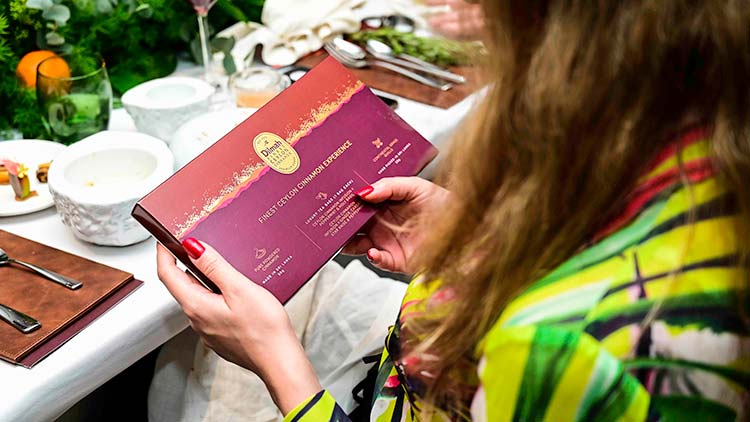
Our Ceylon Cinnamon was first presented to guests at an evening of gastronomy inspired by the fragrance and flavour of Ceylon Cinnamon in Dubai on 17th February, 2023. At the event guests were presented with an exceptional and different experience of the Spice of Kings. In combination, our passion for Ceylon’s Cinnamon, its unique taste, our life enhancing purpose in Cinnamon and the culinary art of Pullman Dubai Chefs Roziro Mathias and Dammika Herath, delivered insight into the taste, goodness and purpose of Dilmah Finest Ceylon Cinnamon.
An amuse bouche of Langouste tortellini with vegetable consomme infused with Ceylon Cinnamon and white truffle, fig chutney and caramelised pears paired with Ceylon Cinnamon Infused Dilmah prince of Kandy Tea. Our entrée was Risotto Alberto with Ceylon Cinnamon infused Wild Asparagus veloute, brie cheese curd and a garnish of gold leaf. Thereafter butter-poached Ceylon Cinnamon dusted wild cod, royal Beluga caviar, caramelised endive, edemame puree and a blood orange glaze. Following a palate cleanser of Ceylon Cinnamon essence in spring water combined with Granny Smith Granita, came a slow roasted veal loin with Ceylon Cinnamon infused herb jus, chive polenta stuffed morel. Finally a trio of dessert, with Ceylon Cinnamon infused chocolate ganache, Ceylon Cinnamon Jelly dome, Warm Lemon cake with vanilla cream, mango mousse and hazelnuts caramelised in Ceylon Cinnamon and Ceylon Cinnamon infused chai.
Entitled ‘Finest Ceylon Cinnamon Experience’ the event heralded the first serving of Dilmah Ceylon Cinnamon and the trade launch of our Cinnamon at Gulfood 2024.
Too many great agricultural industries are built on a foundation of poverty. The transition from colonial to free market economy failed – in most cases – to free growers of coffee, cocoa, tea and many other crops. The extractive and exploitative colonial economic system is too often superseded by traders whose insistence on price, driven by a ruthless discount culture, drive down the incomes of growers, crushing innovation, education and motivation, eventually destroying livelihoods and industries. For genuinely fair trade, fair by customers and fair by producers, quality, integrity, sustainability, innovation and a genuine commitment to ethics are all important.
In the case of Cinnamon, an entire industry was compromised by a misconception perpetrated by traders of cassia, who forced artisanal Cinnamon growers to compete with the much cheaper and inferior spice. That has compromised the benefit that the goodness in Ceylon Cinnamon offers a world suffering from the chronic diseases that it has potent therapeutic effects against. That unfair competition has also marginalized generations of Cinnamon growers and peelers who have not benefited from the true value of their produce.
As a family with a commitment to the finest Ceylon Tea and the finest Ceylon Cinnamon, we will continue therefore to fulfill my father’s vision, to serve humanity through our business. We will do that through our mission to offering great Taste, natural Goodness and ethical Purpose in our teas and cinnamon.
Follow us on Instagram for more updates: https://www.instagram.com/dilmahceyloncinnamon/



Sri Lanka is not quite ready to join the Regional Comprehensive Economic Partnership (RCEP), since it is lacking sufficient development, Trade Ministry Secretary K.A. Vimalenthirarajah said.
‘At present the Trade Ministry is establishing Sri Lanka’s readiness to join RCEP, which consists of 15 countries, through several channels, Vimalenthirarajah said at a recent round table discussion titled, ‘Sri Lanka’s Pathway to RCEP and the Emerging Global Trading Order’, organized by the Pathfinder Foundation and held at the Colombo Club, Taj Samudra.
‘Sri Lanka is actively accelerating its compliance efforts to join the 15-nation RCEP having submitted its required accession questionnaire in early 2026, he explained.
Vimalenthirarajah added: ‘The Cabinet has established a high-level policy and working committee and also obtained some technical assistance from multilateral partners because complying with RCEP requirements is challenging. Subsequently, this body responded to the follow-up questions that came up and had discussions with RCEP representatives and it expects more follow-up questions with regard to Sri Lanka’s readiness to join RCEP.
‘Sri Lanka has also secured political and diplomatic support from current RCEP members, including Australia, New Zealand, and Indonesia, to facilitate its entry process.’
Meanwhile, state officials, including Industries and Entrepreneurship Development Deputy Minister Chathuranga Abeysinghe, are implementing key economic structural reforms, a new tariff policy, and transparent investment criteria required by the bloc. Because formal accession protocols for RCEP are still being finalized, Sri Lanka is also simultaneously negotiating bilateral trade and investment agreements with regional members to accelerate integration.
Abeysinghe, participating virtually in the event said that Sri Lanka cannot achieve sustained export growth and attract large-scale investment by relying solely on its domestic market. ‘As a small economy, the country’s future lies in deeper integration with regional and global value chains. RCEP connects 15 economies, including Japan, South Korea, Australia, New Zealand, China and ASEAN member states, collectively accounting for nearly 30% of global trade, he explained.
Abeysinghe added: ‘Access to such a market would create new opportunities for Sri Lankan businesses, particularly the country’s Small and Medium Enterprises (SMEs), which currently contribute only around 10 percent to national exports.
‘However, Sri Lanka is at least a decade behind in implementing many of the reforms required to fully participate in modern global trade. Recognizing this challenge, the government is now moving forward with several critical reforms: A new tariff policy to improve competitiveness and eliminate barriers to trade, transparent and predictable investment criteria, investment facilitation reforms to improve the ease of doing business, new legislation including the Public-Private Partnership (PPP) Act and SOE reforms to strengthen investor confidence and measures to improve investment protection and unlock new sources of capital, including venture capital and angel investment funds.
‘Sri Lanka’s exports currently stand at approximately US$ 17 billion and have grown only gradually over the years. Expanding market access through bilateral and multilateral agreements, while continuing domestic reforms, is essential if the country is to achieve its long-term economic ambitions.’
By Hiran H Senewiratne

In a landmark development for Sri Lanka’s organic spice sector, Pussalla Agri Ventures has been awarded both EU Organic and USDA Organic certifications for its premium Ceylon cinnamon products. The certifications were officially conferred at Control Union Sri Lanka, signaling a major milestone in the company’s strategic transformation toward fully certified organic operations.
The recognition strengthens Pussalla Agri Ventures’ position as an emerging exporter of certified organic products, with its flagship offering, organic Ceylon cinnamon (Cinnamomum verum, also known as Cinnamomum zeylanicum), cultivated in Sri Lanka’s traditional cinnamon-growing regions.
Notably, the dual certification opens doors to some of the world’s most lucrative and compliance-driven organic markets, including the European Union and the United States.
Pussalla Agri Ventures began its structured transition into organic cinnamon cultivation several years ago, building a fully integrated system covering cultivation, processing, and value addition. The company currently manages extensive cinnamon cultivation lands and operates under strict organic agricultural principles, ensuring compliance with global certification standards.
These certifications, issued through Control Union Sri Lanka, validate that the company’s farming and processing systems meet rigorous international requirements, including restrictions on synthetic chemicals, comprehensive traceability controls, and environmental sustainability practices. These certifications add to an existing portfolio that already includes SL GAP, Food GMP, and Cosmetic GMP certifications.
Company representatives described the achievement as a “milestone” in the Pussalla organic journey, one that paves the way for expanded access to premium export markets in Europe and the United States. According to them, the certifications are expected to enhance buyer confidence, particularly among health-conscious consumers and clean-label food brands.
Pussalla Agri Ventures emphasised that its organic cinnamon is sourced entirely from its own cultivated estates.
“This estate-to-exporter integration ensures full control over quality, traceability, and processing integrity. The company’s model allows cinnamon to be harvested, processed, and packed under continuously monitored conditions, maintaining strict alignment with international organic standards,” they noted.
Speaking further they said:
“Sri Lanka supplies the majority of the world’s True Ceylon Cinnamon, a spice prized for its delicate aroma, low coumarin levels, and reputed medicinal properties. The growing global demand for certified organic spices has created new opportunities for local producers who meet international compliance standards. Pussalla Agri Ventures’ certification achievement places it among a select group of Sri Lankan exporters adopting globally recognised organic systems, thereby enhancing the country’s reputation in high-value spice markets.”
“As organic food sales continue to rise in North America and Europe, certifications such as these are becoming essential rather than optional. For Pussalla Agri Ventures, the journey from conventional to certified organic is not merely a compliance exercise but a strategic repositioning aimed at long-term sustainability and premium pricing power.”
By Sanath Nanayakkare

The National Chamber of Commerce of Sri Lanka (NCCSL) will host a timely and insightful seminar titled “Data Protection & Privacy: Safeguarding Businesses in the Digital Era” on 18th June 2026, from 9.00 a.m. to 12.30 p.m., at the National Chamber of Commerce Auditorium, Colombo 10 with the objective of enhancing awareness among businesses on emerging cyber risks, data protection requirements, and digital security best practices.
As organizations increasingly rely on digital platforms, online transactions, cloud-based systems, and data-driven operations, protecting sensitive information and ensuring privacy compliance have become critical priorities for organizations of all sizes. The seminar aims to provide practical knowledge and strategic guidance to help businesses strengthen resilience against cyber threats while fostering trust and confidence among customers and stakeholders.
Interested parties are encouraged to register by contacting Udula – 0714034775/ 0114741788 | udula.nccsl@gmail.com or Nishanthi – 0762555707 | nishanthi@nationalchamber.lk

G7 leaders meet in France with Iran and Ukraine high on agenda

A long-term programme should be formulated to minimize the spread of the Dengue Epidemic – PM

Tunisia sack boss Sabri Lamouchi after World Cup thrashing by Sweden

Tuesday at T20 World Cup: New Zealand eye first win; Ireland run into England

‘Spider-Man of Yemen’ dies falling into volcanic crater

Norwegian crown princess’s son found guilty of two counts of rape

‘Dates have the highest sugar content to fight Coronavirus’

Sunday Island 27 December – Headlines

#SundayIsland 17th December – Headlines

Sunday Island – 28th March

Sunday Island Headlines – 21 March

Sunday Island – 21st February – Headlines
-

 News4 days ago
CIABOC summons Yoshitha over his participation in British Navy training programme
-
 News6 days ago
Local firms move millions of dollars overseas for phantom imports: Govt.
-

 Midweek Review6 days ago
July 09: An inexcusable overall security failure and exceptional contingency plan
-

 Sports1 day ago
Tharanga set for high-profile javelin clash in Ostrava
-

 News3 days ago
Commonwealth lawyers urge Lanka to uphold rule of law
-

 News6 days ago
AI raises concerns over arrest of Sallay and rapper under PTA
-

 Features2 days ago
Politics of protected species
-

 News4 days ago
Justice Minister responds to social media claims he represented Easter Sunday ringleader