
Features
The bond scandal: Killing the duck

Killing the duck or goose that lays golden eggs is a metaphorical cautionary tale that serves as a reminder for everyone to consider the sustainable and enduring value of an  asset or resource rather than succumbing to impulsive decisions that may lead to irreparable consequences. In essence, it encourages a thoughtful and strategic approach to resource management, discouraging actions that jeopardise the very source of sustained success.
The auction for Rs. 1 billion 30-year bond on 27 February 2015.
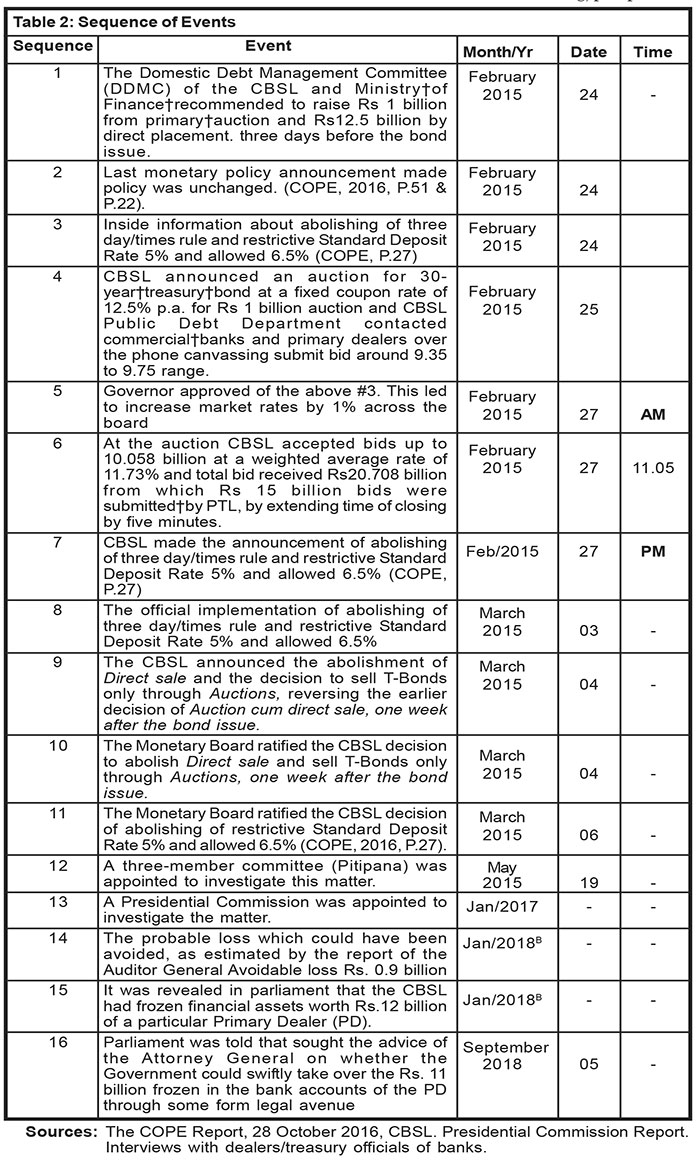
On 24 Feb., 2015, the Domestic Debt Management Committee (DDMC) of the Central Bank of Sri Lanka (CBSL) and the Ministry of Finance recommended raising Rs 1 billion from a primary auction and Rs 12.5 billion by direct placement and announced on 25 February 2015. The CBSL Public Debt Department contacted commercial banks and primary dealers for bids.
The auction, opening at 10:00 AM witnessed overwhelming demand, receiving 36 bids totaling Rs. 20 billion, in contrast to the initial offer of Rs. 1 billion, the CBSL extended acceptance to bids totaling Rs. 10.058 billion. Predominantly, 26 bidders sought amounts of Rs. 100 million or less, offering interest rates within the range of 9.5% to 10.5%, weighted average rate was 11.73%.
Remarkably, a faction of bidders, notably Perpetual Treasuries Limited (PTL), advocated for elevated interest rates ranging from 11% to 12%, with a substantial Rs. 15 billion of both direct and indirect bids. Despite the intended closure at 11:00 AM, the auction was extended until 11:05 AM to facilitate late bids, predominantly from PTL.
Inside information
Banks are permitted to place their surplus liquid funds with the Central Bank of Sri Lanka (CBSL) at Standing Deposit Facility Rate (SDFR) of 6% per annum, but only for three days. Subsequently, any such deposits extending beyond three days attract a reduced rate of 5%, termed as the restrictive SDFR. The abolishing of the three-day restriction was indicated within the CBSL three days prior (on 24th February 2023). Surprisingly, there was a 1% increase in market rates means this inside information would have been leaked to outsiders.
More seriously, his decision was against the Monetary Board’s decision to maintain the existing policy. This decision was then disclosed (only within the CBSL) in the morning, but publicly announced only in the afternoon on February 27, 2015, and subsequently ratified by the Monetary Board (MB) on March 3, 2023, without seeking explanations for the unilateral deviation from the initial decision.
At the auction, CBSL accepted bids up to Rs 10.058 billion against the earlier decision that collecting only Rs1 billion through auction and the rest through direct placement. Notably, Rs 15 billion bids were submitted by single Primary Dealer (PTL). The auction’s closing time was extended until 11:05 to accommodate late bids, particularly those submitted directly by PTL and indirectly through the Bank of Ceylon.
However, only a week after the bond issue, the Monetary Board ratified this decision on 3 March 2015 and officially implemented them.
Freezing of Assets and Legal Action:
In January 2018, it was revealed in parliament that CBSL had frozen financial assets worth Rs.12 billion of PTL.Parliament sought the advice of the Attorney General on the possibility of the government taking over the frozen Rs. 11 billion through legal avenues in September 2018.
Appointing commissions
A three-member committee and a Presidential Commission were appointed to investigate the matter, revealing an avoidable loss of Rs. 0.9 billion according to the Auditor General’s report. The freezing of financial assets worth Rs. 12 billion in January 2018 and subsequent legal actions underscored the gravity of the scandal.
This bond scandal not only exposes the vulnerabilities within the financial system but also highlights the need for robust governance, transparency, and regulatory oversight to prevent such incidents and safeguard the integrity of the nation’s financial institutions. However, it’s troubling to note that similar transactions occurred on a much larger scale—approximately 9-10 times greater—on 29th March 2016.
Collusions and absence of action
This adds to the concern, as the absence of any actions against the parties involved in the auction on February 27, 2023, seems to have encouraged a repeat of the scandal on a larger scale. This worrisome pattern prompts important questions about the effectiveness of oversight mechanisms and underscores the urgency of implementing stronger regulatory measures to prevent the repeated occurrence of such financial irregularities.
The Employees’ Provident Fund, overseen by the CBSL, has consistently been involved in collisions with bidders. These collusions may be attributed not only to monetary benefits but also to familial connections, given that the then-governor’s sister was simultaneously a board member of PTL. The Presidential Commission asserts that similar incidents, as disclosed in the Commission Report, occurred as early as 2008, pointing to a longstanding pattern of favoritism and potential fraudulent deals.
The Treasury bond scandal, marked by irregularities in bond issuances, criminal offence such as insider dealing, pump and dump deals, front running, SWICTHING, market manipulation etc., and subsequent investigations, had far-reaching consequences on Sri Lanka’s financial sector. The sequence of events outlined in this report sheds light on the critical decisions, policy changes, and investigations that unfolded during this tumultuous period impacting the country’s economic landscape.
(The writer, a senior Chartered Accountant and professional banker, is Professor at SLIIT University, Malabe. He is also the author of the “Doing Social Research and Publishing Results”, a Springer publication (Singapore), and “Samaja Gaveshakaya (in Sinhala). The views and opinions expressed in this article are solely those of the author and do not necessarily reflect the official policy or position of the institution he works for.)







Features
Mannar’s silent skies: Migratory Flamingos fall victim to power lines amid Wind Farm dispute

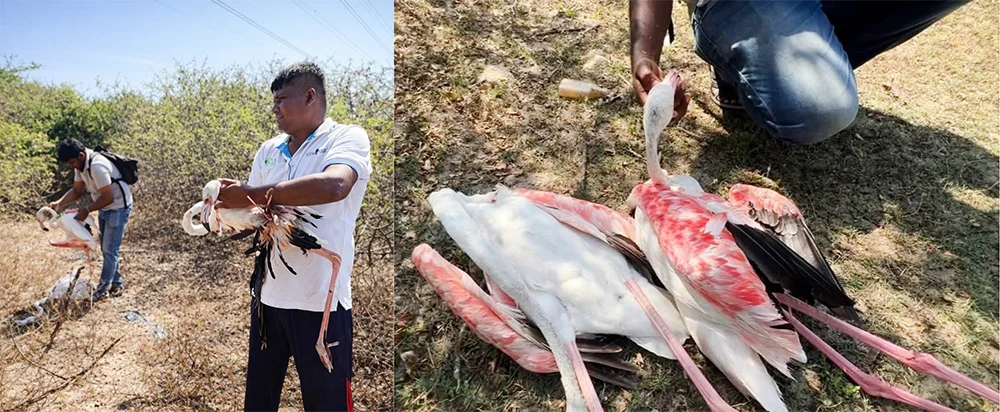
By Ifham Nizam
A fresh wave of concern has gripped conservationists following the reported deaths of migratory flamingos within the Vankalai Sanctuary—a globally recognised bird habitat—raising urgent questions about the ecological cost of large-scale renewable energy projects in the region.
The incident comes at a time when a fundamental rights petition, challenging the proposed wind power project, linked to India’s Adani Group, remains under examination before the Supreme Court, with environmental groups warning that the very risks they highlighted are now materialising.
At least two flamingos—believed to be part of the iconic migratory flocks that travel thousands of kilometres to reach Sri Lanka—were found dead after entanglement with high-tension transmission lines running across the sanctuary. Another bird was reportedly struggling for survival.
Professor Sampath Seneviratne, a leading ornithologist, expressed deep concern over the development, noting that such incidents are not isolated but indicative of a broader and predictable threat.
“These migratory birds depend on specific flyways that have remained unchanged for centuries. When high-risk infrastructure, like poorly planned power lines, intersect these routes, collisions become inevitable,” he said. “What we are witnessing now could be just the beginning if proper mitigation measures are not urgently implemented.”
Environmentalists argue that the Mannar region—particularly the Vankalai wetland complex—is one of the most critical stopover sites in South Asia for migratory waterbirds, including flamingos, pelicans, and various species of waders. The sanctuary’s ecological value has also supported a niche with growing eco-tourism sector, drawing birdwatchers from around the world.
Executive Director of the Centre for Environmental Justice, Dilena Pathragoda, said the incident underscores the urgency of judicial intervention and stricter environmental oversight.
“This tragedy is a direct consequence of ignoring scientifically established environmental safeguards. We have already raised these concerns before court, particularly regarding the location of transmission infrastructure within sensitive bird habitats,” Pathragoda said.
“Renewable energy cannot be pursued in isolation from ecological responsibility. If due process and proper environmental impact assessments are bypassed or diluted, then such losses are inevitable.”
Conservation groups have long cautioned that the installation of wind turbines and associated grid infrastructure—especially overhead transmission lines—within or near sensitive habitats could transform these landscapes into lethal zones for avifauna.
An environmental activist involved in the ongoing legal challenge said the latest deaths validate earlier warnings.
“This is exactly what we feared. Development is necessary, but not at the cost of biodiversity. When projects of this scale proceed without adequate ecological assessments and safeguards, the consequences are irreversible,” the activist stressed.
The debate has once again brought into focus the delicate balance between renewable energy expansion and biodiversity conservation. While wind energy is widely promoted as a clean alternative to fossil fuels, experts caution that “green” does not automatically mean “harmless.”
Professor Seneviratne emphasised that solutions do exist, including rerouting transmission lines, installing bird diverters, and conducting comprehensive migratory pathway studies prior to project approval.
“Globally, there are well-established mitigation strategies. The issue here is not the absence of knowledge, but the failure to apply it effectively,” he noted.
The timing of the incident is particularly worrying. Migratory flamingos typically remain in Sri Lanka until late April or May before embarking on their return journeys. Conservationists warn that if hazards remain unaddressed, larger flocks could face similar risks in the coming weeks.
Beyond ecological implications, experts also highlight potential economic fallout. Wildlife tourism—especially birdwatching—contributes significantly to local livelihoods in Mannar.
Repeated reports of bird deaths could deter eco-conscious travellers and damage the region’s reputation as a safe haven for migratory species.
Environmentalists are now calling for immediate intervention by authorities, including a temporary halt to high-risk operations in sensitive zones, pending a thorough environmental review.
They stress that protecting animal movement corridors—whether elephant migration routes or avian flyways—is a fundamental pillar of modern conservation.
As the controversy unfolds, one question looms large: can Sri Lanka pursue sustainable energy without sacrificing the very natural heritage that defines it?
Pathragoda added that for now, the sight of fallen flamingos in Mannar stands as a stark reminder that development, if not carefully planned, can carry a heavy and irreversible cost.

 A picture of US President Donald Trump apparently being prayed for by supporters, appearing in sections of the international media, said it all loud and clear. That is, religion is being flagrantly leveraged or prostituted by politicians single-mindedly bent on furthering their power aspirations.
Although in the case of the US President the trend took on may be an exceptionally graphic or dramatic form, the ‘weaponizing’ of religion is nothing particularly new, nor is it confined to only religiously conservative sections of the West. For example, in South Asia it is an integral part of politics. The ‘South Asian Eight’ are notorious for it and it could be unreservedly stated that in Sri Lanka, the latter’s ethnic conflict would be more amenable to resolution if religion was not made a potent weapon by ambitious politicians of particularly the country’s South.
The more enlightened sections of Christian believers in the US may not have been able to contain their consternation at the sight of the US President apparently being ‘blessed’ by pastors claiming adherence to Christianity. Any human is entitled to be blessed but not if he is leading his country to war without exhausting all the options at his disposal to end the relevant conflict by peaceful means.
More compounded would be his problem if his directives lead to the death of civilians in the hundreds. In the latter case he is stringently accountable for the spilling of civilian blood, that is, the committing of war crimes.
However, the US along with Israel did just that in the recent bombings of Iran, for instance. The majority of the lives lost were those of civilians. If the US President is endowed with a Christian conscience he would have paused to consider that he is guilty of ordering the taking of the life of another human which is forbidden in the teachings of Jesus Christ.
Moreover, the ‘pastors’ praying over the US President should have thought on the above lines as well. May be they were in an effort to curry the President’s favour which is as blame-worthy as legitimizing in some form the taking of civilian lives. Apparently, the realisation is not dawning on all Christian conservatives of the US that some of these ‘pastors’ could very well be the proverbial false prophets and the latter are almost everywhere, even in far distant Sri Lanka.
However, the political reality ‘on the ground’ is that the Christian Right is a stable support base of the Republican Right in the US. Considering this it should not come as a surprise to the seasoned political watcher if the Christian Right, read Christian fundamentalists, are hand-in-glove, so to speak, with President Trump. But it is a scathing indictment on these rightist sections that they are all for perpetrating war and destruction and not for the fostering of peace and reconciliation. Ideally, they should have impressed on their President the dire need to make peace.
That said, political commentators should consider it incumbent on themselves to point out that religion is being ‘weaponized’ in Iran as well. Theocratic rule in Iran has been essentially all about perpetuating the power of the clerical class. The reasons that led to the Islamic Revolution in Iran are complex and the indiscreet Westernization of Iran under the Shah dynasty is one of these but one would have expected Iran to develop from then on into a multi-party, pluralistic democratic state where people would be enjoying their fundamental rights, as enshrined in the Universal Declaration of Human Rights, for example.
Moreover, Iran should have taken it upon itself to be a champion of world peace, in keeping with its Islamic credentials. But some past regimes in Iran had vowed to virtually bomb Israel out of existence and such regional policy trajectories could only bring perpetual conflict and war. Considering the current state of the Middle East it could be said that the unfettered playing out of these animosities is leading the region and the world to ‘reap the whirlwind’, having recklessly ‘sowed the wind’.
However, religious fundamentalism-inspired conflict and war has spread well beyond the Middle East into almost every region since 1979, the year of the Islamic Revolution in Iran. So much so, knowledgeable opinion now points out that religious identity has come to replace nationalism as a principal shaper of international politics or “geopolitics”, as quite a few sections misleadingly and incorrectly term it.
Elaborating on the decisive influence of religious identity, the well known and far traveled Western journalist Patrick Cockburn says in his authoritative and comprehensive book titled, ‘The Age of Jihad – Islamic State and the Great War for the Middle East’ at page 428 in connection with the war in Chechnya ; ‘If nationalism was not entirely dead, it no longer provided the ideological glue necessary to hold together and motivate people who were fighting a war. Unlike the Islamic faith, it was no longer a belief or a badge of identity for which people would fight very hard.’ (The book in reference was published by VERSO, London and New York).
In his wide coverage of Jihadist Wars the world over Cockburn goes on to state that today a call from a cleric could motivate his followers to lay down no less than their lives for a cause championed by the former. The 9/11 catastrophe alone should convince the observer that this is indeed true.
However, as often pointed out in this column, there is no alternative but to foster peace and reconciliation if a world free of bloodshed and strife is what is being sought. Fortunately we are not short of illustrious persons from the East and West who have shone a light on how best to get to a degree of peace. Besides Mahatma Gandhi of India, who was the subject of this column last week, we have former President of Iran Mohammad Khatami, who made a case for a ‘Dialogue of Civilizations’ rather than a ‘Clash of Civilizations’.
The time is more than ripe to take a leaf from these illustrious personalities, for, the current state of war in the Middle East has raised the possibility of a war that could transcend regional boundaries. The antagonists are obliged to exhaust all the peaceful options with the assistance of the UN system. Besides, war cannot ever have the blessings of the sane.
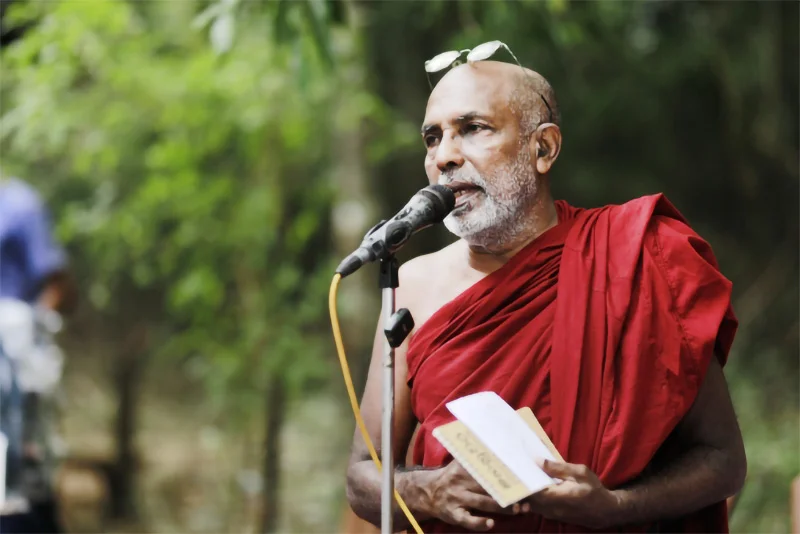
It was 35 years ago, on March 28, 1991, that Venerable Rahula Thera, then a young monk, embarked on a journey to the Na forest in Ulpathagama, Palagama, in the Anuradhapura District. Today, three and a half decades later, this mission stands as living proof of the enduring bond between Buddhist philosophy and the natural world.
Marking the 35th year of this green mission, Rahula Thera’s relentless dedication has transformed the National Namal Uyana into an environmental landmark admired not only across Sri Lanka but around the globe, as well.
When studying the life of Venerable Rahula Thera, one cannot ignore the profound connection between Buddhism and the environment. Buddhism is a philosophy deeply attuned to nature. The historical use of the sacred “Na Ruka” by all four Buddhas: Mangala Buddha, Sumana Buddha, Revata Buddha, and Sobhita Buddha — for enlightenment —demonstrates that from time immemorial, Buddhism has maintained a sacred bond with the Na tree. From the birth of Siddhartha to his enlightenment, the propagation of the Dharma, and even the great Parinirvana, all of these milestones unfolded in verdant, living landscapes.
Venerable Rahula Thera did not embark on the Namal Uyana mission seeking government support or personal gain. His commitment sprang from a deep devotion to the Buddha’s teachings on grove cultivation. A grove cultivator is one who spreads compassion for nature. As the Vanaropa Sutta teaches:
Venerable Rahula Thera reclaimed Namal Uyana which was then under the control of timber smugglers and treasure hunters. The term “Wanawasi” does not merely mean living in a forest; it signifies finding rest and enlightenment through nature, free from the destructive roots of greed, sin, and delusion.
Another defining aspect of Venerable Rahula Thera’s 35-year mission is the purification of the human mind. He has consistently taught the thousands who visit Namal Uyana that a person who loves a tree will never harm another human being. As the Dhamma proclaims:
It is important to remember that Venerable Rahula Thera devoted his life, without fear, speaking the truth and taking necessary action, tirelessly advancing the national mission he began. From 1991 to the present, he has worked with every government elected by the people, maintaining impartiality and independence from political ideology. Yet, he never hesitated to raise his voice fearlessly against any individual, of any rank or party, who committed wrongdoing.
Religious and Social Mission
The National Namal Uyana is not merely a forest; it is a magnificent heritage site, dating back to ancient times. Scattered across the landscape are boundary walls, the remains of ancient monastery complexes, and stone carvings believed to date back to the reign of King Devanampiyatissa. In earlier centuries, this sacred land had served as a meditation sanctuary for hundreds of monks. The name “National Namal Uyana,” by which this ecological and archaeological treasure is known today, was introduced by Venerable Rahula Thera in 1991. The government’s later recognition of the site as the National Namal Uyana stands as a significant achievement for both religion and national heritage.
Venerable Rahula Thera is a monk who has lived a life of renunciation. A striking example of this is his decision not to assume the position of Chief Incumbent of the National Namal Uyana Viharaya, instead entrusting the temple to the Ramanna Nikaya and its trustees. In doing so, he set a precedent for the contemporary Sangha. The Thera himself stated that he was merely the trustee of Namal Uyana, not its owner.
Legacy and Continuing Inspiration
The 35th anniversary of Venerable Wanawasi Rahula Thera’s arrival at Namal Uyana is not merely the commemoration of a period of time; it is a message of nature to future generations. Through his work, the Thera revived the ancient Hela tradition of loving trees and venerating the environment as something sacred. This religious and environmental mission remains unforgettable.
The revival experienced by Namal Uyana, after the arrival of Venerable Wanawasi Rahula Thera, is beyond simple description. Some of the major accomplishments achieved under his leadership include:
* Securing and protecting the largest Rose Quartz (Rosa Thirivana) reserve in South Asia.
* Restoring the Na forest spread across hundreds of acres, providing shelter to numerous rare plants and animal species.
* Transforming the area into a living centre for environmental education, offering practical learning experiences for thousands of schoolchildren and university students.
* Drawing the attention of world leaders and international environmentalists to Sri Lanka’s unique environmental heritage.
In recognition of his immense contribution to environmental conservation, Venerable Rahula Thera was honoured with the Presidential Environment Award and the Green Award in 2004—a significant moment in his life. Yet the Thera himself has always remained devoted to the work rather than the recognition it brings, making such appreciation even more meaningful.

Heat Index likely to increase up to ‘Caution level’ at some places in the Western, Sabaragamuwa, Southern, North-western, Northern and North- central provinces and in Monaragala district

Israel says it has killed Iran’s navy chief overseeing Strait of Hormuz blockade

A strong Technical and Vocational Education and Training (TVET) system equips individuals with practical, relevant, and future-oriented skills helping to innovate responsibly towards a greener and sustainable future – PM

PM reviews progress of the committee appointed for the establishment of a National Nursing University

UN votes to recognise enslavement of Africans as ‘gravest crime against humanity’

Meta and YouTube found liable in landmark social media addiction trial

‘Dates have the highest sugar content to fight Coronavirus’

Sunday Island 27 December – Headlines

#SundayIsland 17th December – Headlines

Sunday Island – 28th March

Sunday Island Headlines – 21 March

Sunday Island – 21st February – Headlines
-

 News2 days ago
Senior citizens above 70 years to receive March allowances on Thursday (26)
-

 Features4 days ago
Trincomalee oil tank farm: An engineering marvel
-
 News7 days ago
CIABOC tells court Kapila gave Rs 60 mn to MR and Rs. 20 mn to Priyankara
-
 Features7 days ago
Science and diplomacy in a changing world
-

 Features4 days ago
The scientist who was finally heard
-

 Business23 hours ago
Dialog Unveils Dialog Play Mini with Netflix and Apple TV
-
 News2 days ago
Japanese boost to Sri J’pura Hospital, an outright gift from Tokyo during JRJ rule
-

 News2 days ago
CEB Engineers warn public to be prepared for power cuts after New Year