
Features
Test cricket of a different kind in 1948

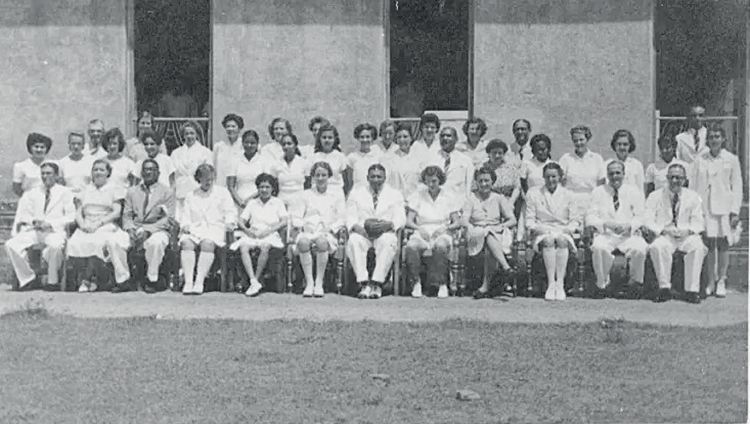
Early last year [probably 2004] I received a call from Michael Ludgrove the then head of the rare book section at Christies Auction house requesting help to decipher the names of Ceylonese cricketers who had signed a cricket bat in the 1930’s following a combined India-Ceylon match against the visiting MCC. This led to my keeping an eye out for unusual items on Ceylon cricket.
A few months later a set of autographs came up for sale. They were of the visiting English women cricketers who played a match in Colombo, against the Ceylon women in the first “Test” of its kind. I was lucky to trace two of the test cricketers from the Ceylon team who now live in Victoria, Beverly Roberts (Juriansz) and Enid (Gilly) Fernando. Incidentally Gilly is called Gilly after AER Gilligan the Australian Cricketer and answers to no other name.
The visiting English team were on their way to Australia on the SS Orion. The Colombo Cricket Club were the hosts and the match was played at the Oval on the November 1, 1948. The match attracted a crowd of around 5,000 many of whom had not seen women play cricket before. Among the distinguished guests were the Governor General, the Bishop of Brisbane, the Assistant Bishop of Colombo -the Reverend Lakdasa de Mel, the Yuvaraj and Yuvaranee of Kutch and Sir Richard Aluwihare.
The well known cricket writer, SP Foenander, provided the broadcast commentary.
The English team consisted of: Molly Hyde (Capt.), Miss Rheinberger, Nacy Joy, Grace Morgan, Mary Duggan, Betty Birch, Dorothy McEroy, Mary Johnson, Megan Lowe, Nancy Wheelan,
The Ceylon team consisted of Miss O Turner (Capt.), Miss Enid (Gilly) Fernando, Miss C Hutton, Miss S Gaddum, Shirley Thomas, Marienne Adihetty, Beverley Roberts, Pat Weinman, Leela Abeykoon, Binthan Noordeen
Reserves: Mrs D H Swan & Mrs E G Joseph. Umpires: W S Findall and H E W De Zylva.
There is on record a previous match, played by a visiting English women’s cricket team in Colombo. However, they played against a team consisting mainly of wives of European Planters and no Ceylonese were included.
Beverley Roberts, 16 years old Leela Abeykoon and Phyllis De Silva were from St John’s Panadura which was the first girl’s school to play cricket. Their coach was G C Roberts (older brother of Michael Roberts). Marienne Adihetty was from Galle and her brother played for Richmond College. Binthan Noordeen was from Ladies College. She is the granddaughter of M.C. Amoo one of the best Malay cricketers of former days, who took a team from Ceylon to Bombay in 1910. Binthan was a teacher at Ladies College at the time and also excelled in hockey, netball and tennis. Pat Weinman is the daughter of Jeff Weinman, a former Nondescripts cricketer.
The team was mainly coached by S. Saravanamuttu with others such as S J Campbell helping. The arrangements were made by the Board of Control of Cricket headed by P Saravanamuttu. Though the match itself was one sided with the Ceylon women cricketers beaten decisively, the Ceylon team impressed the visitors by their gallant display, after less than two months of practice as a team. The English team won the toss and batted first. Molly Slide the captain scored a century in a fine display of batting. The captain of the Ceylon team Mrs Hutton took six wickets for 43.
(Michael Roberts Thuppahi blog)
Dr. Srilal Fernando in Melbourne, reproducing an essay that appeared originally in The CEYLANKAN, a quarterly produced by the Ceylon Research Society in Australia.


It has become fashionable to criticise the US for its recent conduct toward Iran. This is not an attempt to defend or rationalise the US’s actions. Rather, it seeks to inject perspective into an increasingly a historical debate. What is often missing is institutional memory: An understanding of how the present international order was constructed and the conditions under which it emerged.
The “rules-based order” was forged in the aftermath of two catastrophic wars. Earlier efforts had faltered. Woodrow Wilson’s proposal for a League of Nations after World War I was rejected by the US Senate. Yet, it introduced a lasting premise: International order could be consciously designed, not left solely to shifting power balances. That premise returned after World War II. The Dumbarton Oaks process laid the groundwork for the UN, while Bretton Woods established the global financial architecture.
These frameworks shaped modern norms of security, finance, trade, and governance. The US played the central role in this design, providing leadership even as it engaged selectively- remaining outside certain frameworks while shaping others. This underscored a central reality: Power and principle have always coexisted uneasily within it.
This order most be understood against the destruction that preceded it. Industrial warfare, aerial bombardment, and weapons capable of unprecedented devastation reshaped both the ethics and limits of conflict. The post-war system emerged from this trauma, anchored in a fragile consensus of “never again”, even as authority remained concentrated among five powers.
The rise of China, the re-emergence of India, and the growing assertiveness of Russia and regional powers are reshaping the global balance. Technological disruption and renewed competition over energy and resources are transforming the nature of power. In this environment, some American strategists argue that the US risks strategic drift Iran, in this view, becomes more than a regional issue; it serves as a platform for signalling resolve – not only to Tehran, but to Beijing and beyond. Actions taken in one theatre are intended to shape perceptions of credibility across multiple fronts.
Recent actions suggest that while the US retains unmatched military reach, it has exercised a level of restraint. The avoidance of escalation into the most extreme forms of warfare indicates that certain thresholds in great-power conflict remain intact. If current trends persist-where power increasingly substitutes for principle — this won’t remain a uniquely American dilemma.
Other major powers may face similar choices. As capabilities expand, the temptation to act outside established norms may grow. What begins as a context-specific deviation can harden into accepted practice. This is the paradox of great power transition: What begins as an exception risk becoming a precedent The question now is whether existing systems are capable of renewal. Ad hoc frameworks may stabilise the present, but risk orphaning the future. Without a broader framework, they risk managing disorder rather than designing order. The Dumbarton Oaks process was a structured diplomatic effort shaped by competing visions and compromise. A contemporary equivalent would be more complex, reflecting a more diffuse distribution of power and lower levels of trust Such an effort must include the US, China, India, the EU, Russia, and other key powers.
India could serve as a credible convenor capable of bridging divides. Its position -engaged with multiple powers yet not formally aligned – gives it a degree of convening legitimacy. Nalanda-the world’s first university – offers an appropriate symbolic setting for such dialogue, evoking knowledge exchange across civilisations rather than competition among them.
Milinda Moragoda is a former cabinet minister and diplomat from Sri Lanka and founder of the Pathfinder Foundation, a strategic affairs think tank could be contacted atemail@milinda.org. This article was published in Hindustan Times on 2026.04.19)
By Milinda Moragoda

The combination of father and daughter, Shafi and Jana, as a duo, turned out to be a very rewarding experience, indeed, and now they have advanced to Section 8 – a high-energy, funk-driven, jazz-oriented live band, blending pop, rock, funk, country, and jazz.
Guitar wizard Shafi is a highly accomplished lead guitarist with extensive international experience, having performed across Germany, Australia, the Maldives, Canada, and multiple global destinations.

Shafi: Guitar wizard, at the helm of Section 8

Jana: Dynamic and captivating lead vocalist
He is best known as a lead guitarist of Wildfire, one of Sri Lanka’s most recognised bands, while Jana is a dynamic and captivating lead vocalist with over a decade of professional performing experience.
Jana’s musical journey started early, through choir, laying the foundation for her strong vocal control and confident stage presence.
Having also performed with various local bands, and collaborated with seasoned musicians, Jana has developed a versatile style that blends energy, emotion, and audience connection.
The father and daughter combination performed in the Maldives for two years and then returned home and formed Section 8, combining international stage experience with a sharp understanding of what it takes to move a crowd.
In fact, Shafi and Jana performed together, as a duo, for over seven years, including long-term overseas contracts, building a strong musical partnership and a deep understanding of international audiences and live entertainment standards.
Section 8 is relatively new to the scene – just two years old – but the outfit has already built a strong reputation, performing at private events, weddings, bars, and concerts.
The band is known for its adaptability, professionalism, and engaging stage presence, and consistently delivers a premium live entertainment experience, focused on energy, groove, and audience connection.
Section 8 is also a popular name across Sri Lanka’s live music circuit, regularly performing at venues such as Gatz, Jazzabel, Honey Beach, and The Main Sports Bar, as well as across the southern coast, including Hikkaduwa, Ahangama, Mirissa, and Galle.
What’s more, they performed two consecutive years at Petti Mirissa for their New Year’s gala, captivating international audiences present with high-energy performance, specially designed for large-scale celebrations.
With a strong following among international visitors, the band has become a standout act within the tourist entertainment scene, as well.
Their performances are tailored to diverse audiences, blending international hits with dance-driven sets, while also incorporating strong jazz influences that add depth, musicianship, and versatility to their sound.
The rest of the members of Section 8 are also extremely talented and experienced musicians:
Suresh – Drummer, with over 20 years of international experience.
Dimantha – Keyboardist, with global exposure across multiple countries.
Dilhara – Bassist and multi-instrumentalist, also a composer and producer, with technical expertise.

Rajiv Sebastian could be classified as an innovative performer.
Yes, he certainly has plenty of surprises up his sleeves and that’s what makes him extremely popular with his fans.
Rajiv & The Clan are now 35 years in the showbiz scene and Rajiv says he has plans to celebrate this special occasion … in a unique way!
According to Rajiv, the memories of Clarence, Neville, Baig, Rukmani, Wally and many more, in its original flavour, will be relived on 14th July.
“We will be celebrating our anniversary at the Grand Maitland (in front of the SSC playground) on 14th July, at 7.00pm, and you will feel the inspiration of an amazing night you’ve never seen before,” says Rajiv, adding that all the performers will be dressed up in the beautiful sixties attire, and use musical instruments never seen before.
In fact, Rajiv left for London, last week, and is scheduled to perform at four different venues, and at each venue his outfit is going to be different, he says, with the sarong being very much a part of the scene.

Six Foreign Envoys Present Credentials to President Dissanayake

Tilak ends Mumbai Indian’s losing streak with 45-ball century

Showers or thundershowers will occur at most places of the island after 1.00 pm

Rs 13 bn NDB fraud: Int’l forensic audit ordered

Easter Sunday commemorations

Former Minister Gamage under CIABOC probe over recruiting 134 persons from Galle district

‘Dates have the highest sugar content to fight Coronavirus’

Sunday Island 27 December – Headlines

#SundayIsland 17th December – Headlines

Sunday Island – 28th March

Sunday Island Headlines – 21 March

Sunday Island – 21st February – Headlines
-

 News6 days ago
PNS TAIMUR & ASLAT set sail from Colombo
-

 Business3 days ago
Harnessing nature’s wisdom: Experts highlight “Resist–Align” path to resilience
-

 News3 days ago
Gratiaen Trust announces longlist for the 33rd Annual Gratiaen Prize
-

 News2 days ago
From Nuwara Eliya to Dubai: Isha Holdings markets Agri products abroad
-

 News3 days ago
Heroin haul transported on 50-million-rupee contract
-

 Latest News5 days ago
Singapore Zoo’s first Sri Lankan leopard cubs make their public debut
-

 News1 day ago
Church calls for Deputy Defence Minister’s removal, establishment of Independent Prosecutor’s Office
-

 Opinion1 day ago
Shutting roof top solar panels – a crime