
News
Suspicious death of elephant ‘Sujeewa’ sparks fresh demands for probe into wildlife crime

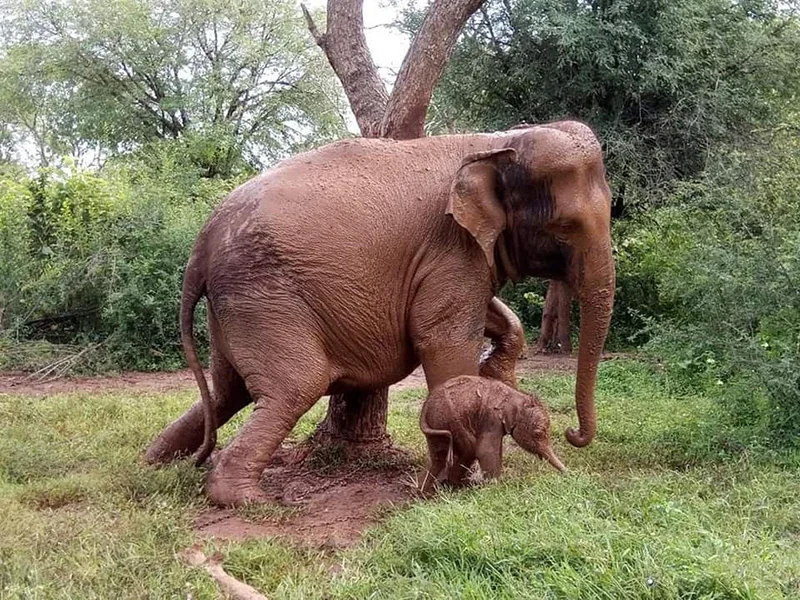
The death of “Sujeewa,” a female elephant held under state custody for nearly a decade, has ignited renewed calls for accountability, transparency, and urgent reform in Sri Lanka’s handling of wildlife crime—particularly the shadowy networks behind elephant smuggling.
Environmental conservationist and researcher Supun Lahiru Prakash has urged authorities, including the Ministry of Environment and the Criminal Investigation Department (CID), to launch an immediate and comprehensive investigation into the circumstances surrounding the elephant’s death. His concerns echo a growing unease among conservationists who see the incident not as an isolated tragedy, but as part of a troubling pattern.
Sujeewa was taken into custody in February 2016 by the Department of Wildlife Conservation (DWC) in connection with a high-profile case involving the illegal capture and trade of wild elephants. For years, she remained under state supervision at a holding facility in Udawalawe, where she later gave birth to a calf—offering a rare glimmer of hope amid an otherwise grim narrative of exploitation.
However, that hope soon gave way to controversy. In 2021, a move by the then-government to release both mother and calf back to individuals linked to the smuggling case—via Gazette Notification No. 2241/41—sparked widespread public outrage. Many viewed the decision as a dangerous precedent that could legitimize illegal wildlife trade. Following legal intervention by environmental groups, the courts halted the release, ensuring the elephants remained under DWC custody.
Today, Sujeewa’s sudden and reportedly “suspicious” death has reopened old wounds and raised pressing questions.
“We now have a serious issue that cannot be ignored—why did this elephant die under state custody?” Supun said. “If an adult elephant, held for years by the authorities, dies without a clear and justifiable explanation, it points to systemic lapses. Either there was negligence, or something far more concerning.”
According to claims circulating among individuals allegedly connected to elephant smuggling networks, Sujeewa had been ill for months and may not have received adequate veterinary attention. While these claims remain unverified, they add another layer of complexity—and suspicion—to an already sensitive case.
Supun warns that the implications go beyond mere negligence. “There is also a risk that this death could be used strategically,” he noted. “If custodial animals begin to die under state care, it could strengthen arguments by suspects to reclaim such animals, claiming they would be ‘safer’ in private custody. This is a dangerous narrative.”
He further raised the possibility—however uncomfortable—that foul play cannot be ruled out. “We must consider whether any party with vested interests may have intentionally caused harm, with the aim of discrediting the Department of Wildlife Conservation,” he said.
Disturbingly, Sujeewa’s case is not without precedent. The death of another elephant, “Siewali,” a juvenile taken into custody from Gannoruwa in Kandy in connection with a similar smuggling investigation, also remains shrouded in controversy. Reports now indicate that yet another elephant under similar custodial conditions is suffering from severe health complications.
“These recurring incidents point to a systemic issue,” Supun stressed. “We cannot treat them as isolated events. There must be a transparent, independent inquiry into all such cases, and those responsible—whether through action or inaction—must be held accountable.”
Beyond the immediate tragedy lies a deeper, more entrenched problem: the illegal wildlife trade, which continues to threaten Sri Lanka’s biodiversity.
Supun, who has extensively researched the subject, revealed that between 2008 and 2018, at least 55 cases of illegal elephant trade were documented in Sri Lanka. The data, compiled through court records, archives, and stakeholder interviews, likely represents only a fraction of the true scale.
“The actual numbers are almost certainly higher,” he explained. “Many elephants die during capture operations, and this is a highly organized illicit trade where data is difficult to obtain.”
The research uncovered alarming trends, including spikes in elephant seizures during 2014–2015, evidence of illegal captures from protected areas, and, most troublingly, indications of corruption within enforcement agencies.
“We found credible evidence pointing to the involvement of wildlife officers, politicians, and other influential individuals,” Prakash said. “This is not just an environmental issue—it is a governance issue.”
Asian elephants, long revered in Sri Lankan culture for their religious, cultural, and economic value, have increasingly become commodities in a lucrative black market. With limited focus on structured captive breeding programs, demand continues to be met through the illegal capture of wild animals.
“The demand for captive elephants—whether for religious pageantry, tourism, or private ownership—remains high,” Supun noted. “Until we address this demand and strengthen enforcement, these crimes will persist.”
He emphasized that Sujeewa’s death should serve as a turning point rather than just another statistic.
“This is an opportunity for the government to demonstrate seriousness in tackling wildlife crime,” he said. “We need stronger legal frameworks, faster court proceedings, better veterinary care for seized animals, and above all, zero tolerance for corruption.”
Supun also called for prioritizing ongoing court cases related to elephant smuggling, warning that prolonged legal delays only embolden perpetrators.
“Justice delayed is justice denied—not just for people, but for wildlife as well,” he said.
As the nation reflects on the life and death of Sujeewa, the broader question remains: will this tragedy finally compel decisive action, or will it fade into the long list of unresolved wildlife crimes?
By Ifham Nizam







The Italian Naval Vessel ‘ITS Giuseppe Garibaldi’ departed the Port of Colombo today, 12 September 2026, after completing a replenishment stop for logistics and services.
During the ship’s stay, the Commanding Officer of ITS Giuseppe Garibaldi, Captain Marco GUERRIERO, called on the Commander Western Naval Area, Rear Admiral Harsha De Silva, at the Western Naval Command Headquarters.
Members of the visiting crew also toured several tourist attractions across the Colombo area during their port call.
News
Green Climate Fund (GCF) Regional Dialogue for East and South Asia will be held from 14 to 17 September 2026 at Cinnamon Life at City of Dreams Hotel, Colombo


The Green Climate Fund (GCF) Regional Dialogue for Eastern and Southern Asia is scheduled to be held from September 14 to 17, 2026, at Cinnamon Life at City of Dreams, Colombo.
The Dialogue is hosted by the Government of Sri Lanka. The Green Climate Fund is the world’s largest dedicated climate fund established under the United Nations Framework Convention on Climate Change to assist developing countries in responding to the challenges of climate change.
The Green Climate Fund aims to promote a paradigm shift towards low-emission and climate-resilient development
pathways by supporting developing countries in reducing their greenhouse gas emissions and adapting to the impacts of climate change.
The Ministry of Environment of Sri Lanka serves as the country’s National Designated Authority for the Green Climate Fund, playing a critical role in coordinating access to climate finance, nominating institutions for accreditation to the Green Climate Fund and approving funding proposals, and ensuring that activities supported by the Green Climate Fund are aligned with national development objectives.
More than 120 delegates from 10 countries are expected to participate. The participating countries are Bangladesh, Bhutan, China, India, the Maldives, Mongolia, Nepal, Pakistan, the Republic of Korea, and Sri Lanka.
Participants will include representatives of National Designated Authorities of the above countries, Direct Access Entities, Accredited Entities, civil society organizations, the private sector, development partners, and technical institutions across the region.
Sri Lanka’s delegation comprises Dr. Dammika Patabendi, Minister of Environment, Anton Jayakody, Deputy Minister of Environment, K.R. Uduwawala, Secretary, Ministry of Environment, and high-level government officials.
The Dialogue will provide a platform to:
Share challenges, experiences, and lessons learned from the implementation of climate change projects and programmes.
Strengthen regional cooperation and partnerships on climate finance.
Discuss the Green Climate Fund’s evolving strategies, policies, and approaches.
Identify opportunities to accelerate climate investments across East and South Asia.
Hosting the Regional Dialogue in Colombo will provide Sri Lanka with an important opportunity to engage with senior government officials, private-sector representatives, development partners, technical experts, and international climate finance institutions.
The event is expected to support Sri Lanka’s efforts to improve access to climate finance and international grants, showcase national climate action initiatives and achievements, and strengthen the country’s engagement with the global climate community.
The Dialogue will also offer a strategic platform for Sri Lankan institutions that have applied for direct accreditation to present their project concepts and engage directly with representatives of the Green Climate Fund. These engagements are expected to support the accreditation process and contribute to the expansion of Sri Lanka’s network of Direct Access Entities through stronger regional partnerships and increased cooperation on climate finance, the Regional Dialogue will
contribute to positioning Sri Lanka as a credible and reliable partner for climate investment.
Projects that Sri Lanka has received funding from this fund are:
• The main projects that Sri Lanka has received support from the Green Climate Fund at present include the Wevu Gam Pubuduwa Project (52.1 USD Million) and the GCF Knuckles Project (49 USD Million).
7.5 USD Million has been allocated from GCF for 5 National Designated Authority Readiness Projects (NDA Readiness Projects) and for the National Adaptation Plan Readiness Project (NAP Readiness Project).
Approval has also been obtained for 3 regional projects. (Cooling Facility Programme, Global Fund for Coral Reef Investment Window, PEEB COOL Programme)
Sri Lanka has also identified 5 project concepts as priority projects for the Green Climate Fund period 2024-2027 and has taken steps to submit those project concepts (Concept Notes) for
approval by the Green Climate Fund.
The “Climate-resilient Fisheries in Sri Lanka” project concept (USD 107.5 million) submitted by DFCC Bank has already received approval.


Former Minister and People’s Joint Opposition Convener Prof. G.L. Peiris has challenged the assertion that the Supreme Court’s determination on the 22nd Amendment to the Constitution would be based solely on law and not Buddhist teachings, arguing that such a position is inconsistent with Article 9 of the Constitution and established judicial precedent.
In a special statement, titled “Buddhist Doctrine as a Source of Law in Sri Lanka”, Prof. Peiris has said the issue had arisen during the 22nd Amendment determination proceedings when Ven. Balangoda Kassapa referred to the Buddha Dhamma in his submissions.
According to Prof. Peiris, the Chief Justice responded that the determination would be made on the basis of the law and not Buddhist teachings.
Describing this as a “cavalier dismissal” of the Buddha Dhamma. Prof. Peiris has said it is contrary to Article 9, which gives Buddhism the foremost place and requires the State to protect and foster the Buddha Sasana.
Full text of the statement: In the 22nd Amendment determination proceedings, Venerable Balangoda Kassapa, in his submissions, made reference to the Buddha Dhamma. His Lordship the Chief Justice, in reply, made the strong assertion that the determination would be made on the basis of the law and not Buddhist teachings. This cavalier dismissal of the Buddha Dhamma is totally inconsistent with Article 9 of the Constitution and its authoritative interpretation in judicial decisions.
I. Authoritative Sri Lankan Judicial Authority A few examples may be cited.
In the Antiquities Amendment Bill, the Supreme Court, in its determination, observed: “The expression Buddha Sasana is wider than Buddhism and includes the entire establishment, together with objects and places of religious practices and worship of Buddhists”.
In Re the Thirteenth Amendment to the Constitution and the Provincial Councils Bill, 1987 2 Sri Lanka LR 312, Wanasundera J, referring to the term Buddha Sasana, said that it was “a compendious term encompassing all ancient, historic and sacred objects and places which have from ancient times been associated with the religious practices and worship of Sinhala Buddhists”.
It is clear that the Buddha Sasana is not confined to matters of ritual or practice, but includes the substance of Buddhist teachings. This is borne out clearly in other judgments of the Supreme Court.
An explicit example is the determination of the Supreme Court in the Ayurveda Amendment Bill, SCSD, numbers 22-35/2023, where the Court declared: “We hold that Buddha Sasana in Article 9 of the Constitution includes the dhamma, principles and teachings of Buddhism, including in particular recognized and undisputed codifications of the teachings of Lord Buddha”.
There are several other passages in the judgment which offer strong authority on the point.
The Court declared: “We determine that the word Buddha Sasana in Article 9 is a compendious term and includes the entire establishment of Buddhism as defined above. We conclude that the Tripitaka, consisting of the Vinaya Pitaka, the Sutta Pitaka and the Abhidhamma Pitaka, falls within the word Buddha Sasana. Hence the State has a duty inter alia to protect and foster the Tripitaka”.
The Court was uncompromising in its declaration that “While retaining the word Buddhism to denote the religion to which foremost place has been accorded in the Republic, the word Buddha Sasana was used to impose a duty on the State to protect and foster the entire establishment of Buddhism”.
The Court’s approach is very clear from the following passage: “We must proceed to interpret Article 9 of the Constitution on the basis that this change was intentional on the part of the legislature. It was meant to cover an area wider than Buddhism”.
II. International Judicial Authority
There is valuable material in the jurisprudence of the International Court of Justice at The Hague.
Judge C. G. Weeramantry, in his dissenting opinion in the ICJ’s 1996 advisory opinion on the legality of the threat or use of nuclear weapons, said that Buddhism could provide an important humanitarian perspective when considering the legality of nuclear weapons. The judge cited as his source the work by Walpola Rahula, entitled What the Buddha Taught, 1959.
Similarly, Judge Weeramantry, in his separate opinion in the maritime delimitation in the area between Greenland and Jan Mayen case, 1993, commented on the international legal concept of equity. In this connection, he referred to “the elaborately researched concept of fairness and justice in Buddhism”.

ITS Giuseppe Garibaldi’ departs Colombo

Green Climate Fund (GCF) Regional Dialogue for East and South Asia will be held from 14 to 17 September 2026 at Cinnamon Life at City of Dreams Hotel, Colombo

Showers will occur in the Western, North-western and Sabaragamuwa provinces and in Kandy, Nuwara-Eliya, Galle and Matara districts

Prof. Pieris says Buddha Dhamma recognised as source of law under Constitution

GR leaves FCID after making statement over MiG deal

Dengue cases top 97,000 in 2026

‘Dates have the highest sugar content to fight Coronavirus’

Sunday Island 27 December – Headlines

#SundayIsland 17th December – Headlines

Sunday Island – 28th March

Sunday Island Headlines – 21 March

Sunday Island – 21st February – Headlines
-

 Sports2 days ago
DDS set to lose Test captaincy
-

 Latest News7 days ago
Tharanga creates history with Diamond League crown in Brussels
-

 Features6 days ago
After the parade: What a traffic OIC’s walk-out tells us
-

 News7 days ago
Dispute which triggered listed company director being detained at BIA resolved
-

 Editorial6 days ago
Arrests as theatre
-

 News5 days ago
Thailand shuts door on undesirables from Sri Lanka
-

 Latest News6 days ago
Harshitha’s composed knock seals Sri Lanka’s semi-final berth
-

 News6 days ago
‘Choka Malli’ slips out of country before travel ban