
News
Suspicious death of elephant ‘Sujeewa’ sparks fresh demands for probe into wildlife crime

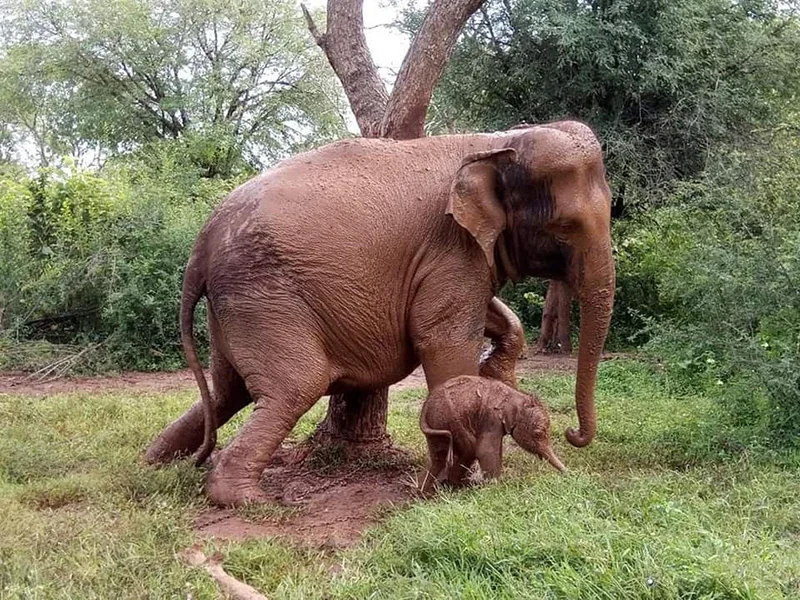
The death of “Sujeewa,” a female elephant held under state custody for nearly a decade, has ignited renewed calls for accountability, transparency, and urgent reform in Sri Lanka’s handling of wildlife crime—particularly the shadowy networks behind elephant smuggling.
Environmental conservationist and researcher Supun Lahiru Prakash has urged authorities, including the Ministry of Environment and the Criminal Investigation Department (CID), to launch an immediate and comprehensive investigation into the circumstances surrounding the elephant’s death. His concerns echo a growing unease among conservationists who see the incident not as an isolated tragedy, but as part of a troubling pattern.
Sujeewa was taken into custody in February 2016 by the Department of Wildlife Conservation (DWC) in connection with a high-profile case involving the illegal capture and trade of wild elephants. For years, she remained under state supervision at a holding facility in Udawalawe, where she later gave birth to a calf—offering a rare glimmer of hope amid an otherwise grim narrative of exploitation.
However, that hope soon gave way to controversy. In 2021, a move by the then-government to release both mother and calf back to individuals linked to the smuggling case—via Gazette Notification No. 2241/41—sparked widespread public outrage. Many viewed the decision as a dangerous precedent that could legitimize illegal wildlife trade. Following legal intervention by environmental groups, the courts halted the release, ensuring the elephants remained under DWC custody.
Today, Sujeewa’s sudden and reportedly “suspicious” death has reopened old wounds and raised pressing questions.
“We now have a serious issue that cannot be ignored—why did this elephant die under state custody?” Supun said. “If an adult elephant, held for years by the authorities, dies without a clear and justifiable explanation, it points to systemic lapses. Either there was negligence, or something far more concerning.”
According to claims circulating among individuals allegedly connected to elephant smuggling networks, Sujeewa had been ill for months and may not have received adequate veterinary attention. While these claims remain unverified, they add another layer of complexity—and suspicion—to an already sensitive case.
Supun warns that the implications go beyond mere negligence. “There is also a risk that this death could be used strategically,” he noted. “If custodial animals begin to die under state care, it could strengthen arguments by suspects to reclaim such animals, claiming they would be ‘safer’ in private custody. This is a dangerous narrative.”
He further raised the possibility—however uncomfortable—that foul play cannot be ruled out. “We must consider whether any party with vested interests may have intentionally caused harm, with the aim of discrediting the Department of Wildlife Conservation,” he said.
Disturbingly, Sujeewa’s case is not without precedent. The death of another elephant, “Siewali,” a juvenile taken into custody from Gannoruwa in Kandy in connection with a similar smuggling investigation, also remains shrouded in controversy. Reports now indicate that yet another elephant under similar custodial conditions is suffering from severe health complications.
“These recurring incidents point to a systemic issue,” Supun stressed. “We cannot treat them as isolated events. There must be a transparent, independent inquiry into all such cases, and those responsible—whether through action or inaction—must be held accountable.”
Beyond the immediate tragedy lies a deeper, more entrenched problem: the illegal wildlife trade, which continues to threaten Sri Lanka’s biodiversity.
Supun, who has extensively researched the subject, revealed that between 2008 and 2018, at least 55 cases of illegal elephant trade were documented in Sri Lanka. The data, compiled through court records, archives, and stakeholder interviews, likely represents only a fraction of the true scale.
“The actual numbers are almost certainly higher,” he explained. “Many elephants die during capture operations, and this is a highly organized illicit trade where data is difficult to obtain.”
The research uncovered alarming trends, including spikes in elephant seizures during 2014–2015, evidence of illegal captures from protected areas, and, most troublingly, indications of corruption within enforcement agencies.
“We found credible evidence pointing to the involvement of wildlife officers, politicians, and other influential individuals,” Prakash said. “This is not just an environmental issue—it is a governance issue.”
Asian elephants, long revered in Sri Lankan culture for their religious, cultural, and economic value, have increasingly become commodities in a lucrative black market. With limited focus on structured captive breeding programs, demand continues to be met through the illegal capture of wild animals.
“The demand for captive elephants—whether for religious pageantry, tourism, or private ownership—remains high,” Supun noted. “Until we address this demand and strengthen enforcement, these crimes will persist.”
He emphasized that Sujeewa’s death should serve as a turning point rather than just another statistic.
“This is an opportunity for the government to demonstrate seriousness in tackling wildlife crime,” he said. “We need stronger legal frameworks, faster court proceedings, better veterinary care for seized animals, and above all, zero tolerance for corruption.”
Supun also called for prioritizing ongoing court cases related to elephant smuggling, warning that prolonged legal delays only embolden perpetrators.
“Justice delayed is justice denied—not just for people, but for wildlife as well,” he said.
As the nation reflects on the life and death of Sujeewa, the broader question remains: will this tragedy finally compel decisive action, or will it fade into the long list of unresolved wildlife crimes?
By Ifham Nizam




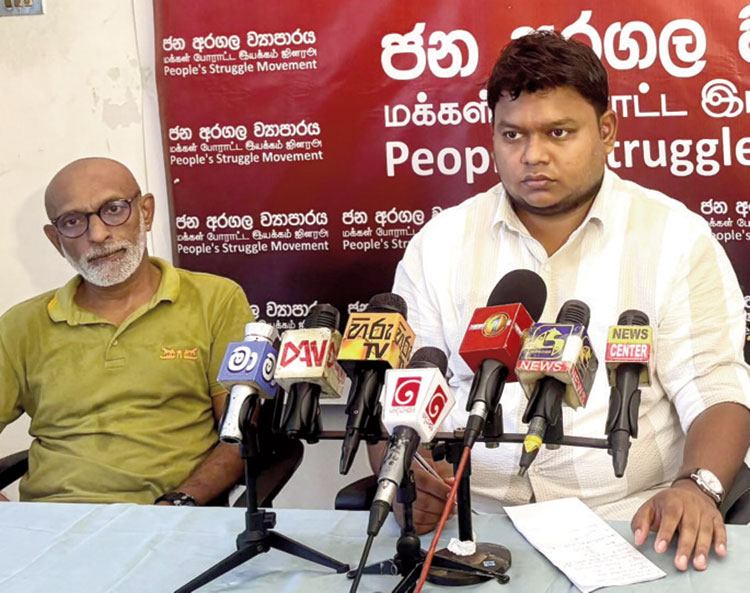
The Frontline Socialist Party-backed People’s Struggle Movement is set to stage a protest march in Colombo today (03) against what it describes as the growing tax burden on the public and the rising cost of living.
The organisers are due to commence the “Colombo March Against Unjust Taxes” at noon from Campbell Park, Borella. The FSP has also been mobilising support for the protest in Colombo and its suburbs in the run-up to the event.
People’s Struggle Movement National Executive Council member Wasantha Mudalige, speaking at a media briefing in Nugegoda yesterday (02), called on the public to join the protest, saying the movement intended to bring the tax burden faced by ordinary people to the forefront.
Mudalige alleged that successive tax measures had placed an excessive burden on households, particularly through taxes on food and educational items. He also criticised the Government over what he described as the high cost of basic food items and the difficulties faced by parents in meeting their children’s educational expenses.
He accused the Opposition of failing to adequately address the issue, claiming that opposition parties raised such concerns, mainly during election periods.
Mudalige also criticised the Government for what he described as a departure from promises made before the 2024 presidential election regarding taxes on educational equipment.
He questioned the tax burden on food items, citing figures of Rs. 100 per kilogramme on dried sprats, Rs. 310 per kilogramme on chicken and Rs. 11 per egg.
He further alleged that while ordinary people were bearing a heavy tax burden, wealthy groups were receiving tax concessions. He also criticised the Government’s economic programme and its implementation of measures associated with the International Monetary Fund (IMF).
The movement has framed today’s protest as part of a broader campaign over the cost of living and taxation. The People’s Struggle Alliance has separately announced that the Campbell Park demonstration will be the first in a series of public actions, with further protests planned in November.
Mudalige said the movement would continue to take the issue to the streets and urged the public to participate in today’s demonstration.
People’s Struggle Movement National Executive Council member Jayantha Amarasinghe also addressed the press.

The Colombo High Court yesterday postponed the trial in the case filed under the Prevention of Money Laundering Act against Yoshitha Rajapaksa, son of former President Mahinda Rajapaksa.
The case was taken up before Colombo High Court Judge Udesh Ranatunga, with Yoshitha Rajapaksa, who is currently out on bail, appearing in court.
The trial was postponed as the President’s Counsel appearing for the defence was indisposed.
The Attorney General has filed the case against Rajapaksa, alleging that he committed an offence under the Prevention of Money Laundering Act by purchasing five plots of land in Dehiwala and Ratmalana, worth more than Rs. 73 million.
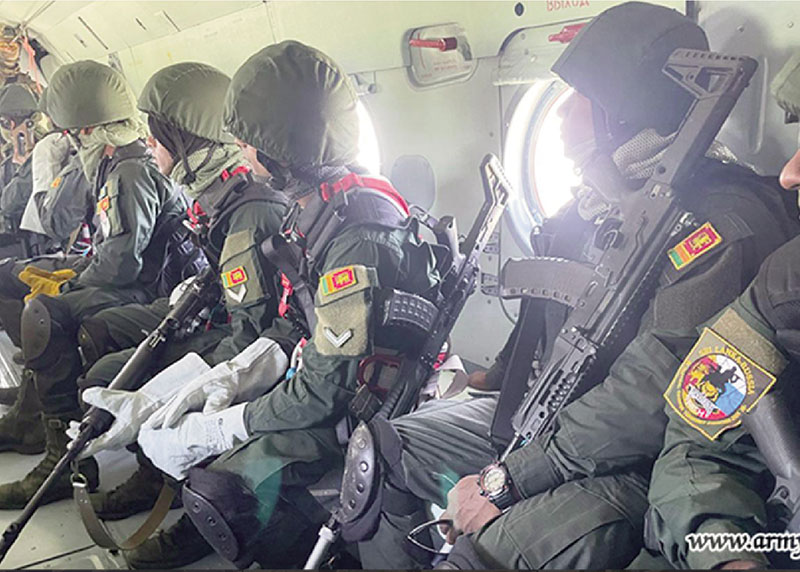
A contingent of the Sri Lanka Army, comprising 20 officers and 55 other ranks, participated in the combined military exercise ‘Wolverine Path II–2026’, conducted with the Armed Forces of the Russian Federation in Vladivostok, Russia, from September 18 to 25.
According to the Ministry of Defence, the exercise primarily focused on counter-terrorism operations and provided participating troops with training in a challenging combined operational environment.
The exercise included a range of tactical activities, including heli-rappelling, close-quarters battle (CQB), ambush operations, sniper firing, drone operations, buggy training and combat medical support.
The Ministry said the training enabled Sri Lankan troops to further develop their combat skills, tactical coordination and operational readiness.
It also provided an opportunity for the two militaries to exchange professional knowledge, operational experience and tactical expertise. Sri Lankan personnel gained exposure to training methodologies, tactical approaches and operational practices adopted by the Russian Armed Forces, the Ministry said.
The participation also enabled the Sri Lankan contingent to identify lessons from the joint training and share its own experiences with the Russian military.
The Sri Lankan contingent returned to the country following the exercise and arrived at Mattala Rajapaksa International Airport on September 28.
The Ministry said participation in the exercise contributed to enhancing the professional knowledge, tactical awareness and operational preparedness of Army personnel while promoting military-to-military cooperation, mutual understanding and professional relations between Sri Lanka and Russia.

Turkish court detains football refereeing chief pending corruption trial

Ten injured after car crashes into rugby supporters in Australia

Polls open in Latvia against backdrop of perceived Russia threat

Abhishek, Tilak and spinners secure gold for India at Asian Games again

Tharindu Rathnayake, bowlers secure Asian Games Bronze for Sri Lanka

G7 to release 100 million barrels of oil and diesel after Trump export ban threat

‘Dates have the highest sugar content to fight Coronavirus’

Sunday Island 27 December – Headlines

#SundayIsland 17th December – Headlines

Sunday Island – 28th March

Sunday Island Headlines – 21 March

Sunday Island – 21st February – Headlines
-

 News6 days ago
Police remove Thileepan statue in Jaffna
-

 Features6 days ago
The 22nd Amendment, constitutional recovery and illiberal slippage
-

 Features6 days ago
Of foreigners as CEOs of Lankan ventures
-

 Latest News4 days ago
Gold winner Tharanga gets brand-new Honda Vezel from SLAAJ
-

 News6 days ago
Sajith rejects Jt. Opp. protest sabotage claim; SJB TU chief demands remedial action
-

 Features4 days ago
Why Sri Lanka needs an Inclusive Civic Nationalism – urgently
-

 Features5 days ago
Thailand’s biggest new global star …
-

 News3 days ago
US-assisted ‘Ice’ detection: NPC to examine IGP’s move to transfer drug-busting team