
Editorial
Stop this game of chicken


Saturday 7th June, 2025
The Joint Council of the Professions Supplementary to Medicine (JCPSM), which is currently on a continuous strike, and the government are engaged in a game of chicken at the expense of the sick, who are without the wherewithal to seek treatment in private hospitals. The ongoing strike has adversely impacted the state-run hospitals though the government has sought to make light of the situation for political reasons.
Health Minister Dr. Nalinda Jayatissa has told the strikers that he will not negotiate with them unless they return to work. The warring unions have decided to intensify their trade union action. However, the JCPSM has said its members attached to the Maharagama Cancer Hospital, Maternity and Children’s Hospitals, Kidney Hospitals, and the Central Blood Bank will not join the strike. If only they were considerate towards other patients as well.
Instead of trying to resolve the issues that have led to the current strike, government politicians have sought to give the JCPSM’s struggle a political twist; it has claimed that some Opposition politicians are trying to sabotage the health sector to further their political interests by instigating strikes. It will have a hard time trying to make the public buy into its claim. That is what all governments say when they have trade union battles to contend with.
The health sector strikers are demanding that their grievances pertaining to recruitment, promotions, internships, holiday allowances, salary anomalies, etc., be redressed, or a written assurance be given to that effect for them to call off their trade union action. The government’s intransigence beggars belief. Its attitude and warnings remind us of the dark era when President J. R. Jayewardene crushed trade unions and suppressed workers’ rights ruthlessly, going to the extent of sacking tens of thousands of strikers in 1980.
Several key JVP trade unionists have been elected to the current Parliament, and some of them, such as Lal Kantha and Wasantha Samarasinghe, are Cabinet ministers. Their silence is deafening. They should have got the JCPSM strikers around the table to work out a compromise formula.
It is unbecoming of a government to turn down a request from strikers for talks. Previous governments also laboured under the misconception that the best way to deter workers from resorting to trade union action was to refuse to negotiate with strikers. Their modus operandi proved to be counterproductive. Workers’ resentment stemming from their unaddressed grievances cannot be contained by suppressing their right to trade union action.
Let the striking JCPSM personnel and the government be urged to declare a truce, sit down to negotiations and make a serious effort to arrive at a settlement without further delay. Most Sri Lankans are struggling to make ends meet and cannot obviously pay for healthcare. Even a decent meal is a luxury for them.
It is the duty of both the government and the health sector trade unions to ensure that the state-run hospitals remain open for the benefit of the ordinary people, who pay for maintaining politicians including the Health Minister and state officials like the strikers.

Friday 15th May, 2026
Politics is full of unexpected twists and turns. No sooner had newly elected Tamil Nadu Chief Minister Joseph Vijay punched above his weight to win a crucial trust vote in the Tamil Nadu Legislative Assembly to consolidate his power than he had to roll back the appointment of an astrologer as an Officer on Special Duty (OSD) due to protests. One of the first few things Vijay did after being sworn in as Chief Minister was to appoint famous astrologer Radhan Pandit Vettrivel, as an OSD. It has been reported that Vettrivel predicted Vijay’s electoral victory, and on his counsel Vijay rescheduled his oath-taking ceremony. The new Chief Minister had to give in to pressure from his political allies and rivals and make a volte-face; they questioned his wisdom of appointing an astrologer as a top aide when the need was for the new government to “foster a scientific outlook”.
Vijay should consider the removal of Vettrivel as a foretaste of what is to be expected in coalition politics, where the tail tends to wag the dog, so to speak. Perhaps, by taking up the issue of the astrologer’s appointment, and pressuring Vijay to cancel it, the parties that enabled his TVK to secure a working majority have tested their ability to leverage their support for the TVK to influence the new government.
Intense opposition to an astrologer’s appointment to a Chief Minister’s staff in India, of all places, has come as a surprise. Astrologers wield tremendous influence on people and their political leaders in this part of the world despite the advancement of science and technology. Prof. Richard Lachman of the Toronto Metropolitan University, in an article in The Conversation, reproduced on this page today, discusses how AI Chatbots are believed to manipulate us and shape our opinions. He points out that scholars have long argued that “the algorithms used by social networking sites and search engines create filter bubbles, in which we are fed well-crafted text, video and audio content that either reinforces our worldview or exerts influence towards someone else’s.” It can be considered an instance of the creature manipulating the creator. However, in South Asian politics, astrologers are far more influential than AI Chatbots. Astrologer Vettrivel’s list of clients is said to include a number of prominent Indians.
According to media reports, the late Tamil Nadu Chief Minister J. Jayalalithaa was one of Vettrivel’s clients, and they fell out over his wrong prediction that she would not be found guilty in a disproportionate assets case and imprisoned. Astrologers have taken quite a few political leaders for a ride in this country as well. Some of them even let their guard down, believing in astrological predictions only to be killed in terror attacks, and others who took astrologers’ claims seriously even advanced elections and suffered humiliating defeats. An astrologer was appointed as a director of a state bank. Strangely, there were no protests though the astrologer’s plum job was a sinecure. Time was when Sri Lankans did as governments said; the governments did as the Presidents said, and the Presidents did as astrologers said.
Why Vijay’s allies and rivals have opposed the astrologer’s appointment at issue is not clear. Do they genuinely believe that the new Tamil Nadu government should promote science at the expense of pseudoscience and occult practices involving divination, or did their protests emanate from political and personal rivalries? Whatever the reason, astrologers are facing formidable challenges in this day and age, with a resurgence of global interest in space exploration and new scientific inventions and discoveries. While astrology is focused on interpreting the positions of the celestial bodies within the solar system, astronomy is examining the Milky Way and beyond. A new scientific research has proposed a striking alternative to the long-held scientific belief that a supermassive black hole lies at the centre of the Milky Way, but according to some researchers, the mysterious object may be an ultra-dense concentration of dark matter rather than a black hole. Scientists have long argued that there could be a ninth planet in the solar system, orbiting the sun at a huge distance.
There are several key factors that pose existential challenges to astrology. Some of them are rapid advances in the field of AI, the growth of the Internet with increasing access to information and scientific knowledge, the emergence of a digitally native generation, and the spread of scientific reasoning through modern education.
As for the political brouhaha in Tamil Nadu, the question is why Vettrivel, described as a competent astrologer, could not foresee political trouble for him and his master, Vijay, over his controversial appointment and did not decline the sinecure, when it was offered, without waiting to be removed unceremoniously.


Thursday 14th May, 2026
US President Donald Trump’s recent statement at a business summit that he would leave the White House in eight or nine years is widely considered a light-hearted remark intended to provoke his critics. It has apparently had the desired impact, but it has also evoked the dreadful memories of his refusal to concede defeat after losing the 2020 presidential election, his unruly supporters’ attacks on the US Capitol, and his previous statements that he would seek a third term. The US Constitution prevents any American President from seeking a third term and is robust enough to keep the likes of Trump in check. But Trump and his fellow Republicans are doing everything in their power to win the upcoming midterm elections and have employed some controversial methods to achieve that goal.
President Trump, who is trying to redraw the world map, according to his whims and fancies, to expand the US territory, as part of his grandiose MAGA initiative, has resorted to gerrymandering (or ‘Trumpmandering’) in the name of redistricting to make his Republican Party great. On Monday, his party’s efforts to secure an undue advantage at the midterm elections by resorting to gerrymandering tactics such as “cracking” and “packing” voters in some states, received a judicial boost.
On Monday, the US Supreme Court allowed the Alabama Republicans to pursue a new electoral map that will be more favourable to them in the midterm elections due in November. The apex court ruling was reportedly split 6–3 along ideological lines; six conservative justices formed the majority while the court’s three liberal justices dissented, according to media reports. It has overturned a lower court decision and narrowed the landmark Voting Rights Act. The lower court had decided that the Republicans’ preferred electoral map intentionally discriminated against Black voters and unlawfully diluted their voting power.
The main allegation against the Republicans’ electoral map, which will now become official, thanks to the Supreme Court endorsement, is that it seeks to “pack” or cram many Black voters into a single district while “cracking” (distributing) other Black communities across several white-majority districts. Observers have pointed out that the Republican strategy will prevent the Black voters from electing candidates of their choice in a fair manner although they make up about 25% of Alabama’s population. The Republican redistricting plan is antithetical to the democratic ideals the US claims to cherish.
Alabama has been at the centre of the US racial conflict and civil rights campaigns by Blacks and therefore regarded as the cradle of defining battles of the American civil rights movement. Black Americans in Alabama were victims of racial segregation in schools and public transport, barbaric violence unleashed by the Ku Klux Klan, disenfranchisement and economic exclusion. It was the intense civil rights struggles in Alabama that brought Black rights icons such as Rosa Parks and Martin Luther King, Jr. into the national spotlight. The situation has improved significantly thanks to civil rights struggles and pathbreaking judicial decisions, but Alabama is not totally free from tensions over racial inequality, and therefore it is feared that the Supreme Court decision under discussion will weaken the Voting Rights Act to the extent of paving the way for the revival of discriminatory practices such as voter suppression and diluting the political influence of the Blacks. One can only hope that what is feared will not come to pass.
The Supreme Court endorsement of the controversial redistricting map is sure to have implications for other states. The legal victory for the Republicans’ efforts signals a wider issue that severely erodes the credibility and legitimacy of the US as a leading democracy and its campaign for promoting global democracy. How would the US have reacted if a government in the Global South had resorted to gerrymandering? It would have condemned such a move in the strongest possible terms and pontificated on the virtues of democracy and the need to respect the rights of all communities. The protection of civil rights, like charity, should begin at home.
Wednesday 13th May, 2026
Former President Mahinda Rajapaksa yesterday visited the Commission to Investigate Allegations of Bribery or Corruption (CIABOC), made a statement on the Airbus bribery scandal and returned home. A large number of his supporters flocked to Colombo to pledge solidarity with him. Speaking at a District Coordination Committee meeting at the Matale District Secretariat yesterday, President Anura Kumara Dissanayake stated that nobody was above the law, and anyone could be questioned in an investigation. He claimed that his predecessors had violated the Constitution and committed other offences, with impunity. His reference was obviously to President Rajapaksa making a statement to the CIABOC. By making that claim, President Dissanayake left room for allegations that he has a vested interest in the ongoing Airbus scandal investigation and defends the CIABOC action against Rajapaksa.
Yesterday’s show of strength near the CIABOC was organised by the SLPP. It is an affront to the intelligence of the public for anyone to claim that it was the result of a spontaneous outburst of public anger at an alleged move to frame former President Rajapaksa. Such protests are tantamount to attempts to intimidate the CIABOC. It is the organisers of such events who were responsible for Rajapaksa’s defeat in the 2015 presidential election and his ouster as Prime Minister in 2022, when they acted like the proverbial monkey that killed his sleeping royal master by striking a mosquito with the king’s own sword. They attacked the peaceful Aragalaya protesters at Galle Face, triggering widespread retaliatory attacks. The rest is history.
President Dissanayake yesterday said in Matale that his government had ensured that nobody was above the law and urged the public to bring instances of selective law enforcement, if any, to his attention. Is he unaware that the NPP politicians are more equal than others before the law? Kumara Jayakody was not arrested over the coal procurement scam, which is believed to have caused a loss of more than Rs. 10 billion to the state coffers, and led to a situation where a colossal amount of diesel has to be burnt daily to produce power to meet a generation shortfall at Norochcholai due to the use of low-grade coal imported by a company favoured by the government while Jayakody was the Minister of Energy. Power tariffs have been increased to recover the losses caused by the substandard coal imports. It may be recalled that Keheliya Rambukwella was arrested and prosecuted during the previous government for procuring substandard medicines while he was the Health Minister. That administration initially defended Rambukwella but did not stoop so low as to prevent his arrest and make a cover-up attempt by setting up a presidential commission of inquiry to probe all drug procurement issues in the Health Ministry under successive governments. President Dissanayake has appointed a presidential commission to investigate alleged irregularities in coal procurement since 2009! They must be probed, but the allegations against Jayakody are so serious that they should have been investigated separately on a priority basis.
Ironically, while President Dissanayake was waxing eloquent about his government’s commitment to upholding the rule of law, bashing his predecessors for having violated the Constitution, and claiming that his government had ended the culture of impunity, the Joint Opposition levelled a very serious allegation against him. Former Minister of Justice and Constitutional Affairs Prof. G. L. Peiris, addressing the media in Colombo, said that at a recent May Day rally, President Dissanayake had committed a serious offence by asking the public to get ready to hail the judgement to be delivered in a court case on 25 May. Pointing out that only the judge who heard a case was privy to the judgement therein before it was delivered and could not inform a third party of it or have any discussion thereon, Prof. Peiris said interference with the judiciary was a very serious offence, according to the Constitution, and a person who committed it was liable to one-year imprisonment and the suspension of civic disabilities for five years. He said the Joint Opposition had brought the President’s statement at issue to the attention of the Chief Justice and would take it up with international professional associations.
The public may not have a high opinion of the Opposition, which has quite a few tainted politicians among its ranks, but shouldn’t the JVP-NPP government and their leaders turn the searchlight inwards and put their own house in order before preaching to others about the virtues of good governance?

LPL 2026 Opening Game between Jaffna and Galle

New Zealand’s Māori Queen meets King Charles at Buckingham Palace

Trump and Xi conclude ‘very successful’ talks but no deals announced

India hikes fuel prices as Iran crisis bites

Kuldip Yadav in for Khaleel; Gleeson for Thushara

Eyman Fatima powers Pakistan to series victory

‘Dates have the highest sugar content to fight Coronavirus’

Sunday Island 27 December – Headlines

#SundayIsland 17th December – Headlines

Sunday Island – 28th March

Sunday Island Headlines – 21 March

Sunday Island – 21st February – Headlines
-

 News6 days ago
Lanka Port City officials to meet investors in Dubai
-
 News3 days ago
Ex-SriLankan CEO’s death: Controversy surrounds execution of bail bond
-
 News7 days ago
SLPP expresses concern over death of former SriLankan CEO
-
 News7 days ago
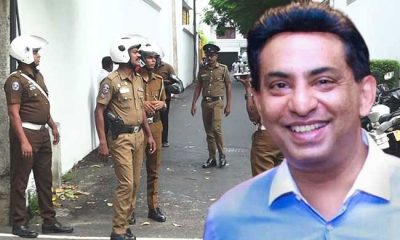
Police inform Fort Magistrate’s Court of finding ex-CEO of SriLankan dead under suspicious circumstances
-
 Features4 days ago
When University systems fail:Supreme Court’s landmark intervention in sexual harassment case
-
Features4 days ago
High Stakes in Pursuing corruption cases
-
 Midweek Review3 days ago
A victory that can never be forgotten
-

 News7 days ago
President of Vietnam and delegation departs Sri Lanka