
News
Sri Lanka’s debt negotiations stall over GDP growth projections and repayment terms – Nishan de Mel


In a recent televised interview, Nishan de Mel, the Executive Director of Verité Research, stated that holders of Sri Lanka’s International Sovereign Bonds (ISBs) have expressed concerns about specific aspects of the debt sustainability analysis conducted by the country alongside the IMF. This disagreement is one of the key hurdles in reaching an accord with them, he said.
Dr. de Mel said holders of Sri Lanka’s ISBs disagree with the IMF’s and Sri Lanka’s GDP growth projections. They believe that the potential economic growth of the country has been underestimated, he added.
He said that bondholders believed Sri Lanka had underestimated its economic growth potential, and therefore, its capacity to repay debt. “If the GDP growth potential is higher, then we can pay more. The bondholders argue that if Sri Lanka’s economy grows more than the IMF’s projections, then we should agree to pay them more,” he said. He further noted that Sri Lanka has acknowledged this possibility and has provided the bondholders with estimates of higher repayments contingent on achieving greater than projected GDP growth.
According to Dr. de Mel, while Sri Lanka has agreed to higher repayments if GDP exceeds forecasts, it has sought the flexibility to pay less if growth falls short of IMF estimates. There is currently a disagreement regarding the discrepancy between the higher payments Sri Lanka is willing to make and the amount the bondholders expect, centered around this variance in growth projections, Dr. de Mel said..
“This is natural, and we don’t need to panic,” he said.
He also said there are many challenges of forecasting, noting that the results of GDP growth projections rely heavily on the underlying theories and hypotheses used. He mentioned that the IMF had developed its GDP
projections for Sri Lanka by examining other countries that have undergone debt restructuring processes.
“However, neither Sri Lanka nor the IMF has revealed how they came up with these figures. Also, there is no one way of calculating this. If we underestimate the GDP growth, it’s good for Sri Lanka. If GDP growth is overestimated, this benefits the bond holders,” he said.
It was unlikely that IMF would delay the next tranche of the three-billion-dollar financial package due to the delay in coming to an agreement with ISB holders, he said. The main reason why there would be a delay in issuing the third tranche was that Sri Lanka had not kept many promises it has made to the IMF, he said.
The Executive Director of Verité Research said his institution had come up with novel way of debt restructuring, called Governance-Linked Bond. “We will present this to the world during a conference in Paris next month. The basic design of a Governance-Linked Bond is to have a coupon (interest rate) reduction, which is triggered when specific governance actions are achieved by a certain date.
This structure makes the bond “index eligible” (an important feature for bond-holders), as opposed to the Value Recovery Instrument, which has also been mooted in current negotiations. The same structure was recently proposed by bond-holders in a GDP-Linked rather than a Governance-Linked Bond. A good set of criteria for the Governance-Linked Bond will be that they (a) improve the probability of sustainable recovery, (b) are easily observable and verifiable, (c) have a high level of public support.”






The Indian Naval Ship (INS) GHARIAL made a port call in Colombo for operational turnarounds on 04 Feb 26. The Sri Lanka Navy welcomed the visiting ship in compliance with naval traditions.
Commanded by Commander Gaurav Tewari, INS GHARIAL is a vessel with a length of 124.8 meters.
During this visit, ten (10) Bailey Bridges, brought by ship, through the coordination of the High Commission of India in Sri Lanka, will be handed over to the Disaster Management Center. These bridges will provide temporary transportation links while bridges damaged across the island by adverse weather conditions are repaired.
The crew’s itinerary features scheduled goodwill activities with the Sri Lanka Navy, alongside visits to several tourist attractions across the island.
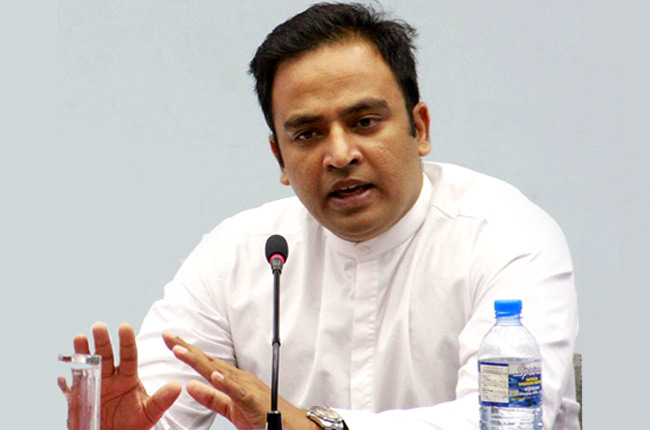
SJB Gampaha District MP Harshana Rajakaruna yesterday told Parliament that the Speaker’s Personal Secretary had written to the Secretary-General of Parliament seeking information on a complaint lodged with the Commission to Investigate Allegations of Bribery or Corruption (CIABOC) by a former Deputy Secretary of Parliament against the Speaker. Rajakaruna called for an immediate investigation into what he described as interference with an ongoing probe.
Raising the matter in the House, Rajakaruna said he had formally requested the Commission to initiate an inquiry into the conduct of the Speaker’s Personal Secretary, Chameera Gallage, questioning the authority under which such information had been sought.
Rajapakaruna tabled in Parliament a copy of the letter allegedly sent by Gallage to the Secretary-General requesting details of the bribery complaint.
Addressing the House, Rajakaruna said that the letter, sent two days earlier, had sought “full details” of the complaint against the Speaker. He maintained that seeking such information amounted to interference with an investigation and constituted a serious offence under the Bribery Act.
“The Speaker’s Secretary has no right to interfere with the work of the Bribery Commission. Under what law is he acting? What authority does he have? The Speaker, like everyone else, is subject to the law of the land,” Rajakaruna said, urging the Commission to take immediate action.
He noted that the Bribery Act treated the obstruction of investigations and the destruction of documents relating to such inquiries as serious offences punishable by law, and said he believed the Minister of Justice would concur.
The allegations sparked sharp reactions in the Chamber, as Opposition members called for accountability and due process in relation to the complaint against the Speaker.
By Saman Indrajith
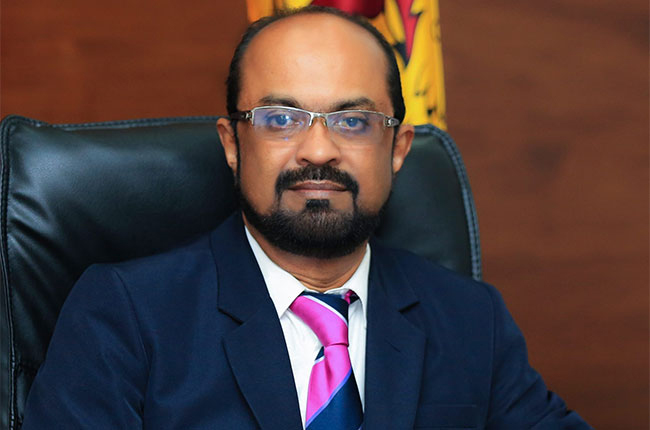
The Ceylon Electricity Board has managed to reduce the average cost of electricity generation from Rs. 37 per unit to Rs. 29, marking a 22 percent reduction, Minister of Power and Energy Eng. Kumara Jayakody told Parliament yesterday.
Responding to an oral question raised by Opposition MP Ravi Karunanayake, the Minister said that electricity tariffs cannot be reduced unless the cost of generation is brought down.
“You cannot reduce electricity tariffs without reducing the cost of generation. What we are currently doing is buying at a higher price and selling at a lower price. When we assumed office, the cost of purchasing and generating electricity was Rs. 37 per unit. We have now managed to bring it down to Rs. 29, a reduction of 22 percent.
Our target is to further reduce this to Rs. 25. Once that is achieved, we will reduce electricity tariffs by 30 percent within three years, as we promised,” Minister Jayakody said.
He added that the government has already formulated a long-term generation plan to further expand the country’s power generation capacity.
According to the Minister, key measures include increasing the absorption of renewable energy into the national grid, expanding the national transmission and distribution network, introducing renewable energy storage systems, and constructing thermal and liquefied natural gas (LNG) power plants to replace aging facilities and meet future demand.
He also said that steps would be taken to enhance the capacity of existing hydropower plants as part of the broader strategy to ensure energy security and reduce long-term electricity costs.
By Ifham Nizam

India chase sixth Under-19 World Cup title, England their first since 1998

Meet the women protecting India’s snow leopards

Louvre Museum crown left crushed but ‘intact’ after raid

US and Iran talks to begin as fears of direct conflict continue

INS GHARIAL makes port call in Colombo

ICC-PCB in back-channel talks to resolve India boycott at T20 World Cup

‘Dates have the highest sugar content to fight Coronavirus’

Sunday Island 27 December – Headlines

#SundayIsland 17th December – Headlines

Sunday Island – 28th March

Sunday Island Headlines – 21 March

Sunday Island – 21st February – Headlines
-

 Business6 days ago
Hayleys Mobility ushering in a new era of premium sustainable mobility
-

 Business3 days ago
SLIM-Kantar People’s Awards 2026 to recognise Sri Lanka’s most trusted brands and personalities
-

 Business6 days ago
Advice Lab unveils new 13,000+ sqft office, marking major expansion in financial services BPO to Australia
-

 Business6 days ago
Arpico NextGen Mattress gains recognition for innovation
-

 Business5 days ago
Altair issues over 100+ title deeds post ownership change
-

 Editorial6 days ago
Govt. provoking TUs
-

 Business5 days ago
Sri Lanka opens first country pavilion at London exhibition
-

 Business4 days ago
All set for Global Synergy Awards 2026 at Waters Edge